Date: April 1947Location: Richmond, Virginia (location presumed on the sheet)
Richmond, 1947: theodolite observations during balloon tracking
During balloon tracking, an observer reported seeing a disc through the theodolite; there are no measured angles and no documented triangulation.
- Event date
- April 1947
- Location
- Richmond, Virginia (location presumed on the sheet)
- Topic
- 1947 reports
- Source agencies
- Arquivo histórico · FBI · DOW
- Documents
- 6 documents · 734 pages
- Reading time
- 10 min
 DocumentPhysical page 126
DOCUMENTARY SOURCES · Arquivo histórico / FBI / DOW
What the records tell
The incident 79 sheet gathers three or four observations over six months by Mr. Minozewski, a meteorology professional in Richmond, Virginia. The most recent was placed in April 1947, at 11:00 a.m., during a pilot balloon (“pibal”) measurement. The form calls the location “presumably Richmond,” although it places the observation site in Richmond; this editorial uncertainty is preserved.
The account says Minozewski saw through the theodolite a chrome-looking shape for fifteen seconds, north of the station, moving from east to west. He described it as something between an ellipse and a disc, with a flat base and a rounded top. The sheet states that it appeared larger than the balloon in the instrument's field; the back says it appeared to be below the weather balloon. The balloon was then at 15 thousand feet, but this does not, by itself, provide a determined altitude for the other target.
Another employee, identified as Miss Baron, reported an observation when her balloon was at around 27 thousand feet and described a dull metallic sheen. The text does not show that she saw the same body at the same time, nor does it give a separate date for this observation. It is a reference of limited corroboration, not geometric triangulation.
The instrument makes the observation interesting, but the package contains no azimuth or elevation readings, time series, calibration, or photograph through the theodolite. The back itself states that it is impossible to estimate height and speed. “Larger than the balloon” is a comparison of apparent size in the instrument, with no distance to the target.
Going further requires the pibal records, the operator's notes, and Baron's independent observation. Until they are found, the shape can be described as an instrumentally observed account, never as a measurement of acceleration, altitude, or engineering.
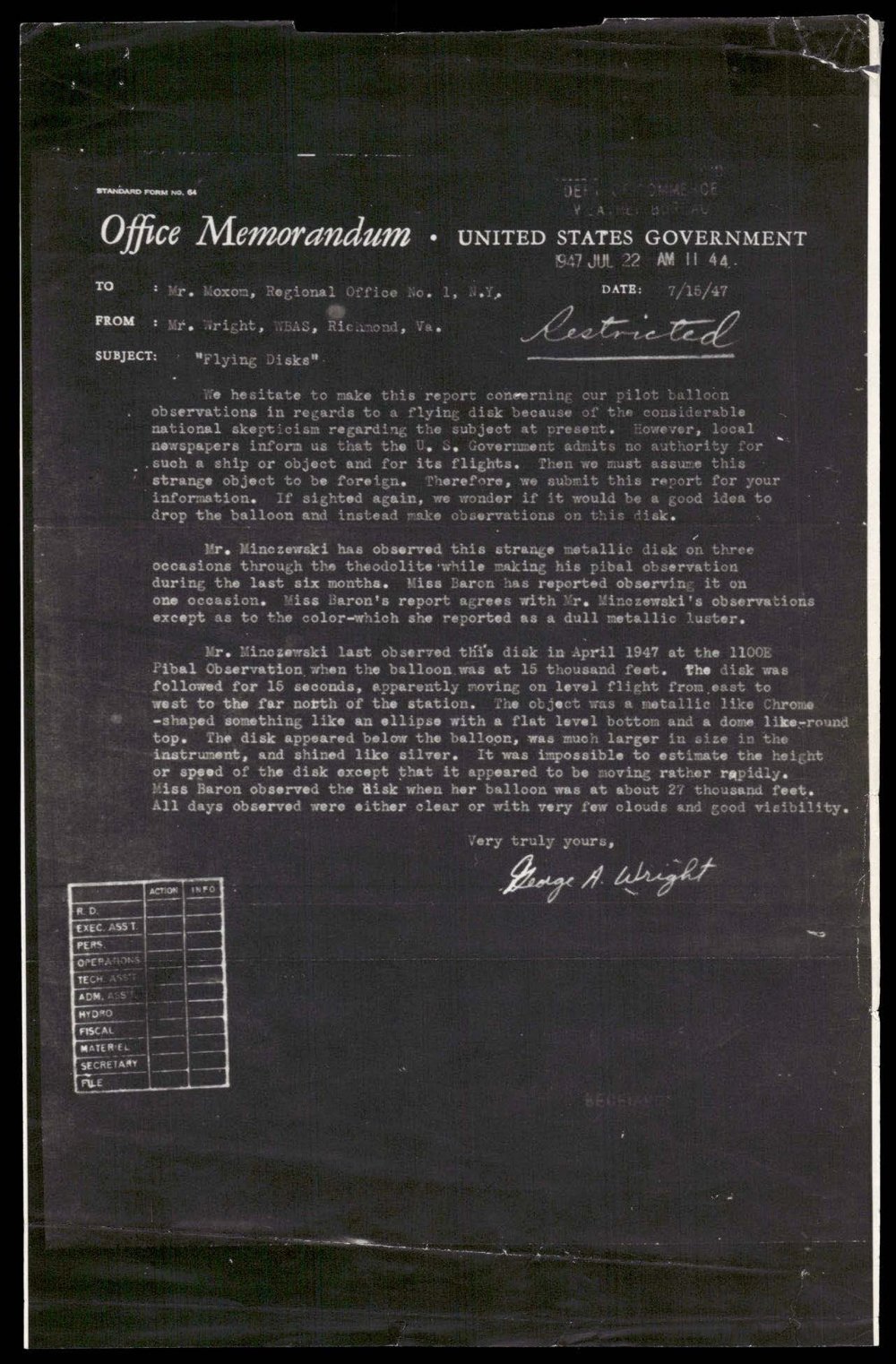
The incident 79 sheet summarizes a memorandum that is elsewhere in the FBI file and that the dossier did not yet include: the original text, written on July 15, 1947, by employee George A. Wright of the Weather Bureau station in Richmond to the New York regional office. It arrived with a Department of Commerce stamp dated July 22 and the word "Restricted" written by hand. The Air Force sheet repeats almost word for word the description of the disc, the balloon's height (15 thousand feet), and the colleague's observation, so the primary source is this letter from a weather station, not a military interview.
The memorandum is frank about the climate of the time. The author says the station hesitated to report the case "because of the considerable national skepticism," but that local newspapers reported that the United States government did not admit authorship of such a craft; so "we must assume that this strange object is foreign." He also suggests, should the disc appear again, releasing the balloon and observing the disc with the theodolite. In other words: the text was written three weeks after Kenneth Arnold's sighting and already after the publicity about discs, although the observations described are earlier, from the half-year up to April 1947.
The incident 79 sheet and its back form a short set, with RESTRICTED stamps at the top and bottom of each page. The back has a typing peculiarity: right after the description of the shape, a line was covered with x's and retyped, so that the next sentence starts over with "The disk appeared below the (weather) balloon". What was under the x's cannot be read. The same sheet exists in two copies in the collection, with the same text, one in the box of incident summaries and another in the corresponding volume of the analysis report. These are not two observations, but the same sheet reproduced twice.
The case appears again, far more visibly, in the Air Force's own analysis reports. In the summary of the study on incidents in the United States, the conclusions paragraph cites the Richmond case to argue that the reports were not merely an effect of newspaper publicity. It says that one well-trained observer saw metallic discs on three occasions, that another saw a similar object once, and that the theodolite showed the balloon and the object at the same time. According to the text, the observations took place months before newspapers spoke of flying discs; the Richmond memorandum, however, was only written on July 15, 1947, when the publicity already existed.
The same report places the case in the appendix of selected reports, among technically trained observers who, according to the text, would not be inclined to sensationalism. The appendix version repeats the sheet's data: a metallic disc, somewhat elliptical, with a flat base and a round top, below the balloon and much larger, seen for fifteen seconds at about 15 thousand feet; the other observations would have occurred at 27 thousand feet. The limit the report does not discuss is worth noting: the conclusion that the discs "would not be balloons" comes from a single account, without angular readings.
What remains, therefore, is an observation made with a measuring instrument, but with no measurements preserved. The collection lacks the weather station's notebooks, the azimuth and elevation angles, the exact time of each reading, and the full names of the witnesses, who appear as Mr. Minozewski (or Minczewski) and Miss Baron. As an editorial hypothesis, and without any documentary support, it cannot be ruled out that something ordinary in the theodolite's field, such as a bird, an insect, or a reflection in the instrument, was mistaken for a metallic object; the file offers no proof of this either. What the documents allow us to state is that the station took it seriously enough to write to its superiors and that the Air Force used it as an argument in the 1948 and 1949 analyses.
DIRECT READING OF THE FILE
The document, in the original
Translations of selected excerpts, checked against physical pages 169, 170. Estimates and testimonies remain attributed.
EXCERPT 1 · PHYSICAL PAGE 126
Memorandum from the Weather Bureau station in Richmond to the New York regional office, 15/07/1947, Serial 130, physical page 126 (in full)
SSTANDARD FORM NO. 64 ed
Office Memorandum + onirep states GOVERNMENT
947 JUL 22 AM II 44.
70 * Mr. Moxom, Regional Office No. 1, NeY, DATE: = 7/15/47
s,
FROM = Mr. Wright, WAS, Ricanond, Vas LIS AOE se
SUBJECT: -§ “Flying Disks"
We hesitate to make this report coneerning our pilot balloon
observations in regards to a flying disk because of the considerable
national skepticism regarding the subject at present. However, local
newspapers inform us that the U. S,. Government admits no authority for
.Ssueh a ship or object and for its flights. Then we must assume this
strange object to be foreign. Therefore, we submit this report for your
information. If sighted again, we wonder if it would be a good idea to
drop the balloon and instead make phase ves foe on this disk.
ra
Mr. Minczewski has observed this strange metallic disk on three
occasions through the theodolite ‘while making his pibal observation
during the last six months. Miss Baron has reported observing it on
ome occasion. Miss Baron's report agrees with Yr. Minczewski's observations
except as to the color-which she reported as a dull metallic luster.
Mr. Minogewski last observed tHis disk in April 1947 at the 1100E
Pibal Observation when the balloon was at 15 thousand feet. fhe disk was
followed for 15 seconds, epparently moving on level flight from east to
west to the far north of the station. The object was a metallic like Chrome
bad “shaped something like an ellipse with a flat level bottom and a dome like-round
top. The disk appeared below the balloon, was much larger in size in the
instrument, and shined like silver. It was impossible to estimate the height
or speed of the disk except that it appeared to be moving rather rapidly.
Miss Baron observed the Bisk when her balloon was at about 27 thousand feet.
All days observed were either clear or with very few clouds and good visibility. «|
Very truly yours,
Broge ft bbaght
MATER'E L at ¥
secnEiA®Y | ZEditorial note: This is the original memorandum from the weather station, whose report is summarized in record 79. The observer's surname is spelled Minczewski here and Minozewski in the record (the signature on the memorandum leaves no doubt about the spelling of the author, George A. Wright). The acronym WBAS is that of the Weather Bureau airport station, according to the usage of the time. The reading "1100E" is that of the original; the record writes "1100 E".
Check the original PDF
STANDARD FORM NO. 64. Office Memorandum - UNITED STATES GOVERNMENT. [Stamps and notes: DEPT. OF COMMERCE, WEATHER BUREAU, 1947 JUL 22 AM 11:44; handwritten "Restricted"; a routing box with the offices R.D., Exec. Ass't, Pers., Operations, Tech. Ass't, Adm. Ass't, Hydro, Fiscal, Materiel, Secretary, File.] TO: Mr. Moxom, Regional Office No. 1, N.Y. DATE: 7/15/47. FROM: Mr. Wright, WBAS, Richmond, Va. SUBJECT: "Flying Disks". We hesitate to make this report concerning our pilot balloon observations in regards to a flying disk because of the considerable national skepticism regarding the subject at present. However, local newspapers inform us that the U. S. Government admits no authority for such a ship or object and for its flights. Then we must assume this strange object to be foreign. Therefore, we submit this report for your information. If sighted again, we wonder if it would be a good idea to drop the balloon and instead make observations on this disk. Mr. Minczewski has observed this strange metallic disk on three occasions through the theodolite while making his pibal observation during the last six months. Miss Baron has reported observing it on one occasion. Miss Baron's report agrees with Mr. Minczewski's observations except as to the color - which she reported as a dull metallic luster. Mr. Minczewski last observed this disk in April 1947 at the 1100E Pibal Observation when the balloon was at 15 thousand feet. The disk was followed for 15 seconds, apparently moving on level flight from east to west to the far north of the station. The object was a metallic like Chrome - shaped something like an ellipse with a flat level bottom and a dome like-round top. The disk appeared below the balloon, was much larger in size in the instrument, and shined like silver. It was impossible to estimate the height or speed of the disk except that it appeared to be moving rather rapidly. Miss Baron observed the disk when her balloon was at about 27 thousand feet. All days observed were either clear or with very few clouds and good visibility. Very truly yours, George A. Wright.View the document record ↗ · Physical page 126, counting the cover.
EXCERPT 2 · PHYSICAL PAGE 169
Incident 79 form, physical page 169 (in full)
10.
il.
13.
‘Ue
15.
16,
18.
19.
20.
al.
Hunbor: of aa
‘Manner of disappearance - ait
Distance of object, 1
tim iy ate 38 sects Wis
Altitude nigh adsivae.
Speod repid ‘ : : % a eck 3
Direction of flight east to ee preps se iG ae Ta
Tactics 8/8 : a sae ea so ee
i Ws : ate — : . ie
Size argo thn pte Mellon tun ehervd tire tdi
Color metallic grey or silver ‘ sk ae
Sheps B/S Hea see ade am se e
Odor dotected ws sh ei ae * ig
Apparent construction 3/8 Bis : *
Exhaust trails pen Ws SER eo: i tee x a0 ie
Woathor conditions clear : . ; Sa. st
Bhfoet on oloude «= . 3/S Pet a A Se i ai
Skotches or aintopiayhe : None ‘ BLS. : ¢
Romarks: (over)
hs ESTRIGI Cy es ie
Oy 4Editorial note: "N/S" is the abbreviation for "not stated" on the form. There is a handwritten number in the lower corner of the sheet.
Check the original PDF
RESTRICTED. CHECK-LIST - UNIDENTIFIED FLYING OBJECTS. Incident # 79. 1. Date: April 1947. 2. Time: 1100 E Pibal Observation. 3. Location: N/S - presumably Richmond, Va. 4. Name of observer: Mr. Minozewski. 5. Occupation of observer: Weather reporters. 6. Address of observer: N/S. 7. Place of observation: Richmond, Va. 8. Number of objects: 3-4 separate sightings. 9. Distance of object from observer: high altitude. 10. Time in sight: 15 seconds. 11. Altitude: high altitude. 12. Speed: rapid. 13. Direction of flight: east to west. 14. Tactics: N/S. 15. Sound: N/S. 16. Size: Larger than pibal balloon when observed thru a theodolite. 17. Color: metallic grey or silver. 18. Shape: N/S. 19. Odor detected: N/S. 20. Apparent construction: N/S. 21. Exhaust trails: N/S. 22. Weather conditions: clear. 23. Effect on clouds: N/S. 24. Sketches or photographs: None. 25. Manner of disappearance: N/S. 26. Remarks: (over). RESTRICTED.View the document record ↗ · Physical page 169, counting the cover.
EXCERPT 3 · PHYSICAL PAGE 170
Back of form 79: narrative, physical page 170 (in full)
r~
Mr. Minozewski observed a strange metallic disk on three occasions
thru the theodolite while making his pibel observation during a six
months period. Mr Minozewski last observed the disk in a 1947
at 1100 E Pibal Observation when the balloon was at 15, - He
followed it for 15 seconds. It was moving on level flight from east to west
to the far north of the station. ‘The object was a metallic like chrome -
shaped somet: like an ellipse with a flat level bottom and a dome like-round
top, _ Sida SE SARNIA The a appeared below the (weather
was larger in size (in the instrumen wD ver.
It wes impossible to estimate the height or speed of the disk except that
it appeared to be moving rather rapidly.
Miss Baron, a co-worker observed the disk when her balloon was at sbout 27,000
ft. She thought the color to be a dull metallic luster.Editorial note: Full translation. The word "weather" appears in parentheses in the typewritten original, and one sentence was retyped over a passage struck out with x's. The text does not say whether Miss Baron saw the disc on the same day, nor does it give the exact date of Minozewski's sighting.
Check the original PDF
RESTRICTED. Mr. Minozewski observed a strange metallic disk on three occasions thru the theodolite while making his pibal observation during a six-months period. Mr Minozewski last observed the disk in April 1947 at 1100 E Pibal Observation when the balloon was at 15,000 ft. He followed it for 15 seconds. It was moving on level flight from east to west to the far north of the station. The object was a metallic like chrome - shaped something like an ellipse with a flat level bottom and a dome like-round top. [typed-over passage, struck out with X marks, illegible] The disk appeared below the (weather) balloon, was much larger in size (in the instrument) and shown like silver. It was impossible to estimate the height or speed of the disk except that it appeared to be moving rather rapidly. Miss Baron, a co-worker observed the disk when her balloon was at about 27,000 ft. She thought the color to be a dull metallic luster. RESTRICTED. [Handwritten: 169]View the document record ↗ · Physical page 170, counting the cover.
EXCERPT 4 · PHYSICAL PAGE 213
full page
- J
•
c. 4 '•-I"".
• ,. • r. "' Ob n ~
..
••
I
• r :-- • i
r ~ 1
r f./ ,J
•
'( .
J o r
l • •
I
:; I
( . h ,.,
!7 . C l r
. I
I
•
,-, l • ,~ . .
3. I
• r
25. of d
• tEditorial note: Incident card 79: a pilot-balloon observer in Richmond describes a metallic disc seen through the theodolite. "Not stated" translates the card's abbreviation N/S.
Check the original PDF
- J
•
c. 4 '•-I"".
• ,. • r. "' Ob n ~
..
••
I
• r :-- • i
r ~ 1
r f./ ,J
•
'( .
J o r
l • •
I
:; I
( . h ,.,
!7 . C l r
. I
I
•
,-, l • ,~ . .
3. I
• r
25. of d
• tView the document record ↗ · Physical page 213, counting the cover.
EXCERPT 5 · PHYSICAL PAGE 214
full page
Minozewski observed a strance neta tiiek ’
xe theodolite wiile malting his ; € ti
ne 4 Minoreweki lest observed tae disk
ibel Observation when the balloon ws at
for 15 seconds. It was moving on level
"+, Tf én . ah 4 ~*
Orin Oo] we ane VUleCL WES
ing like
z s
tse instrument)
1@ helgnt or sveed of
co-worker d the < when. ner balloor
t the
metallic luster,Editorial note: Supplement to incident 79: the metallic disc seen below a pilot balloon at 15.000 feet and the account of a colleague who saw it when her balloon was at about 27.000 feet.
Check the original PDF
Minozewski observed a strance neta tiiek ’
xe theodolite wiile malting his ; € ti
ne 4 Minoreweki lest observed tae disk
ibel Observation when the balloon ws at
for 15 seconds. It was moving on level
"+, Tf én . ah 4 ~*
Orin Oo] we ane VUleCL WES
ing like
z s
tse instrument)
1@ helgnt or sveed of
co-worker d the < when. ner balloor
t the
metallic luster,View the document record ↗ · Physical page 214, counting the cover.
Dates and documentary context
- Event
- Not established — April 1947, according to the record card; the day has not been established.
- Document
- Not established — Date the record was prepared not established in the examined pages.
- Publication
- Not established — Original public release date not identified; the PDF is part of a later official release.
Origin and release
File released by the United States government · 38_143685_box7_Incident_Summaries_1-100.pdf
Physical pages 169, 170. Date given only by month, and main location marked as presumed. The observations by Baron and Minozewski are not documented triangulation.
Official PDF — full source ↗ — Document released by the United States government.
Questions to continue the investigation
- Locate pibal observation notebooks and angular records.
- Determine Miss Baron's date and position.
GEOGRAPHY OF THE CASE
Richmond, Virginia (presumed location on the record card)
Locality as given in the source; point of the phenomenon without a reliable coordinate on the pages examined. Location or region in the document; exact position not verified.
DOCUMENTARY TRAIL
Go back to the sources
References use physical pages of the PDF, counting the cover. Summaries are presented in English; the documents keep their original language.
- 38_143685_box7_Incident_Summaries_1-100.pdf
Physical pages 169, 170 — sheet and narrative
Arquivo histórico · 209 pages - 65_HS1-834228961_62-HQ-83894_Serial_130.pdf
Physical page 126: memorandum from the Weather Bureau station in Richmond to the New York regional office, 15/07/1947 (source document of the account)
FBI · 126 pages - DOW-UAP-D087_US-AirForce_Analysis-of-Flying-Objects-in-the-US_1-100.pdf
Physical pages 213 and 214: second copy of sheet 79 and its back (same text)
DOW · 253 pages - DOW-UAP-D094_Analysis-of-Flying-Object-Incidents-in-the-US_1949.pdf
Physical pages 6, 8 and 13: summary, appendix A and appendix C of the 1949 incident analysis report, with mentions of the Richmond case
DOW · 34 pages - DOW-UAP-D093_Analysis-of-Flying-Object-Incidents-in-the-US_1948.pdf
Physical page 20: appendix with the Richmond case in the 1948 version of the analysis report
DOW · 67 pages - DOW-UAP-D097_Project-Sign-Progress-Report_1948.pdf
Physical pages 6, 13, 19 and 27: incident 79 lines in the tables of the Project Sign progress report
DOW · 45 pages
Related publications and media
Editorial summary based on the collection's research notes. How we read the documents.