Date: 12/09/1947Location: Between Midway and Guam, beyond Necker Island
Pan American, 1947: white UFO that appeared to split in two near Necker
Two crew members reported a UFO with reddish light that appeared to split near Necker; it lasted six seconds, and 1.000 knots is an estimate.
- Event date
- 12/09/1947
- Location
- Between Midway and Guam, beyond Necker Island
- Topic
- 1947 reports
- Source agencies
- Arquivo histórico · DOW
- Documents
- 3 documents · 488 pages
- Reading time
- 8 min
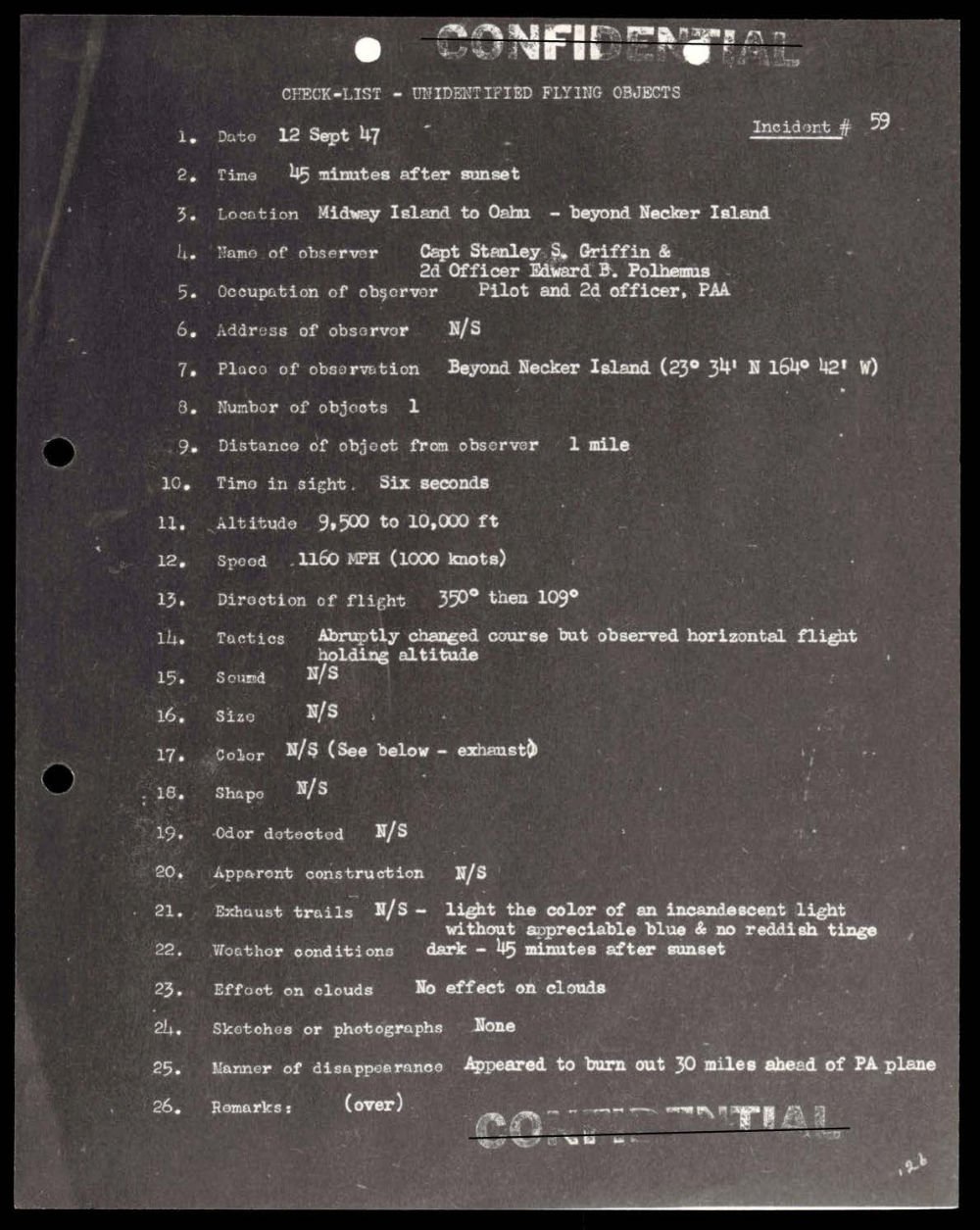 Incident record (checklist for unidentified flying objects)Physical page 127
DOCUMENTARY SOURCES · Arquivo histórico / DOW
What the records tell
On September 12, 1947, about 45 minutes after sunset, Captain Stanley S. Griffin and Second Officer Edward B. Polhemus, of a Pan American aircraft, reported an extremely intense white light beyond Necker Island, in the Pacific. Form 59 summarizes six seconds of observation. The following page specifies that the airplane had passed Necker at 5h35 GCT and that the light appeared at 5h58 GCT; the relationship between that time and “45 minutes after sunset” is not resolved in the package.
According to the narrative, the light appeared ahead and to the right, seemed to approach, changed course abruptly when the crew switched control from autopilot to manual, and then seemed to separate into two less intense reddish lights, separated by approximately the wingspan of an aircraft. The two went out in the distance. The description is of visual appearance; the pages contain no photograph or measurement of physical separation.
The form calculates 1.160 miles per hour, equivalent to a thousand knots, based on distance and an estimated six seconds. Since there is no independent measurement of the distance to the light nor a three-dimensional trajectory, this figure is not a proven speed. The account gives an initial heading of approximately 350 degrees and another of 109 degrees, but the apparent change may depend on perspective and on the relative motion of the airplane.
The pilots considered a meteor, but said that the light seemed to maintain altitude and that it did not illuminate a cloud layer located below. The report records that they were questioned about optical illusion and the possibility of a fall at an oblique angle; both maintained the impression of a change of course. These considerations show an investigation of alternatives, not a demonstrated exclusion of natural phenomena.
The case is strong as an account by two crew members and as detailed documentation of flight conditions, but it is short in duration and lacks any instrument that recorded the phenomenon. The correct editorial approach preserves the extreme estimate as a calculation from the file, distinguishes the appearance of separation from a material division, and does not treat the coincidence with the airplane's change of control as causation.
The checklist for incident 59, confidential, gives the position of the sighting: beyond Necker Island, at 23°34' north and 164°42' west, on the route from Midway to Oahu. It records the distance of one mile, the altitude of 9.500 to 10.000 feet, and the disappearance of the light, which seemed to go out 30 miles ahead of the Pan American airplane. The color was described as that of an incandescent lamp, with no appreciable blue and no reddish tint. It was dark, 45 minutes after sunset, and there was no effect on the clouds.
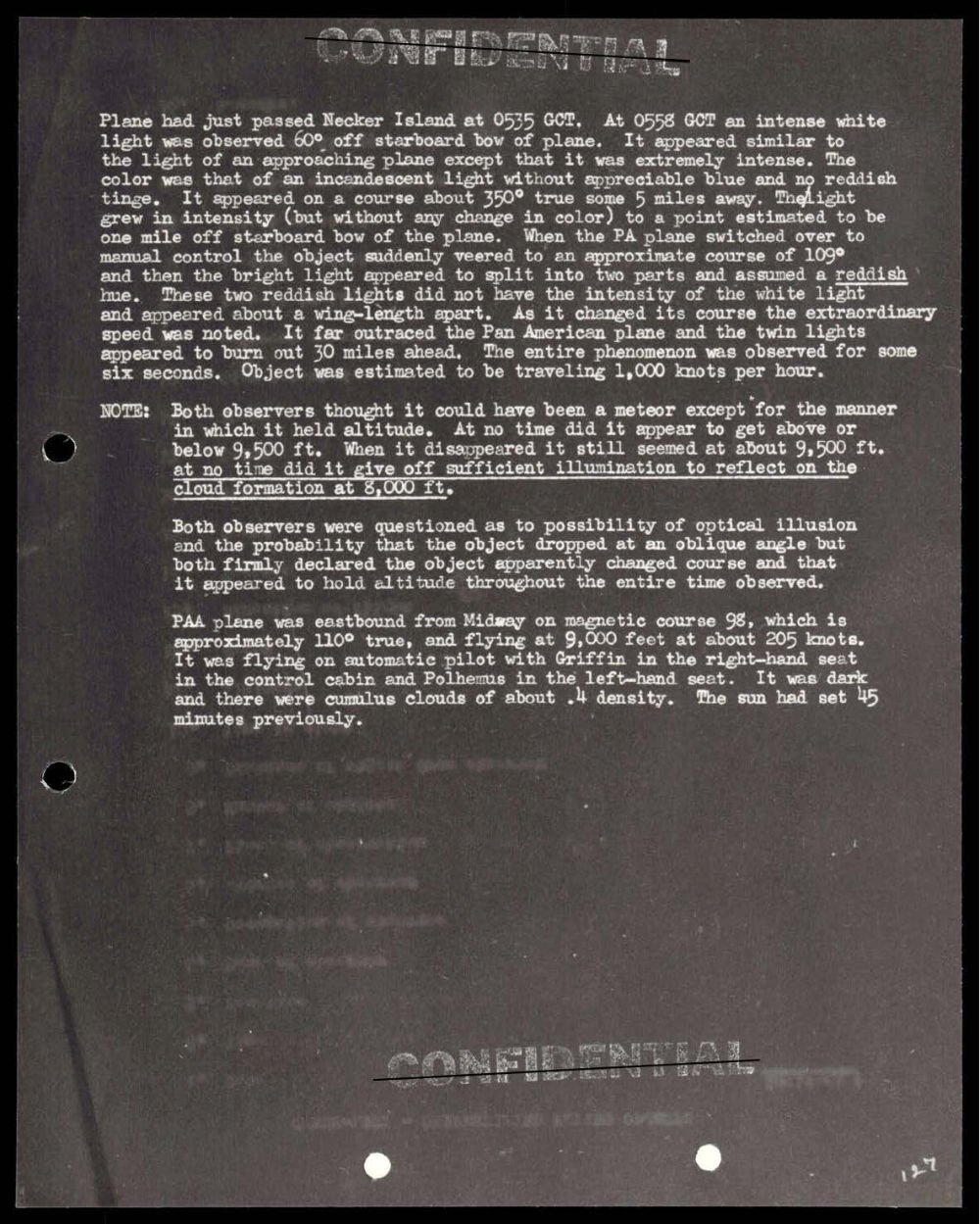
The reverse side adds details from the cockpit. The airplane was flying on autopilot, with Griffin in the right seat and Polhemus in the left, and there were cumulus clouds with coverage of about four-tenths. The light grew in intensity without changing color until it was about one mile away. After changing course, it "far outdistanced" the airplane, and the two twin lights seemed to go out 30 miles ahead. The pilots said that the light never seemed to rise or descend from about 9.500 feet, and that it was still at that height when it vanished.
The episode appears in two Air Force studies. The December 1947 analysis of flying disc reports, by the Air Materiel Command, summarizes it as a light "with the appearance of a twin ramjet" seen near Necker Island by an airplane between Midway and Honolulu. The air intelligence study of December 10, 1948 includes it among the sightings of lights and trails, not of discs: a bluish-white light that approached and, as it moved away, turned into two reddish glows, with a speed estimated by the pilot at about a thousand knots. The two summaries repeat the crew's account and offer no explanation.
Each piece of information is of a different nature. The light, the change of course and the division into two are the account of two crew members in the same airplane. The one-mile distance, the 30 miles and the thousand knots are estimates made at night, with no reference point; the forms themselves write "a thousand knots per hour," a redundant unit. The meteor hypothesis came from the pilots themselves, who dismissed it based on the impression of constant altitude. The questions about optical illusion and an oblique fall show that the interviewer considered alternatives, without recording a conclusion.
More images from the document
DIRECT READING OF THE FILE
The document, in the original
Translations of selected excerpts, verified on physical pages 127, 128. Divergent statements, hypotheses and information remain distinct.
EXCERPT 1 · PHYSICAL PAGE 127
Checklist for incident 59, physical page 127 (full text)
10.
ll.
1,
1.
lhe
15.
16,
17.
- 16,
19.
20,
21.
22.
23.
25.
26.
Cb OD DE OE ed
e cCONFID™=
CFECK=LIST - UNIDENTIFIED FLYING OBJECTS
Date 12 Sept 47 * F Incidort # 59
Time 45 mimtes after sunset
Location Midway Island to Oam - beyond Necker Island
Namo of observor Capt Stenley.S, Griffin &
2d Officer Edward B. Polhems
Occupation of observor Pilot and 2d officer, PAA
Address of observor n/s
Placo of observation Beyond Necker Island (23° 34' N 164° ot w)
Numbor of objeots 1 :
Distance of object from observer 1 mile
Time in sight. Six seconds
Altitude 9,500 to 10,000 ft
Speed 1160 MPH (1000 knots)
Direction of flight 350° then 109°
Tactics Abruptly changed course but observed horizontal flight
holding altitude '
souma -N/S :
Size ws, ; .
cotor M/S (See delow - exhaust) Me
Shapo 4/S '
Odor dotectea N/S
Apparont construction ¥/s
Exhaust trails N/S- light the color of an incandescent light
without appreciable blue & no reddish tinge.
Woathor conditions dark - % mimaites after sunset
Effoot on clouds No effect on clouds
Skotches or photographs None t .
Mammer of disappearance Appeared bed burn out 30 miles ahead of PA plane
Romarks : (over) | : Ca ol oma et eee alae wT a
ww wow weEditorial note: N/S means "not stated". PAA is the acronym for Pan American Airways. The 126 is the file numbering.
Check the original PDF
CONFIDENTIAL. CHECK-LIST - UNIDENTIFIED FLYING OBJECTS. Incident # 59. 1. Date: 12 Sept 47. 2. Time: 45 minutes after sunset. 3. Location: Midway Island to Oahu - beyond Necker Island. 4. Name of observer: Capt Stanley S. Griffin & 2d Officer Edward B. Polhemus. 5. Occupation of observer: Pilot and 2d officer, PAA. 6. Address of observer: N/S. 7. Place of observation: Beyond Necker Island (23° 34' N 164° 42' W). 8. Number of objects: 1. 9. Distance of object from observer: 1 mile. 10. Time in sight: Six seconds. 11. Altitude: 9,500 to 10,000 ft. 12. Speed: 1160 MPH (1000 knots). 13. Direction of flight: 350° then 109°. 14. Tactics: Abruptly changed course but observed horizontal flight holding altitude. 15. Sound: N/S. 16. Size: N/S. 17. Color: N/S (See below - exhaust). 18. Shape: N/S. 19. Odor detected: N/S. 20. Apparent construction: N/S. 21. Exhaust trails: N/S - light the color of an incandescent light without appreciable blue & no reddish tinge. 22. Weather conditions: dark - 45 minutes after sunset. 23. Effect on clouds: No effect on clouds. 24. Sketches or photographs: None. 25. Manner of disappearance: Appeared to burn out 30 miles ahead of PA plane. 26. Remarks: (over). CONFIDENTIAL. [Handwritten:] 126View the document record ↗ · Physical page 127, counting the cover.
EXCERPT 2 · PHYSICAL PAGE 128
Reverse of the incident 59 form, physical page 128 (full text)
~~
Plane had just passed Necker Island at 0535 GCT, At 0555 GCT an intense white
light was observed 60° off starboard bow of plane. It appeared similar to
the light of an approaching plane except that it was extremely intense. The
color was that of an incandescent light without appreciable blue and reddish
tinge. It appeared on a course about 350° true some 5 miles away. ight
grew in intensity (but without any change in color) to a point estimated to be
one mile off starboard bow of the plane. When the PA plane switched over to
mamusal control the object suddenly veered to an approximate course of 109°
and then the bright light appeared to split into two parts and assumed a reddish
me. These two reddish lights did not have the intensity of the white 1
and appeared about a wing-length apart. As it changed its course the extraordinary
speed was noted. It far outraced the Pan American plane and the twin lights
appeared to burn out 30 miles ahead, The entire phenomenon was observed for some
six seconds. Object was estimated to be traveling 1,000 knots per hour.
NOTE: Both observers thought it could have been a meteor except “for the manner
in which it held altitude. At no time did it appear to get above or
below 9,500 ft. When it disappeared it still seemed at about 9,500 ft.
at no time did it give off sufficient illumination to reflect on the
cloud formation at $, 000 £ts
Both observers were questioned as to possibility of optical illusion
end the probability that the object dropped at an oblique angle but
both firmly declared the object apparently changed course and that
it appeared to hold altitude throughout the entire time observed.
PAA plene was eastbound from Midway on magnetic course 98, which is
approximately 110° true, and flying at 9,000 feet at about 205 knots.
It wes flying on automatic pilot with Griffin in the right-hand seat
in the control cabin and Polhems in the left-hand seat. It was dark
and there were cummlus clouds of about .l density. The sun had set 45
mimates previously.
* on @ ‘ yetEditorial note: GCT is Greenwich mean time. "Knots per hour" is a redundancy in the original (a knot is already a nautical mile per hour). The sentences underlined in the original are "reddish" and the one saying the light did not illuminate the clouds. The 127 is the file numbering.
Check the original PDF
CONFIDENTIAL. Plane had just passed Necker Island at 0535 GCT. At 0558 GCT an intense white light was observed 60° off starboard bow of plane. It appeared similar to the light of an approaching plane except that it was extremely intense. The color was that of an incandescent light without appreciable blue and no reddish tinge. It appeared on a course about 350° true some 5 miles away. The light grew in intensity (but without any change in color) to a point estimated to be one mile off starboard bow of the plane. When the PA plane switched over to manual control the object suddenly veered to an approximate course of 109° and then the bright light appeared to split into two parts and assumed a reddish hue. These two reddish lights did not have the intensity of the white light and appeared about a wing-length apart. As it changed its course the extraordinary speed was noted. It far outraced the Pan American plane and the twin lights appeared to burn out 30 miles ahead. The entire phenomenon was observed for some six seconds. Object was estimated to be traveling 1,000 knots per hour. NOTE: Both observers thought it could have been a meteor except for the manner in which it held altitude. At no time did it appear to get above or below 9,500 ft. When it disappeared it still seemed at about 9,500 ft. At no time did it give off sufficient illumination to reflect on the cloud formation at 8,000 ft. Both observers were questioned as to possibility of optical illusion and the probability that the object dropped at an oblique angle but both firmly declared the object apparently changed course and that it appeared to hold altitude throughout the entire time observed. PAA plane was eastbound from Midway on magnetic course 98, which is approximately 110° true, and flying at 9,000 feet at about 205 knots. It was flying on automatic pilot with Griffin in the right-hand seat in the control cabin and Polhemus in the left-hand seat. It was dark and there were cumulus clouds of about .4 density. The sun had set 45 minutes previously. CONFIDENTIAL. [Handwritten:] 127View the document record ↗ · Physical page 128, counting the cover.
EXCERPT 3 · PHYSICAL PAGE 168
full page
t e
•
,
•
~.
..
...
. ,.
I
.. t1.M'J Of
•
7.
.
,, .
•
1.
r
Ti
..1
upt.tl
0
uEo
t'
i
1
I/
r
n
)
r 1 •
I .,
l •
.
..
,.,.
.7.
l .
('.
•
..nlcr 1/1 (...
1/1
-
()
21
. .
2}.
•
25•
•
/1
I'
rEditorial note: Incident 59 sheet: the captain and second officer of a Pan American aircraft between Midway and Oahu record an intense light that swerved and split in two.
Check the original PDF
t e
•
,
•
~.
..
...
. ,.
I
.. t1.M'J Of
•
7.
.
,, .
•
1.
r
Ti
..1
upt.tl
0
uEo
t'
i
1
I/
r
n
)
r 1 •
I .,
l •
.
..
,.,.
.7.
l .
('.
•
..nlcr 1/1 (...
1/1
-
()
21
. .
2}.
•
25•
•
/1
I'
rView the document record ↗ · Physical page 168, counting the cover.
EXCERPT 4 · PHYSICAL PAGE 169
full page
ee
“sptcoscs
Os71U) SUZ “peege SeTTE Of yO Ug 0
: © >
8
os w % . JL
2
3
5
3
z
z
s
g
&
:
cf
» 3Editorial note: Summary on the back of sheet 59, on a rotated sheet: the account of the intense white light, the meteor hypothesis examined with the two pilots, and the flight conditions.
Check the original PDF
ee
“sptcoscs
Os71U) SUZ “peege SeTTE Of yO Ug 0
: © >
8
os w % . JL
2
3
5
3
z
z
s
g
&
:
cf
» 3View the document record ↗ · Physical page 169, counting the cover.
Dates and documentary context
- Event
- 12/09/1947 — Date indicated in the cited record or narrative, attributed to the documentary source.
- Document
- Not established — Date the record was prepared not established in the examined pages.
- Publication
- Not established — Original public release date not identified; the PDF is part of a later official release.
Origin and release
File released by the United States government · 38_143685_box7_Incident_Summaries_1-100.pdf
Physical pages 127, 128. Six seconds and no photograph limit the determination of a trajectory. Two reddish lights do not prove physical separation of an object.
Official PDF — full source ↗ — Document released by the United States government.
Questions to continue the investigation
- Are there logs of the Pan American flight, and astronomical or meteorological records?
- What is the basis for the initial and final distance estimates?
GEOGRAPHY OF THE CASE
Between Midway and Guam, beyond Necker Island
Locality as given in the source; observation point or trajectory without a reliable coordinate on these pages. Place name as it appears on the record card or in the narrative; greater precision is not supported by the document.
DOCUMENTARY TRAIL
Go back to the sources
References use physical pages of the PDF, counting the cover. Summaries are presented in English; the documents keep their original language.
- 38_143685_box7_Incident_Summaries_1-100.pdf
Physical pages 127, 128 — form and narrative
Arquivo histórico · 209 pages - DOW-UAP-D100_Air-Materiel-Command-Report-on-UFOs_1947-1948.pdf
Physical page 240: study 'Analysis of Flying Disc Reports', December 1947, item 1c, light with the appearance of a twin ramjet near Necker Island
DOW · 245 pages - DOW-UAP-D094_Analysis-of-Flying-Object-Incidents-in-the-US_1949.pdf
Physical page 17: air intelligence study of 10/12/1948, Appendix C, item 2p(1), bluish-white light seen by Pan American pilot and copilot between Midway and Honolulu
DOW · 34 pages
Related publications and media
Editorial summary based on the collection's research notes. How we read the documents.