Date: 07/07/1947Location: Omaha, Nebraska, USA (street in front of the declarant's house)
Omaha, 1947: burning UFO falls in the street, turns to ash, and a chemist says it was pipe tobacco
An Omaha resident wrote to the FBI that, on the night of July 7, 1947, six people saw a burning UFO fall in the street and break into pieces. A chemist consulted by the newspaper said the ashes were the same as those of pipe tobacco; the resident disputed this, and Hoover sent the letter to Army intelligence.
- Event date
- 07/07/1947
- Location
- Omaha, Nebraska, USA (street in front of the declarant's house)
- Topic
- FBI file
- Source agencies
- FBI
- Documents
- 1 document · 185 pages
- Reading time
- 6 min
 Newspaper clippingPhysical page 15
DOCUMENTARY SOURCES · FBI
What the records tell
On the night of July 7, 1947, at 22h30, according to a handwritten letter sent to the FBI by Fred R. Reibold, he and his mother-in-law saw a burning object fall in the street in front of the family's house in Omaha, Nebraska. When examined, the object was solid, shaped like a round disc the size of a silver dollar and about 1/4 inch thick, and burned with intense heat. The letter reached the FBI at the height of the first wave of news about flying saucers.
The World-Herald newspaper was notified and sent a reporter. Meanwhile, the letter says, a boy kicked the object, which broke into pieces. The reporter collected the fragments and said he would have them analyzed. According to Reibold, six people saw the object and could attest to the extreme heat with which it burned, enough to scorch the pavement where it fell. He enclosed a newspaper clipping with the result of the analysis and asked for a reasonable explanation, since, had it fallen on a roof, the object would surely have started a fire.
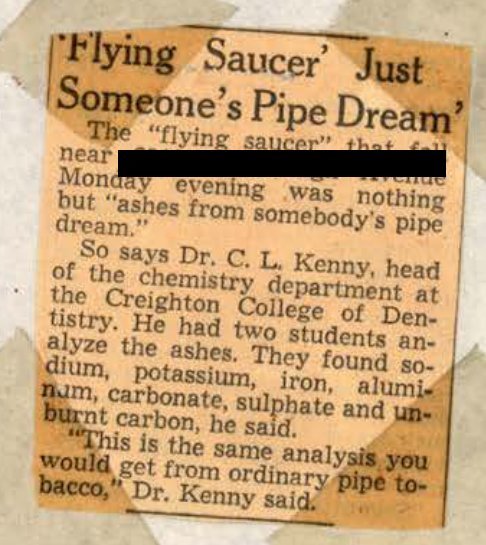
The enclosed clipping, from an Omaha newspaper, says that the “flying saucer” that fell Monday night was nothing more than “ashes of somebody's pipe dream”, a pun on the English expression for fantasy. The phrase is attributed to Dr. C. L. Kenny, head of the chemistry department at the Creighton College of Dentistry, who had two students analyze the ashes. They found sodium, potassium, iron, aluminum, carbonate, sulfate and unburned carbon, and Kenny said it was the same analysis one would get from ordinary pipe tobacco.
Reibold did not accept this. He wrote that he did not claim it was a “flying saucer”, that the object “was not tobacco ash”, and that it might have been a belated Independence Day firework, celebrated three days earlier, or something similar. But he called the chemist's answer ridiculous and wholly unsatisfactory. On August 5, 1947, J. Edgar Hoover sent a copy of the letter and the clipping to the Director of Intelligence of the War Department General Staff, attention Colonel L. R. Forney, and informed the sender that the material had been forwarded.
The case combines three layers that should be kept separate. The account of the fall and the heat comes from the declarant and family members, with no statements taken by any authority. The chemical analysis is from a university laboratory cited by the press, with no report in the file. And the FBI's action was only to forward the matter to the Army. As an editorial hypothesis, the firework suggested by Reibold himself is compatible with a small, glowing disc in July, but nothing in the pages allows confirming this or any other explanation.
The file also holds the reply sent to Reibold. On August 5, 1947, the same day as the memorandum to the Army, Hoover acknowledged receipt of the letter, mailed on July 10, and of the enclosed clipping. He wrote that the information was of interest to the War Department and that he had taken the liberty of forwarding it to that agency. The letter does not comment on the analysis of the ashes or on the explanation requested by the resident. It went out through the FBI communications section on the afternoon of August 5 and received serial number 51 in the file.
The stamps make it possible to reconstruct the sequence. The object fell on the night of July 7; Reibold's letter was mailed on the 10th and reached the FBI Internal Security Section on July 16, at 12h36, according to the stamp on the back of the first sheet. Almost three weeks passed before the reply and the forwarding to the Army. During that interval, the FBI was arranging with the Army Air Forces how to handle flying saucer reports, and letters from private citizens such as Reibold's were forwarded to the military.
No Army document on the case is in the collection, nor any report of the analysis done by the Creighton College of Dentistry students. What is known of the chemical examination comes only from the newspaper clipping, and what is known of the fall comes only from the resident's letter. There is also no record of what became of the fragments collected by the reporter. The case is therefore left with two versions without independent verification: that of the declarant, who saw a solid and very hot disc, and that of the chemist, who identified in the ashes the composition of pipe tobacco.
DIRECT READING OF THE FILE
The document, in the original
Press clipping reproduced in full, with the original in English and a complete translation. Names of minors, home addresses, and health data of private individuals were omitted in the original and in the translation.
EXCERPT 1 · PHYSICAL PAGE 10
Memorandum from J. Edgar Hoover to the director of intelligence of the War Department General Staff, 05/08/1947, physical page 10 (in full)
-
)
BI SPECIAL MESSENGER
August 5, 1947
Director of Intelligence
War Department aenera l Stat!
Tbe Pentagon
ashington 251 D. c.
Attention: Colonel L. R. Forney, Chief, Security Group
John Edgar Hoover - Director, Federal Bureau ot Investigation
FRED R. Rr.'!801,DEditorial note: The left margin of the sheet is torn; the word “CONFIDENTIAL” appears crossed out at the top. Declassification stamps omitted.
Check the original PDF
BY SPECIAL MESSENGER. August 5, 1947. To: Director of Intelligence, War Department General Staff, The Pentagon, Washington 25, D. C. Attention: Colonel L. R. Forney, Chief, Security Group. From: John Edgar Hoover - Director, Federal Bureau of Investigation. Subject: FRED R. REIBOLD. There are attached hereto copies of a letter received from the above-captioned individual, together with copies of a newspaper clipping enclosure, concerning "flying discs." Mr. Reibold's letter has been acknowledged and he has been advised that copies of his letter have been furnished to you for your consideration.View the document record ↗ · Physical page 10, counting the cover.
EXCERPT 2 · PHYSICAL PAGE 11
Handwritten letter from Fred R. Reibold to the FBI, first sheet, physical page 11 (in full; private individual's address and name omitted)
te ee 5 Sek Yb OO
ALA SLBA AG He = po
LPu A . ayEditorial note: Handwritten letter; the house number in the letter (2315) differs from the one cited in the newspaper clipping (2319); both omitted for privacy.
Check the original PDF
Federal Bureau of Investigation, Washington D.C. Gentlemen: On July 7th 1947, 10:30 P.M. [name omitted] my mother in law and I witnessed a flaming object which dropped in street in front of our house at [address omitted], Omaha Nebr. Upon examination, the object was solid and had form of round circular disc, approximately the size of a silver dollar and 1/4" thick, burning with extreme heat. The World Herald newspaper was notified and reporter was sent out. In the mean time, a boy kickedView the document record ↗ · Physical page 11, counting the cover.
EXCERPT 3 · PHYSICAL PAGE 13
Letter from Fred R. Reibold, second sheet, physical page 13 (in full)
r •' •
•Editorial note: Physical page 12 is the back of the first sheet.
Check the original PDF
the object over and it fell into pieces. When the reporter arrived he scooped up the fragments and said he would have them analyzed. Your attention is directed to attached analysis. There were six people who actually saw the object and can testify to the extreme heat at which it was burning. We did not claim it was one of the so called "flying saucers" or any such phenomena but we did want some kind of a reasonable explanation because if this object had dropped on a roof top it would have certainly set fire. We can definitely say itView the document record ↗ · Physical page 13, counting the cover.
EXCERPT 4 · PHYSICAL PAGE 14
Letter from Fred R. Reibold, third sheet, physical page 14 (in full; address omitted)
, .
.,Editorial note: The quotation marks around “learned” are the letter writer's.
Check the original PDF
was not tobacco ashes as inferred by Dr. Kenny. It burned with such extreme heat as to scorch pavement on and near pavement where it lit. Possibly this could have been a late Fourth of July firework or something similar but at any rate we are calling it to your attention as the answer the "learned" Dr. Kenny gave as being pipe ashes is full of ridicule an entirely unsatisfactory. Yours sincerely, Fred R. Reibold, [address omitted], Omaha Nebraska.View the document record ↗ · Physical page 14, counting the cover.
EXCERPT 5 · PHYSICAL PAGE 12
Physical page 12: back of the first sheet of Fred R. Reibold's letter (in full; there is only a stamp)
..
. . t •Editorial note: Ruled sheet; the handwriting on the front shows through.
Check the original PDF
[Stamp:] RECEIVED. JUL 16 12 36 PM '47. INTERNAL SECURITY. F.B.I. U.S. DEPT OF JUSTICE.View the document record ↗ · Physical page 12, counting the cover.
EXCERPT 6 · PHYSICAL PAGE 171
Physical page 171: letter from J. Edgar Hoover to Fred R. Reibold, 05/08/1947 (in full; home address omitted)
August 5, 1947
Mr. Fred . ibold
231; Himebaugll Avenue
Omaha, tJebraska
Dear Vr. Reibold: 0J_;l,d (..~ d/<.~
I wish to acknowledge receipt r your letter post
marked July 10, 1947, together with its enclosure.
Inasmuch as the information which you furnished is
of interest to the ar Department I liave taken the liberty of
furnishing it to that agency for their consideration.
Sincerely yours,-
John Edgar Hoover
Director
r
5/Editorial note: The "R." in the addressee's name was added by hand over another letter. The private individual's home address has been omitted. The rotated stamp is partly faded and the reading "Reading Room" is uncertain. The adhesive tape at the top of the sheet covers part of the margin, with no text.
Check the original PDF
August 5, 1947. Mr. Fred R. Reibold, [address omitted], Omaha, Nebraska. Dear Mr. Reibold: [Handwritten:] Flying Discs. I wish to acknowledge receipt of your letter postmarked July 10, 1947, together with its enclosure. Inasmuch as the information which you furnished is of interest to the War Department I have taken the liberty of furnishing it to that agency for their consideration. Sincerely yours, John Edgar Hoover, Director. WVC:mjp:rb. 62-83894. [Stamp:] COMMUNICATIONS SECTION. MAILED 5. AUG 1947 P.M. FEDERAL BUREAU OF INVESTIGATION. U.S. DEPARTMENT OF JUSTICE. [Stamp:] RECORDED & INDEXED. 62-83894-51. EX-8. 131. 56 AUG 15 1947. [Stamp, rotated:] AUG 6 12 28 PM '47. RECEIVED READING ROOM [?]. [Initials and routing list at left.]View the document record ↗ · Physical page 171, counting the cover.
EXCERPT 7 · PHYSICAL PAGE 15
Newspaper clipping, 07/1947, physical page 15 (in full)
• •
·.ti1ying Saucer' Just
Someone's Pipe Drearn'
The "flying saucer" that fell Inear 2319 Himebaugh Avenue' Monday evening was nothing
but "ashes from somebody's pipe dream." /
So says Dr. C. L. Kenny, head
of the chemistry department at
the Creighton College of Den
tistry. He had two students an
alyze the ashes. They found so
dium, Potassium, iron, alumi
n..im, carbonate, suiphate and I.Ill•
bul'~_carbon, he said.
' ~ nis is the same analysa ;vou
would get from ordinary pJpe to-
bacco,'' Dr. Kenny said. .
J! (-Editorial note: Omaha newspaper clipping, filed as an attachment, in which a chemistry professor attributes the ash from the supposed disc to pipe tobacco, according to the analysis of two students.
Check the original PDF
• •
·.ti1ying Saucer' Just
Someone's Pipe Drearn'
The "flying saucer" that fell Inear [omitido]' Monday evening was nothing
but "ashes from somebody's pipe dream." /
So says Dr. C. L. Kenny, head
of the chemistry department at
the Creighton College of Den
tistry. He had two students an
alyze the ashes. They found so
dium, Potassium, iron, alumi
n..im, carbonate, suiphate and I.Ill•
bul'~_carbon, he said.
' ~ nis is the same analysa ;vou
would get from ordinary pJpe to-
bacco,'' Dr. Kenny said. .
J! (-View the document record ↗ · Physical page 15, counting the cover.
Dates and documentary context
- Event
- 07/07/1947 — Date and time (22h30) given in Reibold's letter.
- Document
- 05/08/1947 — Date of Hoover's memorandum; Reibold's letter has no legible date, but was written after the analysis published in the newspaper.
- Publication
- Not established — The clipping shows no visible newspaper name or date; the text refers to “Monday night,” and 7 July 1947 was a Monday.
Origin and release
FBI, custody; author of the letter: private individual; of the clipping: Omaha newspaper · 65_HS1-834228961_62-HQ-83894_Section_1.pdf
Page 12 is a back side with no legible text.
Related accounts and their differences
Questions to continue the investigation
- Did the World-Herald reporter analyze the same material Reibold saw burning, or only the ash that remained?
- Did the Army give any response to Hoover's referral?
GEOGRAPHY OF THE CASE
Omaha, Nebraska
Approximate reference to the cited city, placed by the editorial team. It does not indicate the address of the occurrence.
DOCUMENTARY TRAIL
Go back to the sources
References use physical pages of the PDF, counting the cover. Summaries are presented in English; the documents keep their original language.
- 65_HS1-834228961_62-HQ-83894_Section_1.pdf
Physical page 10: memorandum from J. Edgar Hoover to War Department intelligence, 05/08/1947; physical pages 11, 13 and 14: handwritten letter from Fred R. Reibold to the FBI, July 1947; physical page 15: enclosed Omaha newspaper clipping
FBI · 185 pages
Editorial summary based on the collection's research notes. How we read the documents.