Date: Date of the account not established · source published on 2001-05-03Location: location and date not given
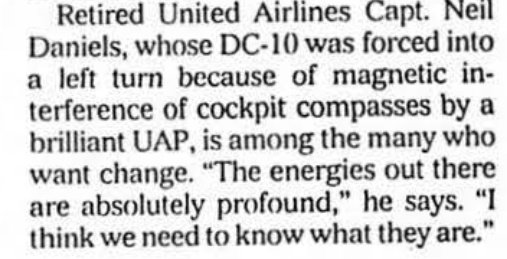
Interference with DC-10 compasses attributed to Neil Daniels
Article mentions a left turn attributed to magnetic interference with the compasses by a luminous UAP; no location, date, or original document.
- Event date
- Date of the account not established · source published on 2001-05-03
- Location
- location and date not given
- Topic
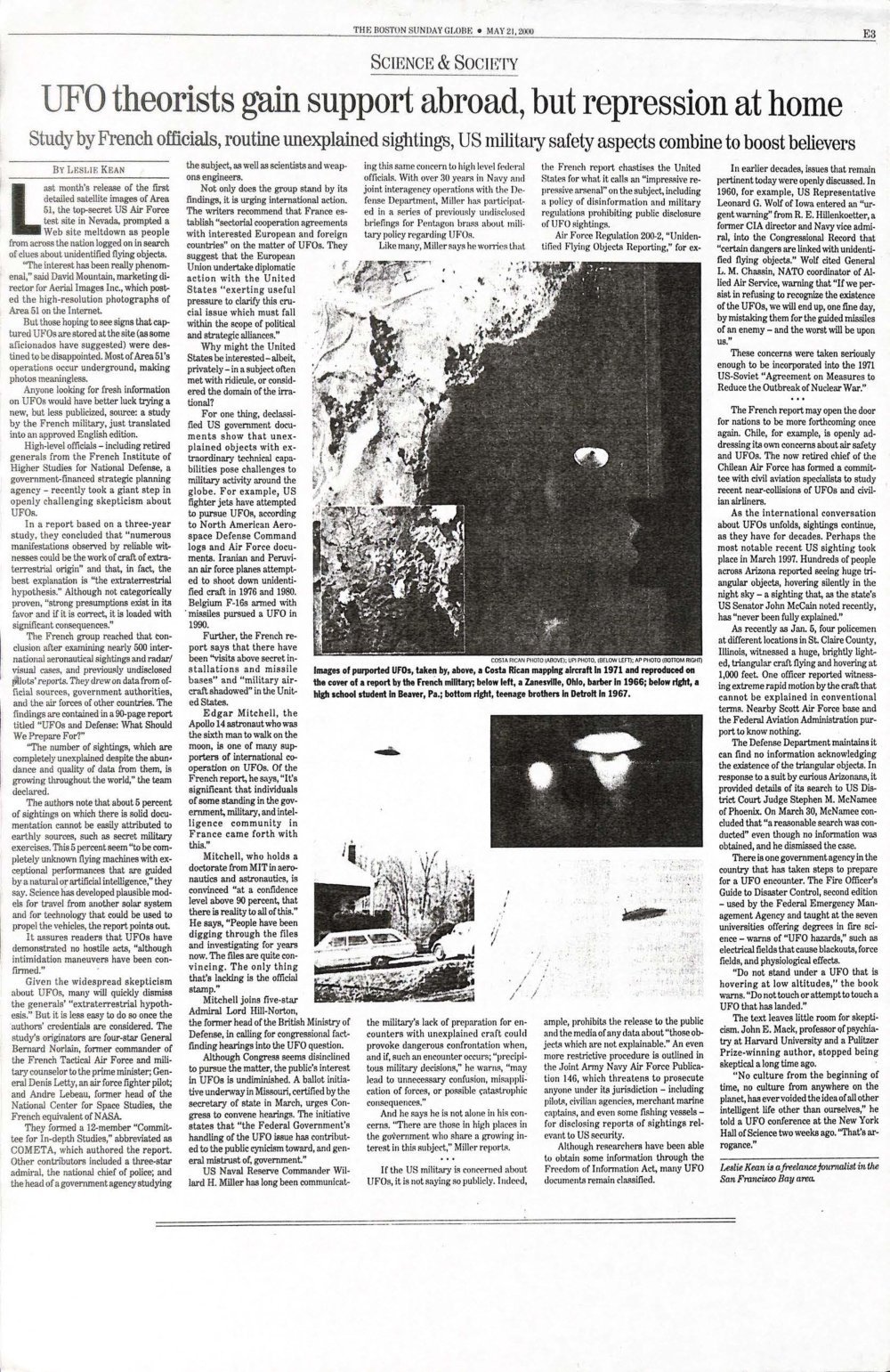
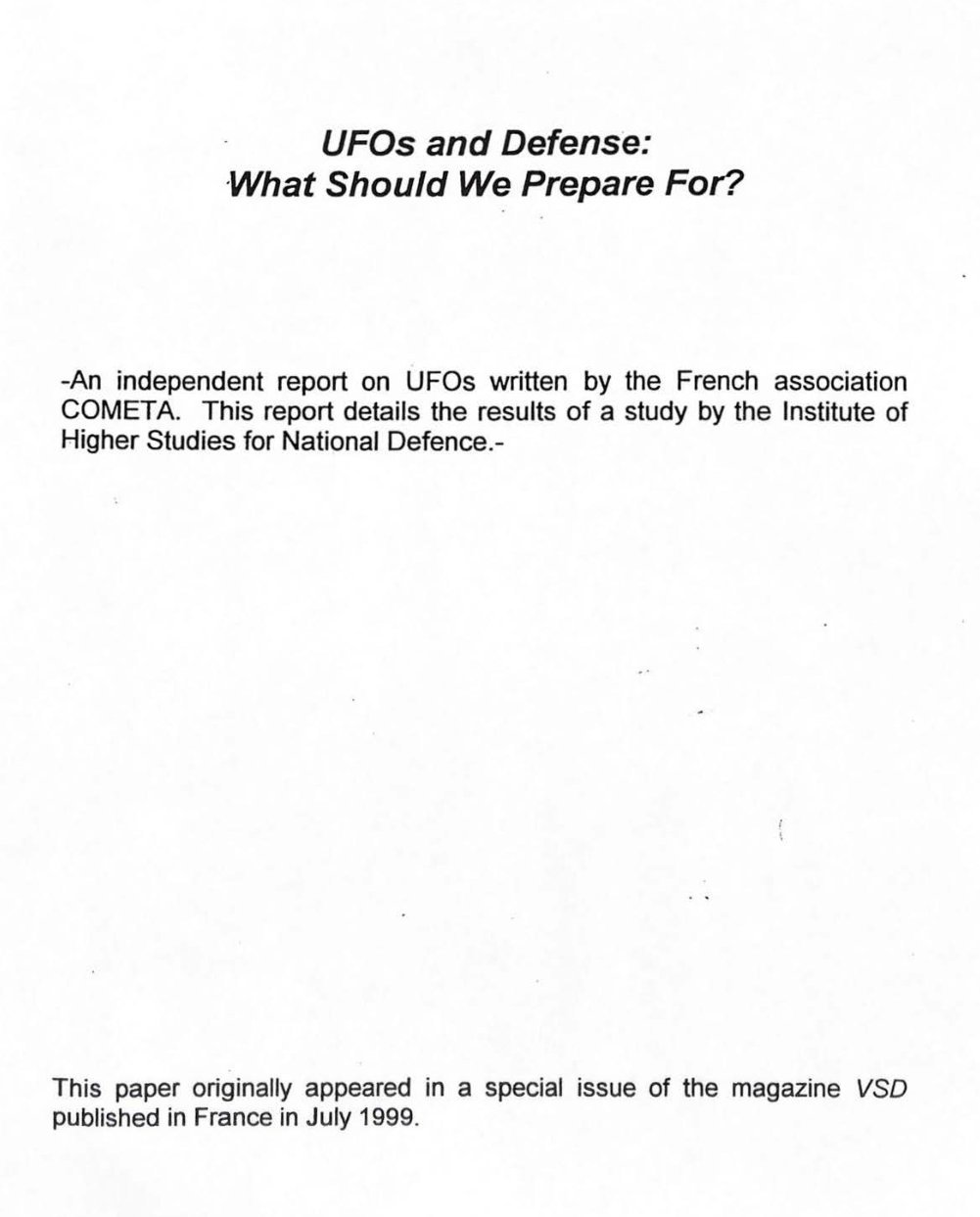
- COMETA and international accounts
- Source agencies
- Arquivo histórico
- Documents
- 1 document · 94 pages
- Reading time
- 17 min
 Newspaper clippingPhysical page 90
DOCUMENTARY SOURCES · Arquivo histórico
What the records tell
Source of this record: Leslie Kean, news article. The PDF combines the private COMETA report and supplementary materials. Inclusion in the public archive does not turn its accounts or conclusions into an official position of the U.S. government.
Article mentions a left turn attributed to magnetic interference with the compasses by a luminous UAP; no location, date, or original document.
In The Providence Journal article of May 3, 2001 (physical page 90), Neil Daniels is identified as a retired United Airlines captain and appears in the final paragraph, among the pilots who want a change in how these reports are handled. The journalist summarizes the episode in one sentence: his DC-10 was reportedly forced into a left turn by magnetic interference from a bright phenomenon on the cockpit compasses. Daniels is quoted as saying that “the energies out there are absolutely profound” and that “we need to know what they are.” The article does not give the date, route, altitude, flight number, or whether there was an official report of the deviation.
Neil Daniels appears in the article's last paragraph, outside the list of examples drawn from Haines's study. The journalist presents him as one of many pilots who want a change in how these reports are handled and summarizes the episode in a single clause: the DC-10 he was commanding was reportedly forced into a left turn by magnetic interference from a bright phenomenon on the cockpit compasses. It is not clear whether the summary comes from an interview with Daniels, from Haines's study, or from another source.
The elements of the account are of different types. The bright phenomenon is an observation attributed to the pilot; the interference with the compasses and the forced turn would be effects on the airplane, but the article provides no instrument readings, flight record, or technical report. The causal link between the phenomenon and the deviation is the way the case was told to the journalist, not the conclusion of an investigation. Daniels's statements about profound “energies” and the need to know what they are express his opinion.
The article was published on May 3, 2001, in The Providence Journal and argues that pilot reports of unidentified aerial phenomena should be treated as a flight safety issue, based on Richard Haines's study of October 2000, which according to the text compiles more than one hundred reports and 56 near collisions. Daniels is identified as a retired United Airlines captain. Since the text gives no year, route, or flight number, the episode cannot be dated or compared with other sources in the archive.
DIRECT READING OF THE FILE
The document, in the original
Translation of the selected excerpts checked against the image, with omissions indicated. This is not a full translation of the PDF. Summaries and evaluations are kept separate from the transcription.
EXCERPT 1 · PHYSICAL PAGE 90
Short excerpt supporting the summary, not a full translation.
Pilot encounters with UFOs
Study challenges secrecy (and denial)
LESLIE KEAN
SAN FHANCISCO
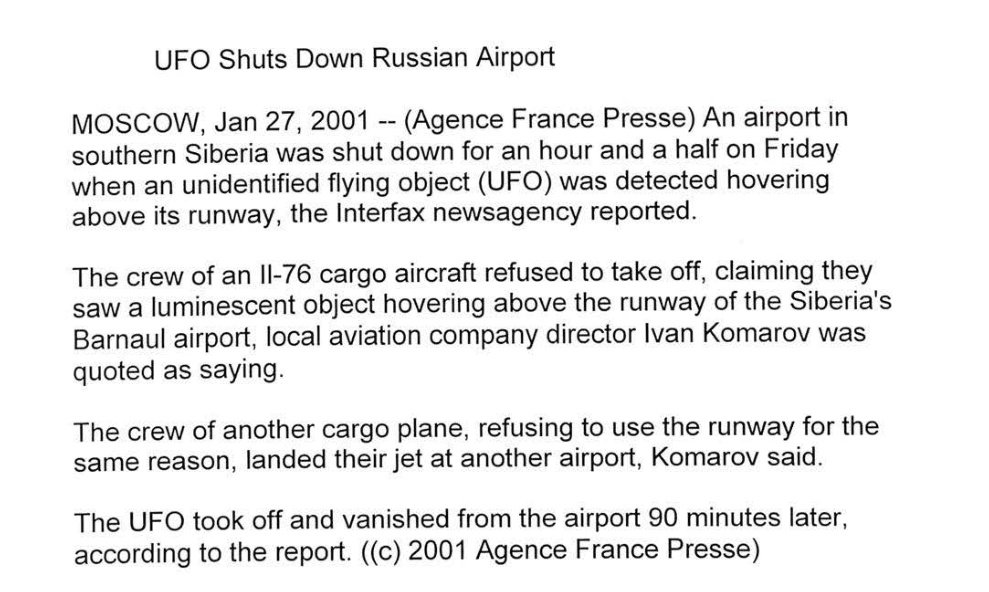
BACK IN JANUARY, Agence
France Presse reported thnt a
Siberian airport was shut for I¼
hours while a luminescent unidentified flying object hovered above its
runway. Although it's hard to imagine
such an event taking place in the industrialized United States, a compelling October 2000 study by a retired
aerospace scientist from NASA-Ames
Research Centershows that similar incidents have occurred in America 1
skies over the last 50 years. "Aviation
Safety in America - A Previously Neglected Factor" presents more than
I 00 pilot and crew reports of encounters with unidentified aerial phenomena (UAP) that appear to have compromised aviation safety.
Author Richard F. Haines, formerly
NASA's chief of the Spnce Human
Factors Office and a Raytheon contract scientist, is chief scientist for the
National Aviation Reporting Center
on Anomalous Phenomena (NAR·
CAP), a research organization founded last year. In stunning detail, pilots
and crew describe a range of geometric forms and lights inconsistent with
known aircraft or naturaJ phenomena.
Bizarre objects paced aircraft at relatively near distances, sometimes disabling cockpit instruments, intern1pting ground communications, or distracting the crew.
The data include 56 near-misses.
Impulsive responses by pilots to an approaching high-speed object can be
hazardous; in a few cases, such violent evasive reactions injured passengers and flight attendants. However,
Haines states that there is no threat of
a collision caused directly by UAP
"because of the re-ported high degree
of maneuverability shown by the
UAP." While flying over Lake Michigan in 1981, TWA Capt. Phil Schultz
saw a "large, round, silver metal object" with dark portholes equally
spaced around the circumference that
"descended into the atmosphere from
above," according to his hand-written
report. Schultz and his first officer
braced themselves for a mid-air collision; the object suddenly made a highspeed tum and departed.
Veteran Japan Airlines 747 Capt.
Kenju Terauchi reported a spectacular
prolonged encounter over Alaska in
1986. "Most unexpectedly, two space
ships stopped in front of our face,
shooting off lights," he said. "The
inside cockpit shined brightly and I felt
wann in the face." Despite the Federal
Aviation Administration's determination that he and his crew were stable,
competent and professional, he was
grounded for speaking out.
In 1997, a Swissair Boeing 747 over
Long Island just missed a glowing,
white, cylindrical object speeding toward the plane. According to an f'M
Civil Aviation Security Office memorandum, pilot Philip Bobet said that "if
the object was any lower, it may have
hit the right wing."
Ground-systems operators have
also been affected by UAP. "The element of sulJ}rise means a decrease in
safety because it diverts the attention
ofair-traffic controllers that should be
focused on landing planes. That is o
danger," says Jim McClenahen, a
recently retired FMair-traffic-control
specialist and NARCAP technical
adviser. "Aviation Safety in America"
does not attempt to explain the origin
of these mysterious objects. But
Haines writes that hundreds of
reports, some dating back to the
1940s, "suggest that they IUAPsj are
associated with a very high degree of
intelligence, deliberate flight control,
and advanced energy management."
In the 1950s, pilots and crews reported
seeing flying discs, cigar-shared craft
with portholes, and gyrating lights, all
with extraordinary technical capabilities. Documents show the unexplained
objects were considered a national ~ecurity concern. By order of th~ Joint
Chiefs ofStaff, commercial pilot., were
required to report sightings and the un•
authorized release of a Uf'O report
could cost them 10 years in prison or a
$1 0,000 fine.
To keep this information from the
public, officials ridiculed and de•
bunked legitimate sightings, angering
some pilots. According to the Newark
Stnr Ledger in 1958, more than fl()
commercial pilots who hnd reported
sightings, each with nt least 15 years of
major airline experience, blasted the
censorship policy and deninls as "bordering on the absolutely ridiculous."
1l1ese pilots said they were intenugated by the Air f'orce, sometimes all
night long, and then "treated like in•
competents and told to keep quiet," according to one pilot. "11,e Air force tells
you that the thing that paced your plane
for 15 minutes was a mirage ora bolt of
lightening," he told the Stor-Led~er.
"Nuts to that. Who needsit?" /\s a result,
manypilots "forget" to repor1 their sight•
ings at all, one pilot said.
According to a 1952 Air f'orce Status Report on UFOs for the AirTechnical Intelligence Center, pilots were so
humiliated that one told investigators,
"If a space ship flew wing-tip to wingtip formation with me, I would not
report it." The vast majority of sightings by American pilots are still not
reported. The media perpetuate the
censorship and ridicule, handicapping
the collection of valuable data.
In contrast, other countries arc
openly investigating the impact of
UAP on aviation safety. A Im.m f'rench
study by retired generals from the
r-rench Institute of Higher Studies for
National Defense and a government
agency with the National Center for
Space Studies examined hundreds of
well-documented pilot reports from
nround the world. The study could not
explain a I 9!l4 Air f'rance viewing of a
UAP that instantaneously disappeared
as confirmed by radar and a 1!195
Aerolineas Argentinas Boeing 727
encounter with a luminous object that
extinguished airport lights as the
plane attempted to land.
"Aeronautic personnel must be
sensitized and prepared to deal with
the situation," the repor1 stntes. They
must first "accept the possibility of the
presence of extraterrestrial craft in
our sky." Then, "it is necessary to over•
come the rear of ridicule."
In 19!l7, the Chilean government
formed the Committee for the Study of
Anomalous Aerial Phenomena (CEFM) following publicly acknowledged observations ofunidentified fly.
ing objects at a remote Chilean airport. Both the f'rench group and Gen.
Ricardo Bermudez Sanhuesn, presi•
dent of the CEFM, have made overtures to the U.S. government for coop•
eration on this issue, with no response.
General Bermudez, and Air force
Gen. Denis Letty, chairman of the
French group. said in recent interviews that the Haines study has international significance and should be
taken seriously.
13rian E. Smith. current head of the
Aviation Safety Program ot NASA·
,/\mes, agrees. "There is objective evidence in pilot repor1s of unexplained
events that may affect the safety of the
aircraft, " he says. "Yet getting people
to tal<e an objective look ut this subject
is sometimes lil<e pulling teeth."
Indeed, the Airline Pilots Association,
our largest pilots union, and the Flight
Safety Foundation, describing itselfas
"offering an objective view of aviation
safety developments," ignored NARCAP requests for a response to the
study. In phone interviews with this
reporter, representatives dismissed
the report out ofhand.after glancing at
the executive summary.
However, such dismissals may soon
lose ground. Next Wednesday, John
Callahan, former division chief of the
Accidents and Investigations Branch
of the f'M, will disclose f'M documentation and subsequent CIA sup•
pression of the Terauchi encounter
over Alaska. Callahan will be joined by
more than 20 other government and
military witnesses, and dozens more
on videotape, at a National Press Club
briefing to challenge official secrecy
about this subject.
Retired United Airlines Capt. Neil
Daniels, whose DC-10 was forced into
a left turn because of magnetic interierence of cockpit compasses by a
brilliant UAP, is among the many who
want change. "The energies out there
are absolutely profound," he says. "l
think we need to know what they are."
Leslie Kean is a journalist and author in the San Francisco Bay area.
'[hr:l)ruuidrnrrJ}1111rmtl
TllllllSl>AY. MAY:I. WllEditorial note: Clipping from The Providence Journal attached to the report: article by Leslie Kean about a study by Richard Haines on pilots' encounters with unidentified aerial phenomena.
Check the original PDF
Retired United Airlines Capt. Neil Daniels, whose DC-10 was forced into a left turn because of magnetic interference of cockpit compasses by a brilliant UAP.View the document record ↗ · Physical page 90, counting the cover.
EXCERPT 2 · PHYSICAL PAGE 90
Statement attributed to Neil Daniels, The Providence Journal report, physical page 90
Pilot encounters with UFOs
Study challenges secrecy (and denial)
LESLIE KEAN
SAN FHANCISCO
BACK IN JANUARY, Agence
France Presse reported thnt a
Siberian airport was shut for I¼
hours while a luminescent unidentified flying object hovered above its
runway. Although it's hard to imagine
such an event taking place in the industrialized United States, a compelling October 2000 study by a retired
aerospace scientist from NASA-Ames
Research Centershows that similar incidents have occurred in America 1
skies over the last 50 years. "Aviation
Safety in America - A Previously Neglected Factor" presents more than
I 00 pilot and crew reports of encounters with unidentified aerial phenomena (UAP) that appear to have compromised aviation safety.
Author Richard F. Haines, formerly
NASA's chief of the Spnce Human
Factors Office and a Raytheon contract scientist, is chief scientist for the
National Aviation Reporting Center
on Anomalous Phenomena (NAR·
CAP), a research organization founded last year. In stunning detail, pilots
and crew describe a range of geometric forms and lights inconsistent with
known aircraft or naturaJ phenomena.
Bizarre objects paced aircraft at relatively near distances, sometimes disabling cockpit instruments, intern1pting ground communications, or distracting the crew.
The data include 56 near-misses.
Impulsive responses by pilots to an approaching high-speed object can be
hazardous; in a few cases, such violent evasive reactions injured passengers and flight attendants. However,
Haines states that there is no threat of
a collision caused directly by UAP
"because of the re-ported high degree
of maneuverability shown by the
UAP." While flying over Lake Michigan in 1981, TWA Capt. Phil Schultz
saw a "large, round, silver metal object" with dark portholes equally
spaced around the circumference that
"descended into the atmosphere from
above," according to his hand-written
report. Schultz and his first officer
braced themselves for a mid-air collision; the object suddenly made a highspeed tum and departed.
Veteran Japan Airlines 747 Capt.
Kenju Terauchi reported a spectacular
prolonged encounter over Alaska in
1986. "Most unexpectedly, two space
ships stopped in front of our face,
shooting off lights," he said. "The
inside cockpit shined brightly and I felt
wann in the face." Despite the Federal
Aviation Administration's determination that he and his crew were stable,
competent and professional, he was
grounded for speaking out.
In 1997, a Swissair Boeing 747 over
Long Island just missed a glowing,
white, cylindrical object speeding toward the plane. According to an f'M
Civil Aviation Security Office memorandum, pilot Philip Bobet said that "if
the object was any lower, it may have
hit the right wing."
Ground-systems operators have
also been affected by UAP. "The element of sulJ}rise means a decrease in
safety because it diverts the attention
ofair-traffic controllers that should be
focused on landing planes. That is o
danger," says Jim McClenahen, a
recently retired FMair-traffic-control
specialist and NARCAP technical
adviser. "Aviation Safety in America"
does not attempt to explain the origin
of these mysterious objects. But
Haines writes that hundreds of
reports, some dating back to the
1940s, "suggest that they IUAPsj are
associated with a very high degree of
intelligence, deliberate flight control,
and advanced energy management."
In the 1950s, pilots and crews reported
seeing flying discs, cigar-shared craft
with portholes, and gyrating lights, all
with extraordinary technical capabilities. Documents show the unexplained
objects were considered a national ~ecurity concern. By order of th~ Joint
Chiefs ofStaff, commercial pilot., were
required to report sightings and the un•
authorized release of a Uf'O report
could cost them 10 years in prison or a
$1 0,000 fine.
To keep this information from the
public, officials ridiculed and de•
bunked legitimate sightings, angering
some pilots. According to the Newark
Stnr Ledger in 1958, more than fl()
commercial pilots who hnd reported
sightings, each with nt least 15 years of
major airline experience, blasted the
censorship policy and deninls as "bordering on the absolutely ridiculous."
1l1ese pilots said they were intenugated by the Air f'orce, sometimes all
night long, and then "treated like in•
competents and told to keep quiet," according to one pilot. "11,e Air force tells
you that the thing that paced your plane
for 15 minutes was a mirage ora bolt of
lightening," he told the Stor-Led~er.
"Nuts to that. Who needsit?" /\s a result,
manypilots "forget" to repor1 their sight•
ings at all, one pilot said.
According to a 1952 Air f'orce Status Report on UFOs for the AirTechnical Intelligence Center, pilots were so
humiliated that one told investigators,
"If a space ship flew wing-tip to wingtip formation with me, I would not
report it." The vast majority of sightings by American pilots are still not
reported. The media perpetuate the
censorship and ridicule, handicapping
the collection of valuable data.
In contrast, other countries arc
openly investigating the impact of
UAP on aviation safety. A Im.m f'rench
study by retired generals from the
r-rench Institute of Higher Studies for
National Defense and a government
agency with the National Center for
Space Studies examined hundreds of
well-documented pilot reports from
nround the world. The study could not
explain a I 9!l4 Air f'rance viewing of a
UAP that instantaneously disappeared
as confirmed by radar and a 1!195
Aerolineas Argentinas Boeing 727
encounter with a luminous object that
extinguished airport lights as the
plane attempted to land.
"Aeronautic personnel must be
sensitized and prepared to deal with
the situation," the repor1 stntes. They
must first "accept the possibility of the
presence of extraterrestrial craft in
our sky." Then, "it is necessary to over•
come the rear of ridicule."
In 19!l7, the Chilean government
formed the Committee for the Study of
Anomalous Aerial Phenomena (CEFM) following publicly acknowledged observations ofunidentified fly.
ing objects at a remote Chilean airport. Both the f'rench group and Gen.
Ricardo Bermudez Sanhuesn, presi•
dent of the CEFM, have made overtures to the U.S. government for coop•
eration on this issue, with no response.
General Bermudez, and Air force
Gen. Denis Letty, chairman of the
French group. said in recent interviews that the Haines study has international significance and should be
taken seriously.
13rian E. Smith. current head of the
Aviation Safety Program ot NASA·
,/\mes, agrees. "There is objective evidence in pilot repor1s of unexplained
events that may affect the safety of the
aircraft, " he says. "Yet getting people
to tal<e an objective look ut this subject
is sometimes lil<e pulling teeth."
Indeed, the Airline Pilots Association,
our largest pilots union, and the Flight
Safety Foundation, describing itselfas
"offering an objective view of aviation
safety developments," ignored NARCAP requests for a response to the
study. In phone interviews with this
reporter, representatives dismissed
the report out ofhand.after glancing at
the executive summary.
However, such dismissals may soon
lose ground. Next Wednesday, John
Callahan, former division chief of the
Accidents and Investigations Branch
of the f'M, will disclose f'M documentation and subsequent CIA sup•
pression of the Terauchi encounter
over Alaska. Callahan will be joined by
more than 20 other government and
military witnesses, and dozens more
on videotape, at a National Press Club
briefing to challenge official secrecy
about this subject.
Retired United Airlines Capt. Neil
Daniels, whose DC-10 was forced into
a left turn because of magnetic interierence of cockpit compasses by a
brilliant UAP, is among the many who
want change. "The energies out there
are absolutely profound," he says. "l
think we need to know what they are."
Leslie Kean is a journalist and author in the San Francisco Bay area.
'[hr:l)ruuidrnrrJ}1111rmtl
TllllllSl>AY. MAY:I. WllCheck the original PDF
“The energies out there are absolutely profound,” he says. “I think we need to know what they are.”View the document record ↗ · Physical page 90, counting the cover.
Dates and documentary context
- Event
- Not established — date not provided. Date given by the secondary source, separate from the publication date.
- Document
- Not established — Individual document date not determined; see the source publication below.
- Publication
- 03/05/2001 — The Providence Journal · Publication of the examined or cited source; do not assume it is the first historical disclosure of the event. · Secondary journalistic source; the cited primary documents do not accompany the clipping.
Origin and release
Leslie Kean, report · Interference with DC-10 compasses attributed to Neil Daniels
Secondary journalistic source; the primary documents cited do not accompany the clipping. Providence Journal, report by Leslie Kean, 2001-05-03. Later newspaper clipping attached to the compilation; do not attribute this report to the 1999 COMETA.
Official collection · release 01 ↗ — Match indicated by the search; bytes of the remote PDF not authenticated.
Questions to continue the investigation
- Locate and verify the primary records and technical documents cited.
GEOGRAPHY OF THE CASE
location and date not provided
Do not estimate coordinates or a specific point. The dossier remains in the map list, without a confirmed geographic marker.
DOCUMENTARY TRAIL
Go back to the sources
References use physical pages of the PDF, counting the cover. Summaries are presented in English; the documents keep their original language.
- 255_413270_UFO's_and_Defense_What_Should_we_Prepare_For.pdf
Physical pages 90
Arquivo histórico · 94 pages
Context and references in this document
contexto ou referencia
UFO seen over a rural school after Antananarivo ↗
contexto ou referencia
Reports of “ghost rockets” in Sweden ↗
contexto ou referencia
Reports of “foo fighters” in World War II ↗
contexto ou referencia
Reports of “airships” in the U.S. and the United Kingdom ↗
contexto ou referencia
Luminous phenomenon attributed to Goethe in 1768 ↗
contexto ou referencia
Aerial phenomena reported in Nuremberg ↗
contexto ou referencia
Aerial phenomenon reported in Basel ↗
contexto ou referencia
Medieval narrative attributed to Agobard about occupants of an “aircraft” ↗
contexto ou referencia
Contact with a Venusian attributed to Adamski ↗
contexto ou referencia
Paul Bennewicz's claims about microwaves, abductions and implants ↗
contexto ou referencia
Triangular lights reported in Arizona in 1997 ↗
contexto ou referencia
Interception attempts by military aircraft in Iran, Peru and Belgium ↗
contexto ou referencia
Shoot-down attempt by Peruvian aircraft, cited in a news report ↗
contexto ou referencia
Pursuit of UFOs by Belgian F-16s in 1990 ↗
contexto ou referencia
Mention of a military Vampire in the Orange region in 1951 ↗
contexto ou referencia
Photograph attributed to a mapping flight over Tilarán, Costa Rica ↗
contexto ou referencia
Image attributed to a Zanesville, Ohio, barber in 1966 ↗
contexto ou referencia
Image attributed to a student from Beaver, Pennsylvania ↗
contexto ou referencia
Image attributed to brothers from Detroit in 1967 ↗
Editorial summary based on the collection's research notes. How we read the documents.