Date: July 24, 1949, at 12:05 MSTLocation: About 10 miles northwest of Mountain Home, Idaho, according to the form.
Formation of seven UFOs near Mountain Home
Account attributed to Clark describes seven UFOs in a V formation, with a triangular/delta appearance and light gray color. The witness estimated a speed above 600 mph and a wide turn; the continuation records an estimated initial altitude near 10 mil feet.
- Event date
- July 24, 1949, at 12:05 MST
- Location
- About 10 miles northwest of Mountain Home, Idaho, according to the form.
- Topic
- Military reports from 1948–1949
- Source agencies
- Arquivo histórico
- Documents
- 1 document · 143 pages
- Reading time
- 6 min
 Document facsimilePhysical page 28
DOCUMENTARY SOURCES · Arquivo histórico
What the records tell
Account attributed to Clark describes seven objects in a V formation, with a triangular/delta appearance and light gray color. The witness estimated a speed above 600 mph and a wide turn; the continuation records an estimated initial altitude near 10 mil feet.
The witness was Harry Clark, manager of Ritchie Field airport, in Nampa, Idaho, and he was piloting. He was flying from Burley to Nampa in a Cub Cruiser, at 10 mil feet, when he saw the formation about a quarter mile to his left and slightly below, heading in nearly the same direction, on an approximate heading of 300 degrees. The seven objects were flying in a V. Clark described them as delta wings with no protrusions, with an apex angle between 30 and 45 degrees and a slightly convex base, larger than an F-51 fighter, colored between light gray and off-white, with no shine and no markings.
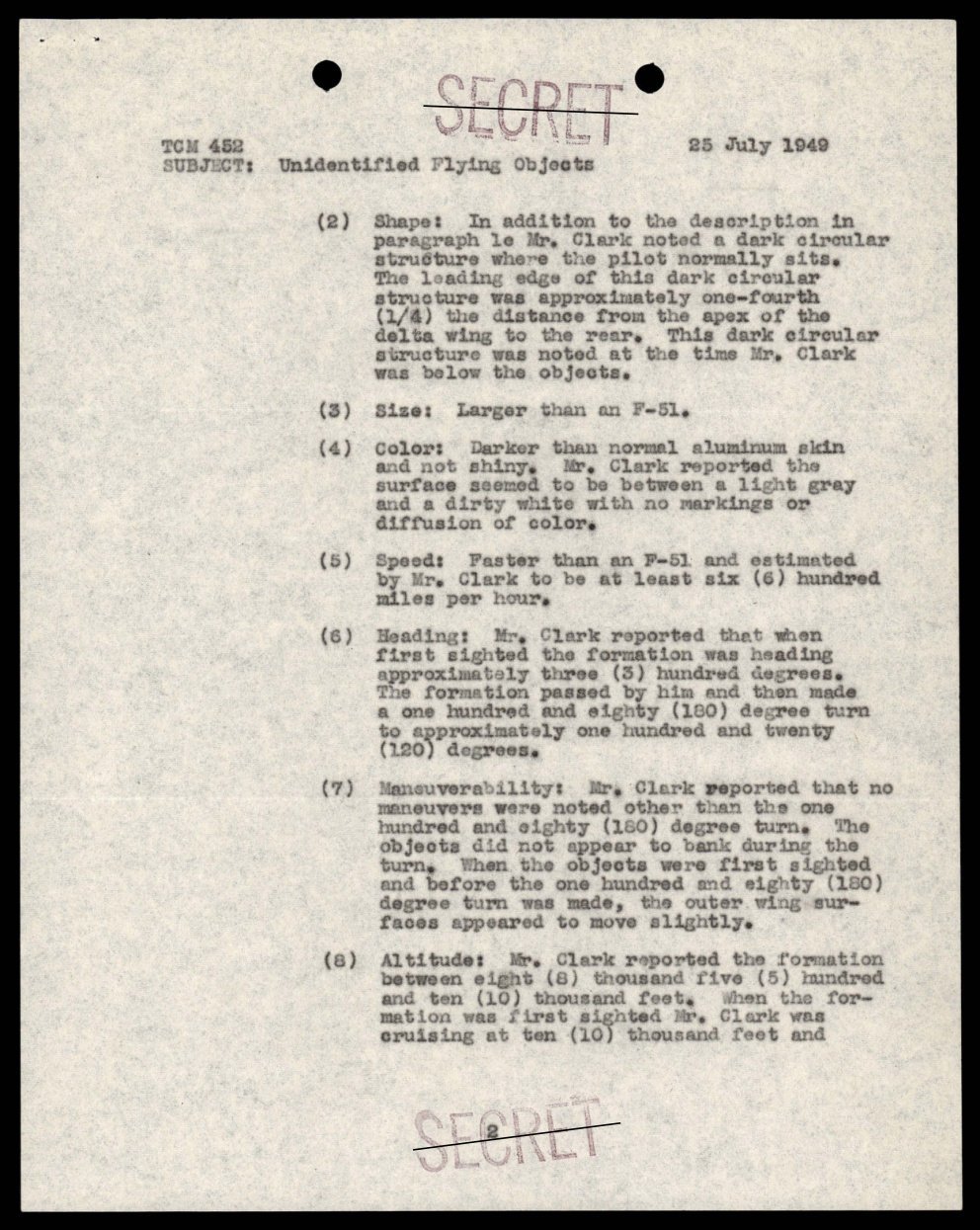
According to the account, the formation passed him and made a turn from 180 degrees to about 120 degrees without banking, as an airplane would; before the turn, the wingtips appeared to move slightly. Clark descended to 8.500 feet and made a 90-degree left turn to try to intercept. Underneath, he noticed a dark circular bulge where the pilot would normally be, one quarter of the distance from the apex to the rear. There was no sound and no trail. The objects soon disappeared due to their speed, which he estimated at no less than 600 miles per hour.
The report, signed by Lieutenant Colonel Earl J. Livesay, adds an assessment of credibility, not of fact: Captain John S. Batie (spelling uncertain), of the same unit, knew Clark personally and considered him a reliable witness. There is a time inconsistency within the document itself. The sighting is given at 12h05, Mountain Standard Time, and the cited weather report, from Mountain Home Air Force Base, at 11h30, Pacific Standard Time. The weather report indicated scattered clouds at 5 thousand feet and visibility of 30 miles.
The report moved quickly. The sighting was at 12h05 on July 24, 1949, and the stamp on the back of the last sheet shows that the McChord Flight Service Center transmitted the text on July 25, at 11h30, less than a day later. The document states that it was prepared in accordance with Flight Service Regulation FS 200-4, of November 2, 1948, with the subject “unidentified flying objects,” and it was addressed to the Air Materiel Command, at Wright-Patterson, Ohio, with copies to the Air Force Chief of Staff and the MATS command.
All of the content comes from a single person. The form states that Harry Clark was the only one to report the sighting, and it records no other witness, radar return, or inquiry about military flights in the area, unlike other reports from the same center, such as the Portland one, a week later, in which a B-29 was checked. The only assessment concerns the person: a captain of the unit knew Clark and considered him reliable. On the first sheet there are two handwritten notations, “B” and “A.I.,” whose meaning the document does not explain.
Editorial hypothesis: a V formation in which the wingtips appear to move before a turn also describes a flock of large birds, and the distance of a quarter mile and the size “larger than an F-51” are visual estimates that are difficult to make against the sky, without reference points. The report does not examine this or any other possibility and reaches no conclusion. Clark's description, with delta wings of 30 to 45 degrees at the apex, a convex base, and a dark bulge underneath, remains on record as he gave it.
More images from the document
DIRECT READING OF THE FILE
The document, in the original
Translation of the selected excerpts checked against the image, with omissions indicated. This is not a full translation of the PDF. Summaries and evaluations are kept separate from the transcription.
EXCERPT 1 · PHYSICAL PAGE 28
Physical page 28, in full: beginning of report TCM 452 of 25/07/1949
•
C
TC 5 r. Jul l
•
U id n j eta
T t
,
llo ..
•
d. i t V 11
p of obj
• bj
(l) 1 t dEditorial note: The time zone difference between the sighting time (MST) and the bulletin time (PST) is in the original.
Check the original PDF
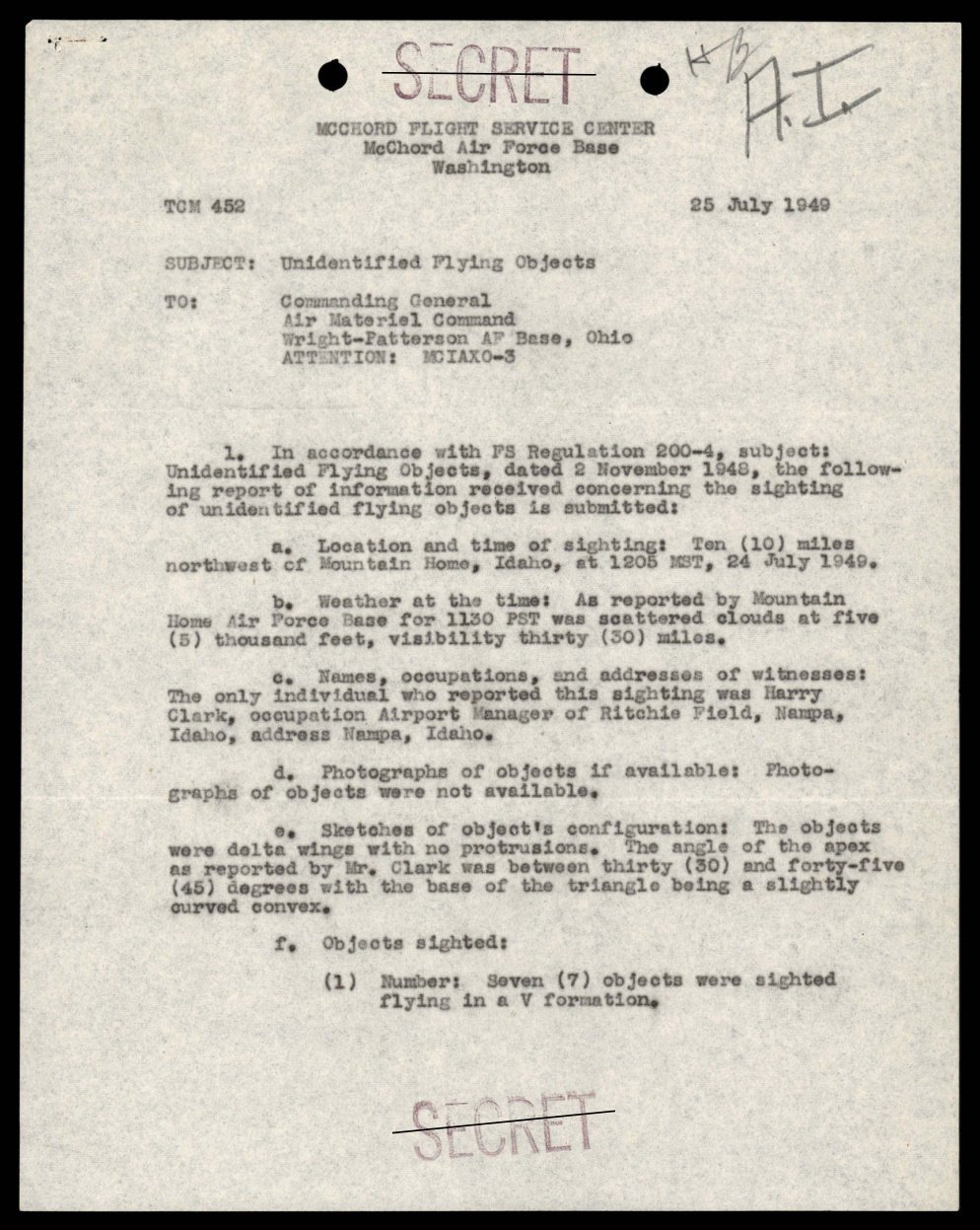
SECRET [riscado]. McCHORD FLIGHT SERVICE CENTER, McChord Air Force Base, Washington. TCM 452. 25 July 1949. SUBJECT: Unidentified Flying Objects. TO: Commanding General, Air Materiel Command, Wright-Patterson AF Base, Ohio. ATTENTION: MCIAXO-3. 1. In accordance with FS Regulation 200-4, subject: Unidentified Flying Objects, dated 2 November 1948, the following report of information received concerning the sighting of unidentified flying objects is submitted: a. Location and time of sighting: Ten (10) miles northwest of Mountain Home, Idaho, at 1205 MST, 24 July 1949. b. Weather at the time: As reported by Mountain Home Air Force Base for 1130 PST was scattered clouds at five (5) thousand feet, visibility thirty (30) miles. c. Names, occupations, and addresses of witnesses: The only individual who reported this sighting was Harry Clark, occupation Airport Manager of Ritchie Field, Nampa, Idaho, address Nampa, Idaho. d. Photographs of objects if available: Photographs of objects were not available. e. Sketches of object's configuration: The objects were delta wings with no protrusions. The angle of the apex as reported by Mr. Clark was between thirty (30) and forty-five (45) degrees with the base of the triangle being a slightly curved convex. f. Objects sighted: (1) Number: Seven (7) objects were sighted flying in a V formation. SECRET [riscado]. [Anotações manuscritas: B; A.I.]View the document record ↗ · Physical page 28, counting the cover.
EXCERPT 2 · PHYSICAL PAGE 29
Physical page 29, in full: shape, size, color, speed, heading, maneuvers and altitude
TCM 4&2
SUBJECT:
(2)
q
a
Unidentified Plying Objects
25 July 1949
Shapet In addition to the description in
paragraph le Mr, Clark noted a dark circeular
struéture where the pilot normally sits.
The leading edge of this dark circular
atructure was approximately one-fourth
(1/4) the distance from the apex of the
delta wing to the rear, This dark circular
structure was noted at the time ir, Clark
was below the objects,
Size: Larger than an F-5l,
Color: Darker than normal aluminum skin
and not shiny, Mr. Clark reported the
surface scemed to be between a light gray
and a dirty white with no markings or
diffusion of colors
Speeds: Paster than an FP-5]. and estimated
by Mre Clark to be at least six (6) hundred
miles per hours,
Heading: Mr, Clark reported that when
first sighted the formation was heading
approximately three (3) hundred degrees.
The formation passed by him and then made
a one hundred and eighty (180) decree tur
to approximately one hundred and twenty
(120) degrees,
Mancuverability: Mr, Clark peported that no
maneuyera were noted other than the one
hundred and eighty (160) degree turn. ‘The
objects did not appear to bank during the
turn, When the objects were first sighted
and before the one hundred and eighty (150)
degree turn was made, the outer wing sur-
faces appeared to move slightlys
Altitude: Mr, Clark reported the formation
between eight (&) thousand five (5) mundred
and ten (10) thousand feet, vhen the for-
mation was first sighted Mr, Clark was
cruising at ten (10) thousand feet andCheck the original PDF
SECRET [riscado]. TCM 452. SUBJECT: Unidentified Flying Objects. 25 July 1949. (2) Shape: In addition to the description in paragraph 1e Mr. Clark noted a dark circular structure where the pilot normally sits. The leading edge of this dark circular structure was approximately one-fourth (1/4) the distance from the apex of the delta wing to the rear. This dark circular structure was noted at the time Mr. Clark was below the objects. (3) Size: Larger than an F-51. (4) Color: Darker than normal aluminum skin and not shiny. Mr. Clark reported the surface seemed to be between a light gray and a dirty white with no markings or diffusion of color. (5) Speed: Faster than an F-51 and estimated by Mr. Clark to be at least six (6) hundred miles per hour. (6) Heading: Mr. Clark reported that when first sighted the formation was heading approximately three (3) hundred degrees. The formation passed by him and then made a one hundred and eighty (180) degree turn to approximately one hundred and twenty (120) degrees. (7) Maneuverability: Mr. Clark reported that no maneuvers were noted other than the one hundred and eighty (180) degree turn. The objects did not appear to bank during the turn. When the objects were first sighted and before the one hundred and eighty (180) degree turn was made, the outer wing surfaces appeared to move slightly. (8) Altitude: Mr. Clark reported the formation between eight (8) thousand five (5) hundred and ten (10) thousand feet. When the formation was first sighted Mr. Clark was cruising at ten (10) thousand feet and 2. SECRET [riscado]View the document record ↗ · Physical page 29, counting the cover.
EXCERPT 3 · PHYSICAL PAGE 30
Physical page 30, in full: end of altitude, sound, trail, general remarks and signature
. ,.
•·
Ju l 4 ...r
( ) ot 0 ...
(lO)
Copies f'urnisp.e ,d:
Chief of St\iflf, USAF •
Commander, · MATS .
Commanding Officer, Flight Se~vice
.,lf r :.i I .>a;, I 3o .,n .iiEditorial note: The captain's surname may be read as Batie or Batis.
Check the original PDF
SECRET [riscado]. TCM 452. SUBJECT: Unidentified Flying Objects. 25 July 1949. objects were slightly below and one-fourth (1/4) of a mile to the left of his position. When the formation made the one hundred and eighty (180) degree turn Mr. Clark descended to eight (8) thousand five (5) hundred feet and was below the formation when they came back. (9) Sound: No sound was noted from the formation. (10) Exhaust trail or not: No exhaust trail was visible. g. General remarks: Mr. Clark was enroute from Burley, Idaho, to Nampa, Idaho, in a Cub Cruiser when the objects were sighted. When the formation was first sighted they were going in approximately the same direction as Mr. Clark and were approximately one-fourth (1/4) of a mile to his left and below. Mr. Clark was cruising at ten (10) thousand feet at this time. He observed the formation until it made the one hundred and eighty (180) degree turn at which time Mr. Clark descended in his aircraft and made a ninety (90) degree turn to the left in an effort to intercept the formation. He was able to get below the level of the formation at eight (8) thousand five (5) hundred feet at which time he noticed the dark circular bulge on the bottom side of the objects. Because of their speed the flying objects soon became lost from the sight of Mr. Clark who proceeded on to his destination. Mr. Clark is known personally by Captain John S. Batie of this organization who states that in his opinion Mr. Clark is a reliable witness. EARL J. LIVESAY, Lt. Col., USAF, Commanding. Copies furnished: Chief of Staff, USAF; Commander, MATS; Commanding Officer, Flight Service. [Carimbo de transmissão do McChord Field, julho de 1949.] 3. SECRET [riscado]View the document record ↗ · Physical page 30, counting the cover.
EXCERPT 4 · PHYSICAL PAGE 31
Physical page 31, in full: reverse of the third sheet of report TCM 452 (transmittal stamp)
• '
Mc CH RD f \ELD ~;:;:- .· . E
bP, riV 0 E II ~z 1nr
.. 0311lWSN'1't!l
.,..Editorial note: Back of physical page 30. The stamp is upside down relative to the sheet; the line with the center's name is inverted relative to the date, as is common in this type of stamp. There is no text of its own besides the stamp.
Check the original PDF
[Stamp:] TRANSMITTED. JUL 25 11 30 AM '49. McCHORD FIELD FLT. SERV. CENTER. [The rest of the page shows, faintly and in reverse, the typed text and the SECRET stamp from the front of the sheet.]View the document record ↗ · Physical page 31, counting the cover.
Dates and documentary context
- Event
- 24/07/1949 — July 24, 1949, at 12:05 MST. Form on physical page 28, compared against the image.
- Document
- 25/07/1949 — July 25, 1949 — McChord report
- Publication
- Not established — No original public publication was identified for these internal forms, messages and reports.
Origin and release
U.S. Air Force (USAF) and military flight information services, according to the report · Military administrative reports and messages
No original public release was identified for these internal forms, messages and reports. Shape, speed, altitude and maneuver are visual estimates; no radar, photo or independent measurement.
Official collection · release 01 ↗ — Correspondence indicated by the local collection; bytes of the remote PDF not authenticated.
GEOGRAPHY OF THE CASE
About 10 miles northwest of Mountain Home, Idaho
Approximate reference for the location cited in the document, positioned by the editorial team. Does not indicate where the witness or the object was.
DOCUMENTARY TRAIL
Go back to the sources
References use physical pages of the PDF, counting the cover. Summaries are presented in English; the documents keep their original language.
- 342_HS1-416511228_box186_319.1-Flying-Discs-1949.pdf
Physical pages 28, 29, 30
Arquivo histórico · 143 pages
Context and references in this document
contexto institucional
Administrative hypothesis about activity in Greenland ↗
Editorial summary based on the collection's research notes. How we read the documents.