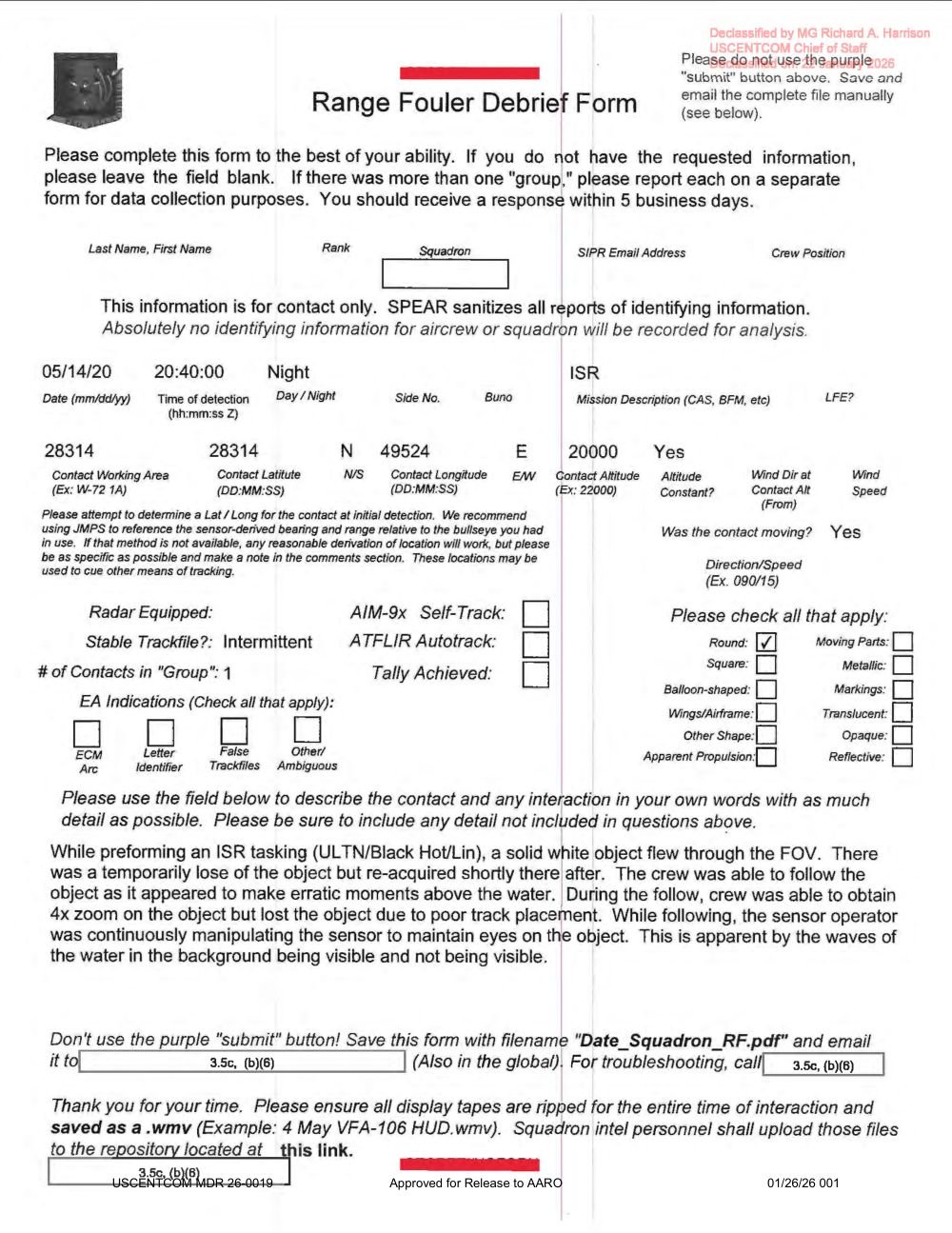
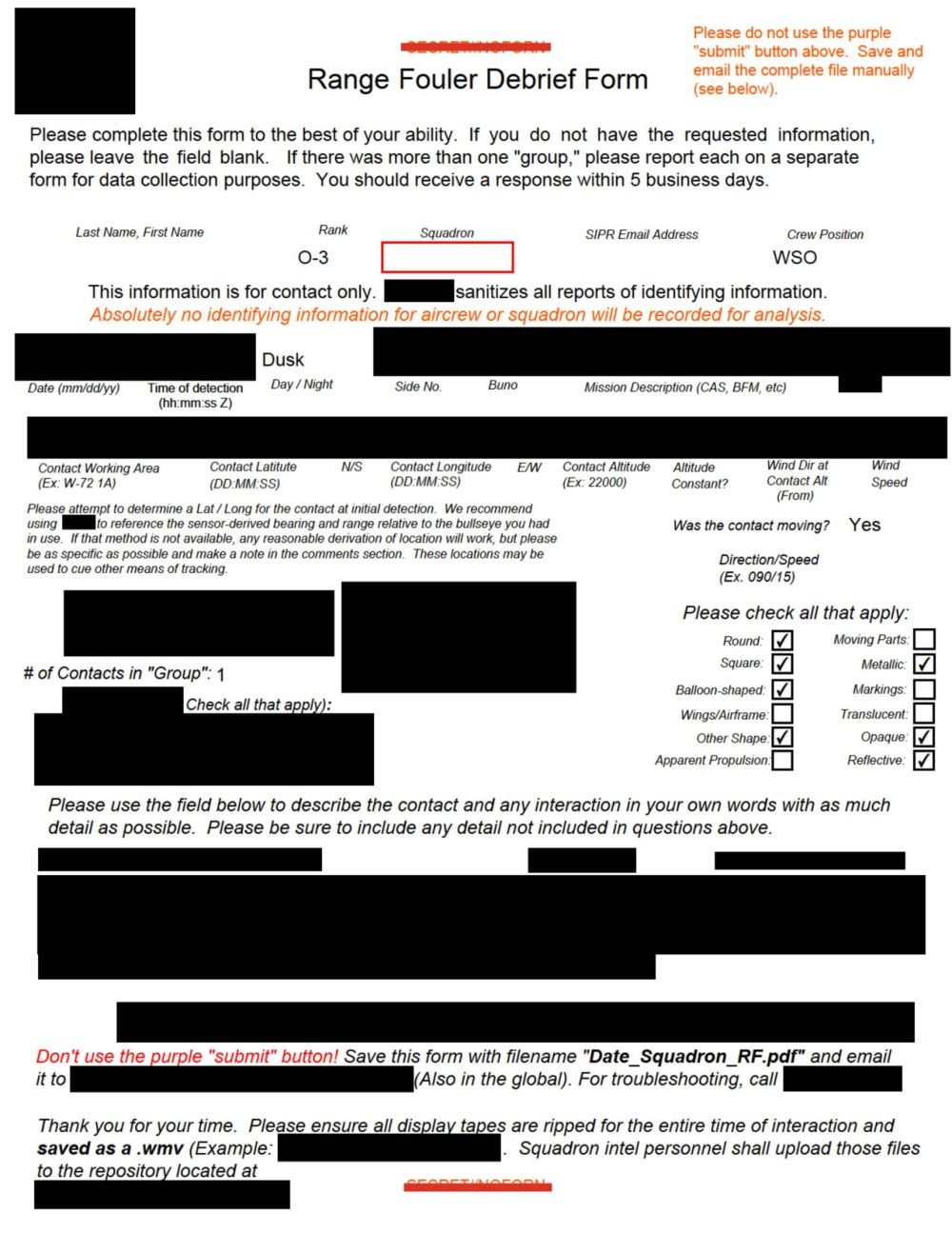
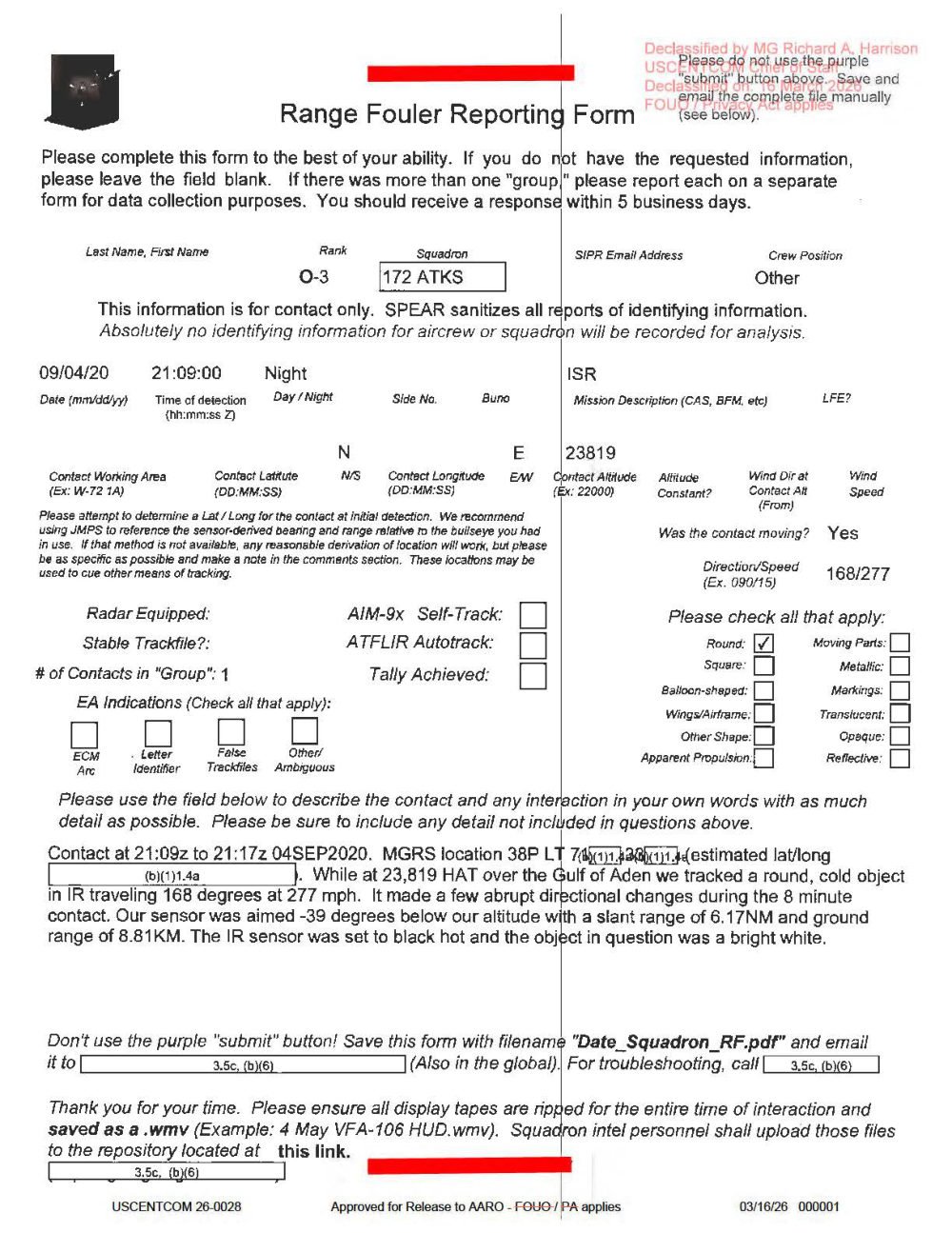
Date: 2020, according to the file title; at 13h54 and at 22h43 (Z time); day and month do not appearLocation: Military grids 34SCE7566990098 (Ionian Sea) and 35TQK1580995057 (Black Sea, near the Danube delta, Romania), per the editorial team's conversion; the file title cites the Arabian Gulf
Ionian Sea and Black Sea, according to the report's grids, 2020: a slow UAP at 5.000 meters and two possible UAPs that accelerate southward
The same mission report, almost entirely redacted, holds two separate records: at 13h54 (Z time), a UAP at a constant speed of 40 knots between 16.000 and 17.000 feet; at 22h43, two possible UAPs estimated at 278 knots, which accelerated and turned south. The position grids point to the Ionian Sea and the Black Sea, about 1.300 km from each other, and not the Arabian Gulf of the title.
- Event date
- 2020, according to the file title; at 13h54 and at 22h43 (Z time); day and month do not appear
- Location
- Military grids 34SCE7566990098 (Ionian Sea) and 35TQK1580995057 (Black Sea, near the Danube delta, Romania), per the editorial team's conversion; the file title cites the Arabian Gulf
- Topic
- Recent military records
- Source agencies
- DOW
- Documents
- 1 document · 6 pages
- Reading time
- 3 min
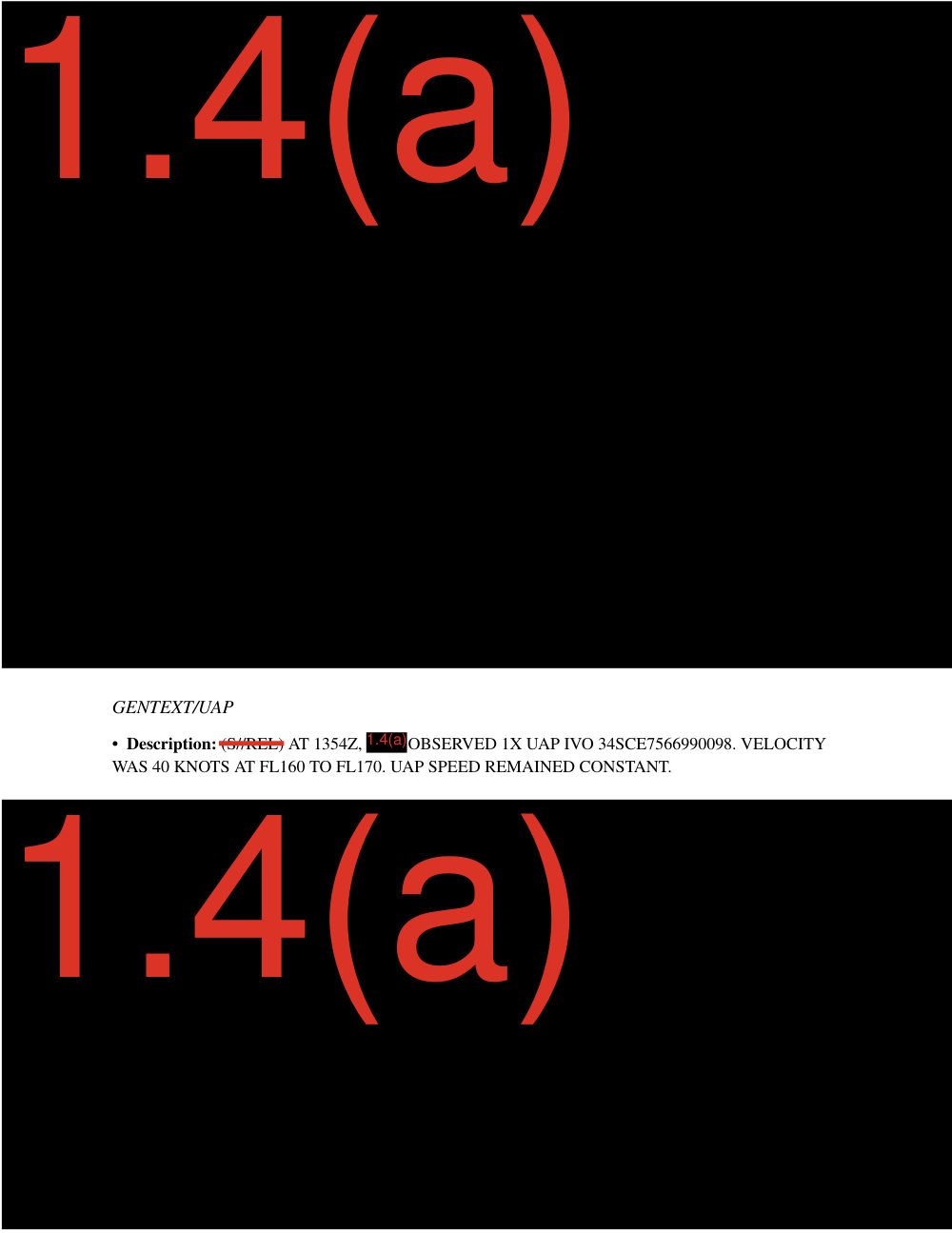 Mission report (facsimile)Physical page 5
DOCUMENTARY SOURCES · DOW
What the records tell
The file has six pages. The first four are completely black, with the red marking 1.4(a), used for military information. Pages 5 and 6 preserve only the free-text fields about UAP, surrounded by redaction bars. The marking (S//REL) is struck through in red, a sign of declassification. No date, aircraft, unit, sensor or observer name appears. The year 2020 and the Arabian Gulf come only from the title of the file published by the Department of War.
The first record says: “At 13h54Z, [suppressed] observed 1 UAP in the vicinity of 34SCE7566990098. Speed was 40 knots, between FL160 and FL170. UAP speed remained constant.” FL160 and FL170 are flight levels, about 16.000 and 17.000 feet, or 4.900 to 5.200 meters. Forty knots is about 74 km/h. Unlike the other records in this set, the text does not use “possible”: it states the observation of a UAP.
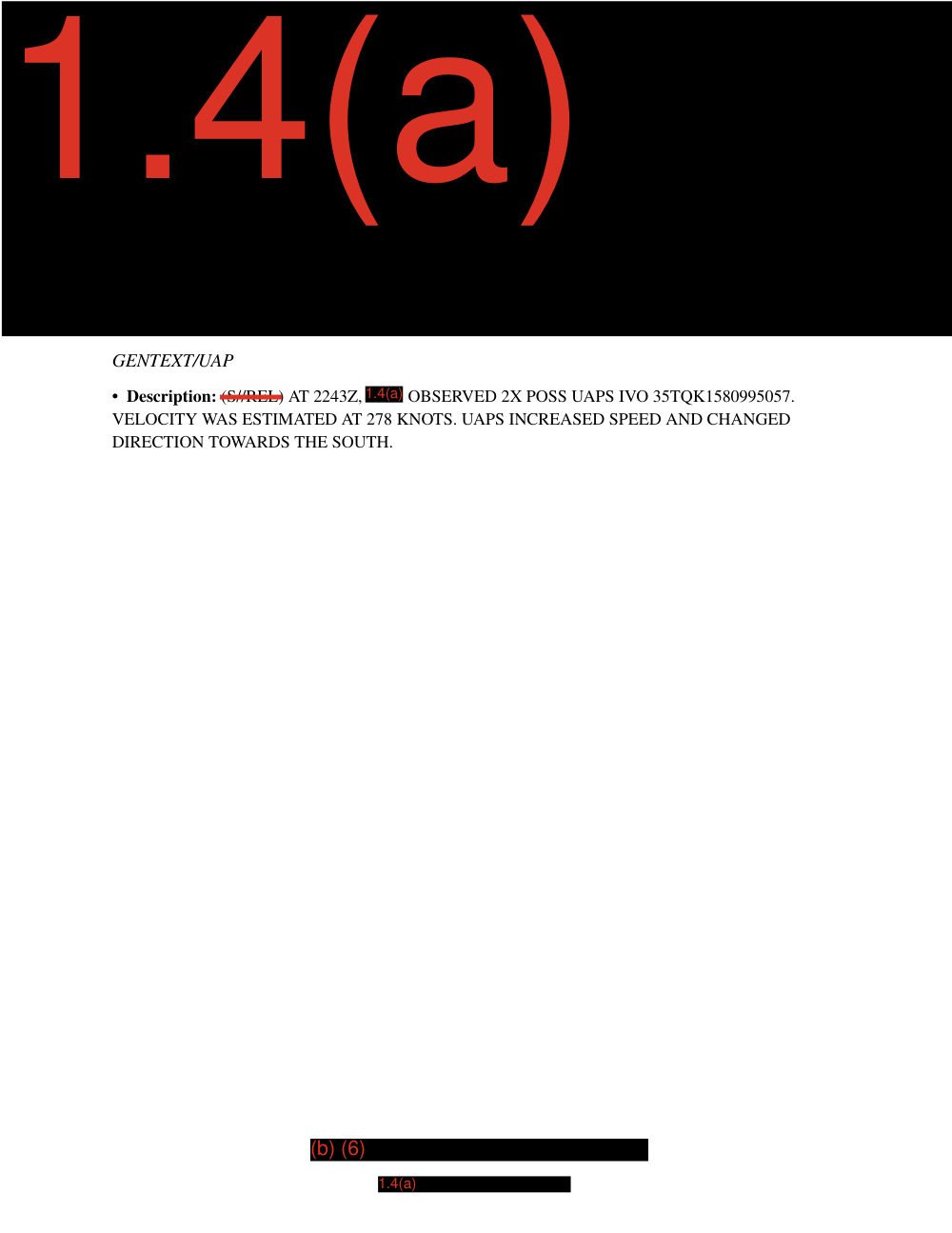
The second record, on the next page, says: “At 22h43Z, [suppressed] observed 2 possible UAPs in the vicinity of 35TQK1580995057. Speed was estimated at 278 knots. The UAPs increased speed and changed direction to the south.” That is about 515 km/h. The nine hours between the two times and the distance between the positions indicate separate events, and the document does not say whether they were seen by the same aircraft or on the same mission.
The two sequences are positions in the MGRS military grid. Converted by the editorial team, the first corresponds to about 36,0° north and 19,6° east, in open sea in the Ionian Sea, southwest of Greece; the second, to about 45,1° north and 29,7° east, in the Black Sea, near the Danube delta, off the coast of Romania. The two are about 1.300 km apart and very far from the Arabian Gulf. The report does not explain this discrepancy with the file title.
There is no institutional assessment, no description of shape, color or size, and no associated image or video. Editorial hypothesis: an object at a constant 40 knots at 5.000 meters has a speed close to that of the wind at that altitude, which is consistent with a drifting balloon; two UAPs at 278 knots that accelerate and change heading are consistent with aircraft. The document, however, gives no wind, heading or sensor, and these readings cannot be confirmed.
More images from the document
DIRECT READING OF THE FILE
The document, in the original
Full translation of the six physical pages. Pages 1 to 4 are entirely redacted and appear as [redacted]; all legible text on pages 5 and 6 was translated. Nothing was left out.
EXCERPT 1 · PHYSICAL PAGE 1
Physical page 1 (full text)
1.4(a)Editorial note: Completely black page, with only the red marking 1.4(a), an exemption used for military plans, weapons systems or operations. No legible text.
Check the original PDF
1.4(a) [entire page redacted]View the document record ↗ · Physical page 1, counting the cover.
EXCERPT 2 · PHYSICAL PAGE 2
Physical page 2 (full text)
1.4(a)Editorial note: Completely black page, with only the red marking 1.4(a), an exemption used for military plans, weapons systems or operations. No legible text.
Check the original PDF
1.4(a) [entire page redacted]View the document record ↗ · Physical page 2, counting the cover.
EXCERPT 3 · PHYSICAL PAGE 3
Physical page 3 (full text)
1.4(a)Editorial note: Completely black page, with only the red marking 1.4(a), an exemption used for military plans, weapons systems or operations. No legible text.
Check the original PDF
1.4(a) [entire page redacted]View the document record ↗ · Physical page 3, counting the cover.
EXCERPT 4 · PHYSICAL PAGE 4
Physical page 4 (full text)
1.4(a)Editorial note: Completely black page, with only the red marking 1.4(a), an exemption used for military plans, weapons systems or operations. No legible text.
Check the original PDF
1.4(a) [entire page redacted]View the document record ↗ · Physical page 4, counting the cover.
EXCERPT 5 · PHYSICAL PAGE 5
Physical page 5 (full text): first UAP record
1.4(a)
GENTEXT/UAP
• Description: (S//REL) AT 1354Z,
1.4(a) OBSERVED 1X UAP IVO 34SCE7566990098. VELOCITY
W AS 40 KNOTS AT FL160 TO FL170. UAP SPEED REMAINED CONSTANT.
1.4(a)Editorial note: 1354Z, grid 34SCE7566990098, 40 knots and FL160 to FL170 check out. FL160 to FL170 = about 16.000 to 17.000 feet (4.900 to 5.200 m) of pressure altitude. 40 knots = about 74 km/h.
Check the original PDF
[1.4(a): upper half of the page redacted]. GENTEXT/UAP. Description: (S//REL) [struck through] AT 1354Z, [1.4(a)] OBSERVED 1X UAP IVO 34SCE7566990098. VELOCITY WAS 40 KNOTS AT FL160 TO FL170. UAP SPEED REMAINED CONSTANT. [1.4(a): lower third of the page redacted].View the document record ↗ · Physical page 5, counting the cover.
EXCERPT 6 · PHYSICAL PAGE 6
Physical page 6 (full text): second UAP record
1.4(a)
GENTEXT/UAP
• Description: (S//REL) AT 2243Z,
1.4(a) OBSERVED 2X POSS UAPS IVO 35TQK1580995057.
VELOCITY W AS ESTIMATED AT 278 KNOTS. UAPS INCREASED SPEED AND CHANGED
DIRECTION TOW ARDS THE SOUTH.
(b) (6)
1.4(a)Editorial note: 2243Z, grid 35TQK1580995057 and 278 knots check out. 278 knots = about 515 km/h.
Check the original PDF
[1.4(a): top quarter of the page redacted]. GENTEXT/UAP. Description: (S//REL) [struck through] AT 2243Z, [1.4(a)] OBSERVED 2X POSS UAPS IVO 35TQK1580995057. VELOCITY WAS ESTIMATED AT 278 KNOTS. UAPS INCREASED SPEED AND CHANGED DIRECTION TOWARDS THE SOUTH. [(b)(6)] [1.4(a)].View the document record ↗ · Physical page 6, counting the cover.
Dates and documentary context
- Event
- 2020 — Year taken from the file title; the legible text gives only the times, 13h54Z and 22h43Z. There is no way to know whether the two records are from the same day.
- Document
- Not established — No legible date.
- Publication
- 2026 — First release of UAP files by the Department of War, in 2026 (Release 1).
Origin and release
U.S. Department of War (DOW); U.S. Air Force (USAF) mission report (MISREP) · DOW-UAP-D5-Mission-Report-Arabian-Gulf-2020.pdf
undefined ↗ — undefined
Related accounts and their differences
Questions to continue the investigation
- Are the two records from the same mission, or does the file combine separate reports?
- What was the wind at 16.000 feet at the location and time of the first record?
GEOGRAPHY OF THE CASE
Ionian Sea, southwest of Greece (first record)
Approximate reference, rounded to 0,1°, derived by the editors from the MGRS grid 34SCE7566990098 of the first record. The second record (35TQK1580995057) is in the Black Sea, near 45,1°N and 29,7°E. The report does not name the places; the file title cites the Arabian Gulf.
DOCUMENTARY TRAIL
Go back to the sources
References use physical pages of the PDF, counting the cover. Summaries are presented in English; the documents keep their original language.
- DOW-UAP-D5-Mission-Report-Arabian-Gulf-2020.pdf
Physical pages 1 to 6: mission report; pages 1 to 4 entirely redacted, UAP records on pages 5 and 6
DOW · 6 pages
Editorial summary based on the collection's research notes. How we read the documents.