Date: 01/05/1954, around midnightLocation: West of Logan, Utah, USA
Logan, Utah, 1954: a midnight explosion opens a crater, and geologists say it was not an ordinary meteorite
A civilian flying saucer newsletter, filed by the FBI, gathers Salt Lake Tribune reports about an explosion that shook houses in Logan and left a crater 16 feet wide. Three scientists, among them Lincoln La Paz, concluded that it had not been a "conventional meteorite fall" and stopped the excavation without saying what opened the hole.
- Event date
- 01/05/1954, around midnight
- Location
- West of Logan, Utah, USA
- Topic
- FBI file
- Source agencies
- FBI
- Documents
- 1 document · 217 pages
- Reading time
- 6 min
 Newsletter pagePhysical page 43
DOCUMENTARY SOURCES · FBI
What the records tell
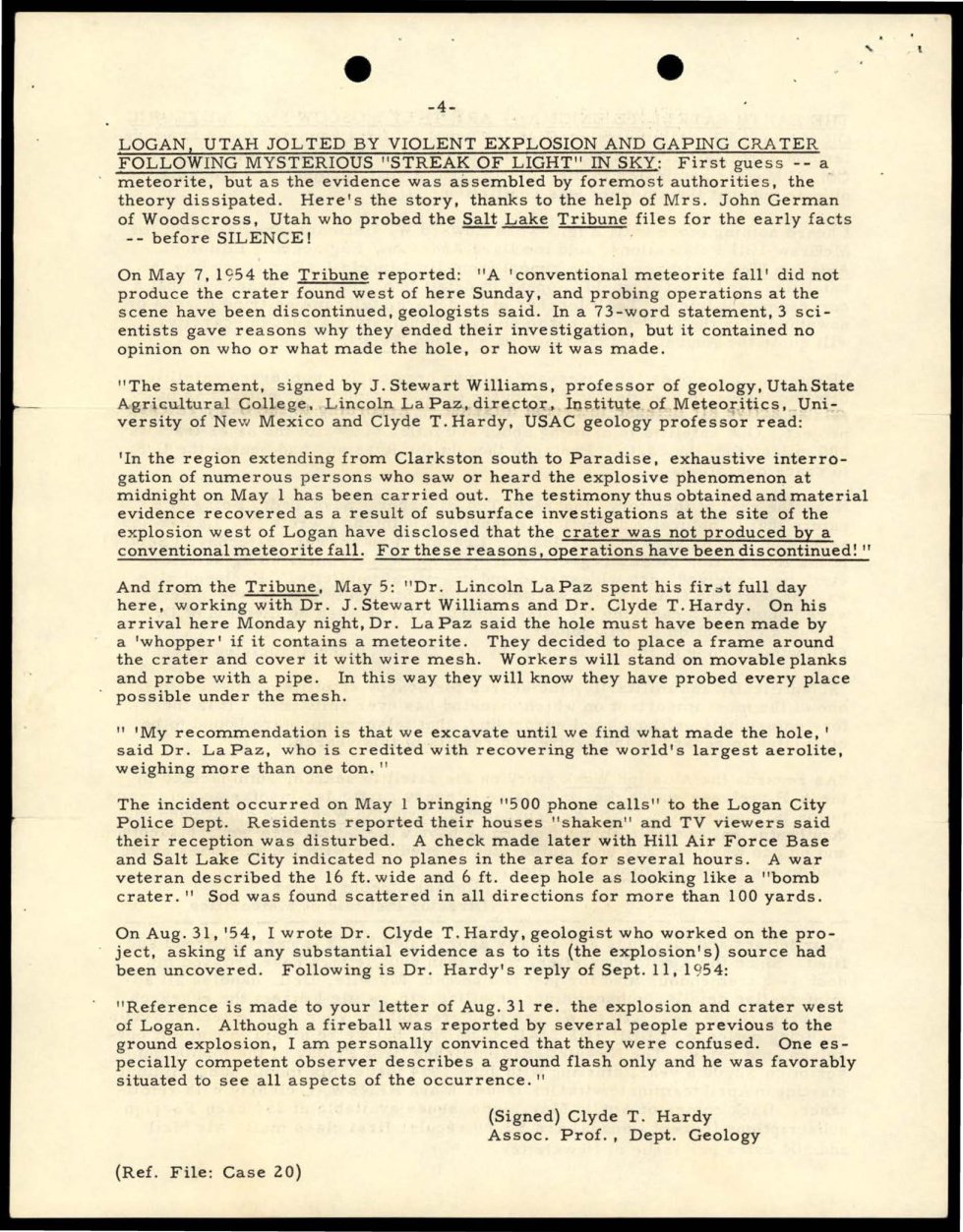
The case entered the FBI file as "case 20" of the C.R.I.F.O. Newsletter of October 1, 1954, published by Leonard H. Stringfield in Cincinnati. The FBI office in that city attached the newsletter to a November 2 memorandum because of another item. Stringfield put the text together with the help of a reader from Woods Cross, Utah, who searched the Salt Lake Tribune archive, and with a letter from one of the geologists who examined the site.
According to the news reports cited, around midnight on May 1, 1954, an explosion was heard across a strip stretching from Clarkston to Paradise. The Logan police received "500 telephone calls". Residents said their houses shook, and people watching television noticed interference in the picture. Inquiries to Hill Air Force Base and to Salt Lake City indicated that there had been no aircraft in the area for several hours. West of the city a hole appeared, 16 feet wide and 6 deep, with clods of grass scattered over more than 100 yards. A war veteran compared it to a "bomb crater".
Geologists J. Stewart Williams and Clyde T. Hardy, of Utah State Agricultural College, worked at the site with Lincoln La Paz, director of the Institute of Meteoritics at the University of New Mexico. La Paz said that if there were a meteorite there, it would be "enormous", and recommended digging until the cause was found. The group covered the crater with screening and probed the ground with pipes. On May 7, the three signed a 73-word statement: after hearing many witnesses and examining the subsoil, they concluded that the crater "was not produced by a conventional meteorite fall" and ended the work.
In September, Stringfield wrote to Hardy asking whether there was any evidence about the origin of the explosion. Hardy replied that several people reported a fireball before the explosion on the ground, but that he was "personally convinced that they were confused": an "especially competent" observer, well positioned, described only a flash on the ground. To Stringfield, the change in the newspapers' tone indicated an imposed "silence". The newsletter shows no evidence of this.
The file does not give the cause. The scientists' statement rules out an ordinary meteorite, and Hardy's letter sets aside the idea of an object coming from the sky; neither proposes another origin. As an editorial hypothesis, Hardy's description is compatible with an explosion in the ground itself, but the pages do not say what could have caused it. The FBI did not examine the case; the newsletter is in the file only because it was attached to a memorandum about Stringfield.
DIRECT READING OF THE FILE
The document, in the original
Press clipping reproduced in full, with the English original and a complete translation.
EXCERPT 1 · PHYSICAL PAGE 43
Clipping from C.R.I.F.O. Newsletter (Civilian Research, Interplanetary Flying Objects), 01/10/1954, physical page 43 (full text)
-4-
LOGAN, UTAH JOLTED BY VIOLENT EXPLOSION AND GAPING CR.ATER
FOLLOWING MYSTERIOUS "STREAK OF LIGHT" IN SKY: First guess -- a
meteorite, but as the evidence was assembled by foremost authorities, the
theory dissipated. Here's the story, thanks to the help of Mrs. John German
of Woodscross, Utah who probed the Salt Lake Tribune files for the early facts
- - before SILENCE!
On May 7, 1954 the Tribune reported: "A 1 conventional meteorite fall' did not
produce the crater found west of here Sunday, and probing operatipns at the
scene have been discontinued, geologists said. In a 73-word statement, 3 scientists gave reasons why they ended their investigation, but it contained no
opinion on who or what made the hole, or how it was made.
"The statement, signed by J. Stewart Williams, professor of geology, Utah State
Agricultural College, Lincoln La Paz.., director. Institute of Meteoritics, University of New Mexico and Clyde T. Hardy, USAC geology professor read:
1In the region extending from Clarkston south to Paradise, exhaustive interrogation of numerous persons who saw or heard the explosive phenomenon at
midnight on May 1 has been carried out. The testimony thus obtained and material
evidence recovered as a result of subsurface investigations at the site of the
explosion west of Logan have disclosed that the crater was not produced by a
conventional meteorite fall. For these reasons, operations have been discontinued! 11
And from the Tribune, May 5: 11Dr. Lincoln La Paz spent his firc;t full day
here, working with Dr. J. Stewart Williams and Dr. Clyde T. Hardy. On his
arrival here Monday night, Dr. La Paz said the hole must have been made by
a 'whopper I if it contains a meteorite . They decided to place a frame around
the crater and cover it with wire mesh. Workers will stand on movable planks
and probe with a pipe. In this way they will know they have probed every place
possible under the mesh.
11 'My recommendation is that we excavate until we find what made the hole,'
said Dr. La Paz, who is credited -with recovering the world's largest aerolite,
weighing more than one ton. 11
The incident occurred on May 1 bringing "500 phone calls" to the Logan City
Police Dept. Residents reported their houses "shaken" and TV viewers said
their reception was disturbed. A check made later with Hill Air Force Base
and Salt Lake City indicated no planes in the area for several hours. A war
veteran described the 16 ft. wide and 6 ft. deep hole as looking like a 11 bomb
crater. 11 Sod was found scattered in all directions for more than 100 yards.
On Aug. 31, 1 54, I wrote Dr. Clyde T.Hardy,geologist who worked on the project, asking if any substantial evidence as to its (the explosion's) source had
been uncovered. Following is Dr. Hardy's reply of Sept. 11, 1954:
11 Reference is made to your letter of Aug. 31 re. the explosion and crater west
of Logan. Although a fireball was reported by several people previous to the
ground explosion, I am personally convinced that they were confused. One especially competent observer describes a ground flash only and he was favorably
situated to see all aspects of the occurrence . "
(Signed) Clyde T. Hardy
Assoc. Prof. , Dept. Geology
(Ref. File: Case 20)Editorial note: Article signed by Leonard H. Stringfield.
Check the original PDF
-4-
LOGAN, UTAH JOLTED BY VIOLENT EXPLOSION AND GAPING CR.ATER
FOLLOWING MYSTERIOUS "STREAK OF LIGHT" IN SKY: First guess -- a
meteorite, but as the evidence was assembled by foremost authorities, the
theory dissipated. Here's the story, thanks to the help of Mrs. John German
of Woodscross, Utah who probed the Salt Lake Tribune files for the early facts
- - before SILENCE!
On May 7, 1954 the Tribune reported: "A 1 conventional meteorite fall' did not
produce the crater found west of here Sunday, and probing operatipns at the
scene have been discontinued, geologists said. In a 73-word statement, 3 scientists gave reasons why they ended their investigation, but it contained no
opinion on who or what made the hole, or how it was made.
"The statement, signed by J. Stewart Williams, professor of geology, Utah State
Agricultural College, Lincoln La Paz.., director. Institute of Meteoritics, University of New Mexico and Clyde T. Hardy, USAC geology professor read:
1In the region extending from Clarkston south to Paradise, exhaustive interrogation of numerous persons who saw or heard the explosive phenomenon at
midnight on May 1 has been carried out. The testimony thus obtained and material
evidence recovered as a result of subsurface investigations at the site of the
explosion west of Logan have disclosed that the crater was not produced by a
conventional meteorite fall. For these reasons, operations have been discontinued! 11
And from the Tribune, May 5: 11Dr. Lincoln La Paz spent his firc;t full day
here, working with Dr. J. Stewart Williams and Dr. Clyde T. Hardy. On his
arrival here Monday night, Dr. La Paz said the hole must have been made by
a 'whopper I if it contains a meteorite . They decided to place a frame around
the crater and cover it with wire mesh. Workers will stand on movable planks
and probe with a pipe. In this way they will know they have probed every place
possible under the mesh.
11 'My recommendation is that we excavate until we find what made the hole,'
said Dr. La Paz, who is credited -with recovering the world's largest aerolite,
weighing more than one ton. 11
The incident occurred on May 1 bringing "500 phone calls" to the Logan City
Police Dept. Residents reported their houses "shaken" and TV viewers said
their reception was disturbed. A check made later with Hill Air Force Base
and Salt Lake City indicated no planes in the area for several hours. A war
veteran described the 16 ft. wide and 6 ft. deep hole as looking like a 11 bomb
crater. 11 Sod was found scattered in all directions for more than 100 yards.
On Aug. 31, 1 54, I wrote Dr. Clyde T.Hardy,geologist who worked on the project, asking if any substantial evidence as to its (the explosion's) source had
been uncovered. Following is Dr. Hardy's reply of Sept. 11, 1954:
11 Reference is made to your letter of Aug. 31 re. the explosion and crater west
of Logan. Although a fireball was reported by several people previous to the
ground explosion, I am personally convinced that they were confused. One especially competent observer describes a ground flash only and he was favorably
situated to see all aspects of the occurrence . "
(Signed) Clyde T. Hardy
Assoc. Prof. , Dept. Geology
(Ref. File: Case 20)View the document record ↗ · Physical page 43, counting the cover.
Dates and documentary context
- Event
- 01/05/1954 — 'At midnight on May 1', according to the scientists' note cited by the bulletin; the crater was found on 'Sunday', 02/05/1954.
- Document
- 01/10/1954 — Date of the C.R.I.F.O. Newsletter; the FBI memorandum that attached it is dated 02/11/1954.
- Publication
- 07/05/1954 — Date of the Salt Lake Tribune news item with the scientists' statement, according to the newsletter.
Origin and release
C.R.I.F.O. Newsletter (Leonard H. Stringfield), enclosed by the Cincinnati FBI · 65_HS1-834228961_62-HQ-83894_Section_8.pdf
The C.R.I.F.O. Newsletter of 01/10/1954 was enclosed with the Cincinnati SAC's memorandum of 02/11/1954 (physical page 34) and appears on the list of enclosures (physical page 48), both already translated in the Woodside dossier.
Related accounts and their differences
Questions to continue the investigation
- Did the geologists from Utah State Agricultural College later publish any report on the Logan crater?
- What did the 'especially competent' observer cited by Hardy report, and where was he?
GEOGRAPHY OF THE CASE
West of Logan, Utah
Approximate reference to the city mentioned in the bulletin, placed by the editorial team. It does not indicate the location of the crater.
DOCUMENTARY TRAIL
Go back to the sources
References use physical pages of the PDF, counting the cover. Summaries are presented in English; the documents keep their original language.
- 65_HS1-834228961_62-HQ-83894_Section_8.pdf
Physical page 43: page 4 of the C.R.I.F.O. Newsletter of 01/10/1954, case 20, attached by the FBI office in Cincinnati · Physical pages 34 and 48: memorandum from the Cincinnati SAC dated 02/11/1954 and list of enclosures
FBI · 217 pages
Editorial summary based on the collection's research notes. How we read the documents.