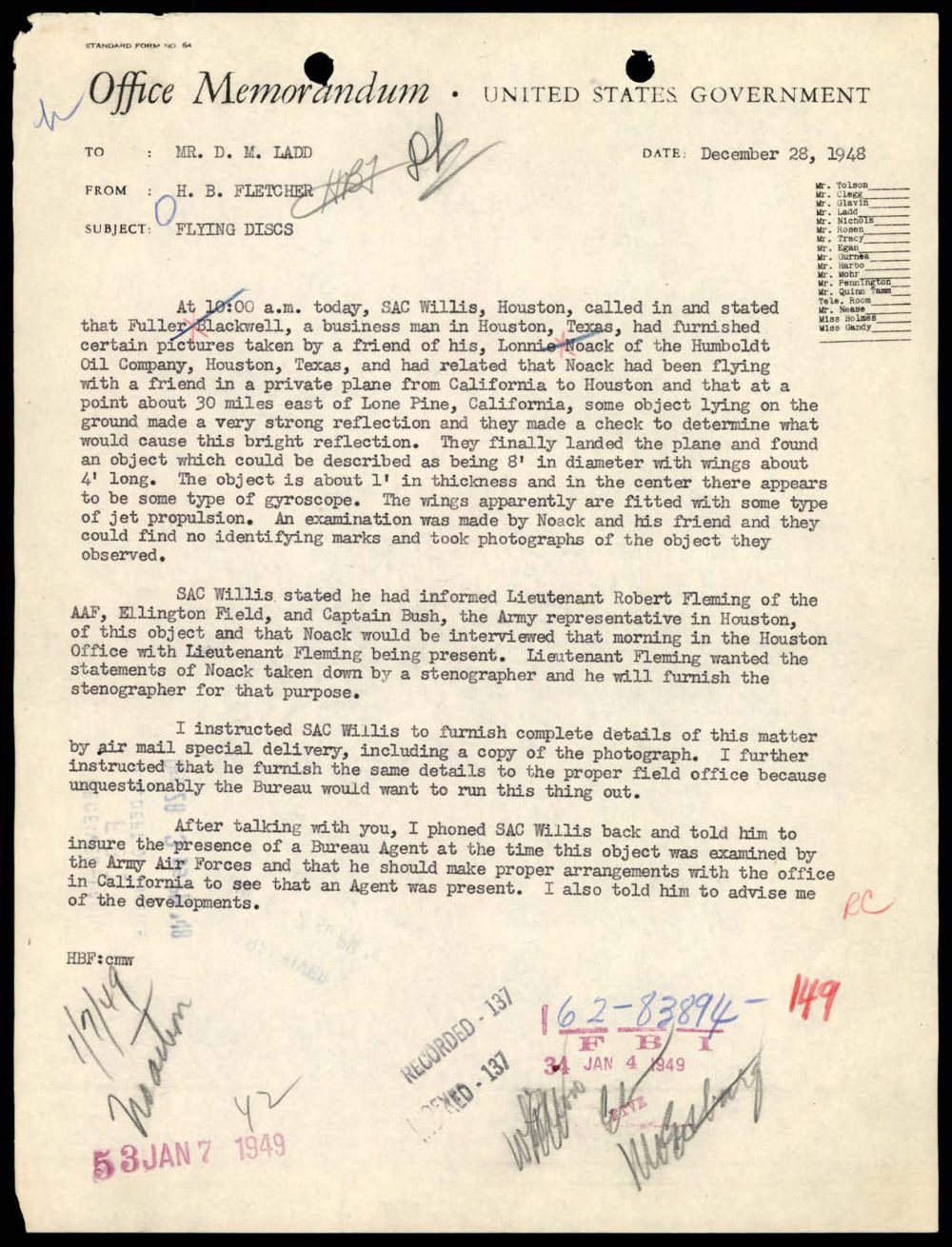
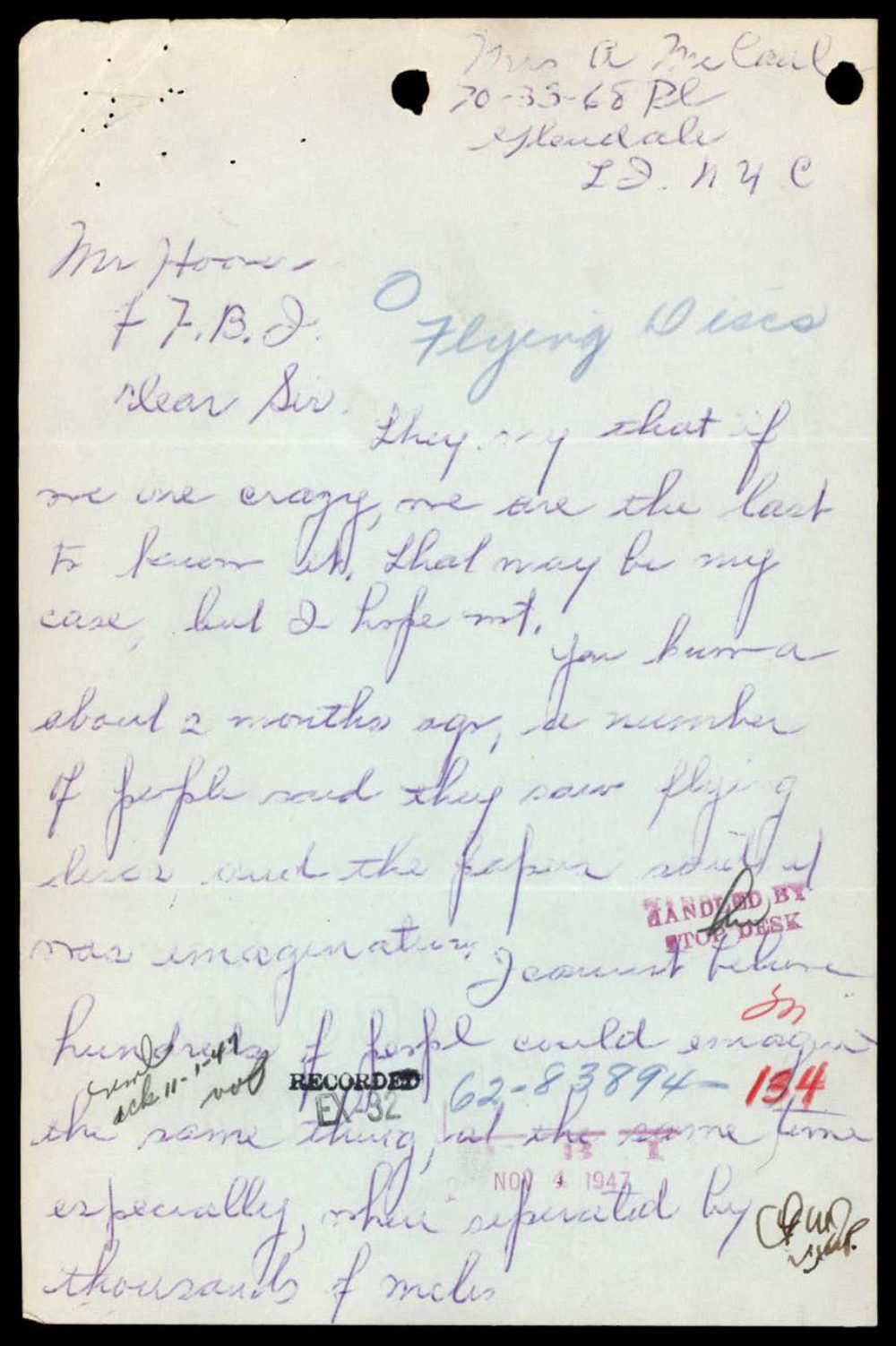
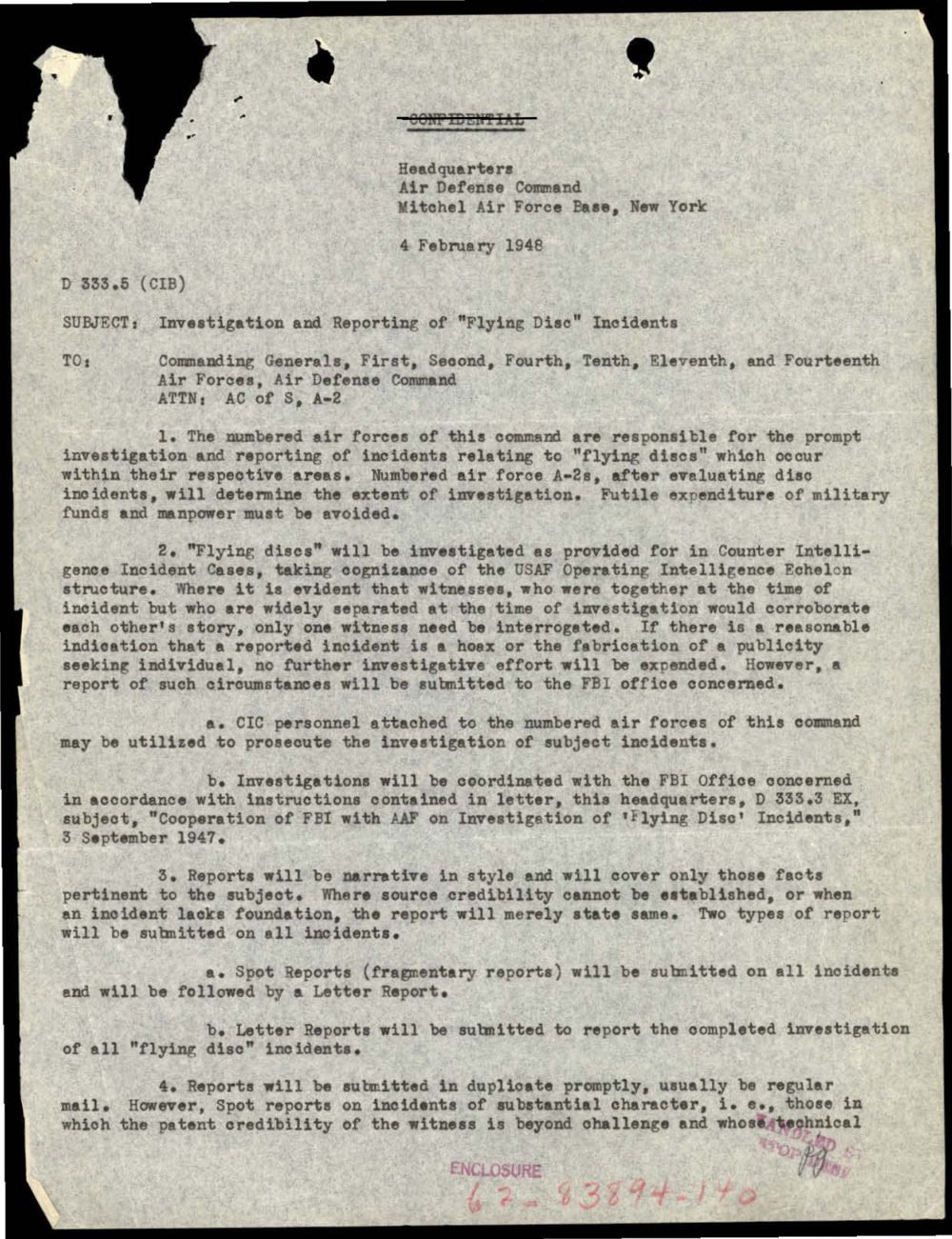
Date: Around November or December 1948 (six months before the May 1949 interviews)Location: Lake Ariel, Wayne County, near Scranton, Pennsylvania, USA
Lake Ariel, 1948-1949: house catches fire after UFO hits the roof, and the ashes end up in the laboratory
A Philadelphia engineer had ashes analyzed from a house that, according to its owner, caught fire after a large UFO struck the roof on a stormy night near Scranton. The municipal analysis found common minerals; the FBI found no federal crime and sent the ashes to its laboratory.
- Event date
- Around November or December 1948 (six months before the May 1949 interviews)
- Location
- Lake Ariel, Wayne County, near Scranton, Pennsylvania, USA
- Topic
- FBI file
- Source agencies
- FBI
- Documents
- 1 document · 214 pages
- Reading time
- 10 min
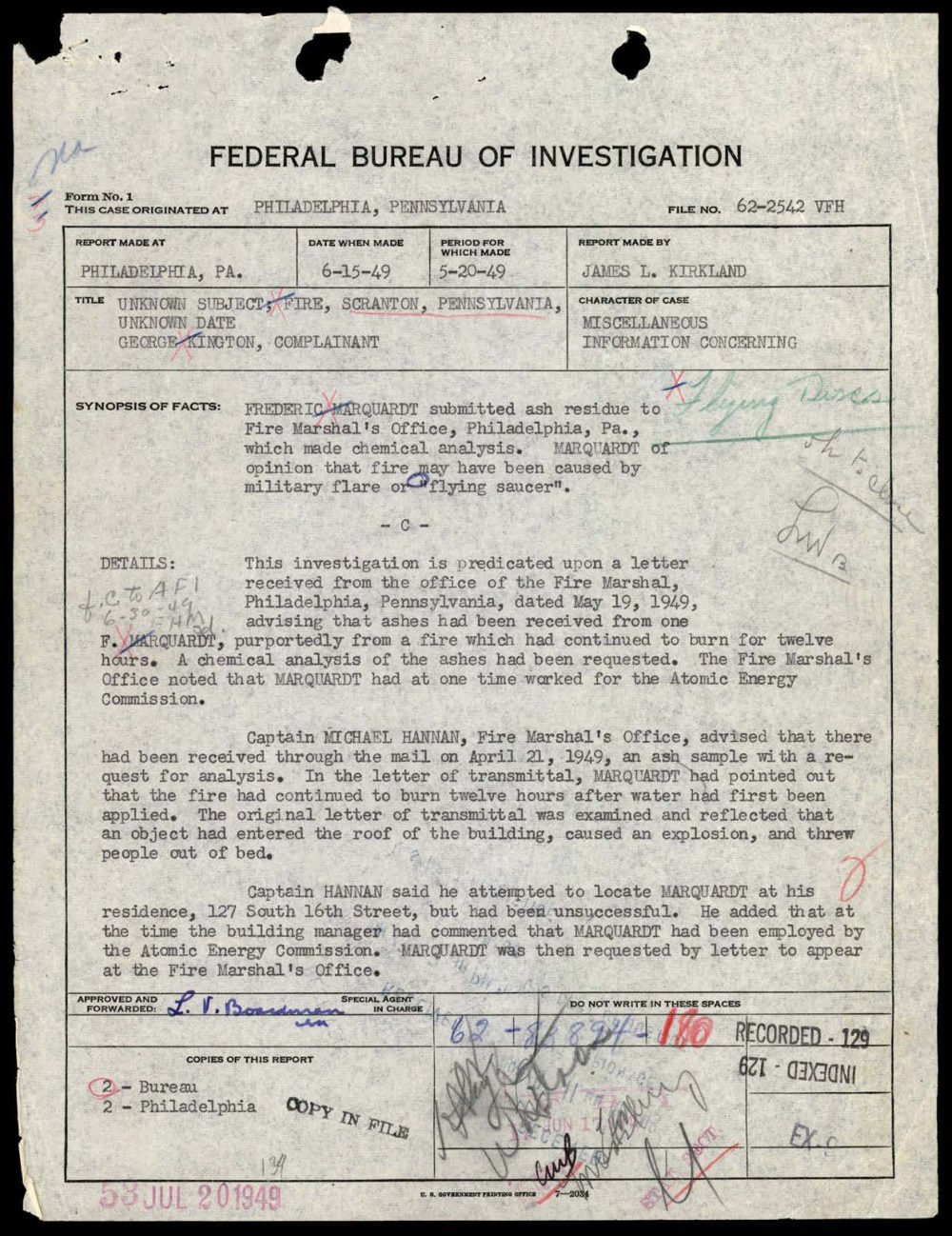 FBI report from PhiladelphiaPhysical page 199
DOCUMENTARY SOURCES · FBI
What the records tell
On April 21, 1949, the Philadelphia Fire Marshal's office (fire prevention authority) received by mail a sample of ashes with a request for chemical analysis. The sender was Frederic Marquardt, an engineer at a company in the city. In the letter, he said the fire had kept burning for twelve hours after water was first thrown on it, and that an object had come through the roof of the building, caused an explosion and thrown people out of bed. The information that Marquardt had worked for the Atomic Energy Commission led the office to notify the FBI on May 19.
Acting chief George Kington told the FBI that only upon meeting Marquardt did he learn that the fire had been near Scranton, about six months earlier, outside Philadelphia's jurisdiction, and he advised him to contact the state police. Kington gave him the result of the analysis by the city chemist, Dr. Edward Burke: the ash contained magnesium, aluminum, iron and calcium in the form of silicates, sulfur and carbonates.
Interviewed at work, Marquardt said he had received the ashes by mail from a friend, Woody Shaeffer, of Lake Ariel, about one mile south of South Canaan, near Scranton. Shaeffer's house had burned some six months earlier, at night, during a storm: a large object reportedly struck the roof and set the house on fire, and it burned to the ground in less than an hour. Marquardt was not present; the details came from his friend's letter. He thought the ash could be from a military flare or a “flying saucer”, and that a bushel of it still remained on the Lake Ariel property.
The versions do not match. The first letter spoke of an explosion and a fire that lasted twelve hours; in the interview, Marquardt said he did not believe there was an explosion, attributing the bang to the vacuum created when the “missile or object” hit the roof, and repeated that the mass of ashes stayed lit for twelve hours, although the house burned in less than one. He ruled out the meteor hypothesis based on the municipal analysis. The agent noted that Marquardt had worked at Oak Ridge until 1943 and that he was “entirely rational”.
The FBI concluded there was no violation of federal law and closed the case, but sent the ashes obtained from the Fire Marshal to the Bureau laboratory, “for any interest or study” regarding flares or the possible presence of “flying saucers”. No result of that examination appears in the pages consulted. As an editorial hypothesis, lightning on a stormy night is compatible with the account of a sudden fire, and silicates, carbonates and common metals are to be expected in building ashes; none of the documents tests this possibility, and no one interviewed Shaeffer himself.
The markings on the first sheet show that the report did not stay only within the FBI. A pencil note beside the details field records a copy sent to Air Force intelligence on June 30, 1949. At headquarters, the report reached the espionage section on June 18 and passed through another section on June 23, according to the stamps on the back. It received serial number 180 in the flying discs file, with the handwritten notation "Flying Discs" in the synopsis field.
The report is the only source for the case, and nearly everything in it is second- or third-hand. Woody Shaeffer, the homeowner, was never interviewed; what is known about the fire comes from a letter he wrote to Frederic Marquardt, which the FBI does not reproduce, and from the agent's conversation with Marquardt. The only measurement is the Philadelphia city chemist's analysis, cited in one sentence. The interpretation that it might be a military flare or a flying disc is Marquardt's personal opinion, recorded as such.
What became of the ashes sent to the FBI Laboratory does not appear in the collection. There is no laboratory report, no response from Air Force intelligence and no record from the Pennsylvania state police, to whom Marquardt and Shaeffer were advised to turn. The date of the fire also remained vague: it is known only that it occurred some six months before May 1949, at night, during a storm.
More images from the document
DIRECT READING OF THE FILE
The document, in the original
The three text pages of the FBI report (199, 201 and 202) were translated in full. Page 200 is a reverse side with no legible text. A private individual's home address was omitted. There is no newspaper clipping in this case.
EXCERPT 1 · PHYSICAL PAGE 199
FBI report, Philadelphia, 15/06/1949, physical page 199 (in full; address omitted)
letter
,,.
••
•
FEDERAL BUREAU OF INVESTIGATION
FormNo.1
THIS CASE ORIG INATED AT PHILADELPHIA, PENNSYLVANIA F ILE NO. 62- 2542 VFH
SYNOPSIS OF FACTS: FREDERI~QUARDT submitted ash residue to
Fire Marshal ' s Office, Philadelphia, Pa.,
which made chemical analysis . }l.ARQT'ARDT o-r-
opinion that fire_Aay have been caused by
military flare oiU'flying saucer 11 •
- C -
DETAILS: This investigation is p~dicated upon a
4 p 1 received from the office of the Fire Marshal,
J,,f.::J ~,/~ u ti Philadelphia, Pennsylvania, dated May 19., 1949,
I ..,,,.) , advising that ashes had been received from one
F. )AA'ftQUARDT, purportedly from a fire which had continued to burn for twelve
hcurs. A chemical analysis of the ashes had been requested. The Fire Marshal's
Office noted that MARQUARDT had at one time worked for the Atomic Energy
Commission .
Captain MICHAEL HANNAN, Fire Marshal's Office, advised that there
had been received through the mail on April 21, 1949, an ash._ sample with a re
quest for analysis . In the letter of transmittal , MARQGARDTnad pointed out
that the fire had continued to burn twelve hours after water had first been
applied . The original letter of transmittal was examined and reflected that
an object had entered the roof of the building., caused an explosion, and threw
people out of bed.
/}
Captain HANNAN said he atte~ted to locate MARQUARDT at his
residence., 127 South 16th Street, but had bee~unsuccessful. He added ihat at
the time the building managev had commented that MARQUARDT had been employed by
the Atomic Energy Con:o:nission. }!ARQU.ARDr was then requested by letter to appear
at the Fire Marshal 's Office .
APPROVED AND SPECIAL AGENT' DO NOT WRITE IN THESE SPACESFORWARDED: IN CHARGE t
1-------~ ---- ,~---'-~~~__,_ ..J:...--.'-_R CORDED. 129
zr -03X3aNt
REPORT MADE AT DATE WHEN MADE PERIOD FOR
WHICH MADE
PHILADEIPIITA, PA. 6-15-49 5- 20-49
mu. UNKNO/IN SUBJECT<fmE, SCRANTON, PE!'rnSYLVANI A,
UNKN(J'(tN DATE -
GEORGE--16:l\UTON, COMPLAINANT
REPORT MADE BY
JAMES L. KIRKLAND
CHARACTER OF CASE
MISCELLANEOUS
INFORMATION CONCERNING
COPIES OF THIS REPORT
,.....2 - Bureau.... 2 - Philadelphia
"Editorial note: The handwritten annotation “Flying Discs” in the summary field and the filing stamps were omitted.
Check the original PDF
FEDERAL BUREAU OF INVESTIGATION. Form No. 1. This case originated at Philadelphia, Pennsylvania. File No. 62-2542 VFH. Report made at: Philadelphia, Pa. Date when made: 6-15-49. Period for which made: 5-20-49. Report made by: James L. Kirkland. Title: UNKNOWN SUBJECT; FIRE, SCRANTON, PENNSYLVANIA, UNKNOWN DATE; GEORGE KINGTON, COMPLAINANT. Character of case: MISCELLANEOUS - INFORMATION CONCERNING. SYNOPSIS OF FACTS: FREDERIC MARQUARDT submitted ash residue to Fire Marshal's Office, Philadelphia, Pa., which made chemical analysis. MARQUARDT of opinion that fire may have been caused by military flare or "flying saucer". - C - DETAILS: This investigation is predicated upon a letter received from the office of the Fire Marshal, Philadelphia, Pennsylvania, dated May 19, 1949, advising that ashes had been received from one F. MARQUARDT, purportedly from a fire which had continued to burn for twelve hours. A chemical analysis of the ashes had been requested. The Fire Marshal's Office noted that MARQUARDT had at one time worked for the Atomic Energy Commission. Captain MICHAEL HANNAN, Fire Marshal's Office, advised that there had been received through the mail on April 21, 1949, an ash sample with a request for analysis. In the letter of transmittal, MARQUARDT had pointed out that the fire had continued to burn twelve hours after water had first been applied. The original letter of transmittal was examined and reflected that an object had entered the roof of the building, caused an explosion, and threw people out of bed. Captain HANNAN said he attempted to locate MARQUARDT at his residence, [address omitted], but had been unsuccessful. He added that at the time the building manager had commented that MARQUARDT had been employed by the Atomic Energy Commission. MARQUARDT was then requested by letter to appear at the Fire Marshal's Office. Approved and forwarded: L. V. Boardman, Special Agent in Charge. Copies: 2 - Bureau; 2 - Philadelphia.View the document record ↗ · Physical page 199, counting the cover.
EXCERPT 2 · PHYSICAL PAGE 201
FBI report, Philadelphia, page 2, physical page 201 (in full)
.. I..,,.
•
PH 62-2542
Acting Chief GEORGE KINGTON advised that he had interviewed
MAR.cyJ.ARDT at the time he came to the office since Captain HANNAN was absent
at the time . He said that he then learned for the first time that the fire
in question had taken pl ace near Scranton , Pennsylvani a, ~@ Q£.QllI'rea_
about §j ;x;,.. J.'lQl!tho .Pte..vious l ~ • This caused the Marshal ' s Office to withdraw
from the caseori a question of jurisdiction and MARQUARDT was advised that
any further action on his part should be referred to the State Police
authorities .
At the same time, KilltTON furnished MARQUARDT with the results
of the analysis which had been ~ade of the ash submitted, and which analysis
had been made by Dr. EDWARD BURKE, City Chemist , Chemical Laboratory, Room
fr'/5, City Hall . This report reflected that the ash contained Magnesium ,
Alumirrum, Iron, and Calcium in the form of silicates , sulphur and carbonates .
FREDERIC iiJ\RQl!ARDT was interviewed at his place of business,
the H. A. KULJIAN COMPANY, Broad Street and Girard Avenue, Philadelphia,
Pennsylvania . At this ti~ he advised that he had received the sample of
ash from a friend, V"O(l)~FER, Lake Ariel, R. n., Wayne County, Pennsyl
vania, through the mail. He said that Lake Arie l is about one mil e south
of South Canaan , near Scranton, Pennsylvania . He stated that SHAEFFER' s
house had burned about six months ago , that the fire had occurred at night
during a storm and that a large object had struck the roof and ignited the
house which had burned to the ground in less than an hour .
He said that he had not been present during the fire but that
these details had been furnished by letter fr001 SHAEFFER at the ti.me a sample
of the ash was forwarded for analysis . He said that he was of the personal
opinion that the ash might be a part of a military flare or a "flying saucer 11 •
He pointed out that he has been advised by associates in the
engineering field that one of the characteristics of some types of flares
is the fact that they burn for a considerable period . He stated that the
mass of the ash residue had remained ignited for a period of twelve hours .
He also stated that he did not think there had been an explosion but that a
loud noise had probably been caused by the vacuum created as the missile
or objects truck the roof . He added that there remains a quantity of the
ash , amounting to one bushel , at SHAEFFER1s premises at Lake Ariel .
- 2 -Editorial note: The first name “Woody” is crossed out by hand in the original but remains legible. Lake Ariel is described only as a rural area (R. D.); no address is given.
Check the original PDF
PH 62-2542. Acting Chief GEORGE KINGTON advised that he had interviewed MARQUARDT at the time he came to the office since Captain HANNAN was absent at the time. He said that he then learned for the first time that the fire in question had taken place near Scranton, Pennsylvania, and had occurred about six months previously. This caused the Marshal's Office to withdraw from the case on a question of jurisdiction and MARQUARDT was advised that any further action on his part should be referred to the State Police authorities. At the same time, KINGTON furnished MARQUARDT with the results of the analysis which had been made of the ash submitted, and which analysis had been made by Dr. EDWARD BURKE, City Chemist, Chemical Laboratory, Room 875, City Hall. This report reflected that the ash contained Magnesium, Aluminum, Iron, and Calcium in the form of silicates, sulphur and carbonates. FREDERIC MARQUARDT was interviewed at his place of business, the H. A. KULJIAN COMPANY, Broad Street and Girard Avenue, Philadelphia, Pennsylvania. At this time he advised that he had received the sample of ash from a friend, WOODY SHAEFFER, Lake Ariel, R. D., Wayne County, Pennsylvania, through the mail. He said that Lake Ariel is about one mile south of South Canaan, near Scranton, Pennsylvania. He stated that SHAEFFER's house had burned about six months ago, that the fire had occurred at night during a storm and that a large object had struck the roof and ignited the house which had burned to the ground in less than an hour. He said that he had not been present during the fire but that these details had been furnished by letter from SHAEFFER at the time a sample of the ash was forwarded for analysis. He said that he was of the personal opinion that the ash might be a part of a military flare or a "flying saucer". He pointed out that he has been advised by associates in the engineering field that one of the characteristics of some types of flares is the fact that they burn for a considerable period. He stated that the mass of the ash residue had remained ignited for a period of twelve hours. He also stated that he did not think there had been an explosion but that a loud noise had probably been caused by the vacuum created as the missile or object struck the roof. He added that there remains a quantity of the ash, amounting to one bushel, at SHAEFFER's premises at Lake Ariel. - 2 -View the document record ↗ · Physical page 201, counting the cover.
EXCERPT 3 · PHYSICAL PAGE 202
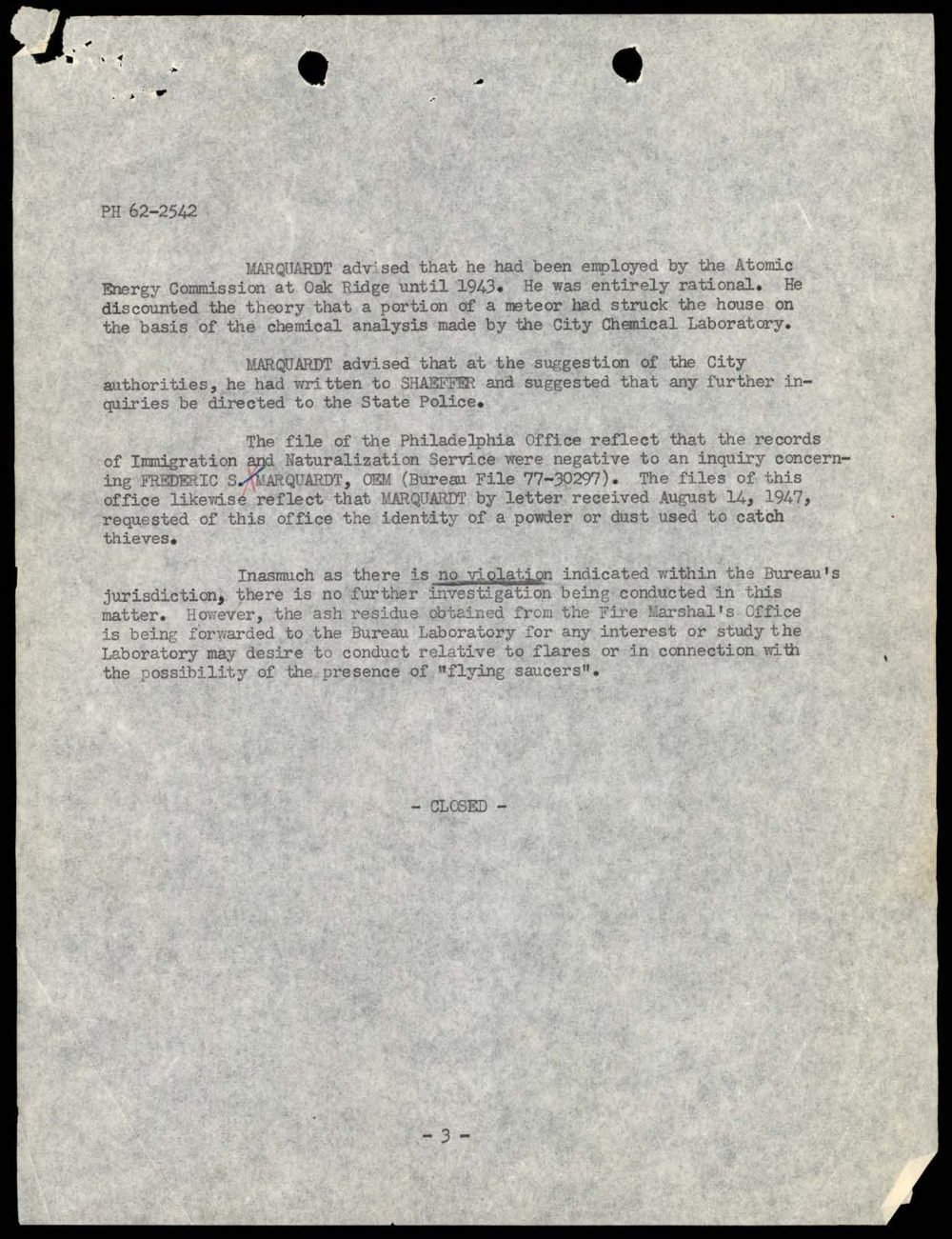
FBI report, Philadelphia, page 3, physical page 202 (in full)
• •
• >
PH 62-2542
MARQUARDT adv· sed that he had been employed by the Atomic
Energy Commission at Oak Ridge until 1943. He was entirely rational . He
discounted the theory that a portion of a rooteor had struck the house on
the basis of the chemical analysis made by the City Chemical Laboratory .
MARQUARDT advised that at the suggestion of the City
authorities , he had written to SHAEFF'ffi and suggested that any further in
quiries be directed to the State Police .
The file of the Philadelphia Offi ce reflect that the records
of Immigration aJ)d Naturalization Service were negative to an inquiry concern
ing FREDERIC S4ARQUARDT, OEM (Bureau File ?7- 30'S7) . The files of this
office likewise reflect that M.ARQUARDT by letter received August 14, 194?,
requested of this office the identity of a powder or dust used to catch
thieves .
Inasmuch as there is no yiql.F'ti.9n indicated within the Bureau I s
jurisdiction , there is no further investigation being conducted in this
matter . However, the ash residue obtained from the Fil·e t.arshal ' s Office
is being forvrarded to the Bureau Laboratory for any interest or study the
Laboratory may desire to conduct relative to flares or in connection with
the possibi lity of the presence of "flying saucers" •
- CLa3ED -
- 3 -Editorial note: The acronym after the name in the immigration inquiry was not translated because it is an internal filing code.
Check the original PDF
PH 62-2542. MARQUARDT advised that he had been employed by the Atomic Energy Commission at Oak Ridge until 1943. He was entirely rational. He discounted the theory that a portion of a meteor had struck the house on the basis of the chemical analysis made by the City Chemical Laboratory. MARQUARDT advised that at the suggestion of the City authorities, he had written to SHAEFFER and suggested that any further inquiries be directed to the State Police. The file of the Philadelphia Office reflect that the records of Immigration and Naturalization Service were negative to an inquiry concerning FREDERIC S. MARQUARDT, OEM (Bureau File 77-30297). The files of this office likewise reflect that MARQUARDT by letter received August 14, 1947, requested of this office the identity of a powder or dust used to catch thieves. Inasmuch as there is no violation indicated within the Bureau's jurisdiction, there is no further investigation being conducted in this matter. However, the ash residue obtained from the Fire Marshal's Office is being forwarded to the Bureau Laboratory for any interest or study the Laboratory may desire to conduct relative to flares or in connection with the possibility of the presence of "flying saucers". - CLOSED - - 3 -View the document record ↗ · Physical page 202, counting the cover.
EXCERPT 4 · PHYSICAL PAGE 200
Physical page 200: back of the first sheet of the report (in full; there are only stamps)
•
..' . ... ... ,
li10ITAfJIT83VVH ,O UA3flU8 JAs:1303::i
... .•
I
I.....-
0J"I :jf.Jl'lfEditorial note: The text on the front shows through and appears mirrored. The name of the section in the second stamp and the entire third stamp are faded out.
Check the original PDF
[Stamp, inverted:] RECEIVED. JUN 18 11 44 AM '49. REC'D ESPIONAGE. F B I. U.S. DEPT. OF JUSTICE. [Stamp, rotated:] RECEIVED. JUN 23 3 38 PM '49. [...] U.S. DEPT. OF JUSTICE. [Stamp, rotated, faint:] RECEIVED. [illegible] AM '49. [illegible].View the document record ↗ · Physical page 200, counting the cover.
Dates and documentary context
- Event
- 11/1948 — The report says the fire occurred “about six months” before the May 1949 interviews; the month is an estimate, and the exact date is unknown (the case title says “date unknown”).
- Document
- 15/06/1949 — Date of the Philadelphia field office report.
- Publication
- Not established — Internal FBI document.
Origin and release
FBI, Philadelphia office; agent James L. Kirkland · 65_HS1-834228961_62-HQ-83894_Section_4.pdf
Related accounts and their differences
Questions to continue the investigation
- Did the FBI Laboratory ever examine the ashes sent in June 1949?
- Was there any fire department or state police record of the Lake Ariel fire?
- Why would the same mass of ashes have stayed lit for twelve hours if the house burned down in less than one?
GEOGRAPHY OF THE CASE
Lake Ariel, near Scranton, Pennsylvania
Approximate reference to the cited locality, placed by the editorial team. It does not indicate the location of the house.
DOCUMENTARY TRAIL
Go back to the sources
References use physical pages of the PDF, counting the cover. Summaries are presented in English; the documents keep their original language.
- 65_HS1-834228961_62-HQ-83894_Section_4.pdf
Physical pages 199, 201 and 202: report from the FBI Philadelphia office, 15/06/1949 (file 62-2542)
FBI · 214 pages
Editorial summary based on the collection's research notes. How we read the documents.