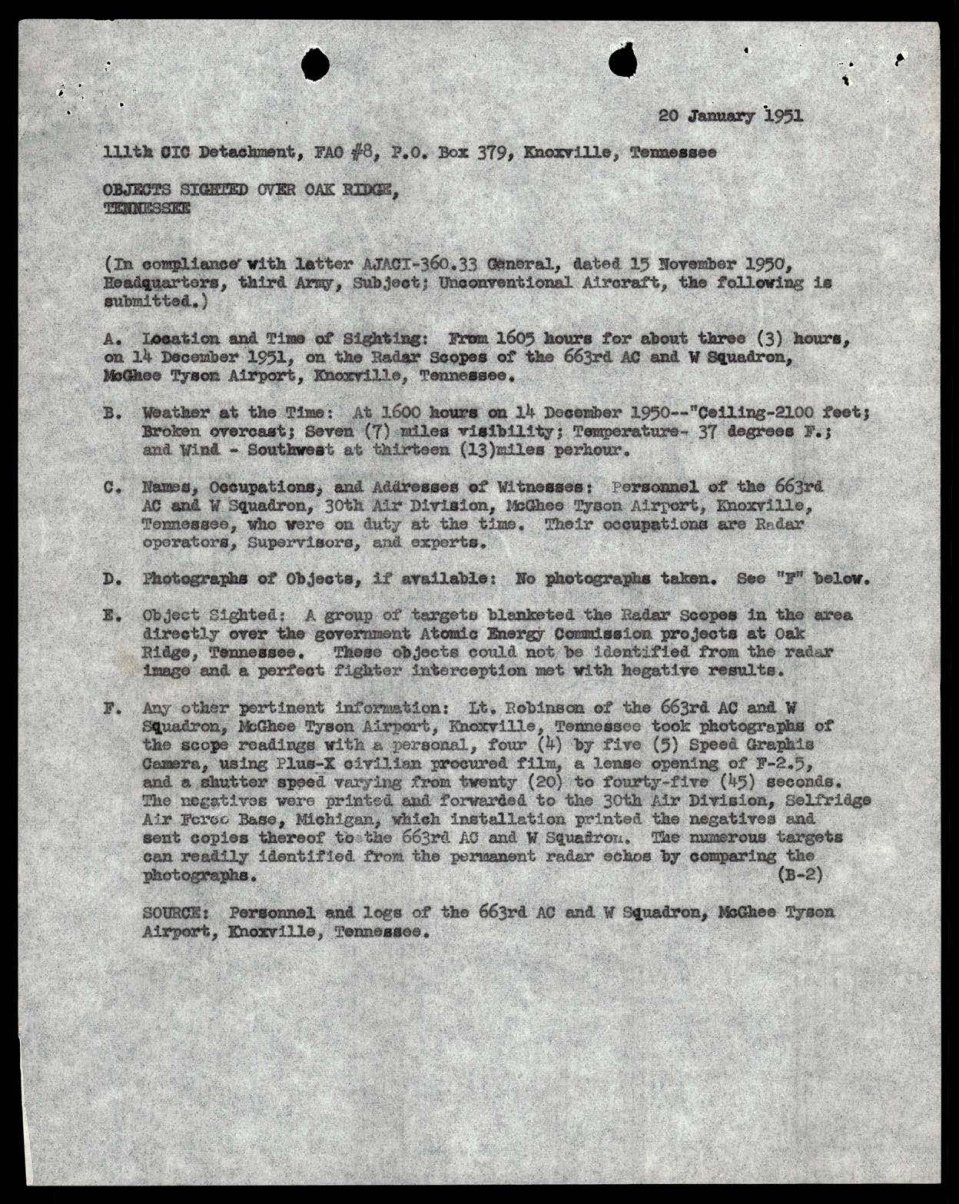
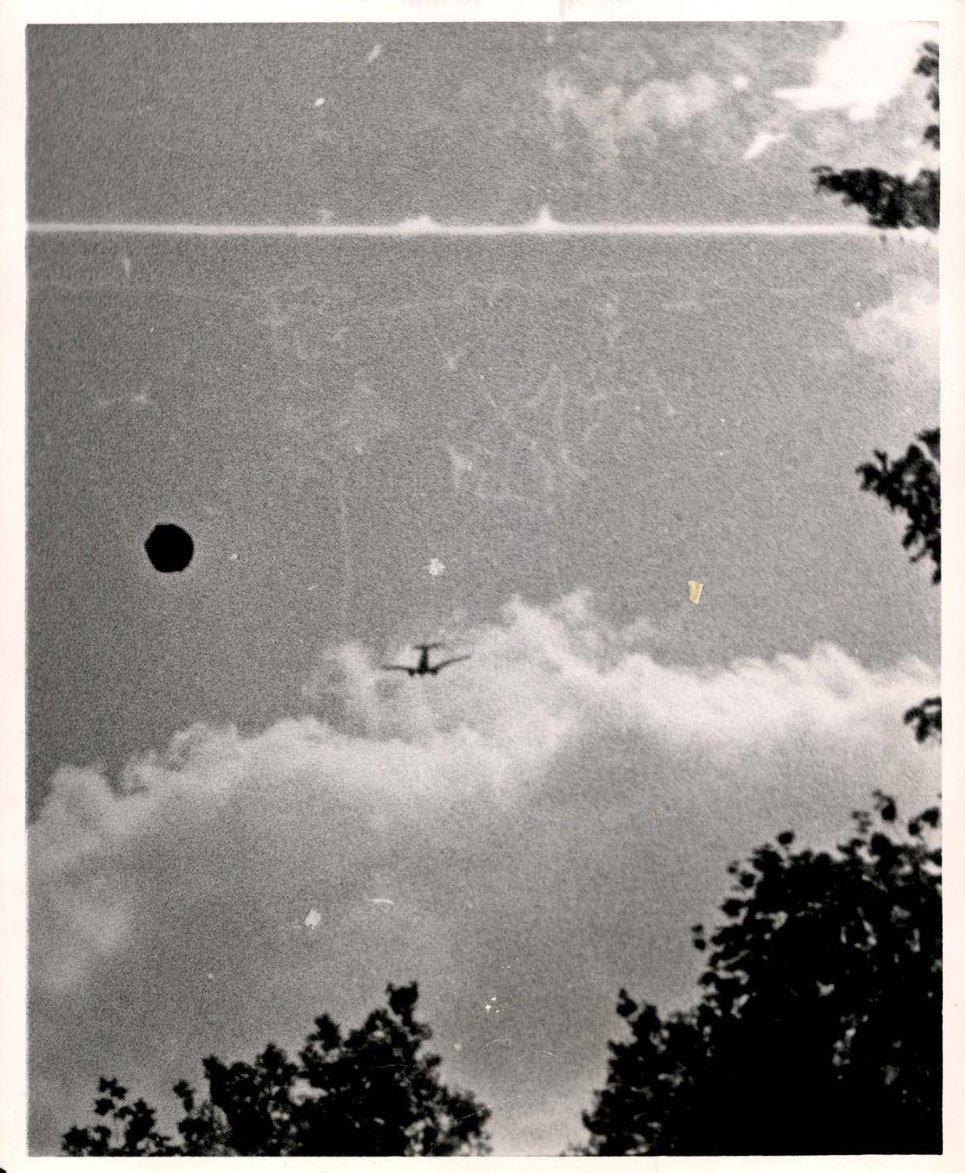
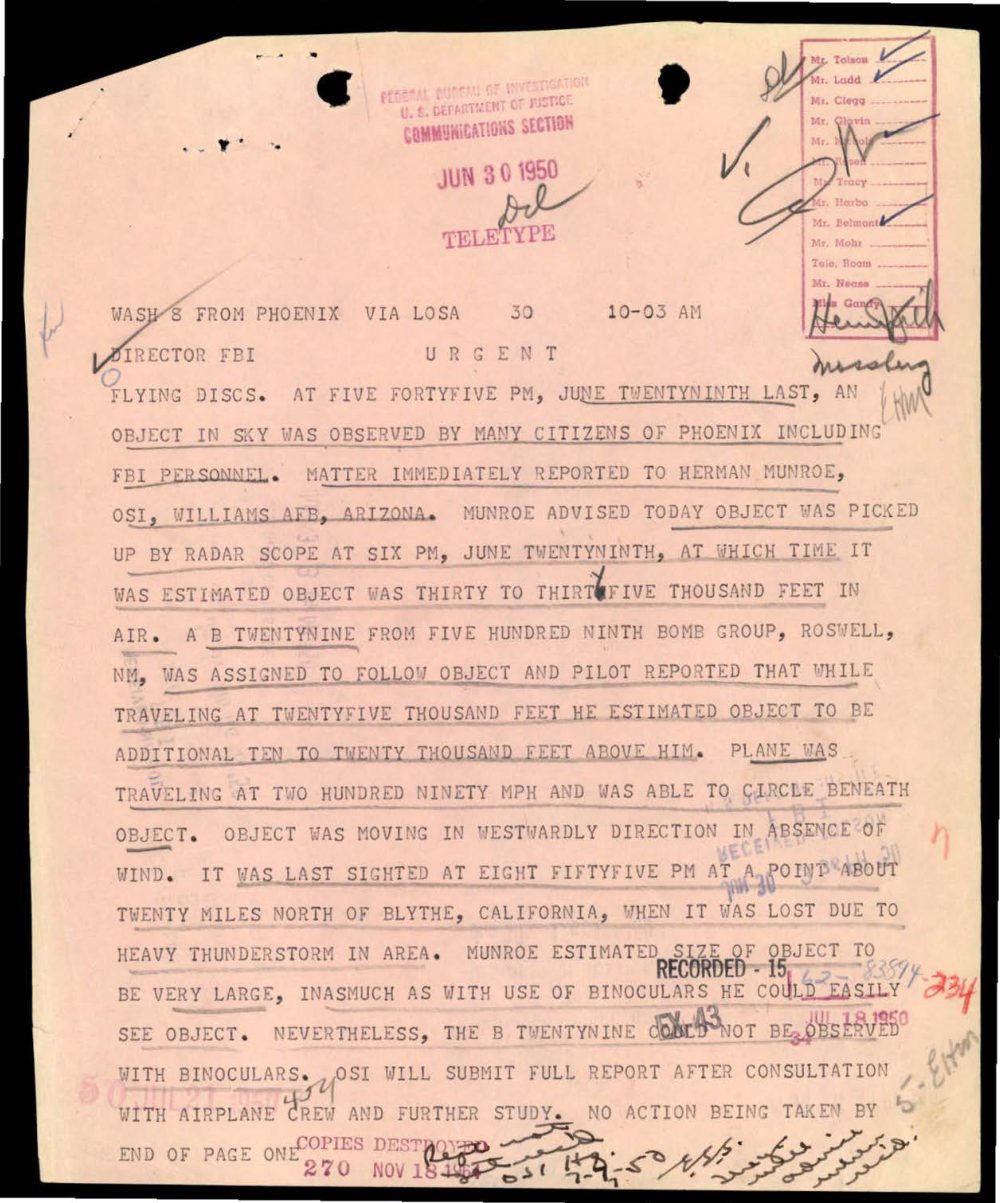
Date: January 22–23, 1950Location: Alaska, USA
The Kodiak nights
Visual sightings and radar appear in a sequence of episodes that need to be followed separately.
- Event date
- January 22–23, 1950
- Location
- Alaska, USA
- Topic
- Radar and sensors
- Source agencies
- FBI
- Documents
- 1 document · 209 pages
- Reading time
- 12 min
 Official document pagePhysical page 147
DOCUMENTARY SOURCES · FBI
What the records tell
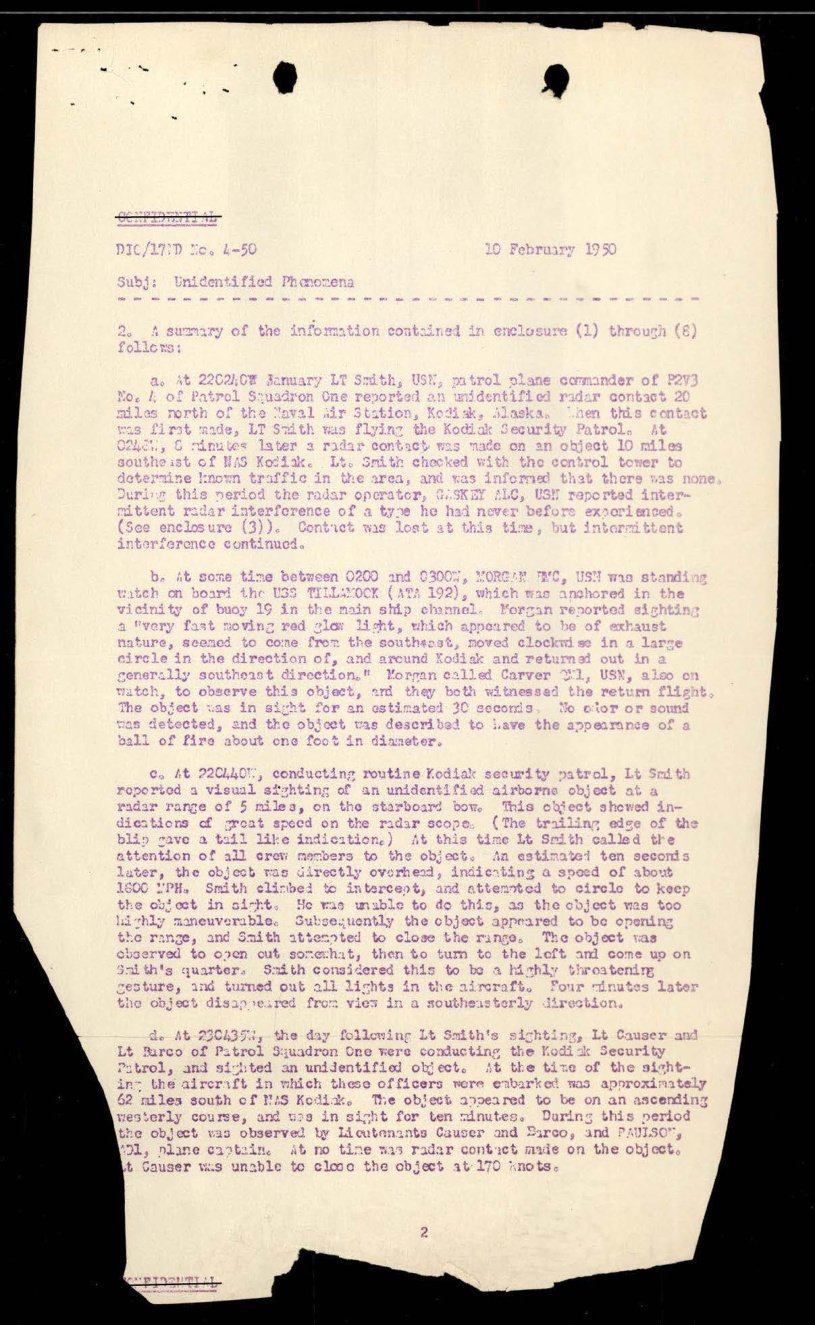
The naval summary of 10/02/1950 describes radar contacts, interference and visual reports from January 22, including a narrated speed of about 1.800 mph and maneuvers interpreted by the pilot. For the sighting on the following day, the page itself states that there was no radar contact. These episodes are also distinct from the Kodiak case of April 1949, mentioned above.
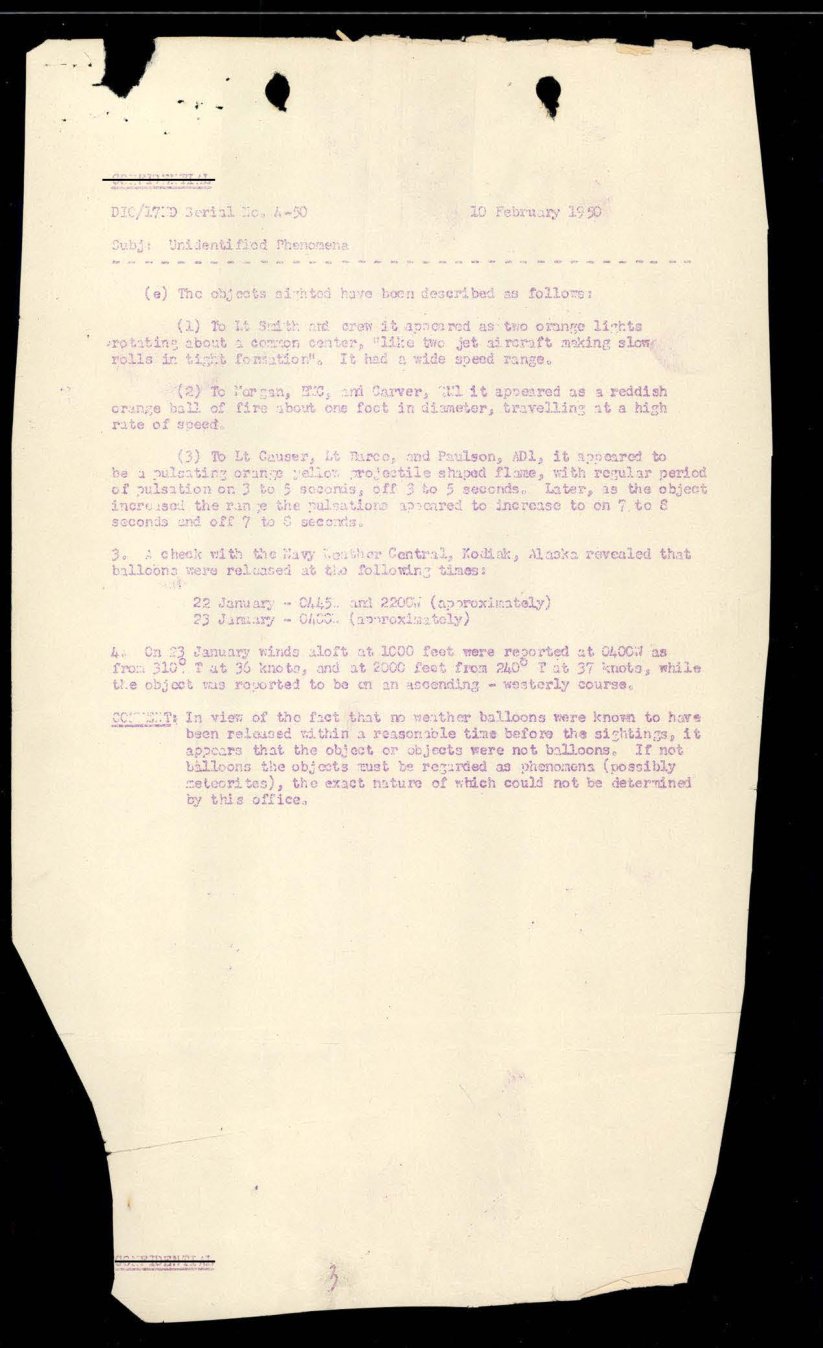
The continuation compares the observers' descriptions, balloon launches and winds. It considers balloons unlikely under the circumstances and keeps the nature undetermined, allowing meteorites as a possibility.
The same naval summary describes, under item (e) of the document, three different descriptions of what each crew saw. To Lieutenant Smith and his crew, the object looked like two orange lights rotating around a common center, "like two jet aircraft making slow turns in close formation," with great variation in speed. To Petty Officer Morgan and Seaman Carver, it was a reddish-orange ball of fire, about 30 centimeters in diameter, at high speed. To Lieutenant Causer, Lieutenant Barco and Petty Officer Paulson, it was a pulsating, orange and yellow, projectile-shaped flame, whose blinking cycle was 3–5 seconds at first and changed to 7–8 seconds as the object moved away.
The document also records that, during the first radar contact on January 22, operator Gaskey reported intermittent interference "of a type he had never experienced before" — a technical detail that the Navy treated as part of the same set of occurrences, without asserting a causal relationship with the visual sightings. The Navy checked the weather balloon launch times at the base and concluded that none had been released close enough to the sightings to explain them; for that reason it considered balloons unlikely, but kept the nature of the objects as undetermined, allowing meteors as a possibility.
The cover sheet of the naval report, filed by the FBI in the same folder, shows where the reports came from. It is intelligence report No. 4-50, issued at Kodiak on February 10, 1950 by the intelligence office of the 17th Naval District, with the source classified as official and an evaluation of A-2. It lists eight enclosures: three sighting forms filled out by Lieutenant Smith, by seamen Morgan and Carver and by Lieutenant Barco, a sketch of the radar interference experienced in Smith's aircraft, the route chart of Barco's aircraft, statements, and wind and balloon launch data. The sheet itself notes that the standard Navy form had no field for "phenomena of this nature."
The times in the naval report are followed by the letter W, the military time zone ten hours behind Greenwich, which was Kodiak's local time. In the early morning of January 22, the sequence is as follows: at 2:40 a.m. the radar of Lieutenant Smith's aircraft registers an echo 20 miles north of the base; at 2:48 a.m. it registers another 10 miles to the southeast; between 2 a.m. and 3 a.m., the two electricians on duty aboard the USS Tillamock see the red light circle around Kodiak; at 4:40 a.m. Smith himself and his crew see the object. The Causer and Barco episode occurs the following early morning, at 4:35 a.m., 62 miles south of the base.
The speed of about 1.800 miles per hour was not measured by an instrument. The report explains that the object appeared on radar at 5 miles, off the starboard bow, and that about ten seconds later it was directly over the aircraft. The figure comes from this time estimate made by the crew. The same passage records that the echo left a kind of tail on the screen, a sign the writer associated with high speed, and that Smith turned off the aircraft's lights because he considered the object's approach from his rear quarter threatening.
The weather balloon table that the report itself reproduces shows launches at Kodiak at 4:45 a.m. on January 22, at around 10 p.m. on the same day, and at around 4 a.m. on January 23. The final comment states that no balloon was released within a reasonable time before the sightings and therefore rules out that explanation. The text does not discuss the 4:00 a.m. launch on the 23rd, which took place a little over half an hour before the Causer and Barco observation. It also records the west-northwest and southwest winds that early morning, without drawing any conclusion from them.
The comment by the intelligence office of the 17th Naval District ends with a cautious formula: if they were not balloons, the objects should be regarded as phenomena, possibly meteorites, whose exact nature the office was unable to determine. It is an institutional assessment, not a demonstrated explanation. The report reached the FBI through the Office of Naval Intelligence on April 24, 1950, was entered in the file on May 9 and filed among the papers on flying discs. The eight enclosures cited on the cover sheet, with the forms, the sketch of the radar interference and the route chart, are not part of the folder.
More images from the document
DIRECT READING OF THE FILE
The document, in the original
Full translation of the pages added to this dossier. Addresses and personal data of private individuals were omitted and marked.
EXCERPT 1 · PHYSICAL PAGE 146
Physical page 146: cover sheet of naval intelligence report no. 4-50, Kodiak, 10/02/1950 (typewritten text in full)
:·c--:
• :1b.~ • e obj ec .. Is , by variou!I
0 ')I) °t O V i \!ini ty of
(1) 1 ls i !for-
I."') lFJ :: \.c: .. n
_). ) j !'.., • 01 ?'! .b,1U:\X"1 19;5~
-r- wi ~·c.!1 fer .:;;c!'th.2' ;,h.1-;.xr.en:J. of this 1'1'11, ire
{l)
(~)
(3)
(4)
( ,,) :J.
,, .. ,...
I
L't .. 5_..:th, t::-;
Cc::-:,Jctd C:CTX f:.,Jt:1 cont.1.1..tns i.ni'.:.!'m~ticn 1iven by
~'l 1'J • 3. 'JI. t '"I, • u:,~~ f::'~,,. ,.C U!;'··
s· etc-!, ?.. nc u~;."'"'~~1a •~i'4 "'7::"li:xd$lced hy
Lt. ~!!'~ '!
C'.c, . .:)lc1os:d Cl :.C ·'L fern co ~~ininr: infornation .. iven b:1 U ..
S:i rec , us~·
7.'r:.ck ch::irt c4' :tl. rcr~ft. in du ~h Lt 3~roo, USN emb:dl-:l!d
( ~) '1~ t,c-nc .. ~~ ~ o:. : .l R~ 1' ~' :J'l :l ni ~ \~~~ !:
(?) .5t..:.tc:-.:.cnt. cf ..._t, ib.reo
(C) ,;inJ~ :l:Of't '!'"':i '-;-:li..ccJn rel•3'.lS() ci".b.
f1 ,., ...
j t .... . ... .,. ' .
---rm is no,
of' 1h, 3H/ i( 2) .I'
fhis document contdna 1n c,
n rEditorial note: Morgan's and Carver's ratings appear swapped between the list of enclosures and item 1 (EM1/EMC) and are partially faded; for this reason they were indicated in brackets. The eight enclosures are not in this PDF; the file contains only the cover sheet and the two summary pages (physical pages 147 and 148, already translated in the dossier). Handwritten annotations ('File in Flying Discs') and stamps not translated.
Check the original PDF
Received from ONI through Liaison Channels, Date 4/24/50. CONFIDENTIAL. Issued by the Intelligence Division, Office of Chief of Naval Operations, Navy Department. INTELLIGENCE REPORT. Serial No. 4-50 at Kodiak, Alaska, Date 10 Feb. 1950. From DIO/17ND. (See note 2). Source: OFFICIAL - U. S. Navy. Evaluation: A-2. Subject: Unidentified Phenomena [handwritten: in vicinity of Kodiak, Alaska]. BRIEF: A report of sightings of unidentified airborne objects, by various naval personnel, on 22 and 23 January 1950, in the vicinity of Kodiak, Alaska is contained herein. NOTE: (1) This information is as of 23 January 1950. (2) IFI makes no provision for reporting phenomena of this nature. ENCL: (1) Completed CINCAL form containing information given by Lt. Smith, USN. (2) Completed CINCAL form containing information given by MORGAN, [rating] and CARVER, [rating], USN. (3) Sketch of radar interference characteristics experienced by Lt. Smith, USN. (4) Completed CINCAL form containing information given by Lt. Barco, USN. (5) Track chart of aircraft in which Lt. Barco, USN embarked 23 January 1950. (6) Statements of MORGAN [rating] and CARVER [rating], USN. (7) Statement of Lt. Barco. (8) Winds aloft and balloon release data. 1. Enclosures (1), (2), and (4) are completed forms suggested by Commander in Chief, Alaskan Command, Fort Richardson, Alaska for the reporting of sighting of unidentified objects. Enclosure (3) is a sketch of radar interference experienced in aircraft piloted by Lt. Smith. Enclosure (5) is a track chart of aircraft in which Lt. Barco was embarked when he sighted unidentified object. Enclosure (6) contains statements by MORGAN, [rating], USN and CARVER, [rating], USN relative to their sighting. Enclosure (7) is a copy of Lt. Barco's statement and enclosure (8) is a summary of weather and balloon release information. THIS REPORT CONSISTS OF THREE PAGES. Distribution by Originator: CNO, CINCAL, COMALSEAFRON(?), CINCPACFLT. [Routing:] CIA (8), STATE (5), DI USAF (5), [illegible] (6), FBI (2). Declassified by NIS letter 9/20/77 concerning request of Bruce S. Maccabee.View the document record ↗ · Physical page 146, counting the cover.
EXCERPT 2 · PHYSICAL PAGE 147
Physical page 147: second sheet of naval intelligence report no. 4-50, item 2, subitems a to d (full text)
- - '
. .....
•
l)JC/17~1> :;c . L-50 10 Fcbru1ry l<) 50
Subj: 1jni.C:<mt,i!icd Pha:o~ena
-- - - - -- -- - -- - -- - - --- - --- - - -- -- -- - -
2., ,~ SU'J."l~l':Y of tho infom:::;tion cont:.inel in ancl:.,sure (1) throush (S)
follc..-:s:
a •. •\t 22G;>J,C'ff l.:.nuary LT S::tl.th, USt:, p:i trol ::i1=ine c<r.m:mder ot ?2V3
~;o, I; of P,1.trol s ::u.:.viron Cne re:,ort.e.l ~!l ·m5dentific,J 1•1d.::.r cont1ct 20
~lr.s rorth or the :·1av~l :,ir 3t:-.tio n, Koji1k~ .'il,'.\Sk~" ·.,1en this ccnt;i ot
1.-::s fl Mt ·r.'lde, LT S-:d th vu~ flyln:3 the Kod1 . .:ik !iecuri~y l>o.troL, !,t
021.;..: · .. , C ~m.il:R~ 1st.er J. rid.:ir co.r.t~c~ Ti'.:.J ":ln.<!c on ~n ob.,:iect 10 r.iilos
aou+,h0 ;st c, f ll 1'-S Koci:ik, Lt,. Sni. th checked with the ccn \rol tcT-:er to
dcter,ur.e l:no~n tr:.if.fic in ti•c -u-cm, anti y;as infcm':.rl that there ,·,:is rnmei.
J~rl 1 .!: this ;>eriod the m , .. br opcr.:itcr, G:.sK~ :'.!,C, U:3?: reported inter
rtlttcnt. r::~hr i:-iterfcrence of ,1 ty:,e he hid nov~.r befo:-c ex:~-orimce<i o
(See enclosure (3))., Ccnt·ict w.is lo$t :1t. t,h:.i.s ti~, but intcr ,-:iittent
int~rfercncc c0ntinucdo
b, :, t so:r.e ti:!le be tween 0200 :ind O 3007♦-, ~;:OPG !• t~ 1},'C, US:·! 'f7'l!l s t:.mdi '11!
r: 1tch en bo.:ir1 thr U3~ 'l'ILL.~'.':.OCY. ( ,\T.1; 192) i \'Jhich ri:w .:imhored in the
vicini ~ of buoy 19 in the ~cln shi;, ch3nncl ?'or~1n re;1o rted si5htin J
~ 11vory f.1-;t -:,ovin,: red .310-; li:1,t, r1hich appc1recl to be of ~l".aust
ruture , sce:icd. to co:;ie froT. the south,~9t.,. 11oved clockni~ in ,'l l.:ir3e
drcle in the direction of, 3.:1.d arcund Xo:.li:tk and ret urn9:! out in a
.;:ener.:.lly southf)'l!lt direction., 11 l'.or~a.n c.:i.llErl C:irver -~.'.l; US~, a.loo c 1
1'U. tch, to observe this object, ~rd they both witnessed t.he retum flignt ,;,
The object ~.z,.s in si.:_:ht !'or en ostirr.ate:1 3C accon::l~ ~To ,. tor or sound
-::.:ig det~ cte d, a.nd tr.a object t•-u deacribej to ;,ave the a:,pooron~e of a
b.lll of fire abou t one foe t i n di a?n&ter .
c., t.t :>2Cl;.401". , conductin~ t'outine Y. odia1( se<:uri ty :,1tro l, Lt Sr.d. th
ro:,crtcd :i visuol si'.ghtinr, or an unidcntl fiad nirborn " object at a
r:i.d:ir rnl".£!e of 5 miles , on tho s~:rbo:ir'.l bou" 'Inis oo_-iect 9hcwed :ln-
dic::itior.s c:£ :,-c:it speed on tl:e r:id :ir sco;-,e. ( The tr:ulin~ ed~e of th~
bli;> ::.ivc .1 tail lil~e ilidieJticnc) ,'tt, this time Lt. SriJ.t.h called tl'e
attention or 1ll crcv; r.,l}~bers to the obj cct ~ :\n esti:1::i.tei ten seconi s
luter, the object. t ,cls tiirectly ovome~ , inaic,tin $ a spoed of abo •.tt
1600 !.'PH., Sndth cli:: 1he! to i:.t;ercei)t, .:ind r\tter:ntcd to circle to keep
the ob:, cct in oi--;l:t , ~c T.'.l~ ta1:iblc to do thio, 33 the object \"l.!5 t.oo
ld:,;hly :n~euv~r:ible ,, 3ub:;e.,:ucntl,y the objoot appr-:1red to be cr,onin.;
t!.c r .-.nzc,, ~nd S:711 th :1tt~;,tecl t.o close the rln5o o The oi)ject t.as
ohoerved to o.,cn out so:-:~:h:1t, th~n to turn to the left ::ml CO'Tle up on
'.3::llth's <1u::irter., S.:iith consJ~ered this to bo a l-.i:~hl.:,1 thro3.teni~
,:e:;ture , 1:Kl turned out ::i.ll li!:hts in the .:d.rcr :itt11 r o11r '1inut~s lati,r
tho object dis:i.:1. ,e .• red fro ~ vic:i i n u ~outhe:isterly -.lir ~ liion~
tla At ~Jc435·_; 1 the d.1.y follc.'l'linr l.t Smith's s i:ht l.:;3., Lt C.3uscr ~nd
Lt furco of P~ trol S:1uadron One v;ere cooouctine th~ Y.od1 "J.lt Security
.;->:: t:.rol, .:m:.i si)ited :m unijentifitxl obj ect o ,\t tt.e ti T.c of the 3i~ht
ir.-; the -::lircr-ift in 'l"ih:i.Ch these of ricers -r;erfl e·nb:l.rk~ TIM ap;>roxi i'l:lt.el y
62 .mile.:, south or t~ t.S Kodi :lko 'n;e object. :l:1?eJ. red to be on an ascornincr
l"le<J!.orly cou rse, am 1:i:ia in si,.r;ht for ten ::tlnut.c so Ourin 3 t.hi s ,?erlod
t::c obJ ect ,•ao obsel"'Ved by Lic•utnn::rnts Causer :md ~1rco, a nd F'/,UJSo··,
·.,1, _l')lme c:17t:.:.in(, At no ti::!e ";';:l', r:id:ir cont ·1ct m1de on the objcct o
t Cnuser \•;:.s un~blc tc cl.co c the object :it.· 170 i-.nots GEditorial note: Page 2 of the report. The letter W after the times indicates military time zone W, ten hours behind Greenwich, which was local time in Kodiak. The abbreviations after the names are Navy ratings: ALC, chief aviation electronics technician; EMC, chief electrician's mate; EM1, electrician's mate first class; AD1, aviation machinist's mate first class. The ship's name is spelled TILLAMOCK in the document.
Check the original PDF
[CONFIDENTIAL, struck through] DIO/17ND No. 4-50 10 February 1950. Subj: Unidentified Phenomena. 2. A summary of the information contained in enclosure (1) through (8) follows: a. At 220240W January LT Smith, USN, patrol plane commander of P2V3 No. 4 of Patrol Squadron One reported an unidentified radar contact 20 miles north of the Naval Air Station, Kodiak, Alaska. When this contact was first made, LT Smith was flying the Kodiak Security Patrol. At 0248W, 8 minutes later a radar contact was made on an object 10 miles southeast of NAS Kodiak. Lt. Smith checked with the control tower to determine known traffic in the area, and was informed that there was none. During this period the radar operator, GASKEY ALC, USN reported intermittent radar interference of a type he had never before experienced. (See enclosure (3)). Contact was lost at this time, but intermittent interference continued. b. At some time between 0200 and 0300W, MORGAN EMC, USN was standing watch on board the USS TILLAMOCK (ATA 192), which was anchored in the vicinity of buoy 19 in the main ship channel. Morgan reported sighting a "very fast moving red glow light, which appeared to be of exhaust nature, seemed to come from the southeast, moved clockwise in a large circle in the direction of, and around Kodiak and returned out in a generally southeast direction." Morgan called Carver EM1, USN, also on watch, to observe this object, and they both witnessed the return flight. The object was in sight for an estimated 30 seconds. No odor or sound was detected, and the object was described to have the appearance of a ball of fire about one foot in diameter. c. At 220440W, conducting routine Kodiak security patrol, Lt Smith reported a visual sighting of an unidentified airborne object at a radar range of 5 miles, on the starboard bow. This object showed indications of great speed on the radar scope. (The trailing edge of the blip gave a tail like indication.) At this time Lt Smith called the attention of all crew members to the object. An estimated ten seconds later, the object was directly overhead, indicating a speed of about 1800 MPH. Smith climbed to intercept, and attempted to circle to keep the object in sight. He was unable to do this, as the object was too highly maneuverable. Subsequently the object appeared to be opening the range, and Smith attempted to close the range. The object was observed to open out somewhat, then to turn to the left and come up on Smith's quarter. Smith considered this to be a highly threatening gesture, and turned out all lights in the aircraft. Four minutes later the object disappeared from view in a southeasterly direction. d. At 230435W, the day following Lt Smith's sighting, Lt Causer and Lt Barco of Patrol Squadron One were conducting the Kodiak Security Patrol, and sighted an unidentified object. At the time of the sighting the aircraft in which these officers were embarked was approximately 62 miles south of NAS Kodiak. The object appeared to be on an ascending westerly course, and was in sight for ten minutes. During this period the object was observed by Lieutenants Causer and Barco, and PAULSON, AD1, plane captain. At no time was radar contact made on the object. Lt Causer was unable to close the object at 170 knots. 2 [CONFIDENTIAL, struck through]View the document record ↗ · Physical page 147, counting the cover.
EXCERPT 3 · PHYSICAL PAGE 148
Physical page 148: third sheet of naval intelligence report no. 4-50, subitem (e), items 3 and 4 and comment (full text)
( ·) l'o .'. , .L. ~re. .-.e11 1t rn. Clre::1 as to onnrtc 11·,.r.to
:ro .- ., i,..,:., Qbo~t l:'h:.: t>.¥, Jet '1., rcr1ft .'Ti-:i.:.C:inr slv~
ro tlc. ir. i ... t It h"c:; ., ... i:.!e ~!)eod r-..nge .. ,
(::2) Tc ~·ur~1n, ,r·,::_ 1n ';:u'Ve'!', T: it 1.prc•rod :.i.s s reddish
er• .;e .... 12 of fil'\ .1.bc•tt one foct jn Ji3laBt#c!", tl"'\"cJJ.ir,~ -it a hi~h
1·.1te of ~ceed
. ) 'lb Lt C, w•~.r., "' ...... dr'"-' ~r,1 P lson, ,\Dl_ it 'l:":>(r:.:rcd to
be :i .:,t., a ~:. r3 or:m •-;c • E'~ -._,.,. ,"To • c .. til .. s h1.:,ocl fl:Jme, \'"i th I'C·!l'.1 :t:r ,)ericd
vi' ,1ls:it~01cn 3 to 5 '>cc n:is, off:: .,o 5 Sf;ccnds, L.3.~·, ... , 1s the c~ject
il1cr,J •;,n_ tl1e r.ln ,e ,ht ~ul tio 1.:'>· m:.•e~• to .nc :cj,SC to en 'i to 13
~.ZCO!'J.$ -!'Id off 7 ro · -,C;C::; 't 1
3o .' chee'c dt:1 t.:1e ;:-ni:, ·,..:?,,' _.. Ccnti'l.1, I~oJL'1-:, ,\103:<:::. roveulctl th:1t
I. 1llcon~ ·:ere re) ... .:ise·l Jt t 0 ."ollow:tr..3 t1~1es:
2~ ,J.:.111~1 a?j - Cl.l~:>
2; J.,\rn;..1r-; - C/i','.)'
i C.l .~J l!3.Jt: ~l'Y v-;.i.r.ds .iloft ·i.t, lCOG !'cot 1Tere re:mrted ~t. 01.0C,l o.s
fro., Jlv~ 'I' at 36 ~not ..... :.l!W n.t 2:>0C ::e~t fl'C''n ?.40b r ~t. 37 ~unl,:J.s wl:ile
t.:.e Oi),i cct t"J..3 re ~'0rte1 to be c.n :in lS~endln 6 - w~-;tcrly course,.
In vh:i\"; of tho f-:.ct t.h:it m :-J.nthcr b.11.loons t:t,re knovn to h.:i.v~
been relru~~c ·,,itt,in _, 1•~.1sor1ble ti'.1e be.fora th~ si:lit.ln~s 1 i\i
ap,,c.::.r::1 th.'.lt the ob~ c.;:t c·· objcct:J \-Jere not. b"..lJ.oons~ 1f not
uilloon!'i tbe ob:~ts 1:.•Jst b., r~:;'.!roer.l as }>heno.:-ion:. (~}()s~ibly
.::etecrI te:z), the e:oct n'.'!ture o! tilrlch could not be l!ec.er·'ll.n<:"l
by thl s office.,Editorial note: Page 3 of the report. The letter W after the times indicates military time zone W, ten hours behind Greenwich, which was local time in Kodiak. The document uses the word meteorites. The expression slow rolls designates the slow roll, a maneuver in which the aircraft rotates about its own longitudinal axis.
Check the original PDF
[CONFIDENTIAL, struck through] DIO/17ND Serial No. 4-50 10 February 1950. Subj: Unidentified Phenomena. (e) The objects sighted have been described as follows: (1) To Lt Smith and crew it appeared as two orange lights rotating about a common center, "like two jet aircraft making slow rolls in tight formation". It had a wide speed range. (2) To Morgan, EMC, and Carver, EM1 it appeared as a reddish orange ball of fire about one foot in diameter, travelling at a high rate of speed. (3) To Lt Causer, Lt Barco, and Paulson, AD1, it appeared to be a pulsating orange yellow projectile shaped flame, with regular period of pulsation on 3 to 5 seconds, off 3 to 5 seconds. Later, as the object increased the range the pulsations appeared to increase to on 7 to 8 seconds and off 7 to 8 seconds. 3. A check with the Navy Weather Central, Kodiak, Alaska revealed that balloons were released at the following times: 22 January - 0445W and 2200W (approximately); 23 January - 0400W (approximately). 4. On 23 January winds aloft at 1000 feet were reported at 0400W as from 310° T at 36 knots, and at 2000 feet from 240° T at 37 knots, while the object was reported to be on an ascending - westerly course. COMMENT: In view of the fact that no weather balloons were known to have been released within a reasonable time before the sightings, it appears that the object or objects were not balloons. If not balloons the objects must be regarded as phenomena (possibly meteorites), the exact nature of which could not be determined by this office.View the document record ↗ · Physical page 148, counting the cover.
Dates and documentary context
GEOGRAPHY OF THE CASE
Kodiak area, Alaska
Approximate reference for the island and the city; does not represent the position of each contact.
DOCUMENTARY TRAIL
Go back to the sources
References use physical pages of the PDF, counting the cover. Summaries are presented in English; the documents keep their original language.
- 65_HS1-834228961_62-HQ-83894_Section_5.pdf
65_HS1-834228961_62-HQ-83894_Section_5.pdf, p. 147 · 65_HS1-834228961_62-HQ-83894_Section_5.pdf, p. 148
FBI · 209 pages
Editorial summary based on the collection's research notes. How we read the documents.