Date: 1949-01-25Location: Weather stations at various locations in Japan
Reports of a flash and noise at Japanese weather stations
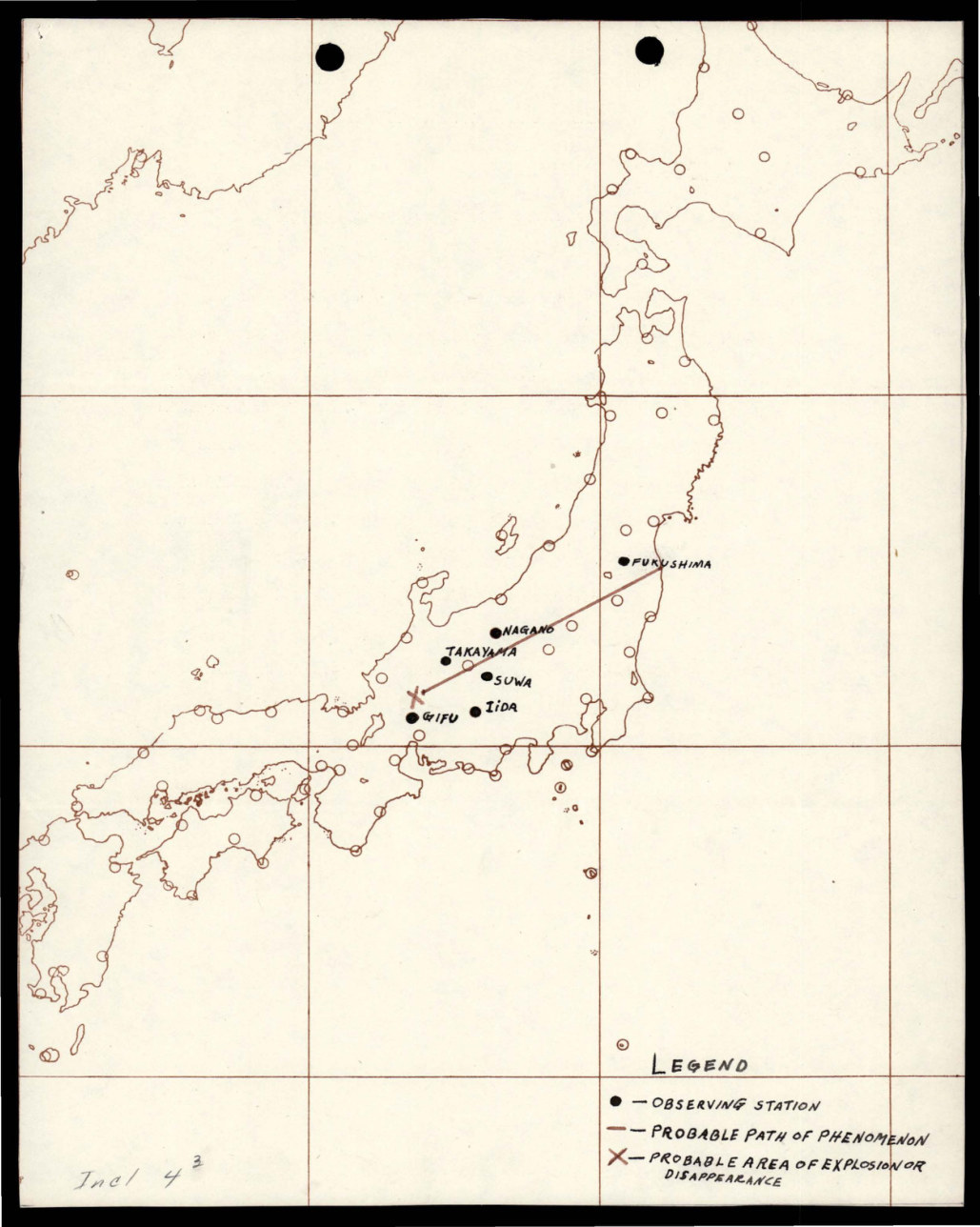
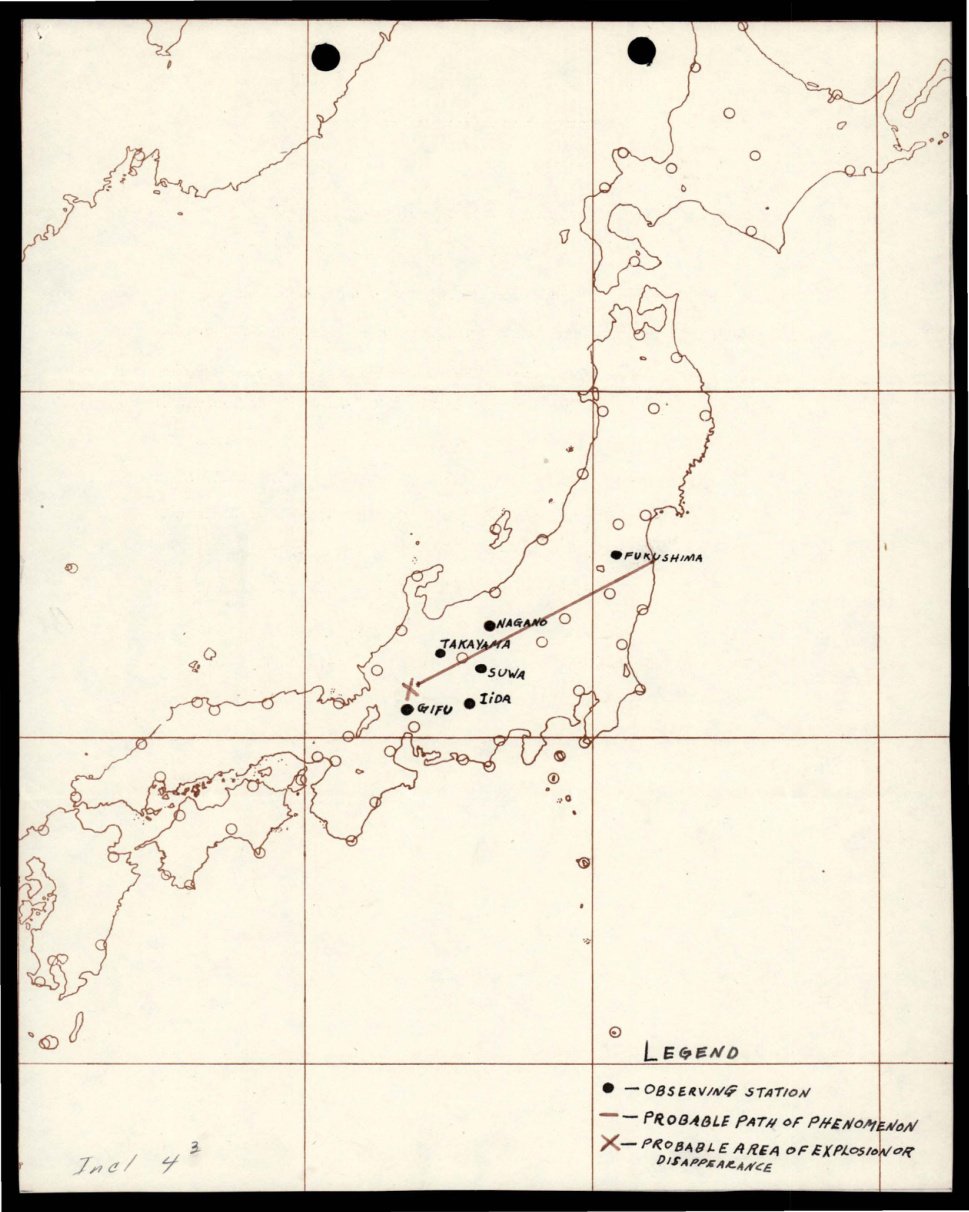
Station reports describe a flash and noise on January 25. Some informants suggested a meteor; the map traces a path and probable area of explosion or disappearance, without proving an impact.
- Event date
- 1949-01-25
- Location
- Weather stations at various locations in Japan
- Topic
- Military reports from 1948–1949
- Source agencies
- Arquivo histórico
- Documents
- 1 document · 143 pages
- Reading time
- 9 min
 Documentary mapPhysical page 87
DOCUMENTARY SOURCES · Arquivo histórico
What the records tell
Station reports describe a flash and noise on January 25. Some informants suggested a meteor; the map traces a path and probable area of explosion or disappearance, without proving an impact.
The memorandum of February 3, 1949 from the 2143rd Weather Wing to the commanding general of the Far East Air Forces explains the origin of the material: three reports received by the Central Meteorological Observatory in Tokyo, with observations made by Japanese meteorologists at the stations, a map with the probable trajectory and two synoptic charts of January 25, at 06h00Z and 12h00Z. By the memorandum's own reckoning, the object was seen about an hour and a half before 12h00Z, that is, around 7:30 p.m. Japan time. The memorandum says it has no information other than the Japanese information.
The local times vary little: 19:30 in Fukushima, 19:40 in Takayama, 19:46:30 in Iida, and 19:50 in Suwa and Nagano. In Suwa, the flash appeared a few degrees from Betelgeuse, in the constellation Orion, lit up the ground for an instant, went from white to yellowish and reddish, and vanished in 3 or 4 seconds; about a minute later a distant thunder was heard for some 15 seconds. In Iida, doors shook. In Takayama, the sound was loud near the town of Osaka (a locality in the region, not the metropolis). The Nagoya observatory recorded nothing.
There are discrepancies in direction among the accounts, and the map does not resolve them. Fukushima described a fall from northwest to southeast near the village of Nakagori, east of Koriyama, while the attached map draws a line from Fukushima to an "X" near Gifu, in the center of the country, as the probable area of explosion or disappearance. In Nagano, the flash reportedly lasted about five minutes, much longer than the seconds cited at the other stations. All the stations that offered an opinion suggested a meteor or a meteor explosion; this interpretation is the informants' own.
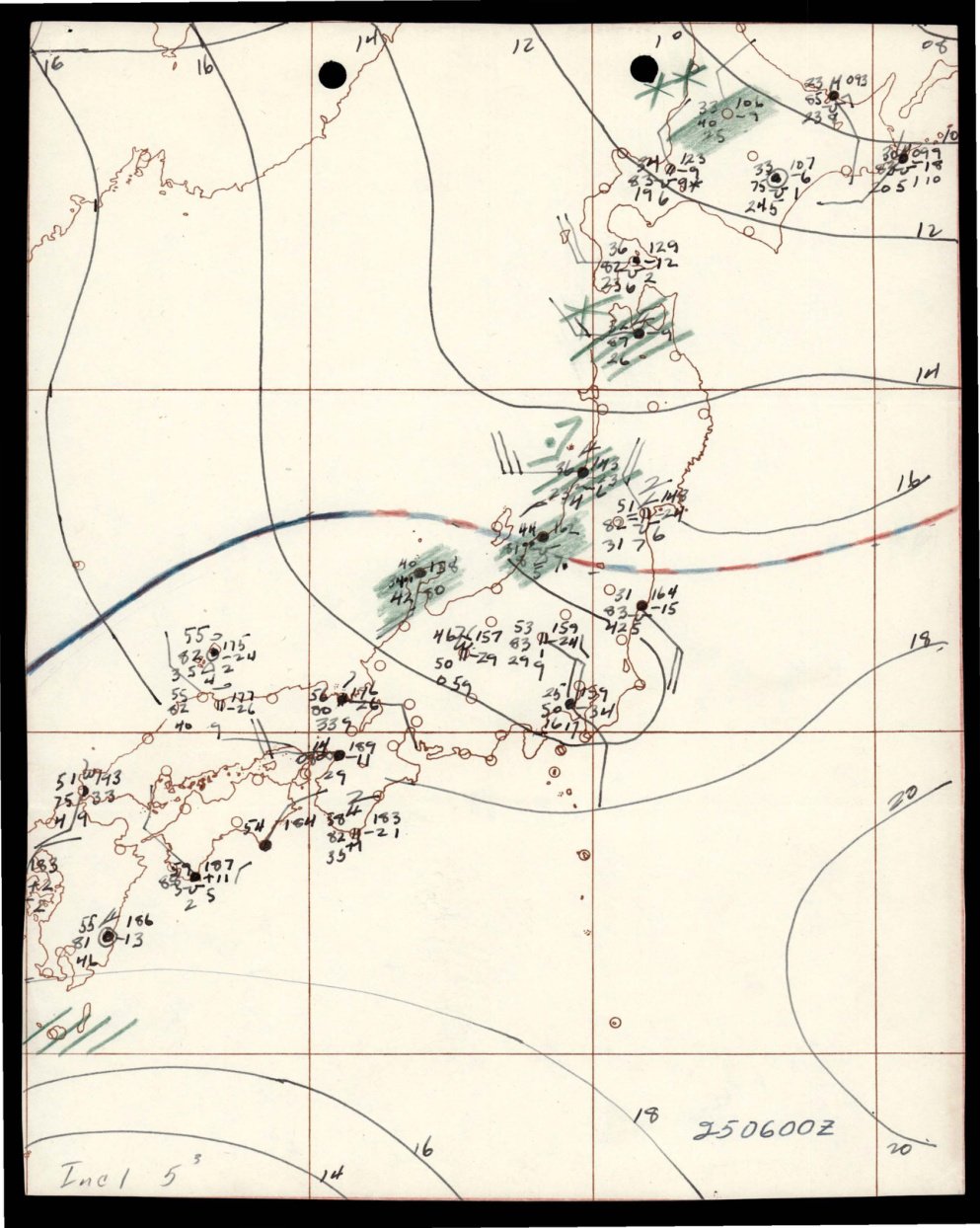
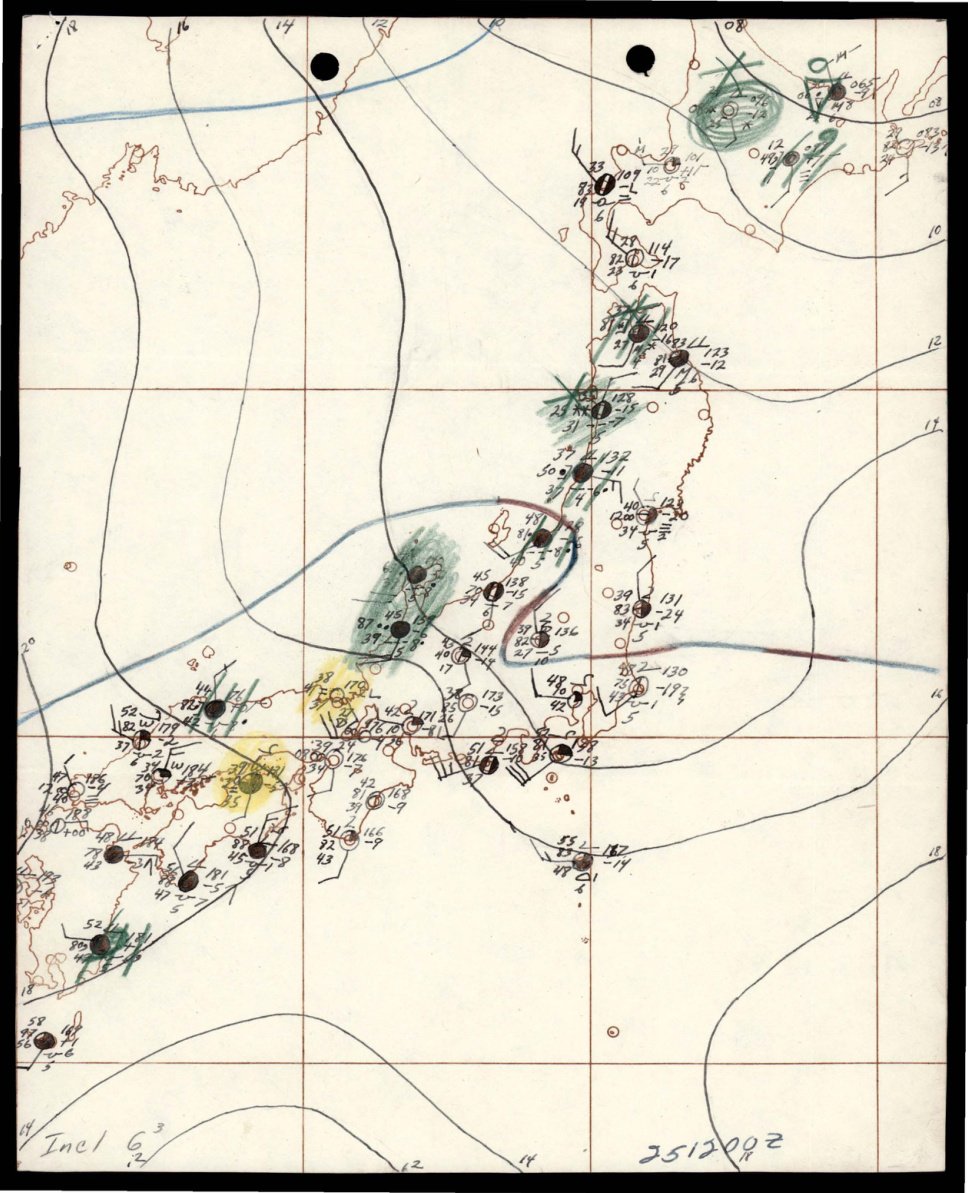
The two synoptic charts attached to the memorandum, inclosures 5 and 6, show the weather over Japan at 06h00 and 12h00 Greenwich time on January 25, 1949. They are hand-drawn maps, with numbered pressure lines, each station's data in code, a front in blue and red crossing the center of the country and green and yellow patches in areas of precipitation or cloud cover. Apart from the notations "250600Z," "251200Z" and "Incl 5" and "Incl 6," they carry no text. They serve to show sky conditions in the hours close to the sighting, and do not record the phenomenon.
The material reached the U.S. Air Force by a route that shows how the occupation worked. The Japanese stations sent their accounts to the Central Meteorological Observatory in Tokyo, which handed them to the 2143rd Weather Wing. The wing forwarded them on February 3 to the headquarters of the Far East Air Forces, with a copy to MATS in Washington, citing the Air Force headquarters letter of February 26, 1948 on "flying discs." The memorandum adds that no information other than the Japanese information had been received.
The stations' accounts rely on naked-eye observation and on the sound heard after the flash; there is no instrumental measurement. The interpretation as a meteor or meteor explosion is that of the Japanese meteorologists themselves, repeated without comment by the American wing. The dossier is complete with the six inclosures and the memorandum, but the archive holds no response from the Far East command nor any attempt to locate remains of the supposed meteor.
More images from the document
DIRECT READING OF THE FILE
The document, in the original
Translation of the selected excerpts checked against the image, with omissions indicated. This is not a full translation of the PDF. Summaries and evaluations are kept separate from the transcription.
EXCERPT 1 · PHYSICAL PAGE 83
Physical page 83, full text: memorandum of the 2143rd Weather Wing of 03/02/1949
FEB3- u49
J f{. 5
SUBJECT Report of Sighting of Unidenti.i'ied Pb no enon
TO • Comina ding 0
·ar Ea t ir a
APO 9.25
ATT h AC/S, -2
1 . In accordance with the provleion of letter, Headquarter,
United Stat ir orce, subj eta •Reporting of Infor t-ion on • lying
Diecs• , 26 February 1948, the tollo ing infor tion is fo rded:
a . Inclosur 1 , 2 and .3 are reportei received by th Japan se
Central teorological Observatorr in Toi;yo. The observations indic ted
in these r ports 11ere taken by J pan se ea.th r personnel t the r .sp ct1
stations .
'
b. Inclosuro 4 indicates the location of th stati n which
obe rved the object and it's probable path and point o exploeion or
disappear nee . •
c . Inclosur s 5 nd 6 are urfac synoptic charts• w th•
weather xist1ng ov r Japan t 0600'l and 1200'L on 25 Janu!lry, 11hicb times
re app:ro::d t ly four and one half (4½) hours before and one and one. half
(l½) hourc er the unident1!1 d obj ect a 1g ted .
c . No information 112.s b en ,ceive ~r ' than that report d 'by-,
t~ Japan ee .
6 Incls1
l . Rpt - tikuehi
2. Rpt - Iida, Suw and· no ..
3. Rpt - Taks.,rama nd Gli"u
4 . Chart - ObaerYO.t-ion and Patb
5. X Chart- 25o600Z
6. x Chart• 2,12ooz
cc I Commanding General
U1t.ary Air Tr nepc:>rt Senice
aab1ngton 25, D.C.
Afl'Jh Chief, Intelli nee Div .Editorial note: The letter “c.” appears twice in the original.
Check the original PDF
CONFIDENTIAL. HEADQUARTERS, 2143D AIR WEATHER WING, APO 925. FEB 3 1949. 311.5 [manuscrito]. SUBJECT: Report of Sighting of Unidentified Phenomenon. TO: Commanding General, Far East Air Forces, APO 925, ATTN: AC/S, A-2. 1. In accordance with the provisions of letter, Headquarters, United States Air Force, subject: "Reporting of Information on 'Flying Discs'", 26 February 1948, the following information is forwarded: a. Inclosures 1, 2 and 3 are reports received by the Japanese Central Meteorological Observatory in Tokyo. The observations indicated in these reports were taken by Japanese Weather personnel at the respective stations. b. Inclosure 4 indicates the location of the stations which observed the object and it's probable path and point of explosion or disappearance. c. Inclosures 5 and 6 are surface synoptic charts showing the weather existing over Japan at 0600Z and 1200Z on 25 January, which times are approximately four and one half (4½) hours before and one and one half (1½) hours after the unidentified object was sighted. c. No information has been received other than that reported by the Japanese. 6 Incls: 1. Rpt - Fukushima. 2. Rpt - Iida, Suwa and Nagano. 3. Rpt - Takayama and Gifu. 4. Chart - Observation and Path. 5. Wx Chart - 250600Z. 6. Wx Chart - 251200Z. cc: Commanding General, Military Air Transport Service, Washington 25, D.C., ATTN: Chief, Intelligence Div. [manuscrito à margem: cc MATS]. CONFIDENTIALView the document record ↗ · Physical page 83, counting the cover.
EXCERPT 2 · PHYSICAL PAGE 84
Physical page 84, full text: Fukushima report (enclosure 1)
tt
BEPORJ! ON .AN ABNOBM.U. FHENCUENON
1
, •
ran. 28, 1949.
l.tMO • , Tdcyo
A. t•1~ _. nceiTed frcm the- Ruku.ahim. lfeather Station
(3..,7°45J1N, J.4,0°'28 'E:) stating aa tollowat
~t. ail:iout 1,.30 p.m., a gJ.a., pale in colour waa, aeen flying. ,
fraa northwea.t . toward aoutheaa¾ whie:h t'al.l- with a. roar · like
thunder.. The a.pot , of deacent seem& to be Nakagpri Village, Tamura
c.bU.nty to the ea.at _. ot K'Priyam& (3,7o24i-1N, 14-0023 1 m:). Prob.ably, it.
~ a. DB.te-:or. The. detailed state 1• DOif.' under invea.ti'gattion.
I ICheck the original PDF
REPORT ON AN ABNORMAL PHENOMENON. Jan. 28, 1949. CMO., Tokyo. A telegram was received from the Fukushima Weather Station (37°45'N, 140°28'E) stating as follows: At about 7.30 p.m., a glow pale in colour was seen flying from northwest toward southeast, which fell with a roar like thunder. The spot of descent seems to be Nakagori Village, Tamura County to the east of Koriyama (37°24'N, 140°23'E). Probably, it was a meteor. The detailed state is now under investigation. Incl 1 [manuscrito].View the document record ↗ · Physical page 84, counting the cover.
EXCERPT 3 · PHYSICAL PAGE 85
Physical page 85, full text: additional report from Iida, Suwa and Nagano (enclosure 2)
ADDITIONAL RE.J?m.r W THE_GL
J'an . 27~ , 1949•
OMO., Taeyo
direction or Northoo
In dditim to the preTious. report on the ,gla, fl:0111 the
~a. r St i , we have -receiTed report ala o ~ran
the other taticns on the same phenanencn , s.tating aa f ollow,u
I er st tion .
ru. ha'fe observed in thia district · a pb.enananon,
imoba.blY. b of or. The- foll Offing is the re.port t
it
6m Joa , ~ pale gl.:oir: obsernd 1n the
t , at an eJ.t1tude ot 35° aliove t:
which mov .d lni t horizo tally th.rough north toward at. and
then di p uec.u·ctu.• a ow as great 8'3 one and a half of
the moon i ·n dianeter , ith conaiderablet brightness . t about
19h .5,0m, a n • ound .a heard end doors trembled . This pheno-
menon. baT been ob ~ d in many places in the district of thia
atai.ion , at hich .roport; will be, made after inv: tigation ..
'
2. , ath r Station .
At 19h 5 en 25th, a pw.e gl like meteor with a ound was
~ ob.sen t Su • This. glow appeared in a distance of a few
degree ~o t' north-narth - eaat of Bctelguc e in· the Orion C
lation and d t to aouthea t-, attaining 1ts maxirium
brigb.tnes a al.ti tude or about 60° abav horiaal . It shined
with palish t colour, th intenai ty of 'ffhich waa such that
obje,cta an t oun.d the obaerver re clearly discernible
tar a. manen illuminated by 1t . ·Thereafter . it beeame yell ish
1n coloo.r, . th.en ei O'i7iBh r p sing point in the 600.thwes.t
and at; an titud 0£ about 40°, and f.inatly di,s.appeax,ed. The
time elap eo. or e ove as 3 or 4 aeconds . out l minute
• thereafter, ounil r mblµig t.o a distant thunder traS heard,
which continued for about l,5 seo-onda .
3.
t on J"anuary 25th, a pi namonon, probably be
teor , ound like that ar explosion was observe in
• many plac near t • station . ccording to the observation taken
by Yasuo •yw o o , JOOinber of this station , a glo , a.p a.red
·1n the dir ion or eaat-south - eaat and at, a -point at medium
altitude ~b horizon, hioh .aOllad aend;ing out palish white
light t ow a point in the direction of weat ~aouth-west , ~here
it.. disap_w d low the horizon . This. g).011 continued about
5, minutes. . bout 3 minutes thereafter, a. sound like that at•.
exl.)lc:eian heard in the direction d est - aouth • st.Editorial note: “Betelguese” and the grammatical constructions are like this in the English original. The Suwa account says the flash moved “almost to the southeast” and then passed a point to the southwest; the contradiction is in the original.
Check the original PDF
ADDITIONAL REPORT ON THE GLOW PHENOMENON ON 25TH. Jan. 27th, 1949. CMO., Tokyo. In addition to the previous report on the glow from the Takayama Weather Station, we have received reports also from the other stations on the same phenomenon, stating as follows: 1. Iida Weather Station. Last night, we have observed in this district a phenomenon, probably be a fall of meteor. The following is the report for it. At Iida, at 19h 46m 30s, a pale glow was observed in the direction of Northeast at an altitude of 35° above the horizon, which moved almost horizontally through north toward west and then disappeared. This glow was as great as one and a half of the moon in diameter with considerable brightness. At about 19h 50m, a heavy sound was heard and doors trembled. This phenomenon have been observed in many places in the district of this station, of which report will be made after investigation. 2. Suwa Weather Station. At 19h 50m on 25th, a pale glow like meteor with a sound was observed at Suwa. This glow appeared in a distance of a few degree to the north-north-east of Betelguese in the Orion Constellation and moved almost to southeast, attaining its maximum brightness at an altitude of about 60° above horizon. It shined with palish white colour, the intensity of which was such that objects on the ground near the observer were clearly discernible for a moment illuminated by it. Thereafter, it became yellowish in colour, then yellowish red passing a point in the southwest and at an altitude of about 40°, and finally disappeared. The time elapsed for the above was 3 or 4 seconds. About 1 minute thereafter, a sound resembling to a distant thunder was heard, which continued for about 15 seconds. 3. Nagano Weather Station. At about 19h 50m on January 25th, a phenomenon, probably be a meteor, with a sound like that of explosion was observed in many places near this station. According to the observation taken by Yasuo Miyamoto, a member of this station, a glow appeared in the direction of east-south-east and at a point of medium altitude above horizon, which moved sending out palish white light toward a point in the direction of west-south-west, where it disappeared below the horizon. This glow continued about 5 minutes. About 3 minutes thereafter, a sound like that of explosion was heard in the direction of west-south-west. Incl 2 [manuscrito].View the document record ↗ · Physical page 85, counting the cover.
EXCERPT 4 · PHYSICAL PAGE 86
Physical page 86, full text: report from Takayama and Gifu (enclosure 3)
REEORT QF., .AN ABNORMAL .HIENCMENON
JTan. 26. 194.9.
GMO•• Tokyo.
A. telegJram waa receiTed tran the.. Takayama lfeather staitia:i
Miya Village, the glOWI appeared there, ail.m.cat; O't&rhead a.ind', a
to the: aoutheaat; of thia.. ata'td.an. Thia gl.os mo,ed aou.thwe.at;
war.d& and . 'then disappeared toll011ed by:r a. sound like thunder
af'ten- a. telfl Jllnute:a. Thia sound waa rdher lowt in the, 'ftc.tini'tiy
ct Ollakai. 'llown near 'bhia ata.tion.
tes .minute-. later, a. aound resembling to thunder waa heard
tl!Clll the south. Smvn1ng up the.. report a by e.ye-wi tnes sea, thia
pienanenon might be the expl. .oaian of a me-teor •.
.ta.o at:. GU'u, a, gl. c,w; was aeen to the: north.-narth-eaat at;
about s the same. inatance, aa aho:Ye, whil.- 1n the: Nag,oya Iliatr:1.ct:;
c·entral &tte<mological Observat:cmy, no such at inenanencn .a
obs.eilVed•
:T,, a I JEditorial note: “Osaka Town” designates a locality near Takayama, not the city of Osaka.
Check the original PDF
REPORT OF AN ABNORMAL PHENOMENON. Jan. 26, 1949. CMO., Tokyo. A telegram was received from the Takayama Weather Station (36°09'N, 137°15'E) stating as follows: At about 7.40 p.m. on 25th, a remarkable glow was experienced to the southeast of this station. This glow moved southwestwards and then disappeared followed by a sound like thunder after a few minutes. This sound was rather loud in the vicinity of Osaka Town near this station. According to a report from Miya Village, the glow appeared there almost overhead and, a few minutes later, a sound resembling to thunder was heard from the south. Summing up the reports by eye-witnesses, this phenomenon might be the explosion of a meteor. Also at Gifu, a glow was seen to the north-north-east at about the same instance as above, while in the Nagoya District Central Meteorological Observatory, no such a phenomenon was observed. Incl 3 [manuscrito].View the document record ↗ · Physical page 86, counting the cover.
EXCERPT 5 · PHYSICAL PAGE 87
Physical page 87: labels of the observation and trajectory map (enclosure 4)
e - 08S Ell.V I /Ill, SiA rto,v'
- - fR.OOA.tJU /'AT/I oF P/1£N'O /lf k'tMI
X - f'teos.1ieJ. £ AREA e>F £KP/.csto.3-
/) IS' APP~ 1111!,t,rcEEditorial note: The line runs from Fukushima to an X west of Takayama and north of Gifu.
Check the original PDF
FUKUSHIMA. NAGANO. TAKAYAMA. SUWA. IIDA. GIFU. LEGEND: ● - Observing station. — - Probable path of phenomenon. X - Probable area of explosion or disappearance. Incl 4 [manuscrito].View the document record ↗ · Physical page 87, counting the cover.
EXCERPT 6 · PHYSICAL PAGE 88
Physical page 88, full text of the inscriptions: surface synoptic chart for 06h00Z on 25/01/1949 (enclosure 5)
---------
;;J.-50b00ZEditorial note: The chart has no legend or title; the station numbers follow the meteorological code and were not decoded one by one.
Check the original PDF
[Hand-drawn surface weather chart of Japan. Isobars labelled 08, 10, 12, 14, 16, 18 and 20 (millibar values abbreviated). Station plots with coded figures for temperature, pressure, dew point, cloud and wind. A frontal line drawn in alternating blue and red; areas shaded in green.] [Handwritten, lower right:] 250600Z. [Handwritten, lower left:] Incl 5.View the document record ↗ · Physical page 88, counting the cover.
Dates and documentary context
- Event
- 25/01/1949 — 1949-01-25. Date stated in the document and/or corrected through visual verification; when uncertain, it remains null.
- Document
- 28/01/1949 — January 28, 1949 — weather report
- Publication
- Not established — No original public publication was identified for these internal forms, messages and reports.
Origin and release
U.S. Air Force (USAF) and military flight information services, according to the report · Military administrative reports and messages
No original public publication was identified for these internal forms, messages and reports. Trajectory/area are marked as probable and do not establish the crash of an object.
Official collection · release 01 ↗ — Correspondence indicated by the local collection; bytes of the remote PDF not authenticated.
GEOGRAPHY OF THE CASE
Japan
The accounts come from stations in several locations; the marker indicates the country. Approximate regional reference, placed by the editorial team based on the place cited in the document. The marker does not represent the exact location of the account.
DOCUMENTARY TRAIL
Go back to the sources
References use physical pages of the PDF, counting the cover. Summaries are presented in English; the documents keep their original language.
- 342_HS1-416511228_box186_319.1-Flying-Discs-1949.pdf
Physical pages 84, 85, 86
Arquivo histórico · 143 pages
Context and references in this document
contexto institucional
Administrative hypothesis about activity in Greenland ↗
Editorial summary based on the collection's research notes. How we read the documents.