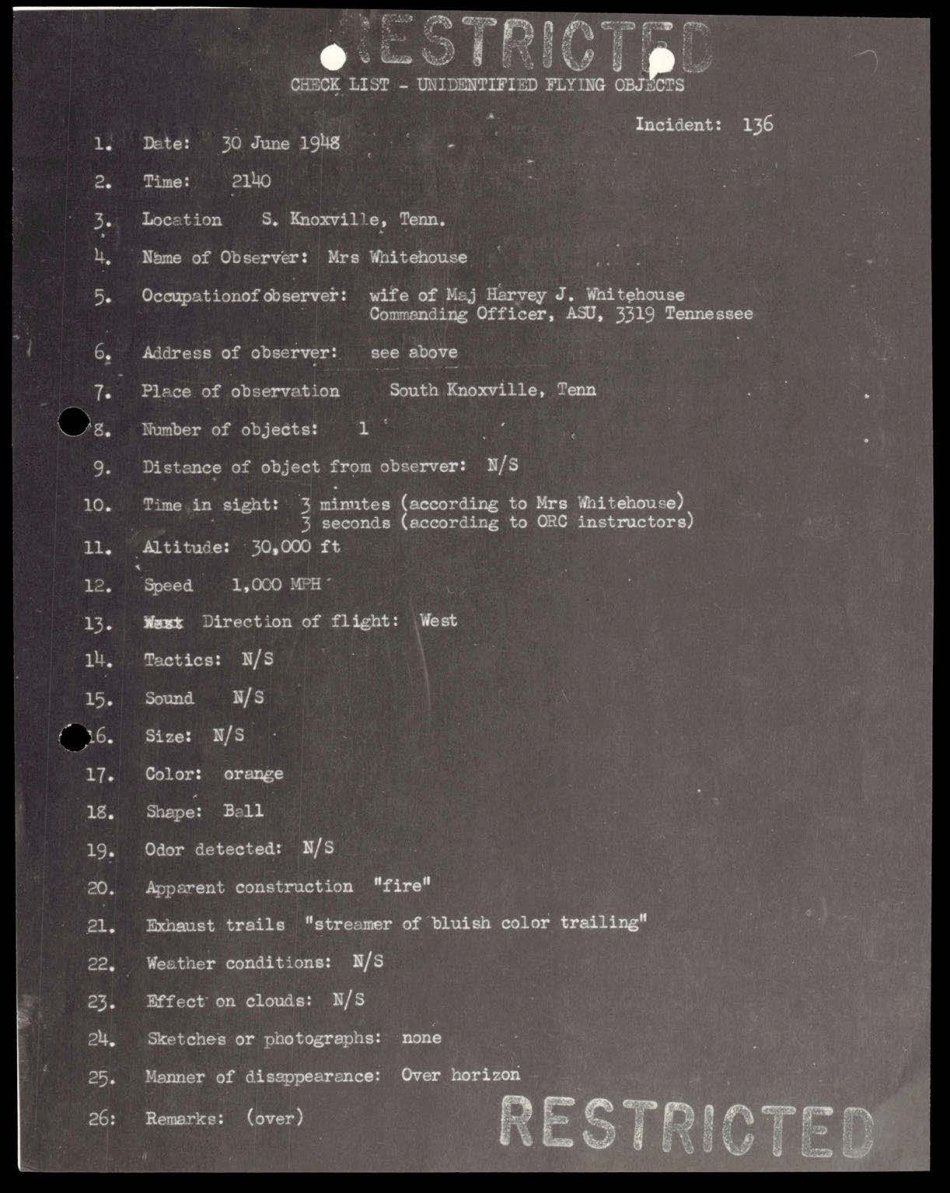
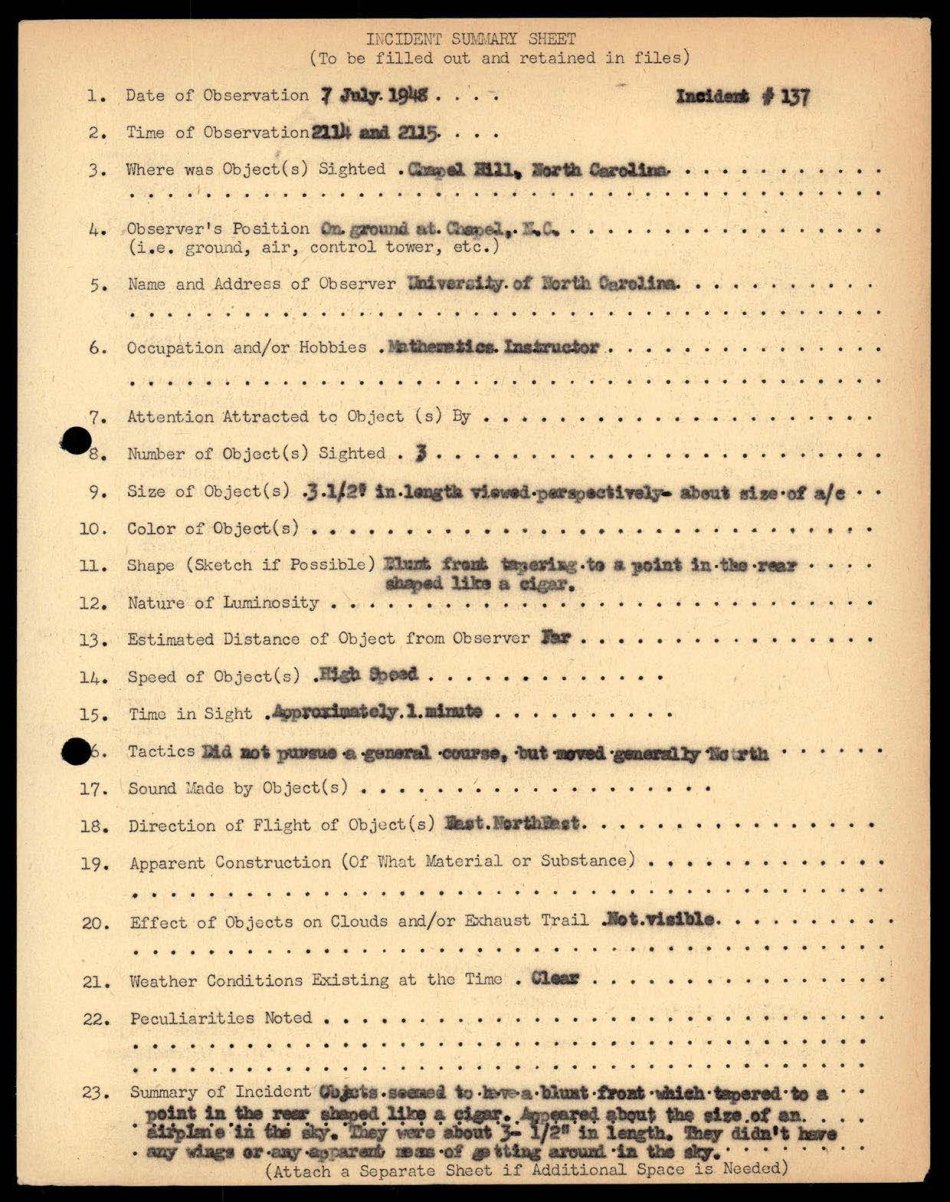
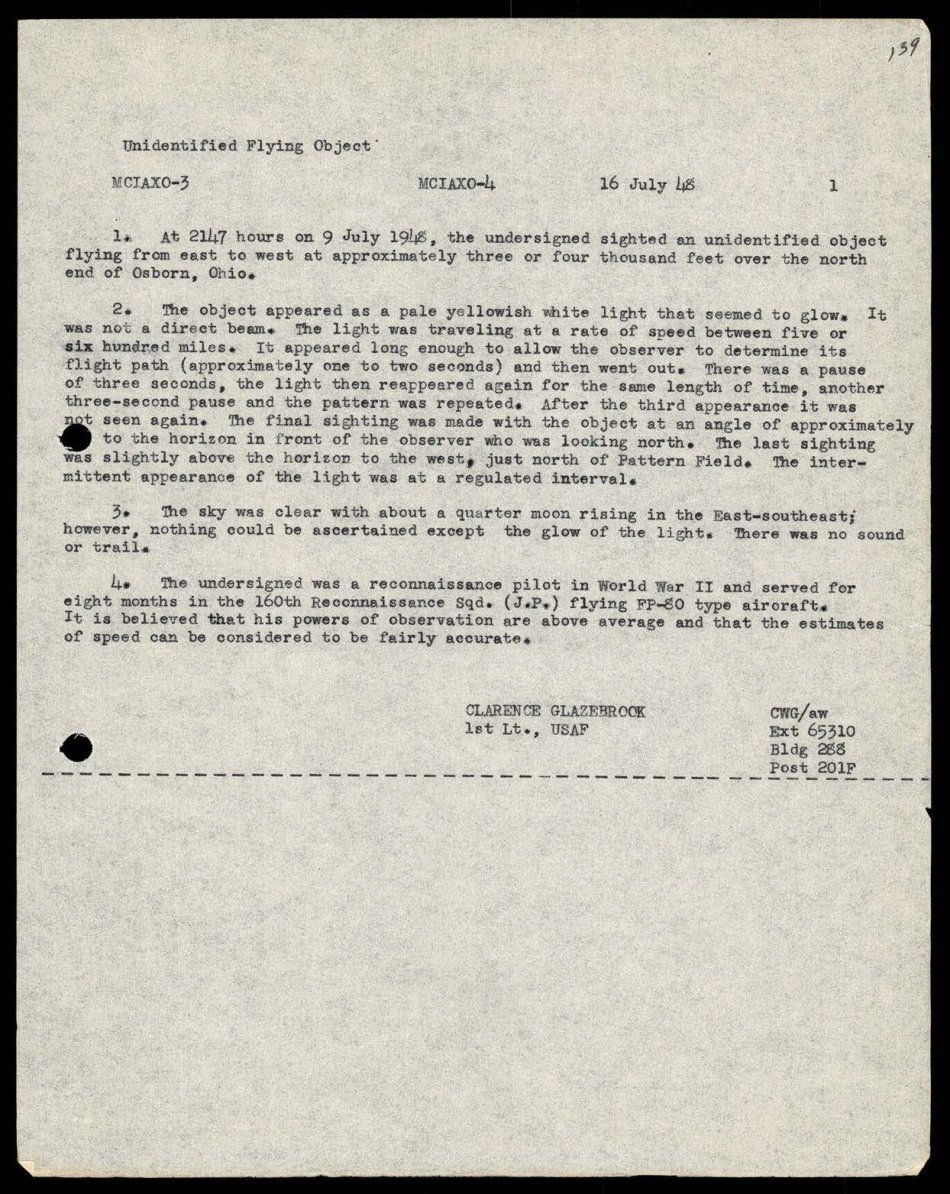
Date: 31/07/1948Location: Indianapolis, Indiana
Indianapolis, 1948: cymbal-shaped UFO reported by the Swigert couple
On July 31, 1948, Vernon Swigert and his wife reported a dull white UFO crossing the sky over the south-central area of Indianapolis in about ten seconds.
- Event date
- 31/07/1948
- Location
- Indianapolis, Indiana
- Topic
- 1948 reports
- Source agencies
- Arquivo histórico · CIA · DOW
- Documents
- 3 documents · 700 pages
- Reading time
- 14 min
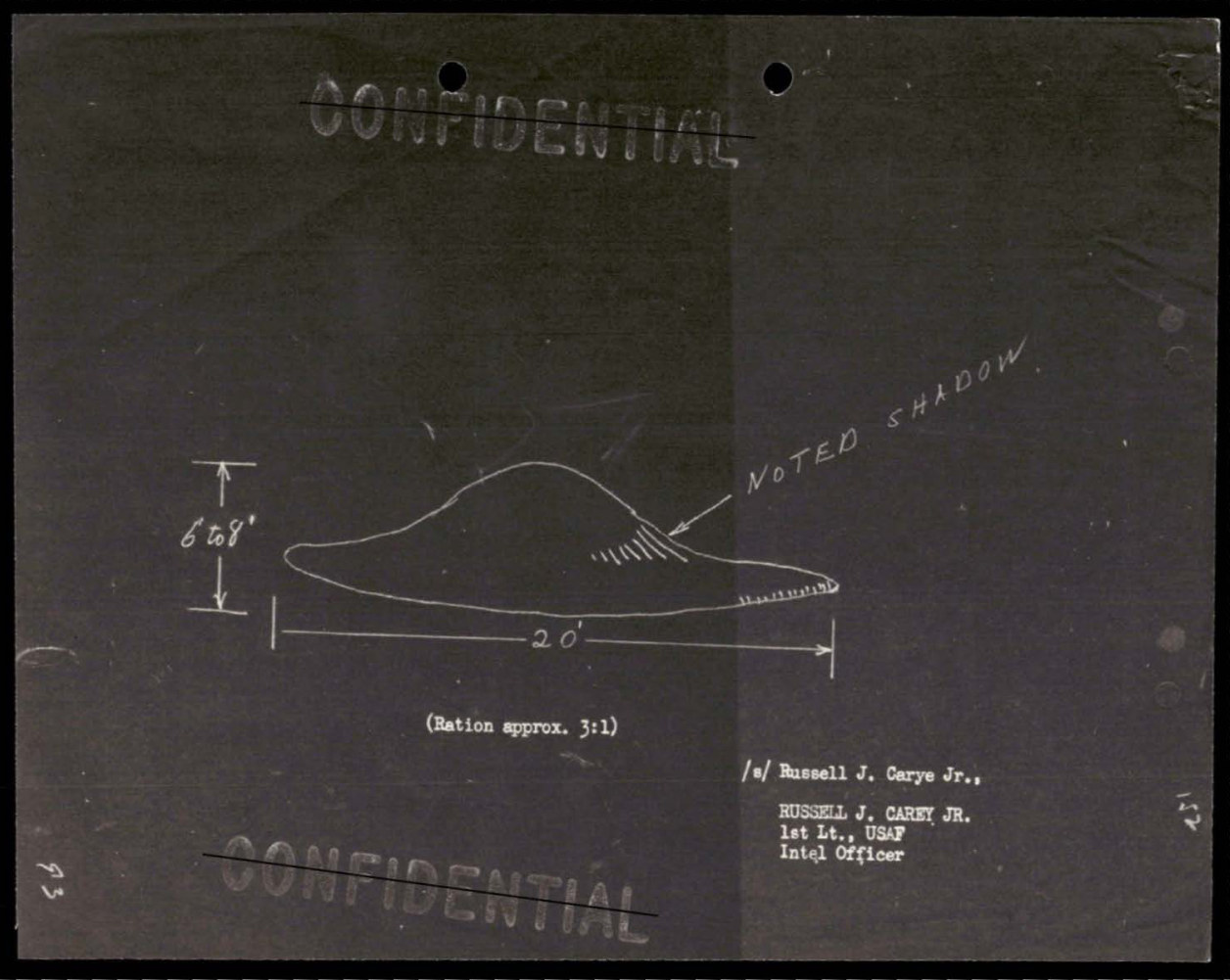 Official reconstruction drawingPhysical page 137
DOCUMENTARY SOURCES · Arquivo histórico / CIA / DOW
What the records tell
On July 31, 1948, Vernon Swigert and his wife reported a dull white object crossing the sky over the south-central area of Indianapolis in about ten seconds.
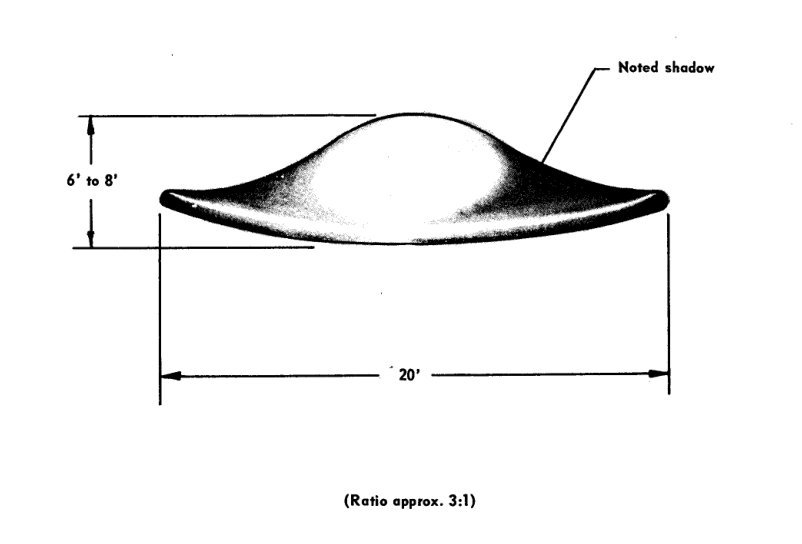
The narrative compares it to a cymbal with smooth surfaces and a raised center, with no sound, trail or visible openings. Sunlight reportedly produced a flickering and an appearance of rotation.
Swigert saw the object through a west-facing window and called his wife, who observed it through a south-facing kitchen window. An intelligence officer recorded that both offered good visibility.
The figures of twenty feet in diameter, six to eight feet in height, 2.000 feet of altitude, five miles traveled and 1.800 miles per hour are interlinked estimates from the report. The record form does not state the object's distance from the observers.
The sequence preserved on the following page explains how the couple came to make the observation. Vernon Swigert noticed the object at the open, west-facing bathroom window and called his wife to the south-facing kitchen window. The investigator, Russell J. Carey Jr., a first lieutenant in the U.S. Air Force (USAF), visited the site after a call from Swigert and noted that there was good visibility from both windows. The record adds that he received no other reports of that object.
The drawing signed by the officer depicts the reported profile, the width of twenty feet, the central height of six to eight feet and an area identified as observed shadow. It is a documentary reconstruction produced during the federal investigation. The image lets the reader check how the report was recorded, without turning it into a photograph of the event or an independent physical measurement.
Another report in Indianapolis was recorded two days earlier, on July 29. It belongs to Incident 151 and involves other witnesses, an object described as similar to a propeller, and a later search in a wooded area. The Swigert couple's episode is Incident 152 and remains in its own dossier. The proximity in city and time prompts the comparison, but does not demonstrate that it was the same object.
Special Report 14 included the couple's report as Case VIII (serial 0576.00) among the 12 "good unknowns." The summary says only that an electrician was at the west-facing bathroom window of his home at 8h25 on July 31, 1948, when he saw the object; he ran to the kitchen and showed it to his wife. The object remained in view for about 10 seconds and crossed the sky in straight and level flight, from horizon to horizon, from west to east. The published drawing repeats the measurements of 20 feet in width and 6 to 8 in height, with the note "observed shadow."
In the final evaluation, Case VIII was one of the five that passed the study's first three conditions: shape and maneuvers similar to those of many unknowns, a reliable observer, and details that would rule out an ordinary object. But the authors recorded that it was the only one of the five that was completely smooth, without protrusions, and that it therefore could not be combined with the others into a single flying-saucer model.
One detail of the narrative does not yet appear in the dossier: Swigert told the investigator that the object seemed large enough to carry a person. This is his impression, recorded after a crossed-out sentence on the sheet, not a conclusion of the officer. The record form marks the object as dull white, "no glow," cymbal-shaped, at about 2.000 feet, and leaves distance, maneuvers and manner of disappearance blank. The only sky information is "clear." The drawing cited in item 24 is the profile signed by Lieutenant Carey.
The same officer handled both Indianapolis reports that week. Lieutenant Russell J. Carey Jr., intelligence officer at Stout Field, signed the drawing and the map for the propeller case of July 29, and two days later went to the Swigerts' home after a phone call from the electrician. On both record forms he produced a reconstruction drawing based on the witnesses' description. In the Swigert case, he noted that visibility was good from both windows and that no other report of that object had come in.
The record form, the continuation sheet and the drawing appear twice in the collection: in the box of incident summaries and in the second Air Force compilation of incidents 101 to 172, with the same text. Seven years later, Special Report No. 14 revisited the case without the names, as Case VIII. The pages in the collection contain no statement signed by the couple, no separate interview with the wife, and no official explanation for the object.
More images from the document
DIRECT READING OF THE FILE
The document, in the original
Translations of selected fields, narrative and drawing labels, checked against physical pages 135–137. Assessments and estimates remain attributed to the record.
EXCERPT 1 · PHYSICAL PAGE 136
full narrative and investigation notes
Object first perceived in the west. The object wes shaped like a cymbal
with smooth surfaces and approximately 20 feet in diameter at the base
and epproximately 6 to & fect in eight in the center. Ratio was sbout 3:1.
It appeared to be flat white tn color with no . It traveled extremely _
fast crossing the sky in approximately 10 seconds (a distance of about 5 miles,
on a 90° heading. eee See course and shimmered in the sun
giving the f£ spinning, The altitude was estimated at approx
imately 2, ft. Object made no discernible sound and left no exheust trail.
No openings were noted on the object.
NOTE: Mr. Swigert was standing by open bathroom wkmimxm window which
faces the west when he wes attracted by the object in the sky.
Couldn't believe his eyes. He rushed into adjoining kitchen
and showed his wife the object thru the kitchen window facing south.
He zmamgkt stated the object appeared large enough to carry one
person
NOTE: Investigation conducted by Intel Officer, lst Lt Russell J. Carey,
dr., on @ call from Mr. Swigert. It wes noted that visibility ws
good from both windows for such observation,
No other reports received on this object.
e : sd WhEditorial note: Full narrative legible. The five-mile distance, the dimensions and the resulting speed depend on visual estimates made without a documented initial distance.
Check the original PDF
Object first perceived in the west. The object was shaped like a cymbal with smooth surfaces and approximately 20 feet in diameter at the base and approximately 6 to 8 feet in height in the center. Ratio was about 3:1. It appeared to be flat white in color with no shine. It traveled extremely fast crossing the sky in approximately 10 seconds (a distance of about 5 miles) on a 90° heading. It maintained a level course and shimmered in the sun giving the appearance of spinning. The altitude was estimated at approximately 2,000 ft. Object made no discernible sound and left no exhaust trail. No openings were noted on the object. NOTE: Mr. Swigert was standing by open bathroom window which faces the west when he was attracted by the object in the sky. Couldn’t believe his eyes. He rushed into adjoining kitchen and showed his wife the object thru the kitchen window facing south. He stated the object appeared large enough to carry one person. NOTE: Investigation conducted by Intel Officer, 1st Lt Russell J. Carey, Jr., on a call from Mr. Swigert. It was noted that visibility was good from both windows for such observation. No other reports received on this object.View the document record ↗ · Physical page 136, counting the cover.
EXCERPT 2 · PHYSICAL PAGE 137
labels of the associated drawing
/•/ Bussell J. Cari-• Jr.,
ROSSE:LL J. CAREY JR.
ht Lt. I USAF •
Int~l OfficerEditorial note: The drawing is a documentary reconstruction prepared by the investigating officer based on the account; it is not a photograph of the UFO. The visual description of the shape appears in the attachment image and in the editorial summary, so that it is not confused with text present in the labels.
Check the original PDF
6 to 8′. 20′. (Ratio approx. 3:1). Noted shadow. /s/ Russell J. Carey Jr., 1st Lt., USAF, Intel Officer.View the document record ↗ · Physical page 137, counting the cover.
EXCERPT 3 · PHYSICAL PAGE 94
Case VIII (series 0576.00), with drawing captions, physical page 94 (full text)
I
I
Case VIII (Serial 0576. 00)
An electrician was standing by the bathroom window of his home, I
facing west, at 0825 hours on July 31, 1948, when he first sighted an object.
He ran to his kitchen where he pointed out the object to his wife. Total I
time in sight was approximately 10 seconds, during which the object flew
on a straight and level course from horizon to horizon, west to east. I
I
I
I
I
I
f
6' to 8'
20'
(Ratio approx. 3:1)
I
I
I
I
I
I
I
I
I
I
I
I
84Editorial note: The drawing is already published in the dossier and is not repeated.
Check the original PDF
Case VIII (Serial 0576.00). An electrician was standing by the bathroom window of his home, facing west, at 0825 hours on July 31, 1948, when he first sighted an object. He ran to his kitchen where he pointed out the object to his wife. Total time in sight was approximately 10 seconds, during which the object flew on a straight and level course from horizon to horizon, west to east. [Desenho:] Noted shadow. 6' to 8'. 20'. (Ratio approx. 3:1)View the document record ↗ · Physical page 94, counting the cover.
EXCERPT 4 · PHYSICAL PAGE 101
Selection criterion and the four conditions of the model, physical page 101 (passage referring to all cases)
I
I
I
These 12 sightings can be classed into four categories on the basis of
their shapes, as follows:
( l} Propeller shape - Case I
I (2) Aircraft shape - Cases II and III
I (3) Cigar shape - Cases IV and V
I (4) Elliptical or disc shape - Cases VI to XII
The criterion for choosing the above sightings was that their descrip I tions were given in enough detail to permit diagrams of the objects to be
I
drawn. It might be noted here that in all but one of these cases (Case XI)
the observer had already drawn a diagram of what he had seen.
The objective of this section of the study was the conceiving of a
I model, or models. The requirement that the description be detailed is an
I
important one, and was the easiest to determine in the re-evaluation program. However, a good model ought to satisfy the following conditions as
well:
I ( 1) The general shape of the object and the maneuvers it
performed should fit the reports of many of the UNKNOWNS
and thus explain them.
I (2) The observer and the report should be reliable.
I (3} The report should contain elements which should have
been observed with accuracy, and which eliminate the
I possibility that the sighting could be ascribed to a
familiar object or to a known natural phenomenon.
I ( 4} The model should be derived from two or more good
UNKNOWNS between which there is no essential conflict.
I It can be shown that it is not possible to deduce a model from the 12
cases that will satisfy all of these conditions. The following case-by-case
I discussion of the 12 good UNKNOWNS will illustrate this point:
I ( 1) Case I does not satisfy Conditions 1 and 4. The reported
shape of this object is not duplicated in any of the other
UNKNOWNS.
I
I •(2) Case II does not satisfy Conditions 1 and 3. There are
very few UNKNOWNS in the aircraft shape classification.
In addition, the unusual characteristic of this sighting
I
(i.e., the red glow) could have been reflection of the
lights of Flint from the objects if they were either birds
or aircraft.
91
IEditorial note: Passage common to the 12 cases; the sign [...] marks a sentence from the middle omitted because it deals only with the general objective of the study, already translated in the Report 14 dossier.
Check the original PDF
The criterion for choosing the above sightings was that their descriptions were given in enough detail to permit diagrams of the objects to be drawn. It might be noted here that in all but one of these cases (Case XI) the observer had already drawn a diagram of what he had seen. [...] a good model ought to satisfy the following conditions as well: (1) The general shape of the object and the maneuvers it performed should fit the reports of many of the UNKNOWNS and thus explain them. (2) The observer and the report should be reliable. (3) The report should contain elements which should have been observed with accuracy, and which eliminate the possibility that the sighting could be ascribed to a familiar object or to a known natural phenomenon. (4) The model should be derived from two or more good UNKNOWNS between which there is no essential conflict.View the document record ↗ · Physical page 101, counting the cover.
EXCERPT 5 · PHYSICAL PAGE 102
Evaluation of Cases VIII to XII, physical pages 102 and 103
(3) Case III does not satisfy Condition 1. It also does not
satisfy Condition 4 when Case II is eliminated as a
good UNKNOWN.
(4) Case IV does not satisfy Conditions 1 or 2. There are
few cigar-shaped or rocket-shaped objects reported in
the literature. In addition, this observer is not considered to be well-qualified technically.
(5) Case V does not satisfy Condition 1. It also does not
satisfy Condition 4 when Case IV is eliminated as a
good UNKNOWN.
It might be argued here that many of the UNKNOWNS might actually
have shapes similar to these good UNKNOWNS. It will be noted, however,
that each of these five cases does not satisfy one of the other three conditions.
(6) Case VI does not satisfy Condition 2. In the description
of the object, it was stated that at certain times there
was no light seen from the object. Apparently, the
"band of no light", as diagrammed by the observer, was
an attempt to explain this. However, if the object were
constructed as shown in the diagram, light should have
been seen at all times. Because of this conflict the
drawing is not considered reliable, and without the drawing, there is not enough detail in the description to make
it useful for this study.
(7) Case VII violates Conditions 1 and 4. Although the shape
is disc-like, the maneuvers performed by the object are
unique both among the UNKNOWNS and among the good
UNKNOWNS.
Cases VIII to XII satisfy Conditions 1 through 3, but they do not
satisfy Condition 4. The features which make them different from each
other are as follows:
(8) Case VIII. The object is smooth, with no protrusions
or other details.
( 9) Case IX. The object had rocket or jet pods on each
side that were shooting out flames.
(10) Case X. The,object had a fin or rudder.
( 11) Case XI. The object had a series of portholes, or
windows, on its under side.
92
I
I
I
I
I
I
I
I
I
I
I
I
I
I
I
I
I
I
I
I
I
IEditorial note: The passage cites the five cases together because the report's conclusion depends on the comparison between them.
Check the original PDF
Cases VIII to XII satisfy Conditions 1 through 3, but they do not satisfy Condition 4. The features which make them different from each other are as follows: (8) Case VIII. The object is smooth, with no protrusions or other details. (9) Case IX. The object had rocket or jet pods on each side that were shooting out flames. (10) Case X. The object had a fin or rudder. (11) Case XI. The object had a series of portholes, or windows, on its under side. (12) Case XII. The object had windows in its top and front and its top midsection. It also had a set of propellers around its waist. It is not possible, therefore, to derive a verified model of a "flying saucer" from the data that have been gathered to date.View the document record ↗ · Physical page 102, counting the cover.
EXCERPT 6 · PHYSICAL PAGE 135
Physical page 135: verification form for incident 152, items 1 to 26 (full text, address omitted)
20.
21.
@ AAP ar ere es
ew EVP NTTAL
CHECK*LIST = UNIDENTIFIED FLYING OBJECTS
Dato 31 July 4g : Incidont 152
Time 0825 7
Kecetion _ Indianapolis, Indiana (South-Central pert) :
Name of observers Mr, & Mrs Vernon Swigert
Occupation of obsorvors M@ENBEX an electrician and housewife
Address of observors 2020 Boyd St,, Indianapolis, Indiana
Placo of obsorvetion As abeve —
Numbor of objects 1
Distance of objoct from observer y/s
Timo in sight 10 seconds
Altitude 2,000 ft
Speod 1890 MPE
Direction of flight 90° - east
Tactics B/S
Sound Mone
Siro PEKKGXEXS - 20 ft in dia. iui epatenticel to 8 ft in height
in center - Ratio about 3:1
Color white with no shine
Shapo like a cymbal
Odor dotectod n/S .¥
Apparent construction u/s
Exhaust trails None
Woether sebdietben Sky clear
Effoct on shina H/S
Sketches or photographs 1
Nanner of disappearance 4/S
Romarks: (over)Editorial note: "N/S" (not stated) was translated as "not stated". In item 12, the second digit was typed over another; in both reproductions of the form (box 7, p. 135; D088, p. 153) the reading is 1800. 20 feet is about 6 meters; 2.000 feet, about 610 meters. The home address was omitted. The drawing in item 24 is the one on physical page 137.
Check the original PDF
CONFIDENTIAL [struck through]. CHECK-LIST - UNIDENTIFIED FLYING OBJECTS. Incident # 152. 1. Date 31 July 48. 2. Time 0825. 3. Location Indianapolis, Indiana (South-Central part). 4. Name of observers Mr. & Mrs Vernon Swigert. 5. Occupation of observers [word struck out] an electrician and housewife. 6. Address of observers [endereço omitido], Indianapolis, Indiana. 7. Place of observation As above -. 8. Number of objects 1. 9. Distance of object from observer N/S. 10. Time in sight 10 seconds. 11. Altitude 2,000 ft. 12. Speed 1800 MPH. 13. Direction of flight 90° - east. 14. Tactics N/S. 15. Sound None. 16. Size [word struck out] - 20 ft in dia. and approx 6 to 8 ft in height in center - Ratio about 3:1. 17. Color white with no shine. 18. Shape like a cymbal. 19. Odor detected N/S. 20. Apparent construction N/S. 21. Exhaust trails None. 22. Weather conditions Sky clear. 23. Effect on clouds N/S. 24. Sketches or photographs 1. 25. Manner of disappearance N/S. 26. Remarks: (over). CONFIDENTIAL [struck through]. [Handwritten:] 92.View the document record ↗ · Physical page 135, counting the cover.
EXCERPT 7 · PHYSICAL PAGE 153
full page
CHECK• LIST - UNIDENT IFIED FLYI?JG OBJECTS
Inc id·mt # 152
2 . Time
3. Locotion Iiacilanapolia. Indiam (South-Central part)
h. I!omo of obser ver I Hr. &Jlr1 T8l"mn Swigert
5. Occupation of ob~orvor I Rilill am. electriclaa ad houeewU'e
6. :~ddross of obsorvor I 203:> Bo,-d. St.• lndl«MpOlia, 1D4hma
7. Placo of obsor~ti on .laabo••-
a. Number or objoots 1
9. Distance of obj ect from obsor vor B/S
10. Til"lO in si ght 10 NOOnds
11. .Altitude 2,000 !~
12. Spood 18')0 MPH
13. Direction of fli ght 90° • east
14. Tactics 11/S
15. S ound Sou
16. Sizo- • a> ft 1n d1a. Ud approx 6 to 8 ft 1a he1d,1.t
1Ja center - Batio about 3:1 17. Col or ,-bite with ao ab1ne
18 . Sha pe lib a q1lbal
19. Odor dotoctod B/S ,t I
20. Apparont construction B/S
21. Exhaust trails Jrone
22 . V/oa thor conditi ons :.;, clear
23 . Effect on c louds •/s
24. Skotohcs or photographs 1
25. Uannor of disappoaranoo 1/S
26. Romorks: ~over)Editorial note: Record card for incident 152: a couple in Indianapolis report, on the morning of July 31, 1948, a white cymbal-shaped object that crossed the sky to the east in about ten seconds.
Check the original PDF
CHECK• LIST - UNIDENT IFIED FLYI?JG OBJECTS
Inc id·mt # 152
2 . Time
3. Locotion Iiacilanapolia. Indiam (South-Central part)
h. I!omo of obser ver I Hr. &Jlr1 T8l"mn Swigert
5. Occupation of ob~orvor I Rilill am. electriclaa ad houeewU'e
6. :~ddross of obsorvor I 203:> Bo,-d. St.• lndl«MpOlia, 1D4hma
7. Placo of obsor~ti on .laabo••-
a. Number or objoots 1
9. Distance of obj ect from obsor vor B/S
10. Til"lO in si ght 10 NOOnds
11. .Altitude 2,000 !~
12. Spood 18')0 MPH
13. Direction of fli ght 90° • east
14. Tactics 11/S
15. S ound Sou
16. Sizo- • a> ft 1n d1a. Ud approx 6 to 8 ft 1a he1d,1.t
1Ja center - Batio about 3:1 17. Col or ,-bite with ao ab1ne
18 . Sha pe lib a q1lbal
19. Odor dotoctod B/S ,t I
20. Apparont construction B/S
21. Exhaust trails Jrone
22 . V/oa thor conditi ons :.;, clear
23 . Effect on c louds •/s
24. Skotohcs or photographs 1
25. Uannor of disappoaranoo 1/S
26. Romorks: ~over)View the document record ↗ · Physical page 153, counting the cover.
EXCERPT 8 · PHYSICAL PAGE 154
full page
Object first perceived in the west. 1.be object w.s shaped like a cymbal
With smooth aurfa.ces and epprorlm.tely 20 f eet in dismeter at the base
and approximately 6 to g feet in aeiDlt in the center. Batio was about 3:1.
It appem-ed to be fiat. white b color with DO shine. It trave.led extremely
fast crossing the aky in sppro:rlratel.5 10 seconds (a distance of about 5 miles)
on a ~ 0 beed.iJl&. It maintained a level course and ahimnered in the sun
giVJ.lli the appearance of spinni.Dg. '?he al.ti tude was estimated at approximatel7 2,000 ft. Object made no discernible sound and left no eDBllst trail.
lo openizlge were noted on the object.
NOTE: Mr. Swi«ert was atand1~ by open bathroom wt i4 ■■■ window which
f~ces the west an be was attracted by the obJect in the u:;y. Couldn't believe hie eyes. He rushed into adjoining ki tcb.en
and showed hie wife the object tbru the kitchen window facing south.
He li••q;kk etated the object appeared lerge enough to carry one
perso.n
ll>':'.E: 1Ave1tigation oondncted b7 Intel Officer, 1st Lt Bussell J. Carey,
Jr., on a call from Mr. Swigert. It was noted that rts1bi11ty 1118.S
good from both windows for such observation.
lo other reports receiTed on this object.
ta
•Editorial note: Narrative of incident 152: the smooth white object, seen through the windows of the house, and the check on visibility made by the base intelligence officer.
Check the original PDF
Object first perceived in the west. 1.be object w.s shaped like a cymbal
With smooth aurfa.ces and epprorlm.tely 20 f eet in dismeter at the base
and approximately 6 to g feet in aeiDlt in the center. Batio was about 3:1.
It appem-ed to be fiat. white b color with DO shine. It trave.led extremely
fast crossing the aky in sppro:rlratel.5 10 seconds (a distance of about 5 miles)
on a ~ 0 beed.iJl&. It maintained a level course and ahimnered in the sun
giVJ.lli the appearance of spinni.Dg. '?he al.ti tude was estimated at approximatel7 2,000 ft. Object made no discernible sound and left no eDBllst trail.
lo openizlge were noted on the object.
NOTE: Mr. Swi«ert was atand1~ by open bathroom wt i4 ■■■ window which
f~ces the west an be was attracted by the obJect in the u:;y. Couldn't believe hie eyes. He rushed into adjoining ki tcb.en
and showed hie wife the object tbru the kitchen window facing south.
He li••q;kk etated the object appeared lerge enough to carry one
perso.n
ll>':'.E: 1Ave1tigation oondncted b7 Intel Officer, 1st Lt Bussell J. Carey,
Jr., on a call from Mr. Swigert. It was noted that rts1bi11ty 1118.S
good from both windows for such observation.
lo other reports receiTed on this object.
ta
•View the document record ↗ · Physical page 154, counting the cover.
EXCERPT 9 · PHYSICAL PAGE 155
full page
' •
(Bation approx. J:l)
/ a/ Russell J • 1,/U,["ye ,.__ Jr.,
RUSSELL J CAREY
l8t Lt. I 05.Al' • JR.
Intel OfficerEditorial note: Drawing of the cymbal-shaped object, signed by the intelligence officer, with measurements of 20 feet wide and 6 to 8 feet high.
Check the original PDF
' •
(Bation approx. J:l)
/ a/ Russell J • 1,/U,["ye ,.__ Jr.,
RUSSELL J CAREY
l8t Lt. I 05.Al' • JR.
Intel OfficerView the document record ↗ · Physical page 155, counting the cover.
Dates and documentary context
- Event
- 31/07/1948 — Date and time 08h25 recorded on the Incident 152 record.
- Document
- Not established — Date the record was prepared not established in the selection.
- Publication
- Not established — Public release date not established in the cited pages.
Origin and release
USAF / Historical archive of the United States government · 38_143685_box7_Incident_Summaries_101-172.pdf
Partial curation of pages 135–137 of a 178-page PDF. Interdependent visual estimates; ten-second observation; no additional independent account, photograph, radar or material trace.
Related accounts and their differences
Questions to continue the investigation
- How were the dimensions and the distance traveled estimated with no recorded initial distance?
- Did Mrs. Swigert leave a separate statement?
- Were there compatible aircraft or local phenomena at the reported time?
GEOGRAPHY OF THE CASE
South-central region of Indianapolis, Indiana
Approximate point in the south-central region indicated by the document, distinct from the generic urban reference. Approximate regional reference, placed by the editorial team based on the place mentioned in the document. The marker does not represent the exact location of the account.
DOCUMENTARY TRAIL
Go back to the sources
References use physical pages of the PDF, counting the cover. Summaries are presented in English; the documents keep their original language.
- 38_143685_box7_Incident_Summaries_101-172.pdf
Physical pages 135–137 — Incident 152
Arquivo histórico · 178 pages - CIA-UAP-015-Project_Blue_Book_Special_Report_No_14.pdf
Special Report No. 14, drawing for case 8, physical page 94
CIA · 312 pages - DOW-UAP-D088_US-AirForce_Analysis-of-Flying-Objects-in-the-US_101-172.pdf
Physical pages 153 to 155: another reproduction of the record form for incident 152, of the continuation sheet and of the drawing (same record, not an independent report)
DOW · 210 pages
Editorial summary based on the collection's research notes. How we read the documents.