Date: October 1948 (the 4th or the 14th; first digit erased), around 14h30Location: Near Dayton, Ohio, USA, in flight at 6.000 feet
Near Dayton, 1948: C-47 pilot ducks to avoid silver "teardrop"-shaped UFOs
In October 1948, Major C. M. Smartt, pilot of a C-47 at 6.000 feet near Dayton, said he saw three or four silver teardrop-shaped UFOs pass so close that he and the copilot ducked. The investigator noted that the first version spoke of 15 to 20 UFOs.
- Event date
- October 1948 (the 4th or the 14th; first digit erased), around 14h30
- Location
- Near Dayton, Ohio, USA, in flight at 6.000 feet
- Topic
- 1948 reports
- Source agencies
- Arquivo histórico
- Documents
- 1 document · 144 pages
- Reading time
- 7 min
 Official formPhysical page 21
DOCUMENTARY SOURCES · Arquivo histórico
What the records tell
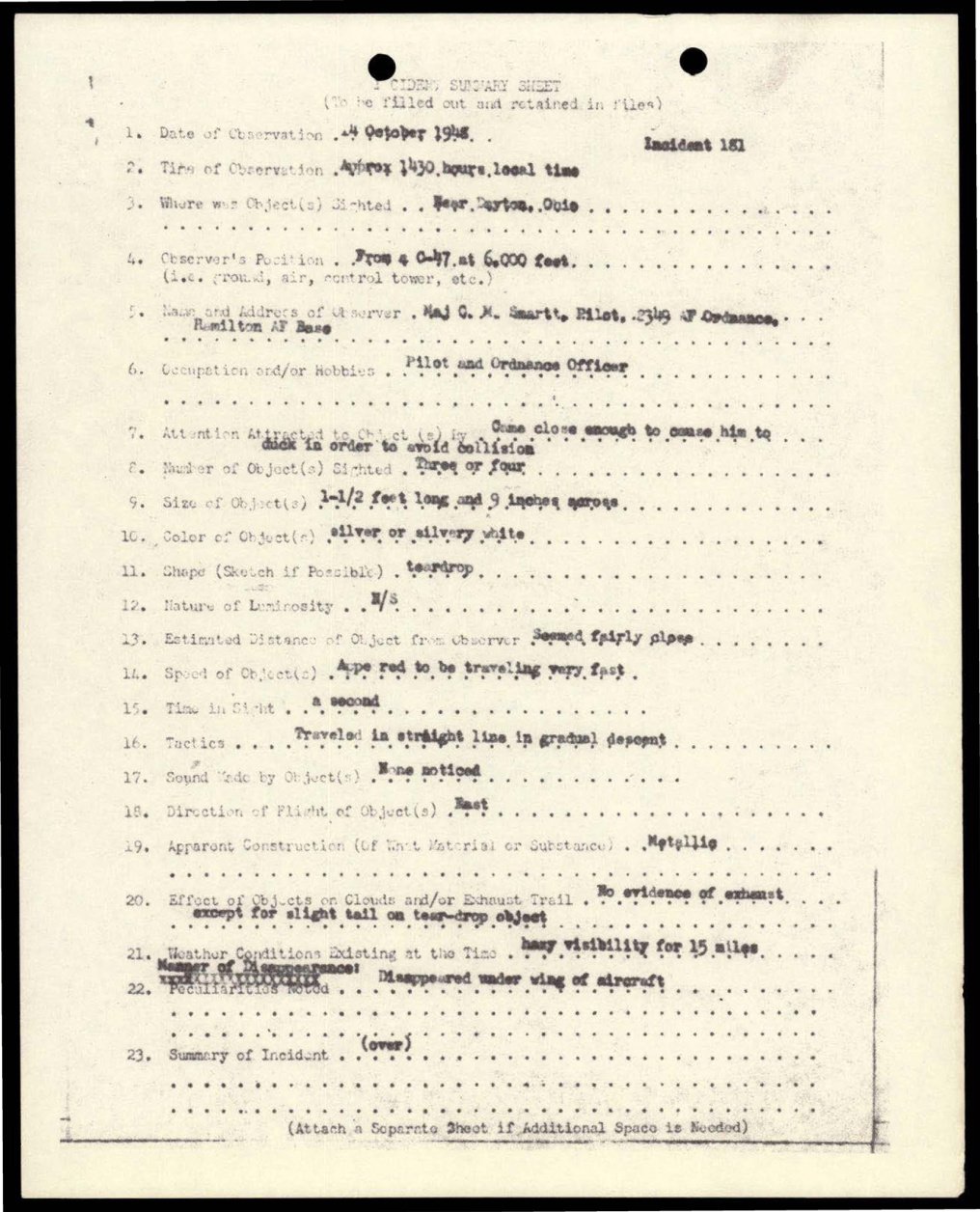
The Project Sign summary sheet for incident 181 records the account of Major C. M. Smartt, a pilot and ordnance officer attached to an Air Force ordnance unit at Hamilton base, California. Around 14h30, local time, in October 1948, he was piloting a C-47 at 6.000 feet near Dayton, Ohio. The day is partially erased on the record: it reads "4", with a first digit that is almost invisible.
According to the record, three or four silver or silvery-white teardrop-shaped objects, about 1,5 feet long and 9 inches wide, came toward the airplane. They appeared metallic and very fast, were in view for only a second, traveled in a straight line in a gradual descent toward the east, and disappeared under the wing. What drew attention was the proximity: one of them came close enough that the pilot ducked, fearing a collision. There was haze, with visibility of 15 miles, and no trail other than a small tail on the teardrop.
The continuation of the record says some objects passed so close that pilot and copilot ducked, because it looked as if they would go through the nose of the airplane. The major offered a comparison: take half a gallon of water and throw it 200 yards ahead of an approaching airplane, some 200 feet above it, with the water taking the shape of a teardrop. In the last version, the objects were seen one at a time, at intervals of three or four minutes.
The investigator noted discrepancies. In the first account, the major spoke of 15 to 20 objects and said they had no definite heading, some descending and others climbing; in the last, he spoke of three or four and did not mention any climbing. For the author of the note, the water-throwing comparison itself suggests the impression of a group seen all at once, as in the first account, and not of individual objects every three or four minutes.
The file has no conclusion. As an editorial hypothesis, small, bright shapes that pass in a second near the windshield, descending, are consistent with drops of water, ice, or loose objects in the air, but the document records no rain, ice, or other airplane nearby, and nothing allows a choice among these possibilities. The statement of the copilot, who according to the record also ducked, is not in the file.
The location of the account carries particular weight. Dayton, Ohio, was the city of Wright-Patterson Air Force Base, headquarters of the Air Materiel Command, where Project Sign operated, gathering and numbering these records. Major Smartt, however, served far from there: the record links him to an Air Force ordnance unit at Hamilton base, California. The document does not say where the C-47 was coming from or going to, nor who the copilot who also reportedly ducked was.
The summary sheet uses the short model of the series, with 23 fields and the instruction "to be filled out and kept on file." The line about the manner of disappearance, "disappeared under the wing of the aircraft," was typed in later, over a crossed-out word, between fields 21 and 22, and the peculiarities field was left empty. The discrepancy note, on the continuation sheet, is the only written evaluation of the case: the investigator gives no reliability letter or number but makes clear that the major's two versions do not match.
The two accounts by the major that the investigator compares, the first and the last, are not in the file; the box holds only the summary that sets them against each other. There is also no complete date: the day appears with its first digit nearly erased. No other document gathered on the portal mentions incident 181, Smartt's name, or a C-47 near Dayton in October 1948. The only available source is the record itself, with the doubts it raises.
DIRECT READING OF THE FILE
The document, in the original
Both pages of the case translated in full (physical pages 21 and 22): the summary sheet, field by field, and the continuation with the annotated discrepancies. There is no other copy of this range of records in the collection.
EXCERPT 1 · PHYSICAL PAGE 21
Full summary sheet of incident 181, physical page 21
.
! -· - -. "- w ... ..-- .1
-
:.i. .:-ct i 1.e .d. ;· · :i.eq)
1 . D.:,t.e ,, !' 1 'b,,:: ··v~U"r .~ 9eio)ef J la.a. lG
, ." ' \4}0. u..
ei . . .o~ . . . •
C.sc:- v •r ' :; P .;:i'i•·: .Jtait ~1 .•, 6.000 feel. t.:. • . ,· --oi ....J , ...,!" r",r • r 1 t o \"'l' t c .
(,. Uot OttlGitr. . . .
clo•-.cbt •
1i!a1oai ' • • ~
f . I.
1-1/2 t \ l. . .. . . .
,. tUlt.. vo: r . m .,,!. zt ( ")
l. Ch::,p' S.t..•~!..ch .:.r o~:;: b \ ) .
,, :::. t,4 '• ... ,I, - .. L· .I/ :
...
.. . ♦ t.•
ll, . t a\ . .
H .
17.
r • ·,.t
1 .,
.]
. a. . .
\
!--. •J~~ ?-~. 1.
I 1m. 1oe& .. .. . . . . .
.. •
• • ..
7 dl , ~-~•.
.....
ot.. .
, " .l . •
J,, •
j
!., a:,c.,
. . . . .-~
• . . . .. • • . • .• . . . . . . •.. . .. . . 1 . .. .. . ·c2J . s .rt ot lr.cid ....n • • • • • • . •
• • • • • • . • . • . • . • . ...
..... ... . . . .... . . . . ..
t f Addit.ionalEditorial note: The first digit of the day is almost invisible; it reads "4" preceded by a mark (October 4, 14 or 24). The line "Manner of Disappearance" was typed over a crossed-out word, above field 22.
Check the original PDF
INCIDENT SUMMARY SHEET (To be filled out and retained in files) | Incident 181 | 1. Date of Observation: [?]4 October 1948 | 2. Time of Observation: Approx 1430 hours local time | 3. Where was Object(s) Sighted: Near Dayton, Ohio | 4. Observer's Position (i.e. ground, air, control tower, etc.): From a C-47 at 6,000 feet | 5. Name and Address of Observer: Maj C. M. Smartt, Pilot, 2349 AF Ordnance, Hamilton AF Base | 6. Occupation and/or Hobbies: Pilot and Ordnance Officer | 7. Attention Attracted to Object(s) By: Came close enough to cause him to duck in order to avoid collision | 8. Number of Object(s) Sighted: Three or four | 9. Size of Object(s): 1-1/2 feet long and 9 inches across | 10. Color of Object(s): silver or silvery white | 11. Shape (Sketch if Possible): teardrop | 12. Nature of Luminosity: N/S | 13. Estimated Distance of Object from Observer: Seemed fairly close | 14. Speed of Object(s): Appeared to be traveling very fast | 15. Time in Sight: a second | 16. Tactics: Traveled in straight line in gradual descent | 17. Sound Made by Object(s): None noticed | 18. Direction of Flight of Object(s): East | 19. Apparent Construction (Of What Material or Substance): Metallic | 20. Effect of Objects on Clouds and/or Exhaust Trail: No evidence of exhaust except for slight tail on tear-drop object | 21. Weather Conditions Existing at the Time: hazy visibility for 15 miles | Manner of Disappearance: Disappeared under wing of aircraft | 22. Peculiarities Noted: [em branco] | 23. Summary of Incident: (over) | (Attach a Separate Sheet if Additional Space is Needed)View the document record ↗ · Physical page 21, counting the cover.
EXCERPT 2 · PHYSICAL PAGE 22
Continuation and discrepancies of incident 181, physical page 22
Objects secued to take no definite course but flew in a general easterly
(rection in e gradual descent. A few came close enough to oa se the
palot & co-pilot to duck as it appecred they might: come thru the nose of
‘he plane, Naj Suartt's analogy is as follows! Take about 1/2 gallon
of weter end <ump it 200 yaris in front of an approaghing ai: about
@O feet above it, wit: the water taking the shape of s teardrop. Theue
objects aype red to trevel in a straight Line toward the aircraft and
gredually descended, passing from view umier the wing of the G7, The
apparent apeed of these objects ape: red quite igh as they remained in
wiew for only @ second, They were sighted one at a time et interval of
three or four minntes,
%
Diecrepancies noted: In first report Haj Smartt recorted seeing 1
jects. Later he revorte seeing three or four.
in first report ke etutes that they purened no
Gefinite course in toat some travele: downward
and som traveled upward. In last report he
Goes not mention thet any pursued an upwerd course,
The analogy of comparing sighting of these objects
to L/2 gallon of w.ter demped approximately 200
yarce in front of cis afireraft and tiat teardrop
object: were formed seems to indicate an i pression
of a group of cbjects seen at one time (as first
reported) and not singly at intervals of three or
four mimates.
’ denon cintnlaieerrscclpa neees taatalatllatbiaai toni inant Satine acesCheck the original PDF
Objects seemed to take no definite course but flew in a general easterly direction in a gradual descent. A few came close enough to cause the pilot & co-pilot to duck as it appeared they might come thru the nose of the plane. Maj Smartt's analogy is as follows: Take about 1/2 gallon of water and dump it 200 yards in front of an approaching aircraft about 200 feet above it, with the water taking the shape of a teardrop. These objects appeared to travel in a straight line toward the aircraft and gradually descended, passing from view under the wing of the C-47. The apparent speed of these objects appeared quite high as they remained in view for only a second. They were sighted one at a time at intervals of three or four minutes. | Discrepancies noted: In first report Maj Smartt reported seeing 15 to 20 objects. Later he reports seeing three or four. In first report he states that they pursued no definite course in that some traveled downward and some traveled upward. In last report he does not mention that any pursued an upward course. The analogy of comparing sighting of these objects to 1/2 gallon of water dumped approximately 200 yards in front of his aircraft and that teardrop objects were formed seems to indicate an impression of a group of objects seen at one time (as first reported) and not singly at intervals of three or four minutes.View the document record ↗ · Physical page 22, counting the cover.
Dates and documentary context
- Event
- 10/1948 — October 4, 14 or 24, 1948: the first digit of the day is erased on the record. At around 14h30, local time.
- Document
- Not established — Record with no drafting date.
- Publication
- Not established — Released in the National Archives batch (box 7, incidents 173 to 233).
Origin and release
U.S. Air Force, Air Materiel Command (technical intelligence, Wright-Patterson), under Project Sign; sheets compiled from witness and air base reports · 38_143685_box7_Incident_Summaries_173-233.pdf
Questions to continue the investigation
- Where is Major Smartt's first account, with 15 to 20 objects?
- Did the copilot, who also ducked, give his own statement?
GEOGRAPHY OF THE CASE
Outskirts of Dayton, Ohio
Approximate reference to Dayton, placed by the editorial team. The record says only "near Dayton"; the aircraft was in flight at 6.000 feet and the exact position is not given.
DOCUMENTARY TRAIL
Go back to the sources
References use physical pages of the PDF, counting the cover. Summaries are presented in English; the documents keep their original language.
- 38_143685_box7_Incident_Summaries_173-233.pdf
Physical page 21: summary sheet of incident 181, near Dayton, October 1948 · Physical page 22: continuation and discrepancies noted by the investigator
Arquivo histórico · 144 pages
Editorial summary based on the collection's research notes. How we read the documents.