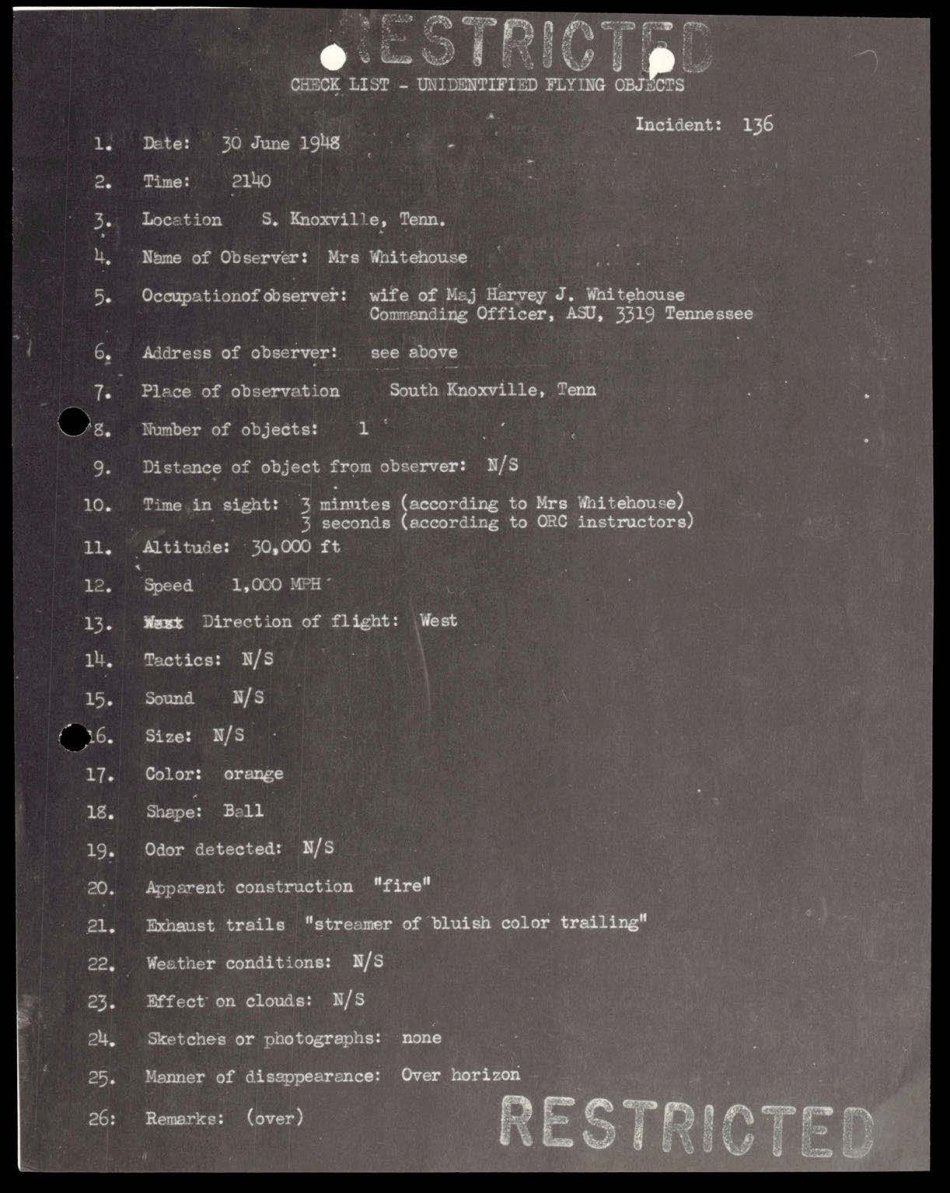
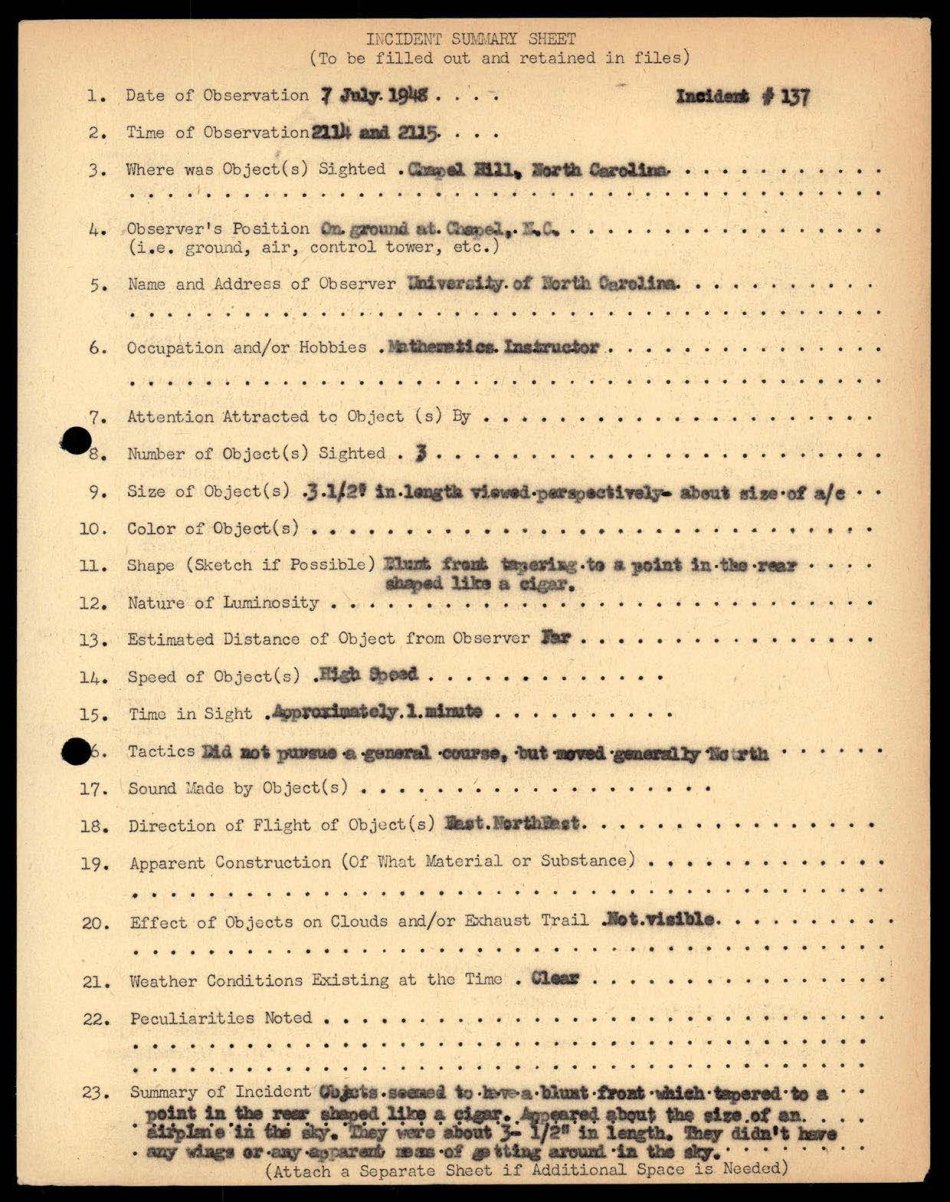
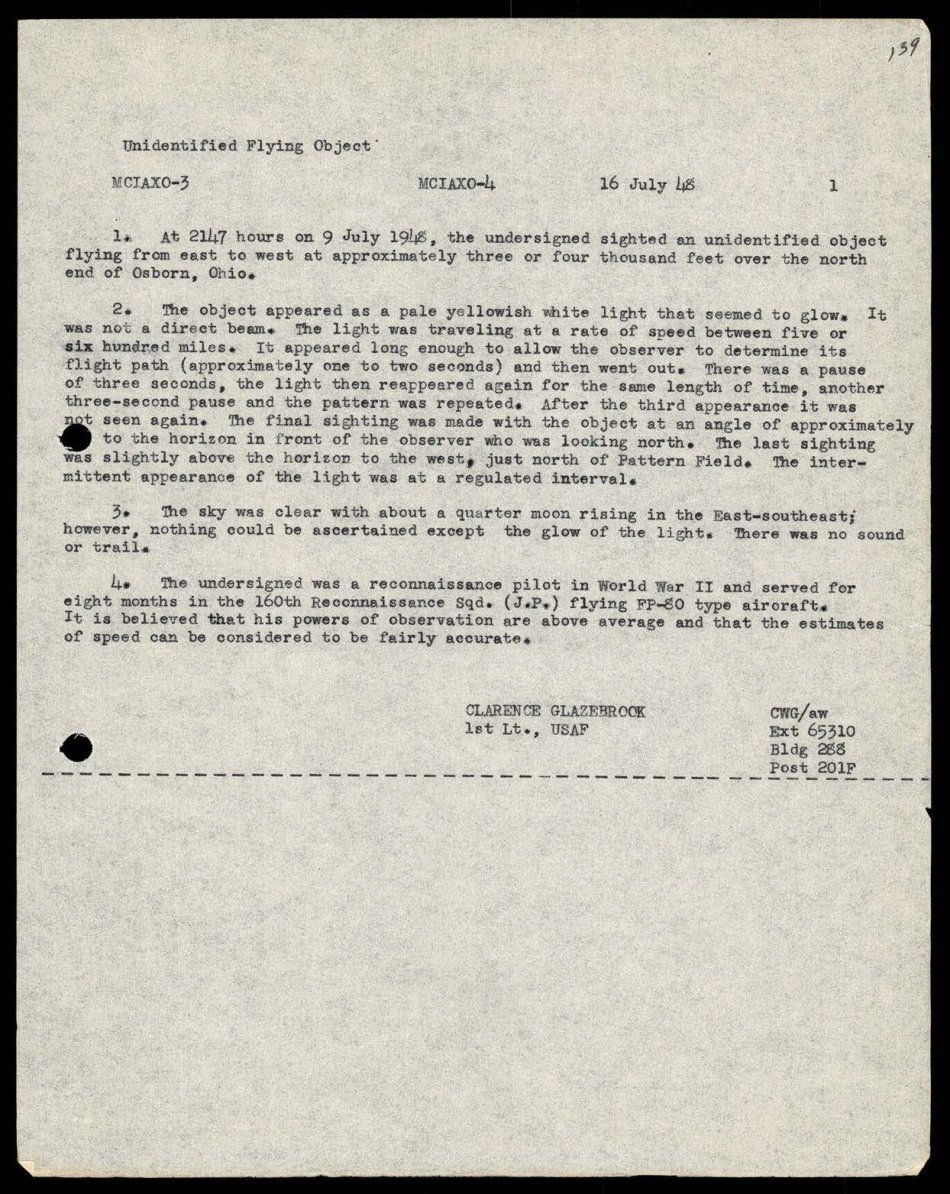
Date: 30/06/1948Location: Between Watertown and Webster, South Dakota
South Dakota, 1948: stationary UFO that reportedly split into hundreds of parts
On June 30, 1948, Norman Pfutzenreuter, described as a chemical engineer and amateur astronomer, reported observing between Watertown and Webster a silver UFO, apparently stationary for a little over two hours.
- Event date
- 30/06/1948
- Location
- Between Watertown and Webster, South Dakota
- Topic
- 1948 reports
- Source agencies
- Arquivo histórico · DOW
- Documents
- 2 documents · 388 pages
- Reading time
- 7 min
 Sketch on an official record sheetPhysical page 110
DOCUMENTARY SOURCES · Arquivo histórico / DOW
What the records tell
On June 30, 1948, Norman Pfutzenreuter, described as a chemical engineer and amateur astronomer, reported observing between Watertown and Webster a silver cluster, apparently stationary for a little over two hours.
According to the form, the shape began to change slowly; a large fragment broke off, the mass reportedly split into hundreds of parts, and three larger components kept a triangular formation until they disappeared.
The form records an altitude estimate of 150 miles followed by a question mark. There is no photograph, instrumental measurement or recovered material in the pages checked.
The form mentions a map of the observation sites, but the attachment does not appear on pages 110–111. This absence remains noted rather than being filled in by a modern reconstruction.
The continuation of the narrative describes about nine minutes between the initial fragmentation and the disappearance of the three larger parts. The account states that they were moving away from the Earth; this is the visual interpretation recorded in the document. The form distinguishes Hecla, noted in the header and in the observer's address, from the observation site, described as between Watertown and Webster.
On the typed sheet, two numerical details bear marks of addition. The incident number, 141, was written over another crossed-out number, and the "9" in "about 9 minutes" between fragmentation and disappearance appears out of line, just before a word struck out with x's. The word "approx" was added above the line in the maneuvers field. A second copy of the same form, in document DOW-UAP-D088, repeats these marks. The form is classified CONFIDENTIAL and also records: no odor, no clouds, and size not reported.
Next to the item on apparent construction, "looked like a cluster of parts," the form has a tiny hand-made drawing: a bunch of small circles touching one another, like a handful of bubbles. It is the only drawing of the case in the collection. The map with the observation points, cited in item 24, was not preserved. The drawing shows how the observer, or whoever filled out the form, imagined the object's appearance before the fragmentation; it has no scale and no measurement value.
The record form logs the observation from 11h25 to 13h27 "and shortly after," in a "brilliantly clear" sky, with a wind of 3 miles per hour. Norman Pfutzenreuter lived in Hecla and saw the object while he was between Watertown and Webster, in South Dakota. The altitude of 150 miles comes with a question mark on the form itself, and distance and size were left unanswered. The description of a bright object, like polished aluminum, nearly stationary for two hours in broad daylight, matches what the Air Force would later attribute to high-altitude balloons. This is an editorial hypothesis: the pages contain no launch data or official assessment.
The record form and the continuation sheet appear twice in the collection: in the box of incident summaries and in the second Air Force compilation of incidents 101 to 172, with the same marks and corrections. There is no signed statement, letter from the observer, interview, map or assessment. What exists is the summary from a single observer, who described himself as a chemical engineer and amateur astronomer, with no indication that he used an optical instrument.
DIRECT READING OF THE FILE
The document, in the original
Translations of selected fields and excerpts, checked against the indicated physical pages. Editorial notes separated from the translated text.
EXCERPT 1 · PHYSICAL PAGE 111
full continuation of the fragmentation narrative
PORTO ARTE AL
q
3G =
9
i
away out from the mass and formed a perfect isometric triangle, the
remaining mass slowly moved into hu dreds of small parts seomingly
lesving very faint vapor trails. The three remaining parts contimed
to move apart holding their related positions of a perfect triangle
but gradually getting smaller and fainter until they dissappeared some 9
minutes after the initial break-up. It could mmxtix easily be seen
that the parts were moving away from the earth,
allyEditorial note: Full translation of the legible continuation. “They were moving away from the Earth” is the visual interpretation recorded by the source, not a measured trajectory.
Check the original PDF
...away out from the mass and formed a perfect isometric triangle, the remaining mass slowly moved into hundreds of small parts seemingly leaving very faint vapor trails. The three remaining parts continued to move apart holding their related positions of a perfect triangle but gradually getting smaller and fainter until they disappeared some 9 minutes after the initial break-up. It could easily be seen that the parts were moving away from the earth.View the document record ↗ · Physical page 111, counting the cover.
EXCERPT 2 · PHYSICAL PAGE 110
Physical page 110: verification form for incident 141, items 1 to 26 (full text)
12.
13.
lh.
15.
26.
stationary and constant for some
S& OOMeio =
Py
é
CHECK-LIST - UNIDENTIFIED FLYING OBJECTS ua
Date 30 June 1948 Incidont # tea
Time 11:25 A. ee. to 1:27 PM and shortly thereafter
Location Hecla, South Dakota
Namo of observer Norman Pfutsenreuter
Oceupation of obgorvor Chemical Engineer - Amateur Astronomer
Address of observer Hecle, South Dakota Fp
Placo of observation Between Watertown, S. D., & Webster, S. D.
Numbor of objocts 1
Distance of object from obsorvor y/s
Timo in sight Slightly over two hours
Altitude 150 miles (7)
Speod Stationary
Diroction of flight Stationary
Tactics Remained in one/position then disintegrated
Soumd Wone
Size W/S
Color Like polished aluminum
ij
mo Of FPe > oP is :
Shapo Changing ee fen WE BP OS 4
Odor dotoctod None
Apparont construction Semed to be a cluster of parts Se
Exhaust trails Partioles of disintegrating mass left very faint
trails of vapor
Wonthor conditions Brilliantly clear (CAVU) - Wind velocity 3 MPH
Effoct on clouds No clouds ;
Skotches or photographs Map showing locations of sightings
Manner of disappoarance Disintegrated into smaller pieces
Romarks +: Object appeared as oluster of parts which remained fairly
two hours when it underwent a rather slow)
entire spot s
SESE Ha Etiech RTE MtelP Matt REDE Ea Ete
over § eeEditorial note: "N/S" (not stated) was translated as "not stated". 150 miles equals about 240 km; the question mark is the form's. The map cited in item 24 is not in the collection. The continuation is on physical page 111.
Check the original PDF
CONFIDENTIAL [struck through]. CHECK-LIST - UNIDENTIFIED FLYING OBJECTS. Incident # 141 [typed over a struck-out number]. 1. Date 30 June 1948. 2. Time 11:25 A. M., to 1:27 PM and shortly thereafter. 3. Location Hecla, South Dakota. 4. Name of observer Norman Pfutzenreuter. 5. Occupation of observer Chemical Engineer - Amateur Astronomer. 6. Address of observer Hecla, South Dakota. 7. Place of observation Between Watertown, S. D., & Webster, S. D. 8. Number of objects 1. 9. Distance of object from observer N/S. 10. Time in sight Slightly over two hours. 11. Altitude 150 miles (?). 12. Speed Stationary. 13. Direction of flight Stationary. 14. Tactics Remained in one/approx [written above] position then disintegrated. 15. Sound None. 16. Size N/S. 17. Color Like polished aluminum. 18. Shape Changing. 19. Odor detected None. 20. Apparent construction Seemed to be a cluster of parts [small hand-drawn sketch: a cluster of small circles]. 21. Exhaust trails Particles of disintegrating mass left very faint trails of vapor. 22. Weather conditions Brilliantly clear (CAVU) - Wind velocity 3 MPH. 23. Effect on clouds No clouds. 24. Sketches or photographs Map showing locations of sightings. 25. Manner of disappearance Disintegrated into smaller pieces. 26. Remarks: Object appeared as cluster of parts which remained fairly stationary and constant for some two hours when it underwent a rather slow change in shape. A large chunk fell off. Within the next 2-1/2 minutes the entire spot started to very slowly disintegrate. Three larger parts moved (over). [Handwritten:] 75.View the document record ↗ · Physical page 110, counting the cover.
EXCERPT 3 · PHYSICAL PAGE 123
full page
CHECK-LIST - UNID&."TIFIEO FLYING OBJroTS
1. Do.to 30 Jun9 1948
2. Tilno 11125 A. 11•• to 1127 Pll ud 1hortl7 therearter
Lo~tion Beola. South Dakota
Nomo ot observer loraan Prut11nreut•r
Occupation ot o~o~r Chemioal Engineer - Amateur Aatrcmoaer
6. Addr ess of obaorvor B•ola,· South Dakota
7. Placo of obsorwtion B~ween Wat•rtown, s. D., & Wtbater, s. D.
a. Nwabor of objoots l
9. Diat-onco of objoct tram obsorvor N/s
10. Ti_110 in sight Slirhtly owr two houri
11. Altitudo 150 miles (?)
12. Spood Stationary
D1roct1on of flight Stationary
,.approx
Tactics Remained in on•/position then d~aintegrated
Sound None
16. Sho N/S
__..., Color Like polished alumin\1111 I r.
r ' I
18. Shapo Chanr,ing
Odor dotoctod None
~- 20. Appnront construction ~~cmed to be • oluater 0£ part• ~ ~
21 . E.xhoust t r aila Partiolea of disintegrating me.£0 !ert very faint
trails of -vapor
22 . Vfoathor conditions Brilliantly oloar (CAW) - Wind velooity 3 'MPH
Effoct on clouds No olouda
24. Skotohos or photographs Map aho•ing looations of s1~ht1n~a •
25. Mnnnor of disoppoaronoo Disintegrated into a~aller pieces
26. Ronu:irk5: Object appeared as olusttr of parts wh1oh remained fairly
stationary and constant for sane two hours when it underwent a rather elow
ohan~e in shape . A large chunk fell otr. Within the next 2-1/2 minutes the
entire spot started to very slowly disintegrate . Three larger parts moved
(over) 7 5Editorial note: Military form for incident 141: a chemical engineer and amateur astronomer from South Dakota describes a silvery cluster nearly motionless for two hours and then disintegrated; the place name was read as Hecla. The altitude of 150 miles comes with a question mark on the form.
Check the original PDF
CHECK-LIST - UNID&."TIFIEO FLYING OBJroTS
1. Do.to 30 Jun9 1948
2. Tilno 11125 A. 11•• to 1127 Pll ud 1hortl7 therearter
Lo~tion Beola. South Dakota
Nomo ot observer loraan Prut11nreut•r
Occupation ot o~o~r Chemioal Engineer - Amateur Aatrcmoaer
6. Addr ess of obaorvor B•ola,· South Dakota
7. Placo of obsorwtion B~ween Wat•rtown, s. D., & Wtbater, s. D.
a. Nwabor of objoots l
9. Diat-onco of objoct tram obsorvor N/s
10. Ti_110 in sight Slirhtly owr two houri
11. Altitudo 150 miles (?)
12. Spood Stationary
D1roct1on of flight Stationary
,.approx
Tactics Remained in on•/position then d~aintegrated
Sound None
16. Sho N/S
__..., Color Like polished alumin\1111 I r.
r ' I
18. Shapo Chanr,ing
Odor dotoctod None
~- 20. Appnront construction ~~cmed to be • oluater 0£ part• ~ ~
21 . E.xhoust t r aila Partiolea of disintegrating me.£0 !ert very faint
trails of -vapor
22 . Vfoathor conditions Brilliantly oloar (CAW) - Wind velooity 3 'MPH
Effoct on clouds No olouda
24. Skotohos or photographs Map aho•ing looations of s1~ht1n~a •
25. Mnnnor of disoppoaronoo Disintegrated into a~aller pieces
26. Ronu:irk5: Object appeared as olusttr of parts wh1oh remained fairly
stationary and constant for sane two hours when it underwent a rather elow
ohan~e in shape . A large chunk fell otr. Within the next 2-1/2 minutes the
entire spot started to very slowly disintegrate . Three larger parts moved
(over) 7 5View the document record ↗ · Physical page 123, counting the cover.
EXCERPT 4 · PHYSICAL PAGE 124
full page
allay ogt trom the ~s• and formed a perfect iaometrio tria.ngl•, the
reaa1n1ng mass slowly moved into hu dreda ot small parts seemingly
l•• "t'1Jlg nry fai.Dt vapor tnile. The three rema i ning pa rts oontillu•d
to move apart holding their relat.ed poeitione ot a perfect triangle
but gradually getting s111&ller and fainter until they dissappeared some 9
aimtea after th• initial break-up. It could mttx:ea$1ly be seen
that the parts ,n,re moving a.way rrom the earth.Editorial note: Reverse of the incident 141 form, with the end of the remarks: three parts forming a triangle and vanishing about nine minutes later; that they were moving away from the Earth is the witness's interpretation.
Check the original PDF
allay ogt trom the ~s• and formed a perfect iaometrio tria.ngl•, the
reaa1n1ng mass slowly moved into hu dreda ot small parts seemingly
l•• "t'1Jlg nry fai.Dt vapor tnile. The three rema i ning pa rts oontillu•d
to move apart holding their relat.ed poeitione ot a perfect triangle
but gradually getting s111&ller and fainter until they dissappeared some 9
aimtea after th• initial break-up. It could mttx:ea$1ly be seen
that the parts ,n,re moving a.way rrom the earth.View the document record ↗ · Physical page 124, counting the cover.
Dates and documentary context
- Event
- 30/06/1948 — Date visually verified on the form/account on the indicated physical page.
- Document
- Not established — Preparation date not established in this selection.
- Publication
- Not established — Release date not established by the selected pages.
Origin and release
Historical archive · 38_143685_box7_Incident_Summaries_101-172.pdf
Partial curation of pages 110, 111 of a 178-page PDF. Exclusively visual estimates; altitude questioned in the form itself; no photograph, instrument or recovered material.
Questions to continue the investigation
- Where is the map mentioned in the sketches or photographs field?
- What method supported the questioned estimate of 150 miles of altitude?
GEOGRAPHY OF THE CASE
Between Watertown and Webster, South Dakota
Approximate regional reference, placed by the editors based on the place cited in the document. The marker does not represent the exact location of the account.
DOCUMENTARY TRAIL
Go back to the sources
References use physical pages of the PDF, counting the cover. Summaries are presented in English; the documents keep their original language.
- 38_143685_box7_Incident_Summaries_101-172.pdf
Physical pages 110, 111
Arquivo histórico · 178 pages - DOW-UAP-D088_US-AirForce_Analysis-of-Flying-Objects-in-the-US_101-172.pdf
Physical pages 123 and 124: second copy of the record form for incident 141 and of its reverse side
DOW · 210 pages
Editorial summary based on the collection's research notes. How we read the documents.