Date: Around 07/07/1947, between 22h30 and 23h, according to the observer himselfLocation: Arlington, Virginia, USA
Arlington, 1947: lieutenant colonel sees from his bedroom a white-light UFO cross the window and sketches its path
An Air Force lieutenant colonel, sitting on his bed, saw a white-light UFO pass quickly in front of the window and disappear to the south. Three weeks later, at the request of counterintelligence, he wrote a memorandum with sketches and calculations, and concluded that it must have been a rare natural phenomenon.
- Event date
- Around 07/07/1947, between 22h30 and 23h, according to the observer himself
- Location
- Arlington, Virginia, USA
- Topic
- FBI file
- Source agencies
- FBI · DOW · Arquivo histórico
- Documents
- 3 documents · 588 pages
- Reading time
- 14 min
 SketchPhysical page 66
DOCUMENTARY SOURCES · FBI / DOW / Arquivo histórico
What the records tell
On July 25, 1947, Lieutenant Colonel James O. Cobb, of the Office of the Air Inspector, wrote a memorandum to the counterintelligence branch at the request of an official from that office. He reported that, around July 7, between 22h30 and 23h, he was at home in Arlington, Virginia. He had just turned off the lamp and was listening to the end of a radio program, sitting on the edge of the bed and talking with his wife about furniture for a recently purchased house.
Sitting facing the windows, he saw a light appear at the right edge of the last window and move quickly until it disappeared behind the trees or the horizon, or went out, in a generally southern direction. At the time, he thought only that "a light went by." Minutes later he remembered that he had never seen anything like it and that it did not resemble the meteors he knew. The next morning, he told people at the office, jokingly, that he had seen a flying disc.
The memorandum is unusual for the care it takes to separate what he could and could not assess. Cobb said the only reliable measurement was the elevation, 3 to 4 degrees, because the light passed behind the tallest trees. Assuming a distance of three-quarters of a mile, the object would have been below 500 feet and about the size of a small airplane, some 30 feet. With a duration of "a few seconds," the calculation would give 1.350 miles per hour, but he said the impression was that of a jet's speed.
He described a cold white light, with no red, like that of the Moon on a clear night, with no tail of fire, smoke or sparks, which moved in a straight line without losing altitude. As for shape, he could perceive it only as a "blur." He consulted the Bolling Field weather records: scattered to broken clouds and visibility of 10 to 12 miles. He also noted that a firefly at 30 feet, an airplane at three-quarters of a mile and a meteor hundreds of miles away can appear the same in size and speed.
With about 2.500 flight hours, Cobb stated emphatically that it was not a weather balloon, nor a searchlight glare on the cloud base, nor a burning airplane, nor pure imagination, and that the object did not stay still. Even so, he concluded that "it was some natural phenomenon that occurs only rarely." The memorandum includes two pencil sketches he made: the floor plan of the bedroom and the apparent path of the light, which he himself called a very tentative sketch.
Cobb's memorandum became incident 80 of the Air Force intelligence incident study, Project Sign. The card summarizes the account in figures: July 7, 1947, between 22h30 and 23h, in Arlington, at three-quarters of a mile, below 500 feet, the size of a small airplane and with the speed of a jet, seen for two to three seconds, shape a 'blur,' reflected white light, no trail, disappearing behind the trees. It records two sketches, which are the drawings from the memorandum. The heading noted is southeast, not the general south of the memorandum.
The card turns into data what Cobb himself treated as a hypothesis. The speed of about 1.350 miles per hour, which in the memorandum was only the result of a calculation based on an assumed distance, appears on the back as speed 'estimated by observer.' The card also spells the name as James A. Cobb rather than James O. Cobb, and gives an address on North Glebe Road as the location of the observation. There is no evaluation or conclusion; Cobb's opinion that he saw a rare natural phenomenon was not copied.
The memorandum did not originate as a spontaneous communication. In the very first paragraph, Cobb explains that the information and opinions gathered there were based on a conversation with Mr. Butler, of the counterintelligence branch of the Air Staff, and on a request he made. The text was written on July 25, 1947, about three weeks after the observation. In the last paragraph, Cobb himself says that, at the time, he did not consider the episode serious enough to wake his wife and describe it to her, nor to make an official report.
Cobb also recounts how he handled the matter at work. The next morning, he announced jokingly that he had seen a flying disc the night before and that it seemed to be heading for Alexandria, where some of the office's officers lived. He then said it must have been a shooting star, but that the thing had seemed somewhat strange. After some conversation, he dropped the subject, according to him so as not to add to the rumors, which he saw as a possible source of serious panic in the country.
Part of the memorandum's reasoning serves to rule out explanations. Cobb says he did not believe the distance was less than three-quarters of a mile because, late at night and with all the windows open, he would have heard some sound, and he heard none. Regarding the weather, he observed that the sky with scattered to broken clouds indicated that the light was not necessarily a meteor, since it might have been impossible to see one. He admitted, however, that he did not remember the weather that night, except that it was not raining. A burning airplane, he wrote, would at least have crashed in that area.
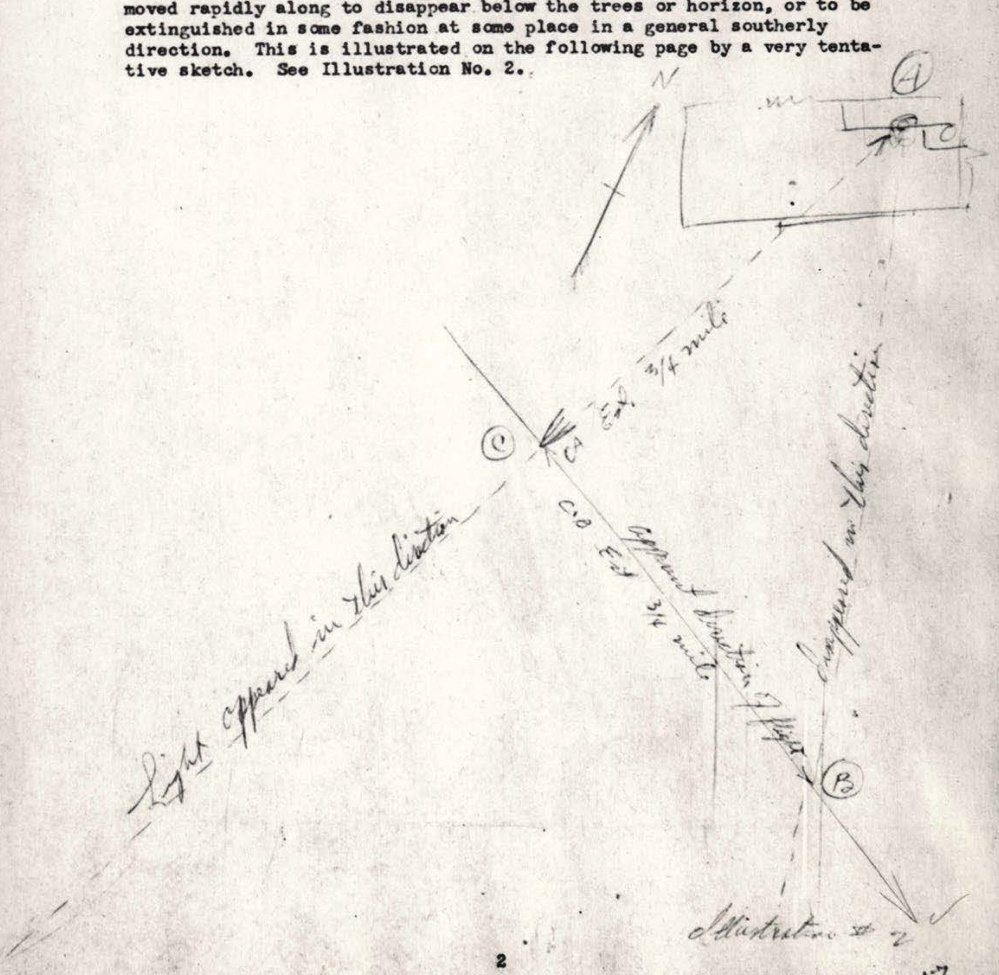
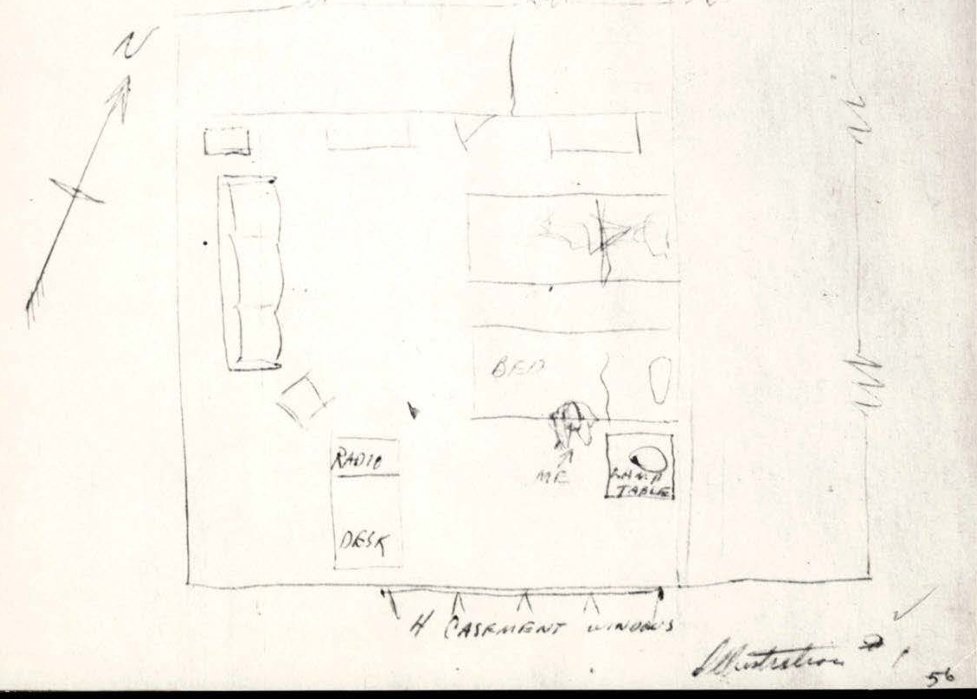
The two pencil sketches show how Cobb reconstructed the scene. The first is the floor plan of the bedroom: a wall with four casement windows, the bed, the lamp table, the radio and the desk, an arrow indicating north, and his position, marked with the word "me," on the edge of the bed. The second marks the bedroom as point A, the nearest point of the path as C and the point of disappearance as B, with the notes "light appeared in this direction," "disappeared in this direction" and "apparent direction of flight," and the estimated distance of three-quarters of a mile on both segments.
The incident 80 card exists in two copies in the collection: one in the Air Force analysis volume and another in box 7 of incident summaries, stamped RESTRICTED at the top and bottom of both sides. The text of both is the same, including the name spelled James A. Cobb and the southeast heading. No other document in the collection returns to the case, and there is no record that counterintelligence replied to Cobb or asked him any further questions.
More images from the document
DIRECT READING OF THE FILE
The document, in the original
Military memorandum translated in excerpts. Observer's home address omitted. The floor plan of the room (Illustration 1) was not reproduced because it shows the interior of the residence; only the sketch of the route (Illustration 2).
EXCERPT 1 · PHYSICAL PAGE 215
Complete incident 80 card, physical page 215 of D087
- •
7 July 19L7 Inr U Jrt. fi $)
~. Cc~upc.tk."I r.f ob-4on""r Lt Col. , AC
6. .. l1
5r• :i:1 or ob:sorv.:ir N/5
7. Ploc of ob3or.:-ut1~n k l1oe i:m, Vt. - ?807 N. Glebt Rood.
H,. Ti!1J in cfrht
L. i.l s•.udo lP-11s t, . ~ : t
l7• Color :lhifir.cted ~ 1te l~ t
10. .:au p!l •blob''
1~. Cdor dotoct d l/S
20. AppflMnt oor,stnaction N/.)
~ . n,l'lthur oond1t1on&
2}. ur~ct on aloud• ~~ne
i?L. Sl:otchvs or photogrc:.p."i• 2
25. r:anr.<:r ot dhopp,o11"'-nco behincltnea
26. REditorial note: Address from 1947, not restricted under the portal's rules.
Check the original PDF
CHECK-LIST - UNIDENTIFIED FLYING OBJECTS. Incident # 80. 1. Date: 7 July 1947. 2. Time: 2230-2300. 3. Location: Arlington, Va. 4. Name of observer: James A. Cobb. 5. Occupation of observer: Lt Col., AC. 6. Address of observer: N/S. 7. Place of observation: Arlington, Va. - 2807 N. Glebe Road. 8. Number of objects: 1. 9. Distance of object from observer: 3/4 mile. 10. Time in sight: 2-3 seconds. 11. Altitude: less than 500 ft. 12. Speed: that of jet. 13. Direction of flight: SOUTH EAST. 14. Tactics: N/S. 15. Sound: N/S. 16. Size: Small plane. 17. Color: Reflected white light. 18. Shape: "blob". 19. Odor detected: N/S. 20. Apparent construction: N/S. 21. Exhaust trails: None. 22. Weather conditions: Scattered clouds - Visibility: 10-12 mi. 23. Effect on clouds: None. 24. Sketches or photographs: 2. 25. Manner of disappearance: behind trees. 26. Remarks: (over)View the document record ↗ · Physical page 215, counting the cover.
EXCERPT 2 · PHYSICAL PAGE 216
Summary on the back of card 80, physical page 216 of D087 (full text)
,.Editorial note: The sentence in quotation marks is a quotation from Cobb's memorandum, already translated in the dossier.
Check the original PDF
Observed from a bedroom window as a blob of light crossing at very high speed estimated by observer at approx 1350 MPH. "In color, the object had the appearance of a reflected white light, a cool bright white light with no red in it, like the moon on a clear night."View the document record ↗ · Physical page 216, counting the cover.
EXCERPT 3 · PHYSICAL PAGE 65
Physical page 65: heading, paragraphs 1 and 2 of the memorandum, and captions of sketch 1 (full text)
.. .
. .
OFFICE OF THE Alll INSPl!:CTCR
26 JULY li47
MElfORAJlDUK TOa AC/ AS-2, Counter Intelligence Branch
l. Information contained herein and opinion• expresaed are baaed
upon conve rsat ion with and request by Mr. Butler ot your orfice. All
pertain t o certai n phenonema c onnected with recent widespread talk or
"flying saucer•"•
2. Approximat ely three weeks ago, on or about 7 July 1947, I
prepared to go to bed around 2230 or 2300 EDT. I was livi ng at 2807
North Glebe Road , Arli ngton, Virginia, with my wife. Illustration No. l
s hows the ceneral layout or the r ooJ11 we occupied at that time. See
Illustrat ion No. l.
I
( _J
;r \
\
I \ )
UJ f,
/,Editorial note: "Phenonema" is spelled this way in the typewritten original. AC/AS-2 was the intelligence section of the Air Staff. The number 56, in pencil in the lower corner, is from the file pagination.
Check the original PDF
OFFICE OF THE AIR INSPECTOR / 25 JULY 1947 / MEMORANDUM TO: AC/AS-2, Counter Intelligence Branch / 1. Information contained herein and opinions expressed are based upon conversation with and request by Mr. Butler of your office. All pertain to certain phenonema connected with recent widespread talk of "flying saucers". / 2. Approximately three weeks ago, on or about 7 July 1947, I prepared to go to bed around 2230 or 2300 EDT. I was living at 2807 North Glebe Road, Arlington, Virginia, with my wife. Illustration No. 1 shows the general layout of the room we occupied at that time. See Illustration No. 1. / [Pencil sketch; handwritten labels:] N [arrow] / BED / ME / LAMP TABLE / RADIO / DESK / 4 CASEMENT WINDOWS / Illustration #1 / [Handwritten page number:] 56View the document record ↗ · Physical page 65, counting the cover.
EXCERPT 4 · PHYSICAL PAGE 66
Physical page 66: paragraph 3 and captions of sketch 2 (full text)
5. I had juat turned ott th• light by my bedside. but aat down
on the aide ot the bed to listed to the end ot a radio proue,m betor.
reclizdng. ID the -,a.ntiae. ay wit• and I ••r• hanng •01111 con-nr••-
tion about the seleotion or certain t'urniture tor a hCIIW we had juat
purchaaed. At the tiae or these ewnt•• as I aat t"acinr; the windows.
a light appeared at the right•hand edge ot the extreae and window and
mo-nd rapidly along to diaappea.r below the tree• or horilon. or to be
extinguished in s c.e taahlon at acae place in a general southerly
direction. Thi• 1a illustrated on the tollowing page by a very tenta- .
tiYe aketch. See Illuatration No. 2. . , / CJ;
Al l .t.' ~ "'"" ·
I__ r ,,,,. ~
/
/
. .
/ .... f ' .J
/
aEditorial note: "Listed" appears this way in the original, for "listen". The text says the sketch is "on the following page", but sketch 2 was drawn on the same sheet, below the paragraph. Point A is the bedroom; C, the point on the path closest to the observer; B, the point of disappearance.
Check the original PDF
3. I had just turned off the light by my bedside, but sat down on the side of the bed to listed to the end of a radio program before reclining. In the meantime, my wife and I were having some conversation about the selection of certain furniture for a home we had just purchased. At the time of these events, as I sat facing the windows, a light appeared at the right-hand edge of the extreme end window and moved rapidly along to disappear below the trees or horizon, or to be extinguished in some fashion at some place in a general southerly direction. This is illustrated on the following page by a very tentative sketch. See Illustration No. 2. / [Pencil sketch; handwritten labels:] N [arrow] / (A) / Light appeared in this direction / (C) / CA Est. 3/4 mile / CB Est. 3/4 mile / Apparent direction of flight / Disappeared in this direction / (B) / Illustration # 2 / [Typed page number:] 2 / [Handwritten page number:] 57View the document record ↗ · Physical page 66, counting the cover.
EXCERPT 5 · PHYSICAL PAGE 67
Physical page 67: paragraphs 4 and 5 (full text)
t. At the ti-, 1inoe my attention wa• diTided and ab1orbed among
the 1ubjeot1 •ntioned, JI)' reaction wa1 limply that "a light paued b)","
and I gaw no turther thought to th• •tter until •oae moment• later,
When th• thought o... to .. that I had nenr aeen 1uo}) an object betore,
and that although the tir•t explanation would have been that a meteor had
fallen ~rd earth in that direction, it did not han the appearance ot
any •t•or or "1hooti~ •tar" I had ever -Mn. Tbinlc:1~ ot the thenprenlent talk of flying diak:1, I :refleo\ed that probably 1ome auoh
thing a• I had just 1een wa■ the aou:roe ot a large &110unt of newapape:r
and radio publicity on the 1ubject. The next morning I jeatingly
announced in the office that I nw a tlying Hucer the nigtlt betore and
thought that it wa1 enroute to Alexand:ria,where •ome ot our o.ffice:r1
liT•• I then went on to aay that I 1uppo1ed it wa■ a •hooting 1tar,
but that it did look: 1011tewhat peculiar. At'ter we had diaou•••d the
general topic tor acae t1ae, I dropped the subject, not wiahing to add
to the auppoaed nao:r1, which I enviaioned aa a aouro• ot 1eriou1 panic
over the country.
6. A cleaoription ot the light, or object 1• almoat impoaaible,
aince obaerntion o.f it waa 10 limited. A• ahown in Illustretion Ro. 2,
the object appeared top••• in cloaeat proximity to• at the tiJDe it
came into view. All o.f my mental calculation• were baaed upon acme
impression or oonoeption ot it• diatance at the clo1est point, (AC).
I had no way ot judgi~ thil, except in the form o.f ffry crude depthperoeption. Ir this by any chance were correct, ar.d inatead of a di••
tant meteor aome objoot had passed near-by, I would assume tor purpose•
of description that the distance AC on the sketch was SOl!le three quarter•
ot a mile. OM factor which I could judge quite reliably was the angular
elevation. Thi.a Ja1St haTe been approximately 3 or 4 degrees, at any
rate, the light was lnte:rmlttently behind the tallest treea forward of
ay position a• lt pa1aed, and these treea are or a normal height, perhap•
aixty or eighty feet at a diate.no~aeveral blocks. Baaod upon a aild
aasuaption aa to distance, and a reaaon.able as•U11ption aa to angular
elevation, the object would be at a low altitude, conaiderably bolow
500 feet, and ot a size approximating a ..all airplane, say 30 1'9et
aero••• The •h•pe nay have been round. 0...1, discal, or irre&ula:r; at - the •peed with lfhich it travelled, I could only percein it a• a "blob."
I do not conaider the distance mentioned to be leas than 3/4 11111•,
lNtoauH had 1t been. I teel sure th•t, late in the evenin:; and w1 th all
my winf\owa open, I would haw heard aome sound, which I definitely did
not in thi• ca••• It llight be well to poin~ out here the relati.,.
siailarity in •ize, altitude and airspeed of~ .firefly at a diatanoe ot
30 feet, au airplane at about 3/4 mile, and a aeteor at senral hundred
ail••• Moat of u• are familiar with thi• illuaion.Editorial note: Three quarters of a mile equals about 1,2 km; 500 feet, about 150 m; 30 feet, about 9 m; sixty to eighty feet, about 18 to 24 m.
Check the original PDF
4. At the time, since my attention was divided and absorbed among the subjects mentioned, my reaction was simply that "a light passed by," and I gave no further thought to the matter until some moments later, when the thought came to me that I had never seen such an object before, and that although the first explanation would have been that a meteor had fallen toward earth in that direction, it did not have the appearance of any meteor or "shooting star" I had ever seen. Thinking of the then-prevalent talk of flying disks, I reflected that probably some such thing as I had just seen was the source of a large amount of newspaper and radio publicity on the subject. The next morning I jestingly announced in the office that I saw a flying saucer the night before and thought that it was enroute to Alexandria, where some of our officers live. I then went on to say that I supposed it was a shooting star, but that it did look somewhat peculiar. After we had discussed the general topic for some time, I dropped the subject, not wishing to add to the supposed rumors, which I envisioned as a source of serious panic over the country. / 5. A description of the light, or object is almost impossible, since observation of it was so limited. As shown in Illustration No. 2, the object appeared to pass in closest proximity to me at the time it came into view. All of my mental calculations were based upon some impression or conception of its distance at the closest point, (AC). I had no way of judging this, except in the form of very crude depth-perception. If this by any chance were correct, and instead of a distant meteor some object had passed near-by, I would assume for purposes of description that the distance AC on the sketch was some three quarters of a mile. One factor which I could judge quite reliably was the angular elevation. This must have been approximately 3 or 4 degrees; at any rate, the light was intermittently behind the tallest trees forward of my position as it passed, and these trees are of a normal height, perhaps sixty or eighty feet at a distance several blocks. Based upon a mild assumption as to distance, and a reasonable assumption as to angular elevation, the object would be at a low altitude, considerably below 500 feet, and of a size approximating a small airplane, say 30 feet across. The shape may have been round, oval, discal, or irregular; at the speed with which it travelled, I could only perceive it as a "blob." I do not consider the distance mentioned to be less than 3/4 mile, because had it been, I feel sure that, late in the evening and with all my windows open, I would have heard some sound, which I definitely did not in this case. It might be well to point out here the relative similarity in size, altitude and airspeed of a firefly at a distance of 30 feet, an airplane at about 3/4 mile, and a meteor at several hundred miles. Most of us are familiar with this illusion. / [Typed page number:] 3 / [Handwritten page number:] 58View the document record ↗ · Physical page 67, counting the cover.
EXCERPT 6 · PHYSICAL PAGE 68
Physical page 68: paragraphs 6, 7 and 8 and signature (full text)
.. .
... .
e. Although I oould not aoourately judg• th• ti•, I 1eena to
recall the object or light wa■ Ti ibl• tor a couple ot econd■•
Taking thi ■ tigure literally and applying it to the ketch, Bo.· 2,
on• could roughly compute th• apeed ot the objeot at 1350 aphJ however,
I did not enH that it wa■ aorlng with uoh great peed ■ thi•. It
rather appeared to acwe with the •pe•d o t a jet-powered airplane. It
did not deviate tram a traight oour ■e While I ob ernd it, and did not
perceptibly lo•• altitude.
'I• In color, the ubjeot had the appearance ot a retlected wh1te
light, a oool, bright white light with no red in 1t, like the naoon on a
olear night. Th•r• wa■ no train v1 1ble to -• in the torm ot fire, -oke, or para. The wather at the aaaumed time and date was checked
through record■ ot the BollinC Pield weather otf'ioe, and con iated ot
acattered to broken clCNdl with v1a1bilitie■ ot 10 - 12 mil••• 1'h• cloud
condition 1• further indication that the object wa■ not nece■■arily a
•.teor, inoe it aigbt have been impoaalble to ••• a •teor. I do not per onally re-lll>er th• ..ather condition, except that I am sure it wa■
not raining.
a. At th• ti- ot thia occurrence, I waa not incll.Ded to think ot
it -rioualy enough to wake ay wit• and deacribe it to her, nor by a~
reaaoalng to ll&b otticial r4port. Aa tiae paaaed, I thought considerably
about the neeting glimp■• I bad ot whatenr I aw, and aa till aomewhat
contuNcl, but teel that it waa acae natural phenomenon which occur■ but
rarely. I have tlown appro:d.11m.tely 2500 how-a during th• put -nn
year• and being 1•nerally tam.liar with a■peota ot a-nation -.n -phatioally atate that (a) •it wa■ no weather balloon, (b) it was not the tla1h or
a beacon on th• oloud-b&■-, (c) it could hardly have beon an airplane on
tire, inc• it would han at least caaahed in thia general area, (d) it
wa■
auo
not entirely a
h tiae in one place.
re ult ot i•gination, and (e) it waa not pending
Yi-- . ~ -~ //
(,/"" JAIIES O. COBB
Lt Colonel, Air Corpe
IEditorial note: One thousand three hundred fifty miles per hour equals about 2.170 km/h; 10 to 12 miles, about 16 to 19 km. Bolling Field was the Army air base in Washington.
Check the original PDF
6. Although I could not accurately judge the time, I seem to recall the object or light was visible for a couple of seconds. Taking this figure literally and applying it to the sketch, No. 2, one could roughly compute the speed of the object at 1350 mph; however, I did not sense that it was moving with such great speed as this. It rather appeared to move with the speed of a jet-powered airplane. It did not deviate from a straight course while I observed it, and did not perceptibly lose altitude. / 7. In color, the subject had the appearance of a reflected white light, a cool, bright white light with no red in it, like the moon on a clear night. There was no train visible to me, in the form of fire, smoke, or sparks. The weather at the assumed time and date was checked through records of the Bolling Field weather office, and consisted of scattered to broken clouds with visibilities of 10 - 12 miles. The cloud condition is further indication that the object was not necessarily a meteor, since it might have been impossible to see a meteor. I do not personally remember the weather condition, except that I am sure it was not raining. / 8. At the time of this occurrence, I was not inclined to think of it seriously enough to wake my wife and describe it to her, nor by any reasoning to make official report. As time passed, I thought considerably about the fleeting glimpse I had of whatever I saw, and am still somewhat confused, but feel that it was some natural phenomenon which occurs but rarely. I have flown approximately 2500 hours during the past seven years and being generally familiar with aspects of aviation can emphatically state that (a) it was no weather balloon, (b) it was not the flash of a beacon on the cloud-base, (c) it could hardly have been an airplane on fire, since it would have at least crashed in this general area, (d) it was not entirely a result of imagination, and (e) it was not spending much time in one place. / [Signature] JAMES O. COBB / Lt Colonel, Air Corps / [Handwritten page number:] 59View the document record ↗ · Physical page 68, counting the cover.
EXCERPT 7 · PHYSICAL PAGE 171
Physical page 171 of box 7: second copy of the incident 80 card (full text)
-
Incid 'mt :/1 ••
UNIDEi~TIFIED
OccupGtion nf ob~orvor
•
of obsorvt.tion -·• "
'Editorial note: Same text as the card in the Air Force analysis volume, with the RESTRICTED stamp at the top and bottom of the sheet. N/S means "not stated". The number 170, in pencil in the corner, is from the box pagination.
Check the original PDF
RESTRICTED / CHECK-LIST - UNIDENTIFIED FLYING OBJECTS / Incident # 80 / 1. Date 7 July 1947 / 2. Time 2230-2300 / 3. Location Arlington, Va. / 4. Name of observer James A. Cobb / 5. Occupation of observer Lt Col., AC / 6. Address of observer N/S / 7. Place of observation Arlington, Va. - 2807 N. Glebe Road. / 8. Number of objects 1 / 9. Distance of object from observer 3/4 mile / 10. Time in sight 2-3 seconds / 11. Altitude less than 500 ft / 12. Speed that of jet / 13. Direction of flight SOUTH EAST / 14. Tactics N/S / 15. Sound N/S / 16. Size Small plane / 17. Color Reflected white light / 18. Shape "blob" / 19. Odor detected N/S / 20. Apparent construction N/S / 21. Exhaust trails None / 22. Weather conditions Scattered clouds - Visibility: 10-12 mi. / 23. Effect on clouds None / 24. Sketches or photographs 2 / 25. Manner of disappearance behind trees / 26. Remarks: (over) / RESTRICTED / [Handwritten page number:] 170View the document record ↗ · Physical page 171, counting the cover.
Dates and documentary context
- Event
- 07/07/1947 — "On or about 7 July 1947", between 22h30 and 23h EDT; date approximated by the observer himself.
- Document
- 25/07/1947 — Memorandum from the Office of the Air Inspector.
- Publication
- Not established — Not indicated.
Origin and release
U.S. Army Air Forces and Naval Research Laboratory; copies preserved in FBI file 62-HQ-83894, serial 130 · 65_HS1-834228961_62-HQ-83894_Serial_130.pdf
Questions to continue the investigation
- Was a bolide recorded over the Washington area on the night of 7 July 1947?
- Did the counterintelligence section do anything with the memorandum other than file it?
GEOGRAPHY OF THE CASE
Arlington, Virginia
Approximate reference for the city, placed by the editorial team. It does not indicate the observer's residence or the light's path.
DOCUMENTARY TRAIL
Go back to the sources
References use physical pages of the PDF, counting the cover. Summaries are presented in English; the documents keep their original language.
- 65_HS1-834228961_62-HQ-83894_Serial_130.pdf
Physical pages 65 to 68: memorandum by Lieutenant Colonel James O. Cobb, Office of the Air Inspector, 25/07/1947, with two sketches
FBI · 126 pages - DOW-UAP-D087_US-AirForce_Analysis-of-Flying-Objects-in-the-US_1-100.pdf
Physical pages 215 and 216: Project Sign incident 80 card and summary on the back (same occurrence, not a new case)
DOW · 253 pages - 38_143685_box7_Incident_Summaries_1-100.pdf
Physical pages 171 and 172: second, more legible copy of the incident 80 card
Arquivo histórico · 209 pages
Editorial summary based on the collection's research notes. How we read the documents.