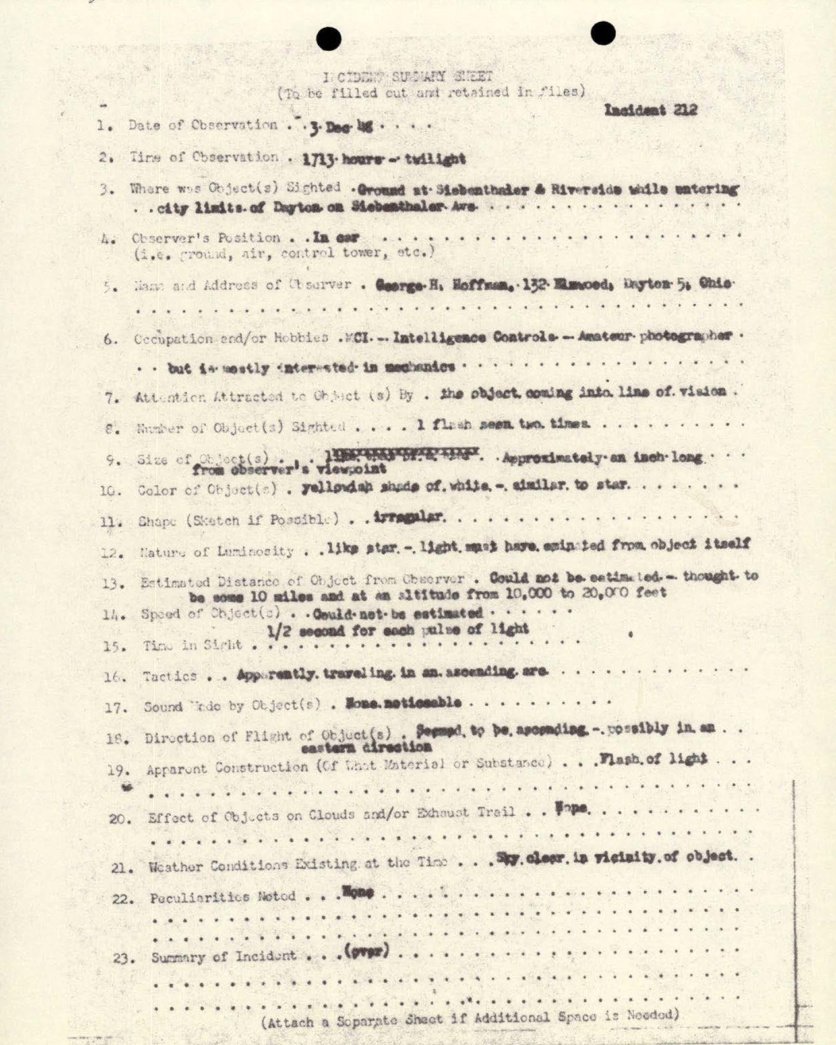
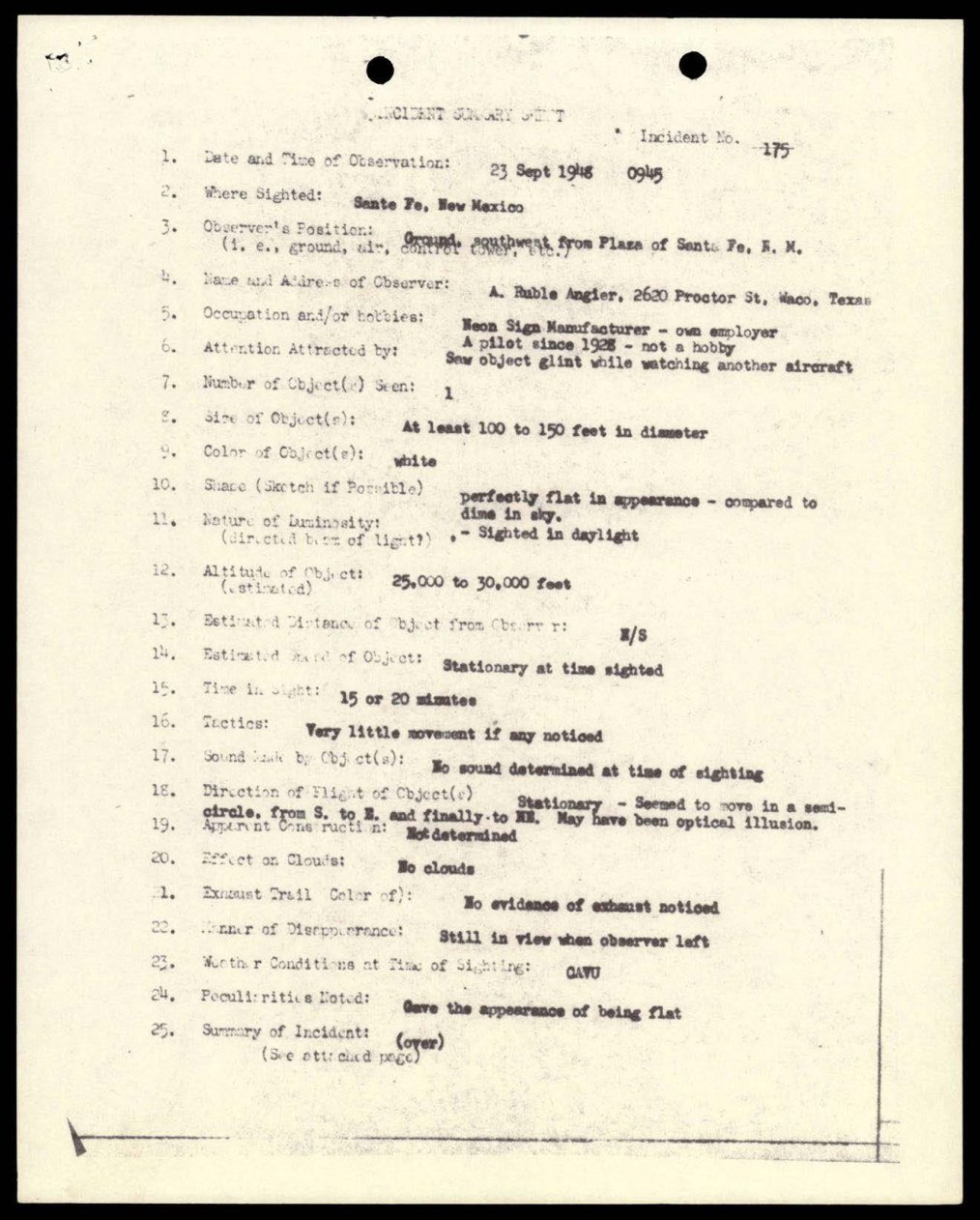
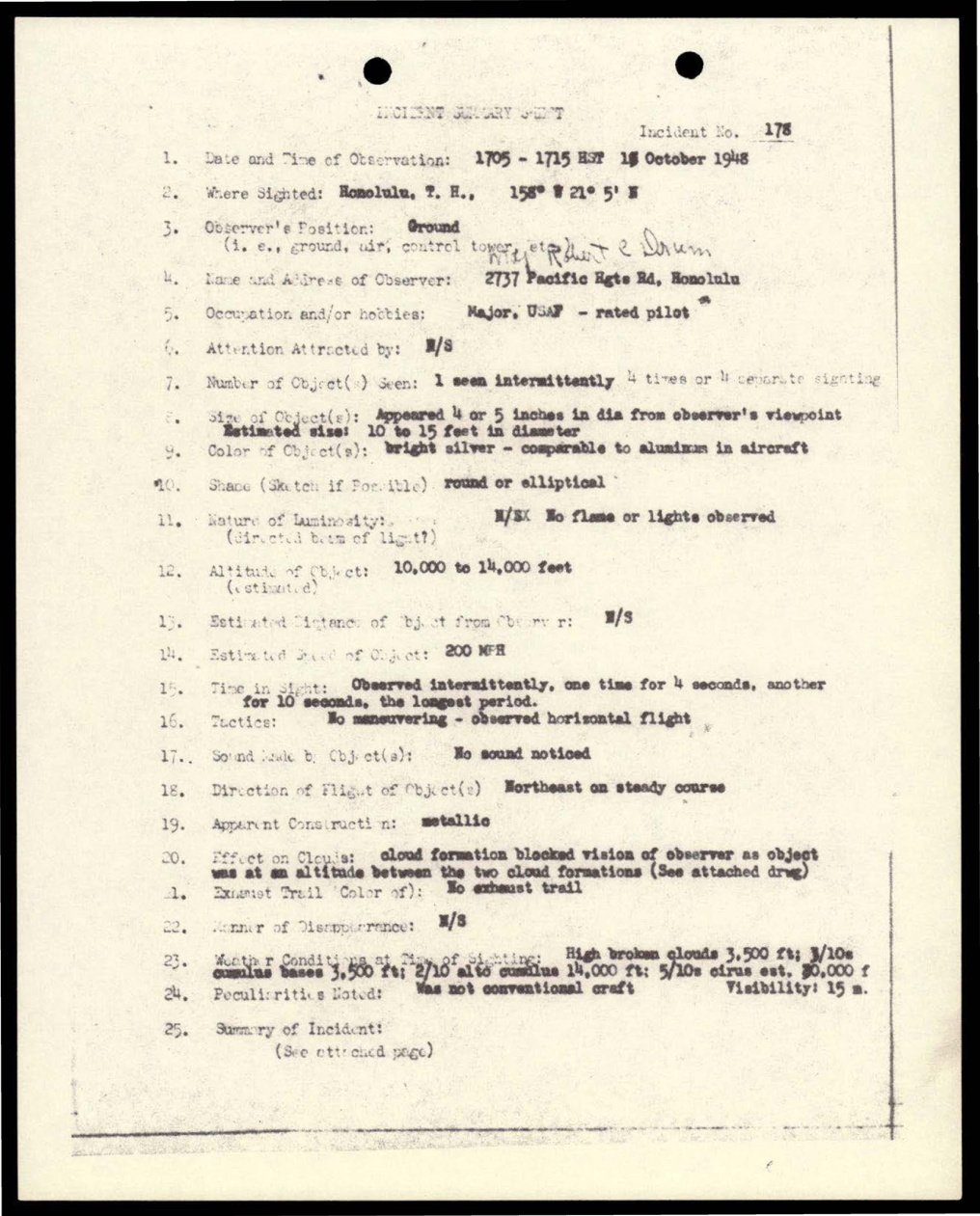
Date: 31/10/1948, between 2h30 and 3h30 (Greenwich time)Location: Over the U.S. Army air base in the Azores
Azores, 1948: three American servicemen see a UFO moving north before dawn
A sergeant and two airmen of the Air Force saw, in the early morning hours, an orange or yellowish-white UFO heading north, oscillating back and forth, until it disappeared into the clouds. The A-2 intelligence section gave its opinion that it was a weather balloon with a light hanging from it.
- Event date
- 31/10/1948, between 2h30 and 3h30 (Greenwich time)
- Location
- Over the U.S. Army air base in the Azores
- Topic
- 1948 reports
- Source agencies
- Arquivo histórico
- Documents
- 1 document · 144 pages
- Reading time
- 8 min
 Official summaryPhysical page 72
DOCUMENTARY SOURCES · Arquivo histórico
What the records tell
In the early morning hours of October 31, 1948, at around 2h30 Greenwich time, Sergeant Joseph J. Barnett of the U.S. Air Force (USAF) was at an American air base in the Azores when he noticed a round, flattened object passing overhead. According to Project Sign incident 201, the color was pale yellow or light orange, "not bluish-white," and the object was heading north at about 160 miles per hour, oscillating but holding its course and altitude, until it disappeared behind the clouds after 3 to 5 minutes.
Barnett pointed the object out to Private Robert R. Anderson (incident 201A). To Anderson, it was round, orange and larger than a star. He described the same curious motion: the object seemed to go forward and then backward along its direction of travel, but always kept advancing. Anderson estimated the speed at 800 miles per hour and the altitude at 2.000 to 3.000 feet above the clouds, which were at 2.500 feet, that is, 4.500 to 5.500 feet. He saw the object for about 2 minutes, until it disappeared behind a cloud. Neither of the two heard any sound or saw any trail.
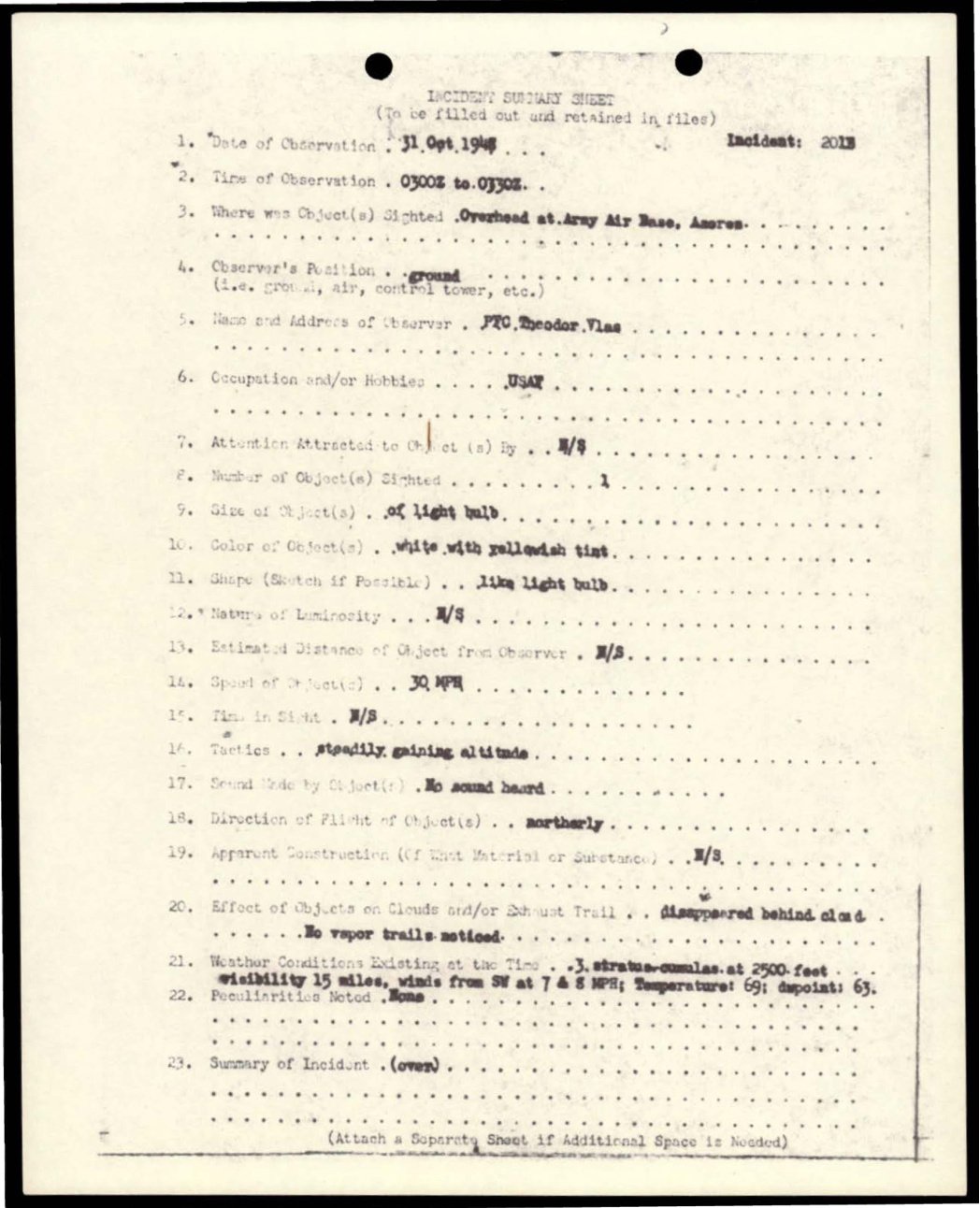
The third account, that of Private Theodor Vlas (incident 201B), records a time between 3h and 3h30 Greenwich time. He described something the size and shape of a light bulb, white with a yellowish tint, climbing steadily and moving north at 25 or 30 miles per hour, until it disappeared behind a cloud and could no longer be found. The weather was the same on all three sheets: three-tenths sky cover with stratocumulus at 2.500 feet, visibility of 15 miles, wind from the southwest at 7 or 8 miles per hour.
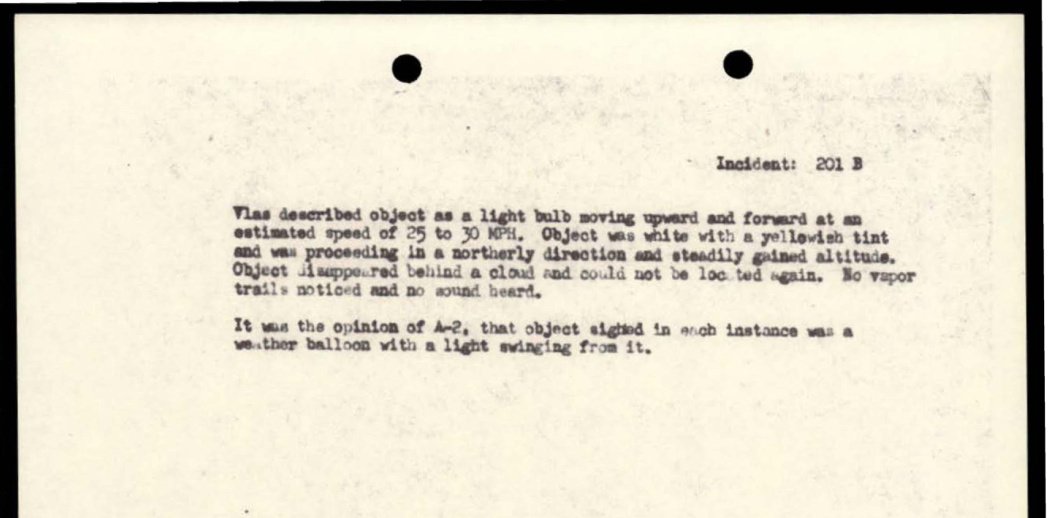
The last line of the summary contains the only assessment of the case: it was the opinion of A-2, the intelligence section, that the object seen "in each case" was a weather balloon with a light swinging from it. Nighttime sounding balloons usually carried a light so they could be tracked from the ground. The steady climb described by Vlas and the oscillation seen by the other two are consistent with this explanation, but the document does not state whether there was a launch at the base at that time.
The estimated speeds range from 25 to 800 miles per hour for what was probably the same object, which shows how difficult it is to judge the distance and speed of an isolated light at night. The sheets identify the base only as an Army air base in the Azores, without naming the island. None of them includes a statement from the base weather section or a record of a balloon launch that early morning.
The three sheets are in the bundle of summary sheets for incidents 173 to 233, forwarded by the Air Materiel Command on March 9, 1949, and stamped on March 22. They use the 23-item form, with the instruction "to be filled out and kept in the files," and give the times with the letter Z, for Greenwich time. The servicemen's unit appears only by the acronym AATS and by the military postal address APO 406, New York; no sheet names the island or the base. Vlas's sheet adds to the recorded weather a temperature of 69 and a dew point of 63, on the Fahrenheit scale.
None of the figures in the case is a measurement. The altitude given in Anderson's account is a calculation made in the document itself: his estimate of 2.000 to 3.000 feet above the clouds, added to the reported cloud base of 2.500 feet. The speeds, of 25 to 30, 160 and 800 miles per hour, are estimates with no known distance. The times also do not match: 2h30 for Barnett and Anderson, and 3h to 3h30 for Vlas, which leaves open whether the third man saw the same object or another one, later.
The only institutional assessment is the final sentence of Vlas's summary: in the opinion of the A-2 intelligence section, the object seen "in each case" was a weather balloon with a light hanging from it. The pages contain no record of a balloon launch or statement from the weather service. No other document in the collection mentions Barnett, Anderson, Vlas or a sighting in the Azores in October 1948; the only other occurrence of "Azores" in the collection is a news item from the 1950s, in another FBI file.
More images from the document
DIRECT READING OF THE FILE
The document, in the original
All pages of the case in this PDF were translated in full, one per block, and checked against the facsimile: the standardized "Incident Summary Sheet" form (items 1 to 25) and the attached summary sheet. Pages 67 to 72 translated in full (three forms and three summaries). For privacy, home addresses, telephone numbers, military service numbers and health data of private individuals were replaced by bracketed markers; the rest follows the original.
EXCERPT 1 · PHYSICAL PAGE 67
Physical page 67: form for incident 201 (Barnett)
- -
• •
)
• i) (J
.. ..... C" ,n . .~•
) - -~
• c . )
('
.. •. J . l~- •.ff
<., . \. ·c,,r •• I/ . .
. .
I • I\' ...
L r. \ J .:, .~I
1·o :'.;i \. . .
..
•
.•{ . . . .
... -~~-~ . . . .' --tla\na4l • ) . . •
\na\e&
.. (' ~ . . . lllae lfioI .
-,. . .) 5 . • • .
I. • I \.;) • .
....,,,.. \ alat.alaS• .,. .~,,...,.. . :·c -C . . . . . . • • . . ...
., . . .; . J'
J. •
1/1
J.,. t, ....... . • .
. . . . .
I)F.ff tL or .•ls. : !D.~ • . . .
. t
. . . . • • .
. .. . . . .(mi-)2.. . l:,ci .r. • • . • . • .
. . . . . .• • . • . •
• . • . . . . • . . . .
)( i s CEditorial note: APO 406 is the unit's military postal address, not a residence. "3 strato-cumulus" was read as three tenths of coverage, a meteorological notation of the period.
Check the original PDF
INCIDENT SUMMARY SHEET (To be filled out and retained in files). Incident: 201. 1. Date of Observation: 31 Oct 1948. 2. Time of Observation: 0230Z. 3. Where was Object(s) Sighted: Overhead - Army Air Base, Azores. 4. Observer's Position: ground. 5. Name and Address of Observer: Staff Sgt. Joseph J. Barnett, [service number], APO 406 New York. 6. Occupation and/or Hobbies: US AF. 7. Attention Attracted to Object(s) By: N/S. 8. Number of Object(s) Sighted: 1. 9. Size of Object(s): N/S. 10. Color of Object(s): [struck through] pale yellow or light orange color. 11. Shape (Sketch if Possible): flat round shape. 12. Nature of Luminosity: Not stated. 13. Estimated Distance of Object from Observer: N/S. 14. Speed of Object(s): approximate speed thought to be around 160 MPH. 15. Time in Sight: 3 to 5 minutes. 16. Tactics: weaving but maintaining course. Did not change altitude. 17. Sound Made by Object(s): none heard. 18. Direction of Flight of Object(s): northerly direction. 19. Apparent Construction (Of What Material or Substance): N/S. 20. Effect of Objects on Clouds and/or Exhaust Trail: N/S - no vapor trails. Disappeared behind clouds. 21. Weather Conditions Existing at the Time: 3 strato-cumulus at 2500 feet, visibility 15 miles, winds from southwest at 7 & 8 MPH. 22. Peculiarities Noted: "weaving" but forward motion. 23. Summary of Incident: (over). (Attach a Separate Sheet if Additional Space is Needed).View the document record ↗ · Physical page 67, counting the cover.
EXCERPT 2 · PHYSICAL PAGE 68
Physical page 68: summary of incident 201
l 1aal t:
•
alti
Steff J'o.epb J. tt, J/1 APO 1'06. I.
\be fo owinc& Oil 31 Oct l4S armre.11:ha:t.1,J 02,0Z be DO flat
o• lac a rl1 at•
·,-uov o 1
8. 0 a, ,_. ) to 5 td.ml\el.
• nor,.. eoUDdD811'4.
•Editorial note: AATS is a unit acronym not spelled out in the document.
Check the original PDF
Incident: 201. Staff Sgt Joseph J. Barnett, [service number], AATS APO 406, N. Y. reported the following: On 31 Oct 48 at approximately 0230Z he noticed a flat round object weaving overhead but maintaining a northerly course at an approximate speed of 160 MPH. Object was pale yellow or light orange color and not bluewhite. Seemed to maintain the same altitude and disappeared behind clouds. The object was viewed from 3 to 5 minutes. No vapor trails were seen nor was any sound heard.View the document record ↗ · Physical page 68, counting the cover.
EXCERPT 3 · PHYSICAL PAGE 69
Physical page 69: form for incident 201A (Anderson)
• •
--
)
IL a .. n
I'.
- .Air •
••
r,
(,.
.,
I •
tc
,..
or. ,d/ H
r
·c
•
-.;i:,.
., ) ,f
·L
'
l.•
. .
l!;l)·of
'
.
• 1 .
(, . ,. . C
••
i.d
)
..
r . el .....
d.lfto
... ' .
. .
")
cf .. c .. ) . . .
. . . . • • • • .. . . . . . . . . .
(A •ah )Editorial note: In item 13, the second number can be read as 3000 or 5000; 3000 was adopted for consistency with the summary on page 70. The speed of 800 mph matches the summary.
Check the original PDF
INCIDENT SUMMARY SHEET (To be filled out and retained in files). Incident: 201A. 1. Date of Observation: 31 Oct 1948. 2. Time of Observation: 0230Z. 3. Where was Object(s) Sighted: overhead - Army Air Base, Azores. 4. Observer's Position: Ground. 5. Name and Address of Observer: PFC Robert R. Anderson; [service number] of AATS, APO 406, N. Y. 6. Occupation and/or Hobbies: USAF. 7. Attention Attracted to Object(s) By: S/Sgt Joseph J. Barnett. 8. Number of Object(s) Sighted: 1. 9. Size of Object(s): larger than a star. 10. Color of Object(s): orange. 11. Shape (Sketch if Possible): round. 12. Nature of Luminosity: N/S. 13. Estimated Distance of Object from Observer: 2000-3000 above clouds which were at 2500 feet, or approx 4500 ft. 14. Speed of Object(s): 800 MPH. 15. Time in Sight: Approximately 2 minutes. 16. Tactics: would swing forward and then backward in same direction it was moving but always maintaining its forward velocity. 17. Sound Made by Object(s): No sound heard. 18. Direction of Flight of Object(s): northerly direction. 19. Apparent Construction: N/S. 20. Effect of Objects on Clouds and/or Exhaust Trail: disappeared behind cloud. No vapor trails noticed. 21. Weather Conditions Existing at the Time: 3 stratus-cumulus at 2500 feet, visibility 15 miles, winds from southwest at 7 & 8 MPH; Temperature: 69. 22. Peculiarities Noted: Object would swing forward and then backward in same direction but still maintained forward velocity. 23. Summary of Incident: (over).View the document record ↗ · Physical page 69, counting the cover.
EXCERPT 4 · PHYSICAL PAGE 70
Physical page 70: summary of incident 201A
Incident: 201A
At approximately 02302 31 Oct 6, Steff Sgt Joesph J. Barnett pointed
out an object to PFO Robert R. Anderson who described it as being
round, orange in color and larger than a ster. Object was moving in
a northerly direction at an estimated of 600 WPA, Altitude was
estimated as 2000-3000 feet above the clouds which were reported to be
at 2500 feet. This would give an approximate altitude of from WO to 5500
feet, Object would swing forward and them beciveard but always maintained
ite forward velocity. Object was seen for approximately 2 mimtes before
it disappeared behind e clowd. No sound was heard.Check the original PDF
Incident: 201A. At approximately 0230Z 31 Oct 48, Staff Sgt Joseph J. Barnett pointed out an object to PFC Robert R. Anderson who described it as being round, orange in color and larger than a star. Object was moving in a northerly direction at an estimated speed of 800 MPH. Altitude was estimated as 2000-3000 feet above the clouds which were reported to be at 2500 feet. This would give an approximate altitude of from 4500 to 5500 feet. Object would swing forward and then backward but always maintained its forward velocity. Object was seen for approximately 2 minutes before it disappeared behind a cloud. No sound was heard.View the document record ↗ · Physical page 70, counting the cover.
EXCERPT 5 · PHYSICAL PAGE 71
Physical page 71: form for incident 201B (Vlas)
·• r
C
. .
:.
••
• . . . . . . .
ry
. . . . . . •
(
-
. o,oos ...OJ)QI.
)
JQ
.,, .
•..
~
&a"'7taa
. . . •
.(
.
r
.,_
.
,.
t, • )
. .
.l ~
. .
...
. .
.
•
. .
-
l )
•
'
. .
. 1
..
1/J .
.. .
i, . .
-~
.
. .
•
. . . .
)
~.
...
6.
I •
..
.. \ .
r
I
"I.... .
2 .
,-..Check the original PDF
INCIDENT SUMMARY SHEET (To be filled out and retained in files). Incident: 201B. 1. Date of Observation: 31 Oct 1948. 2. Time of Observation: 0300Z to 0330Z. 3. Where was Object(s) Sighted: Overhead at Army Air Base, Azores. 4. Observer's Position: ground. 5. Name and Address of Observer: PFC Theodor Vlas. 6. Occupation and/or Hobbies: USAF. 7. Attention Attracted to Object(s) By: N/S. 8. Number of Object(s) Sighted: 1. 9. Size of Object(s): of light bulb. 10. Color of Object(s): white with yellowish tint. 11. Shape (Sketch if Possible): like light bulb. 12. Nature of Luminosity: N/S. 13. Estimated Distance of Object from Observer: N/S. 14. Speed of Object(s): 30 MPH. 15. Time in Sight: N/S. 16. Tactics: steadily gaining altitude. 17. Sound Made by Object(s): No sound heard. 18. Direction of Flight of Object(s): northerly. 19. Apparent Construction: N/S. 20. Effect of Objects on Clouds and/or Exhaust Trail: disappeared behind cloud. No vapor trails noticed. 21. Weather Conditions Existing at the Time: 3 stratus-cumulus at 2500 feet, visibility 15 miles, winds from SW at 7 & 8 MPH; Temperature: 69; dewpoint: 63. 22. Peculiarities Noted: None. 23. Summary of Incident: (over).View the document record ↗ · Physical page 71, counting the cover.
EXCERPT 6 · PHYSICAL PAGE 72
Physical page 72: summary of incident 201B and A-2 opinion
Incident: 201 B
Vlas described object as a light bulb moving upward and forward at an
estimated speed of 25 to 30 MPH. Object was white with a yellowieh tint
and wax proceeding in a northerly direction and steadily gained altitude.
Object iisuppecred beliind a clowl and could not de loc ted again. Wo vepor
trails mticed and no sound heard,
Tt was the opinion of A-2, that object sigttd in ench instance was a
weather balloon with a light swinging from it.Editorial note: A-2 designates the intelligence section of the staff of an Air Force unit; it is not a reliability code.
Check the original PDF
Incident: 201 B. Vlas described object as a light bulb moving upward and forward at an estimated speed of 25 to 30 MPH. Object was white with a yellowish tint and was proceeding in a northerly direction and steadily gained altitude. Object disappeared behind a cloud and could not be located again. No vapor trails noticed and no sound heard. It was the opinion of A-2, that object sighted in each instance was a weather balloon with a light swinging from it.View the document record ↗ · Physical page 72, counting the cover.
Dates and documentary context
- Event
- 31/10/1948 — 02h30Z (Barnett and Anderson) and 03h00Z-03h30Z (Vlas). Z is Greenwich time.
- Document
- Not established — Forms without a completion date.
- Publication
- Not established — Document released in Release 1 of the collection.
Origin and release
U.S. Air Force, Project Sign; incident summary sheets with no identified individual author · 38_143685_box7_Incident_Summaries_173-233.pdf
undefined ↗ — undefined
Questions to continue the investigation
- Was a nighttime sounding balloon launched at the Azores base in the early morning of October 31, 1948?
- Did Vlas see the same object as Barnett and Anderson, half an hour later, or a second balloon?
GEOGRAPHY OF THE CASE
U.S. Army air base in the Azores (island not specified)
The record cards do not name the island or the base; therefore there is no point on the map.
DOCUMENTARY TRAIL
Go back to the sources
References use physical pages of the PDF, counting the cover. Summaries are presented in English; the documents keep their original language.
- 38_143685_box7_Incident_Summaries_173-233.pdf
Physical pages 67 to 72: incidents 201, 201A and 201B (three servicemen at the Azores base)
Arquivo histórico · 144 pages
Editorial summary based on the collection's research notes. How we read the documents.