Date: 30/10/2009Location: Defense Intelligence Agency (DIA), Defense Warning Office; city not given
DIA, 2009: memorandum to the agency's director says the 26 reports from the first year of AAWSAP received reviews that were “all positive”
An information memorandum dated October 30, 2009 responds to the Director of the Defense Intelligence Agency, who had requested an assessment of the quality and value of the technical reports delivered by BAASS in the first year of the AAWSAP contract. The document lists the 26 studies, reproduces excerpts from reviews by other authors under the contract and by researchers at Sandia National Laboratories, and announces the plans for fiscal year 2010.
- Event date
- 30/10/2009
- Location
- Defense Intelligence Agency (DIA), Defense Warning Office; city not given
- Topic
- AAWSAP and advanced technologies
- Source agencies
- DOW
- Documents
- 1 document · 8 pages
- Reading time
- 17 min
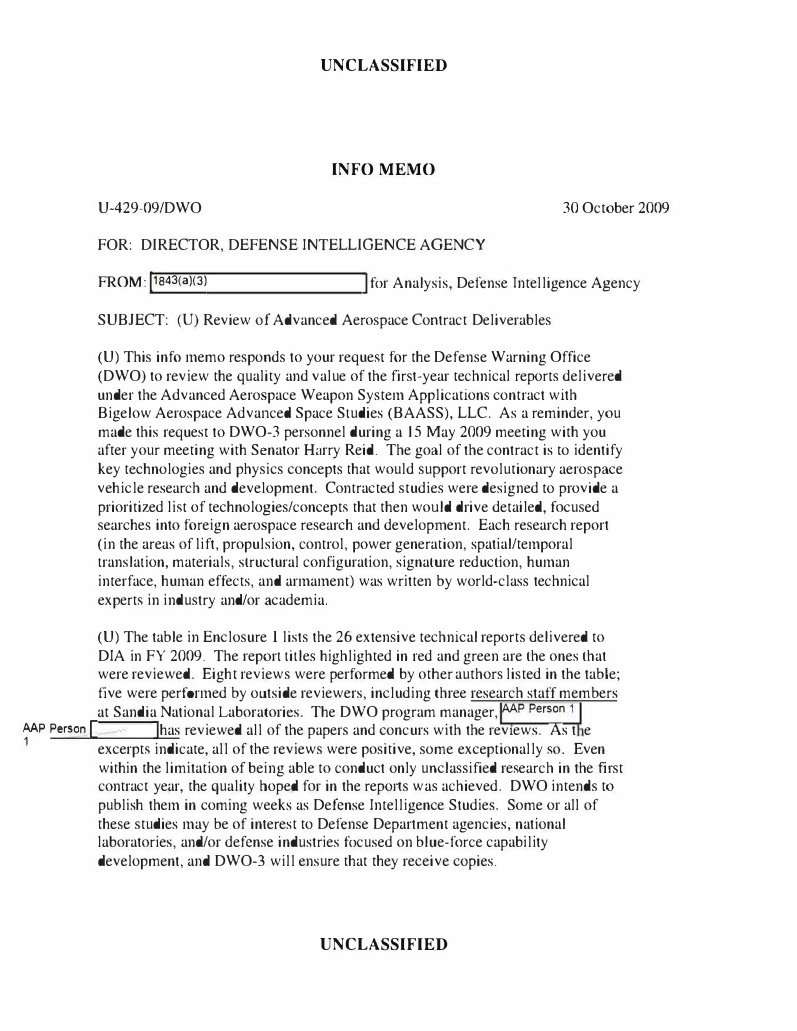 Facsimile of the documentPhysical page 1
DOCUMENTARY SOURCES · DOW
What the records tell
Date: October 30, 2009. Location: Defense Intelligence Agency (DIA), with no city indicated in the document. Information memorandum U-429-09/DWO, unclassified, was addressed to the DIA director by an official in the Analysis area whose name is [redacted]. It responds to a request the director made to DWO-3 personnel at a meeting on May 15, 2009, shortly after meeting with Senator Harry Reid. The request was for the Defense Warning Office to review the quality and value of the technical reports from the first year of the Advanced Aerospace Weapon System Applications (AAWSAP) contract, signed with Bigelow Aerospace Advanced Space Studies (BAASS).
According to the memorandum, the purpose of the contract was to identify key technologies and physics concepts that would support research into revolutionary aerospace vehicles. The studies were to produce a prioritized list of technologies that would guide detailed searches on foreign aerospace research. The areas cited are lift, propulsion, control, power generation, spatial and temporal translation, materials, structural configuration, signature reduction, human interface, human effects and armament. The text states that the reports were written by “world-class” technical experts from industry and academia. This is the assessment of the memorandum's author, not a conclusion verified by third parties in the document.
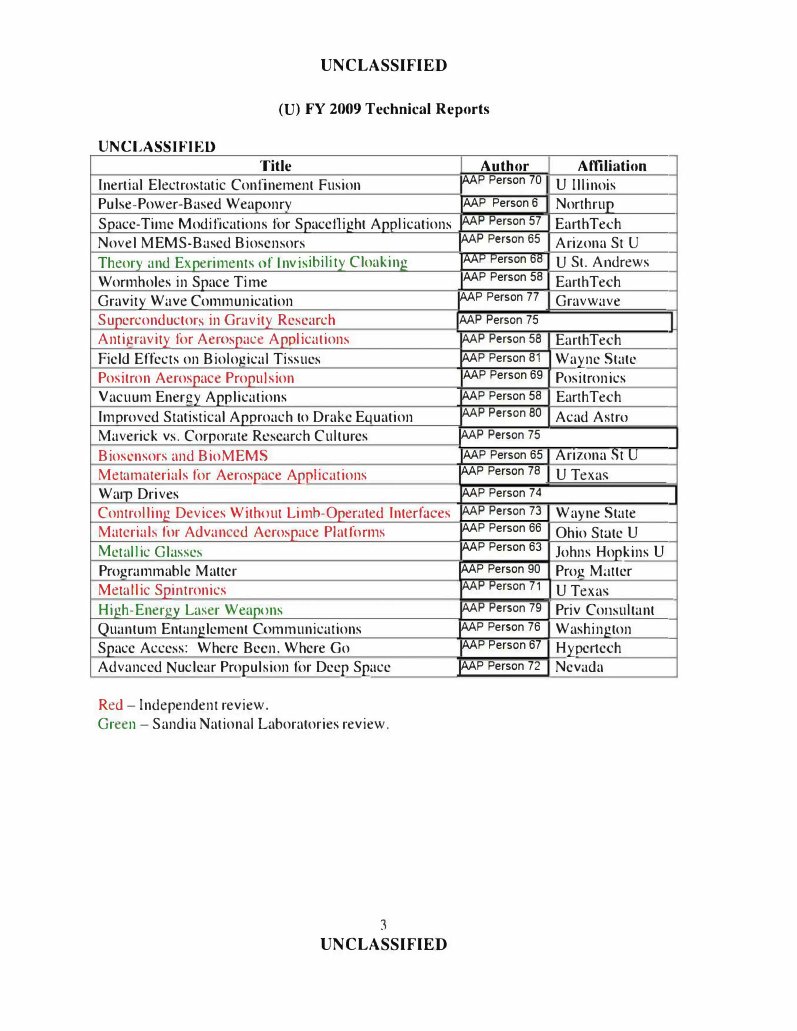
Enclosure 1 is a table of the 26 reports delivered in fiscal year 2009. The authors' names are [redacted], but the titles and affiliations appear: University of Illinois, Arizona State, St. Andrews, Wayne State, University of Texas, Ohio State, Johns Hopkins, and companies such as EarthTech and Positronics. The topics range from electrostatic fusion and positron propulsion to wormholes, warp drives, antigravity, invisibility, the Drake equation and brain interfaces. Eight titles are marked in red, as independent review, and three in green, as Sandia review. The memorandum text, however, refers to 13 reviews, not 11.
The memorandum says eight reviews were done by other authors listed in the table itself and five by outside reviewers, three of them from Sandia. It records that the program manager at the Defense Warning Office reviewed all the papers and agreed with the assessments. The conclusion attributed to the office is that “all reviews were positive, some exceptionally so,” and that the expected quality was achieved despite the limitation of conducting only unclassified research in the first year. The excerpts praise, for example, the antigravity study as an “excellent overview,” but also note that controlling machines by thought “is still quite far off” and that the laser study is “a good general introduction.”
The document describes the next plans. According to preliminary budget guidance, Congress would “apparently” fund the first option year of the contract with US$ 12 million. In fiscal year 2010, the office would use the 26 reports to have BAASS assess how adversaries around the world might exploit these technologies, would select studies for classified experimental verification, and would commission new studies, classified and unclassified. The products were expected by late summer 2010. The memorandum also planned to publish the reports as Defense Intelligence Studies and send them to Department of Defense components, national laboratories and defense industries.
The memorandum does not mention UAP, UFOs or observations of any kind. It is an internal administrative assessment of the quality of technical studies, based on selected excerpts from reviews. The document itself states that most of the reviews came from authors under the same contract, and the table shows identifiers that appear sometimes as author, sometimes as reviewer. The text does not reproduce the full reviews or say how the excerpts were selected. Nor does it confirm whether publication as Defense Intelligence Studies took place or whether the 2010 funding was approved.
More images from the document
DIRECT READING OF THE FILE
The document, in the original
The eight pages of memorandum U-429-09/DWO are translated in full in the page-by-page blocks, including the Annex 1 table with the highlight color of each title and all the review excerpts. The names of authors and reviewers are already redacted in the original and appear as “AAP Person” identifiers.
EXCERPT 1 · PHYSICAL PAGE 1
Physical page 1, full page
UNCLASSIFIED
INFO MEMO
U-429-09/DWO
30 October 2009
FOR: DIRECTOR, DEFENSE INTELLIGENCE AGENCY
FROM: l1843(a)(3)
Ifor Analysis, Defense Intelligence Agency
SUBJECT: (U) Review of Advanced Aerospace Contract Deliverables
(U) This info memo responds to your request for the Defense Warning Office
(DWO) to review the quality and value of the first-year technical reports delivered
under the Advanced Aerospace Weapon System Applications contract with
Bigelow Aerospace Advanced Space Studies (BAASS), LLC. As a reminder, you
made th.is request to DWO-3 personnel during a 15 May 2009 meeting with you
after your meeting with Senator Harry Reid. The goal of the contract is to identify
key technologies and physics concepts that would support revolutionary aerospace
vehicle research and development. Contracted studies were designed to provide a
prioritized list of technologies/concepts that then would drive detailed, focused
searches into foreign aerospace research and development. Each research report
(in the areas of lift, propulsion, control, power generation, spatial/temporal
translation, materials, structural configuration, signature reduction, human
interface, human effects, and armament) was written by world-class technical
experts in industry and/or academia.
(U) The table in Enclosure 1 lists the 26 extensive technical reports delivered to
DIA in FY 2009. The report titles highlighted in red and green are the ones that
were reviewed. Eight reviews were performed by other authors listed in the table;
five were performed by outside reviewers, including three research staff members
son 1
at Sandia National Laboratories. The DWO program manager, AAP Per
»P Pe.¼½gr:iJ
••
!has reviewed all of the papers and concurs with the reviews. As t e
excerpts indicate, all of the reviews were positive, some exceptionally so. Even
within the limitation of being able to conduct only unclassified research in the fu-st
contract year, the quality hoped for in the reports was achieved. DWO intends to
publish them in coming weeks as Defense Intelligence Studies. Some or all of
these studies may be of interest to Defense Department agencies, national
laboratories, and/or defense industries focused on blue-force capability
development, and DWO-3 will ensure that they receive copies.
UNCLASSIFIEDEditorial note: Physical page 1 of DOW-UAP-D188-Review_of_AAWSAP_Contract_Deliverables_October-2009.pdf.
Check the original PDF
UNCLASSIFIED
INFO MEMO
U-429-09/DWO
30 October 2009
FOR: DIRECTOR, DEFENSE INTELLIGENCE AGENCY
FROM: l1843(a)(3)
Ifor Analysis, Defense Intelligence Agency
SUBJECT: (U) Review of Advanced Aerospace Contract Deliverables
(U) This info memo responds to your request for the Defense Warning Office
(DWO) to review the quality and value of the first-year technical reports delivered
under the Advanced Aerospace Weapon System Applications contract with
Bigelow Aerospace Advanced Space Studies (BAASS), LLC. As a reminder, you
made th.is request to DWO-3 personnel during a 15 May 2009 meeting with you
after your meeting with Senator Harry Reid. The goal of the contract is to identify
key technologies and physics concepts that would support revolutionary aerospace
vehicle research and development. Contracted studies were designed to provide a
prioritized list of technologies/concepts that then would drive detailed, focused
searches into foreign aerospace research and development. Each research report
(in the areas of lift, propulsion, control, power generation, spatial/temporal
translation, materials, structural configuration, signature reduction, human
interface, human effects, and armament) was written by world-class technical
experts in industry and/or academia.
(U) The table in Enclosure 1 lists the 26 extensive technical reports delivered to
DIA in FY 2009. The report titles highlighted in red and green are the ones that
were reviewed. Eight reviews were performed by other authors listed in the table;
five were performed by outside reviewers, including three research staff members
son 1
at Sandia National Laboratories. The DWO program manager, AAP Per
»P Pe.¼½gr:iJ
••
!has reviewed all of the papers and concurs with the reviews. As t e
excerpts indicate, all of the reviews were positive, some exceptionally so. Even
within the limitation of being able to conduct only unclassified research in the fu-st
contract year, the quality hoped for in the reports was achieved. DWO intends to
publish them in coming weeks as Defense Intelligence Studies. Some or all of
these studies may be of interest to Defense Department agencies, national
laboratories, and/or defense industries focused on blue-force capability
development, and DWO-3 will ensure that they receive copies.
UNCLASSIFIEDView the document record ↗ · Physical page 1, counting the cover.
EXCERPT 2 · PHYSICAL PAGE 2
Physical page 2, full page
_____
UNCLASSIFIED
(U) Based on draft budget guidance, Congress apparently will fund the contract's
option year one at $12 million. In FY 2010, DWO will use the 26 FY 2009
technical reports in having BAASS evaluate potential adversary exploitation
worldwide, select studies amenable to classified experimental verification by
BAASS, and have BAASS conduct new classified and unclassified studies with
select academic and industry partners. Deliverables are expected in late summer
2010.
2 enclosures as stated
.
. IAAP Person 1
(U) Prepared by:IAAP Person 1
pefense Warnmg Office _a
_
2
UNCLASSIFIEDEditorial note: Physical page 2 of DOW-UAP-D188-Review_of_AAWSAP_Contract_Deliverables_October-2009.pdf.
Check the original PDF
_____
UNCLASSIFIED
(U) Based on draft budget guidance, Congress apparently will fund the contract's
option year one at $12 million. In FY 2010, DWO will use the 26 FY 2009
technical reports in having BAASS evaluate potential adversary exploitation
worldwide, select studies amenable to classified experimental verification by
BAASS, and have BAASS conduct new classified and unclassified studies with
select academic and industry partners. Deliverables are expected in late summer
2010.
2 enclosures as stated
.
. IAAP Person 1
(U) Prepared by:IAAP Person 1
pefense Warnmg Office _a
_
2
UNCLASSIFIEDView the document record ↗ · Physical page 2, counting the cover.
EXCERPT 3 · PHYSICAL PAGE 3
Physical page 3, full page
UNCLASSIFIED
(U) FY 2009 Technical Reports
UNCLASSIFIED
Title
Author
MP Person 70
Inertial Electrostatic Confinement Fusion
Pulse-Power-Based Weaponry
MP Person 6
Space-Time Modifications for Spaceflight Applications MP Person 57
MP Person 65
Novel MEMS-Based Biosensors
MP Person 68
Theory and Experiments of Invisibility CloakinJ:?;
MP Person 58
Wormholes in Space Time
MP Person 77
Gravity Wave Communication
Superconductors in Gravity Research
MP Person 75
Antigravity for Aerospace Applications
MP Person 58
Field Effects on Biological Tissues
MP Person 81
MP Person 69
Positron Aerospace Propulsion
Vacuum Energy Applications
MP Person 58
MP Person 80
Improved Statistical Approach to Drake Equation
Maverick vs. Corporate Research Cultures
MP Person 75
Bioscnsors and BioMEMS
MP Person 65
Affiliation
U Illinois
Northrup
Earth Tech
Arizona St U
U St. Andrews
Earth Tech
Gravwave
Earth Tech
Wayne State
Positronics
Earth Tech
Acad Astra
Arizona St U
MP Person 78
Metamaterials for Aerospace Applications
Warp Drives
MP Person 7 4
MP Person 73
Controlling Devices Without Limb-Operated Interfaces
MP Person 66
Materials for Advanced Aerospace Platforms
MP Person 63
Metal!ic Glasses
MP Person 90
Programmable Matter
MP Person 71
Metallic Spintronics
High-Energy Laser Weapons
MP Person 79
MP Person 76
Quantum Entanglement Communications
MP Person 67
Space Access: Where Been, Where Go
Advanced Nuclear Propulsion for Deep Space
MP Person 72
U Texas
Wayne State
Ohio State U
Johns Hopkins U
Prog Matter
U Texas
Priv Consultant
Washington
Hypertech
Nevada
Red - Independent review.
Green - Sandia National Laboratories review.
3
UN CLASSIFIEDEditorial note: Physical page 3 of DOW-UAP-D188-Review_of_AAWSAP_Contract_Deliverables_October-2009.pdf.
Check the original PDF
UNCLASSIFIED
(U) FY 2009 Technical Reports
UNCLASSIFIED
Title
Author
MP Person 70
Inertial Electrostatic Confinement Fusion
Pulse-Power-Based Weaponry
MP Person 6
Space-Time Modifications for Spaceflight Applications MP Person 57
MP Person 65
Novel MEMS-Based Biosensors
MP Person 68
Theory and Experiments of Invisibility CloakinJ:?;
MP Person 58
Wormholes in Space Time
MP Person 77
Gravity Wave Communication
Superconductors in Gravity Research
MP Person 75
Antigravity for Aerospace Applications
MP Person 58
Field Effects on Biological Tissues
MP Person 81
MP Person 69
Positron Aerospace Propulsion
Vacuum Energy Applications
MP Person 58
MP Person 80
Improved Statistical Approach to Drake Equation
Maverick vs. Corporate Research Cultures
MP Person 75
Bioscnsors and BioMEMS
MP Person 65
Affiliation
U Illinois
Northrup
Earth Tech
Arizona St U
U St. Andrews
Earth Tech
Gravwave
Earth Tech
Wayne State
Positronics
Earth Tech
Acad Astra
Arizona St U
MP Person 78
Metamaterials for Aerospace Applications
Warp Drives
MP Person 7 4
MP Person 73
Controlling Devices Without Limb-Operated Interfaces
MP Person 66
Materials for Advanced Aerospace Platforms
MP Person 63
Metal!ic Glasses
MP Person 90
Programmable Matter
MP Person 71
Metallic Spintronics
High-Energy Laser Weapons
MP Person 79
MP Person 76
Quantum Entanglement Communications
MP Person 67
Space Access: Where Been, Where Go
Advanced Nuclear Propulsion for Deep Space
MP Person 72
U Texas
Wayne State
Ohio State U
Johns Hopkins U
Prog Matter
U Texas
Priv Consultant
Washington
Hypertech
Nevada
Red - Independent review.
Green - Sandia National Laboratories review.
3
UN CLASSIFIEDView the document record ↗ · Physical page 3, counting the cover.
EXCERPT 4 · PHYSICAL PAGE 4
Physical page 4, full page
_ AA
erson 75
_______ ___,I
P P
_
_
I...
Consulting Services
_ _ _ _
UNCLASSIFIED
(U) Excerpts From Reviews
(U) All of the following review information and comments are UNCLASSIFIED.
Antigravity for Aerospace Applications in 2050
IAAP Person 58
I
EarthTech International, Inc.
AAP Person ,_____,,.__.Ihas provided an excellent overview of conventional approaches to
58
gravity manipulation within the confines of Newtonian, relativistic and quantum
physics. With his typical lucid style, he takes the time to add useful explanatory
notes which are especially enlightening for those for whom Relativity is not their
first Language. In addition, his extensive technical appendix concerning such
exotica as squeezed vacuum states, zero-point.fiuctuations and negative energy is
of great benefit.
Technological Approaches to Controlling External Devices in the Absence of
Limb Operated Interfaces
IAAP Person 73
I
Wayne State University School of Medicine
The paper by AAP Person 73
looks at the present and.future prospects.for the
human thoug t contra of ro otics and machines by way of high technology neural
interfaces. The ultimate aim o_fsuch research is to allow an individual to control
the function of a prosthetic or robot as an extension of his own body and mind or
to exercise thought-based control over a mechanized environment. Wefind from
-
P Per, ?.!. j
Áurrent review that the state of the art is still quite far away from
achieving such control but strong efforts are being made on a number of
approaches.
AP Person 65
r
On The Role of Su erconductors in Gravity Research
AAP Person 75
Consulting Services
Because of the author's involvement and activity in the field, it seems natural that
he chose to write on this subject, and he is able to demonstrate not only a solid
4
UN CLASSIFIEDEditorial note: Physical page 4 of DOW-UAP-D188-Review_of_AAWSAP_Contract_Deliverables_October-2009.pdf.
Check the original PDF
_ AA
erson 75
_______ ___,I
P P
_
_
I...
Consulting Services
_ _ _ _
UNCLASSIFIED
(U) Excerpts From Reviews
(U) All of the following review information and comments are UNCLASSIFIED.
Antigravity for Aerospace Applications in 2050
IAAP Person 58
I
EarthTech International, Inc.
AAP Person ,_____,,.__.Ihas provided an excellent overview of conventional approaches to
58
gravity manipulation within the confines of Newtonian, relativistic and quantum
physics. With his typical lucid style, he takes the time to add useful explanatory
notes which are especially enlightening for those for whom Relativity is not their
first Language. In addition, his extensive technical appendix concerning such
exotica as squeezed vacuum states, zero-point.fiuctuations and negative energy is
of great benefit.
Technological Approaches to Controlling External Devices in the Absence of
Limb Operated Interfaces
IAAP Person 73
I
Wayne State University School of Medicine
The paper by AAP Person 73
looks at the present and.future prospects.for the
human thoug t contra of ro otics and machines by way of high technology neural
interfaces. The ultimate aim o_fsuch research is to allow an individual to control
the function of a prosthetic or robot as an extension of his own body and mind or
to exercise thought-based control over a mechanized environment. Wefind from
-
P Per, ?.!. j
Áurrent review that the state of the art is still quite far away from
achieving such control but strong efforts are being made on a number of
approaches.
AP Person 65
r
On The Role of Su erconductors in Gravity Research
AAP Person 75
Consulting Services
Because of the author's involvement and activity in the field, it seems natural that
he chose to write on this subject, and he is able to demonstrate not only a solid
4
UN CLASSIFIEDView the document record ↗ · Physical page 4, counting the cover.
EXCERPT 5 · PHYSICAL PAGE 5
Physical page 5, full page
e hisinvolvement;I
P Person Despit
%
____________ lconsulting, LLC
on
P P r
74
AA
es
_
_ _ _ _
_
- ... I
Mechanics AAP Person 129
UNCLASSIFIED
understanding of the research area, but is also able to provide his personal
accounts of meetings with the prominent researchers. In addition, he describes his
own experimental results, or lack thereof Because of his own personal attachment
to the field, I found the report to be somewhat captivating, as I felt a strong sense
o,fbeing close to the research and hearing from the 'horse's mouth,' so to speak.
observer and he does not appear to take sides, or seem to be trying to promote or
lf;oint of view seems to be that of an impartial
'sell' the research field. He does an excellent job of relaying a candid and
informative survey o.fwhat, to me, seems to be a tantalizing yet controversial field
of study.
Metallic Glasses: Status and Prospects for Aerospace Applications
!AAP Person 63
John Hopkins University
I
This is an excellent and highly readable Survey report that defines Metallic
glasses, the advantages and disadvantages to other composite materials, and how
their mechanical properties are both alike and different from those of pure metals.
These properties include strength, stiffness, and toughness. The author makes a
case that the processing capability meets and sometimes exceeds those of
thermoplastic polymers, and traditional metals. Glass hybrid composites are found
to excel in almost all cases to current materials in widespread use.
AAP Person 129
The Society for Experimental
a.....,.---,.-..--
:-=:-:::---
::---------,
Theory and Experiments of Invisibility Cloaking
IAAP Person 68
I
University of St. Andrews
AAP P r on 68
The report bvl
Idescribes the background and recent advances in the
es
field of invisibility cloaking. This field recently emerged as one o.fthe most
exciting applications of metamaterials - arti cially structured media possessing
unusual refractive properties. AAP Person 68
is a pioneer in this .field, having
published one of the first theoretical papers describing the possibility of cloaking.
This topic still evokes misunderstandings and confusion. That is not surprising:
the concept of invisibility (although not its technical im lementation) has been
preoccupying people for centuries ifnot millennia. AAP Person 68
report does an
excellent job of clearing some of this confusion an provi mg c ear definitions of
what constitutes true cloaking/invisibility. It also honestly discusses technological
challenges to making a practical invisibility cloak.
5
UN CLASSIFIEDEditorial note: Physical page 5 of DOW-UAP-D188-Review_of_AAWSAP_Contract_Deliverables_October-2009.pdf.
Check the original PDF
e hisinvolvement;I
P Person Despit
%
____________ lconsulting, LLC
on
P P r
74
AA
es
_
_ _ _ _
_
- ... I
Mechanics AAP Person 129
UNCLASSIFIED
understanding of the research area, but is also able to provide his personal
accounts of meetings with the prominent researchers. In addition, he describes his
own experimental results, or lack thereof Because of his own personal attachment
to the field, I found the report to be somewhat captivating, as I felt a strong sense
o,fbeing close to the research and hearing from the 'horse's mouth,' so to speak.
observer and he does not appear to take sides, or seem to be trying to promote or
lf;oint of view seems to be that of an impartial
'sell' the research field. He does an excellent job of relaying a candid and
informative survey o.fwhat, to me, seems to be a tantalizing yet controversial field
of study.
Metallic Glasses: Status and Prospects for Aerospace Applications
!AAP Person 63
John Hopkins University
I
This is an excellent and highly readable Survey report that defines Metallic
glasses, the advantages and disadvantages to other composite materials, and how
their mechanical properties are both alike and different from those of pure metals.
These properties include strength, stiffness, and toughness. The author makes a
case that the processing capability meets and sometimes exceeds those of
thermoplastic polymers, and traditional metals. Glass hybrid composites are found
to excel in almost all cases to current materials in widespread use.
AAP Person 129
The Society for Experimental
a.....,.---,.-..--
:-=:-:::---
::---------,
Theory and Experiments of Invisibility Cloaking
IAAP Person 68
I
University of St. Andrews
AAP P r on 68
The report bvl
Idescribes the background and recent advances in the
es
field of invisibility cloaking. This field recently emerged as one o.fthe most
exciting applications of metamaterials - arti cially structured media possessing
unusual refractive properties. AAP Person 68
is a pioneer in this .field, having
published one of the first theoretical papers describing the possibility of cloaking.
This topic still evokes misunderstandings and confusion. That is not surprising:
the concept of invisibility (although not its technical im lementation) has been
preoccupying people for centuries ifnot millennia. AAP Person 68
report does an
excellent job of clearing some of this confusion an provi mg c ear definitions of
what constitutes true cloaking/invisibility. It also honestly discusses technological
challenges to making a practical invisibility cloak.
5
UN CLASSIFIEDView the document record ↗ · Physical page 5, counting the cover.
EXCERPT 6 · PHYSICAL PAGE 6
Physical page 6, full page
_e_e_e_e_e_e__
_ ._AAPePeresoene1e0
U niv ersity of Illinois
_
__,
I
I
_e_e_e_e_e_e___
UNCLASSIFIED
-IAAP Person 78
l
.... -.....,...------------- University of Texas at
Austin
Positron Aerospace Propulsion
!AAP Person 69
I
Positronics Research, LLC
This status paper is very exciting and provides new important information about
the present status and prospects for positron energy production and storage,
especially for space applications. It is recommended reading for both researchers
in the area and aerospace scientists. In addition, others interested in national
policy for both future energy and future space exploration should consider this
status paper to gain further insight into positron energy and propulsion.
Metamaterials for Aerospace Applications: Energy Harvesting, Sub
Wavelength Imaging, Optical-Device Miniaturization, and Non-Reciprocal
Optical Devices
AAPPerson 78
IUniversity of Texas at Austin
Metamaterials are "materials be ond materials" with unusual electromagnetic or
optical properties. The report by AAP Person 78
describes several possibilities
how such materials can be used for advanced aeros ace a lications. As
examples, he often uses his own experiments. AAP Person 78 is one of the research
leaders in the field of metamaterials and has built up a highly credible reputation
in this area. Although the research area of metamaterials is still rather new and
mostly confined to proof-of-principle academic research at present, it will
undoubtedly revolutionize photonics and lead to commercial applications that are
interesting for the aerospace industry.
-._IAAP_e Person68
__,1University of St Andrews
Biosensors and BioMEMS: A Survey of the Present Field
AAP Person 65
I
I
Arizona State University
This paper reaches toward and achieves a laudable goal: making BioMEMS
understandable and relevant. The author's contribution is important, because the
number of current programs and projects in the US Government that are either
touting the importance of, or making responses to research requests in 2009
6
UN CLASSIFIEDEditorial note: Physical page 6 of DOW-UAP-D188-Review_of_AAWSAP_Contract_Deliverables_October-2009.pdf.
Check the original PDF
_e_e_e_e_e_e__
_ ._AAPePeresoene1e0
U niv ersity of Illinois
_
__,
I
I
_e_e_e_e_e_e___
UNCLASSIFIED
-IAAP Person 78
l
.... -.....,...------------- University of Texas at
Austin
Positron Aerospace Propulsion
!AAP Person 69
I
Positronics Research, LLC
This status paper is very exciting and provides new important information about
the present status and prospects for positron energy production and storage,
especially for space applications. It is recommended reading for both researchers
in the area and aerospace scientists. In addition, others interested in national
policy for both future energy and future space exploration should consider this
status paper to gain further insight into positron energy and propulsion.
Metamaterials for Aerospace Applications: Energy Harvesting, Sub
Wavelength Imaging, Optical-Device Miniaturization, and Non-Reciprocal
Optical Devices
AAPPerson 78
IUniversity of Texas at Austin
Metamaterials are "materials be ond materials" with unusual electromagnetic or
optical properties. The report by AAP Person 78
describes several possibilities
how such materials can be used for advanced aeros ace a lications. As
examples, he often uses his own experiments. AAP Person 78 is one of the research
leaders in the field of metamaterials and has built up a highly credible reputation
in this area. Although the research area of metamaterials is still rather new and
mostly confined to proof-of-principle academic research at present, it will
undoubtedly revolutionize photonics and lead to commercial applications that are
interesting for the aerospace industry.
-._IAAP_e Person68
__,1University of St Andrews
Biosensors and BioMEMS: A Survey of the Present Field
AAP Person 65
I
I
Arizona State University
This paper reaches toward and achieves a laudable goal: making BioMEMS
understandable and relevant. The author's contribution is important, because the
number of current programs and projects in the US Government that are either
touting the importance of, or making responses to research requests in 2009
6
UN CLASSIFIEDView the document record ↗ · Physical page 6, counting the cover.
EXCERPT 7 · PHYSICAL PAGE 7
Physical page 7, full page
•
•
- AA P Person 81
Wayne State University School of
........
I
I
_
................................................ _.
_ .,..
.... ........ .....
:r:s;:;r: Ťf electrons, rather han by n1ť;Ŧŧh
Ũũ
t
7
P Person ;
;h
v:ŪūŬ of
t
UNCLASSIFIED
numbers in the thousands. As many recent US Academy of Sciences and other
scholarly studies have shown.few persons in the decision-making areas of the
government have sufficient background in BioMEMS from which to make
intelligent decisions. As key customers of this study, the sponsors are well-served
qP Perr?.s ..withl
!survey. Throughout the Survey, the author often introduces
ancillary technologies that will enable further BioMEMS development, solve
problems, or lead to alternative technologies. The survey is made more useful to
the reader and the sponsor because of this.
Medicine
Metallic Spintronics
IAAP Person 71
I
University of Texas at Austin
IAAP Person 71 !paper is concerned with an emerging technology known as
spintronics ("spin-based electronics"). In this technology information is carried
Texas at Austin, has at Least a dozen publications in the field of study in top-tier
journals, and has won NSF grants to pursue the topic. As a result one must regard
him as an expert in the subject and take his opinions seriously. In addition, the
/!.Ef!!,r cites 97 references, which is quite a lot for a 10,000 word paper. Clearly,
tP Puvw?,Q.L:._Jis giving an overview of the entire field rather than just supplying an
incremental addition to it.
-IAA
........PPers0n9o
xa venbrick, LLC
....
__.
_ _ _ _ _ _ ........................
Materials for Advanced Aerospace Platforms
AAP Person 66
I
I
Ohio State University
AAPPer.? .. ..The.positionŭ.. .
takes at thefirst instant is that previous design
66
methodologies iave argely failed, because of a Lack of appreciation of material
property life cycles, which are clearly now known to be very different. If one is to
examine, for example, in an attempt to reverse engineer materials and components
possibly of interest, one might want to approach the "reverse" paradigm from first
principles of materials in contexts of observed perforrnance. !
· -!atthe
'66'
AAP Person
'" '
.e
beginning of the study subtly suggests that observed performance ... or even
claimed petformance ... may be a better starting point.
7
UN CLASSIFIEDEditorial note: Physical page 7 of DOW-UAP-D188-Review_of_AAWSAP_Contract_Deliverables_October-2009.pdf.
Check the original PDF
•
•
- AA P Person 81
Wayne State University School of
........
I
I
_
................................................ _.
_ .,..
.... ........ .....
:r:s;:;r: Ťf electrons, rather han by n1ť;Ŧŧh
Ũũ
t
7
P Person ;
;h
v:ŪūŬ of
t
UNCLASSIFIED
numbers in the thousands. As many recent US Academy of Sciences and other
scholarly studies have shown.few persons in the decision-making areas of the
government have sufficient background in BioMEMS from which to make
intelligent decisions. As key customers of this study, the sponsors are well-served
qP Perr?.s ..withl
!survey. Throughout the Survey, the author often introduces
ancillary technologies that will enable further BioMEMS development, solve
problems, or lead to alternative technologies. The survey is made more useful to
the reader and the sponsor because of this.
Medicine
Metallic Spintronics
IAAP Person 71
I
University of Texas at Austin
IAAP Person 71 !paper is concerned with an emerging technology known as
spintronics ("spin-based electronics"). In this technology information is carried
Texas at Austin, has at Least a dozen publications in the field of study in top-tier
journals, and has won NSF grants to pursue the topic. As a result one must regard
him as an expert in the subject and take his opinions seriously. In addition, the
/!.Ef!!,r cites 97 references, which is quite a lot for a 10,000 word paper. Clearly,
tP Puvw?,Q.L:._Jis giving an overview of the entire field rather than just supplying an
incremental addition to it.
-IAA
........PPers0n9o
xa venbrick, LLC
....
__.
_ _ _ _ _ _ ........................
Materials for Advanced Aerospace Platforms
AAP Person 66
I
I
Ohio State University
AAPPer.? .. ..The.positionŭ.. .
takes at thefirst instant is that previous design
66
methodologies iave argely failed, because of a Lack of appreciation of material
property life cycles, which are clearly now known to be very different. If one is to
examine, for example, in an attempt to reverse engineer materials and components
possibly of interest, one might want to approach the "reverse" paradigm from first
principles of materials in contexts of observed perforrnance. !
· -!atthe
'66'
AAP Person
'" '
.e
beginning of the study subtly suggests that observed performance ... or even
claimed petformance ... may be a better starting point.
7
UN CLASSIFIEDView the document record ↗ · Physical page 7, counting the cover.
EXCERPT 8 · PHYSICAL PAGE 8
Physical page 8, full page
İ
...
- AA
e
81
P
rson
P
IWayne State University School of
I
______ _,
______
- AAP Person 131
sandia National Laboratories
I
l
___ __.
... _______
AAP Person 13_2
-...
__ __.I Sandia National Laboratories
I_______
UNCLASSIFIED
The author elegantly describes how this "commonly encountered inconsistency
between technical innovation and commercial progresse" has become [in the West]
a current deterrent to the development and the deploymenl ( adoption) of "literally
all classes ... of polymers, metals, and ceramics. "
Medicine
Metallic Glasses: tatus and Prospects for Aerospace Applications
AAP Person 63
John Hopkins University
I found it to be a clear and even-handed evaluation of the pros and cons of bulk
metallic glasses (BMG) and composites employing them. The author clearly points
out possible advantages in processing while he equally clearly points out the
difficulties associated with inherent unstable shear band formation and
consequent lack of general ductility.
AAPaPersona13o
1Sandia National Laboratories
____ ....
... _______a
Theory and Experiments of Invisibility Cloaking
!AAP Person 68
I
University of St. Andrews
Overall, this is a nice qualitative description of the rapidly moving.field of
invisibility and cloaking and can serve as a good starting point for someone
interested in diving into the details of this new technology.
State-of-the-Art&Eve1ution of High Energy Laser Weapons
IAAP Person 79
Je
Independent Consultant
The technical discussions and history review are generally correct to the extent
they address the topics and this paper is a good general introduction for those
unfamiliar with high energy lasers.
8
UN CLASSIFIEDEditorial note: Physical page 8 of DOW-UAP-D188-Review_of_AAWSAP_Contract_Deliverables_October-2009.pdf.
Check the original PDF
İ
...
- AA
e
81
P
rson
P
IWayne State University School of
I
______ _,
______
- AAP Person 131
sandia National Laboratories
I
l
___ __.
... _______
AAP Person 13_2
-...
__ __.I Sandia National Laboratories
I_______
UNCLASSIFIED
The author elegantly describes how this "commonly encountered inconsistency
between technical innovation and commercial progresse" has become [in the West]
a current deterrent to the development and the deploymenl ( adoption) of "literally
all classes ... of polymers, metals, and ceramics. "
Medicine
Metallic Glasses: tatus and Prospects for Aerospace Applications
AAP Person 63
John Hopkins University
I found it to be a clear and even-handed evaluation of the pros and cons of bulk
metallic glasses (BMG) and composites employing them. The author clearly points
out possible advantages in processing while he equally clearly points out the
difficulties associated with inherent unstable shear band formation and
consequent lack of general ductility.
AAPaPersona13o
1Sandia National Laboratories
____ ....
... _______a
Theory and Experiments of Invisibility Cloaking
!AAP Person 68
I
University of St. Andrews
Overall, this is a nice qualitative description of the rapidly moving.field of
invisibility and cloaking and can serve as a good starting point for someone
interested in diving into the details of this new technology.
State-of-the-Art&Eve1ution of High Energy Laser Weapons
IAAP Person 79
Je
Independent Consultant
The technical discussions and history review are generally correct to the extent
they address the topics and this paper is a good general introduction for those
unfamiliar with high energy lasers.
8
UN CLASSIFIEDView the document record ↗ · Physical page 8, counting the cover.
Dates and documentary context
- Event
- Not established — Administrative document, with no sighting episode. The DIA director's request was made on 15/05/2009, according to the memorandum.
- Document
- 30/10/2009 — Date of information memorandum U-429-09/DWO.
- Publication
- Not established — Published by the U.S. Department of War on war.gov, release 08 of UAP files (2026).
Origin and release
Defense Intelligence Agency (DIA), Defense Warning Office (DWO); author and program manager with redacted names · DOW-UAP-D188-Review_of_AAWSAP_Contract_Deliverables_October-2009.pdf
Physical pages 1 to 8: memorandum (1-2), Annex 1 table (3), and excerpts from the reviews (4-8).
undefined ↗ — undefined
Related accounts and their differences
- Washington, 2008: the DIA hires BAASS
- Las Vegas, 2009: BAASS November report
- AAWSAP studies on antigravity and negative mass
- AAWSAP study on superconductors and gravity
- AAWSAP studies on invisibility and metamaterials
- AAWSA study on metallic glasses
- AAWSAP study on high-energy lasers
- AAWSA study on metallic spintronics
Questions to continue the investigation
- Were the 26 reports ever published as Defense Intelligence Studies, as the memorandum anticipated?
- Which were the two reviews mentioned in the text that do not appear highlighted in the table (13 reviews versus 11 marked titles)?
- Was the first option year of the contract actually funded with US$ 12 million in fiscal year 2010?
GEOGRAPHY OF THE CASE
Defense Intelligence Agency (location not stated)
The memorandum does not indicate a city; there is no point on the map.
DOCUMENTARY TRAIL
Go back to the sources
References use physical pages of the PDF, counting the cover. Summaries are presented in English; the documents keep their original language.
- DOW-UAP-D188-Review_of_AAWSAP_Contract_Deliverables_October-2009.pdf
Physical pages 1 to 8
DOW · 8 pages
Editorial summary based on the collection's research notes. How we read the documents.