Date: 10/12/2008Location: San Francisco, California, USA (headquarters indicated by the author)
San Francisco, 2008: Project Capella proposes to BAASS a worldwide database of unusual aerial phenomena
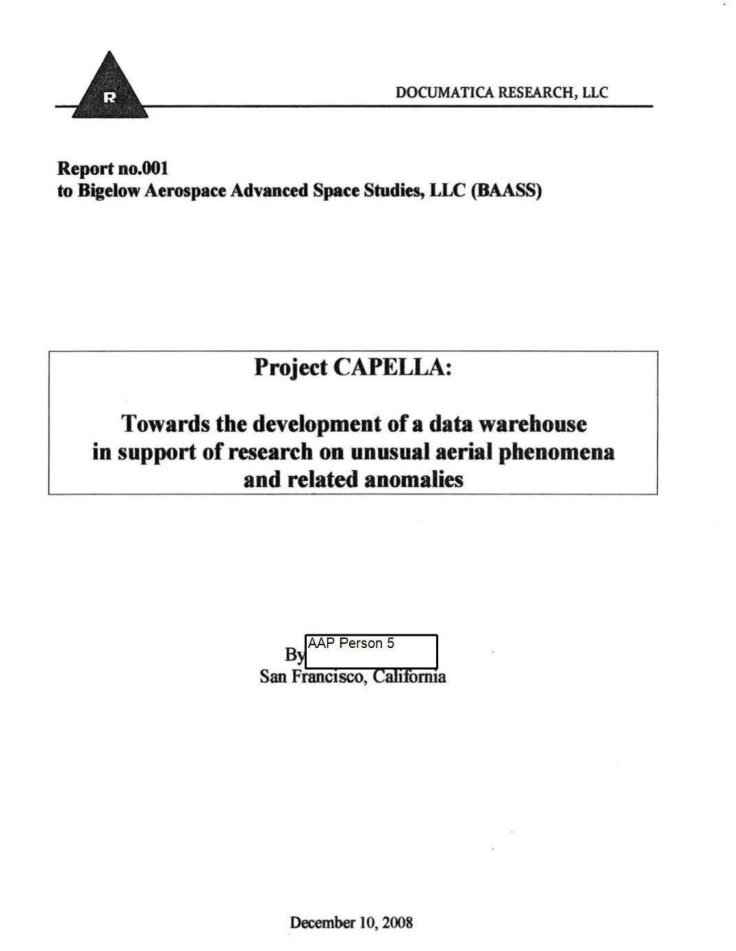
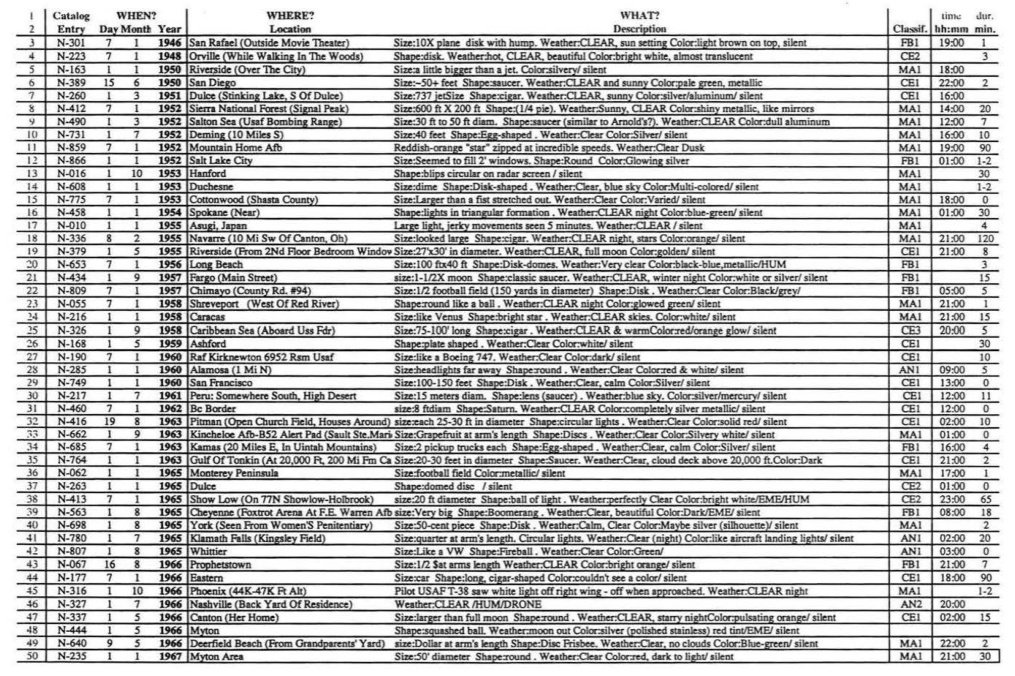
On December 10, 2008, Documatica Research delivered to BAASS report no. 001, which proposes Project Capella: a data warehouse to gather catalogs of unusual aerial phenomena from around the world, with classification by the phenomenon's behavior and a reliability index. The author's name is redacted; the attachment shows 48 records from 1946 to 1967 taken from the NIDS catalog.
- Event date
- 10/12/2008
- Location
- San Francisco, California, USA (headquarters indicated by the author)
- Topic
- AAWSAP and advanced technologies
- Source agencies
- DOW
- Documents
- 1 document · 42 pages
- Reading time
- 79 min
 Document coverPhysical page 2
DOCUMENTARY SOURCES · DOW
What the records tell
Date: 10/12/2008. Location: San Francisco, California. Report no. 001 from Documatica Research, LLC, to Bigelow Aerospace Advanced Space Studies (BAASS) is titled "Project Capella: Toward the Development of a Data Warehouse in Support of Research on Unusual Aerial Phenomena and Related Anomalies". The author's name appears replaced by the redaction "AAP Person 5", and that of a co-author of the appendices by "AAP Person 58". The main text takes up ten pages and is followed by three appendices: a classification system (A), a six-layer model for "high strangeness" phenomena (B) and the structure of the spreadsheets (C), with a sample attachment.
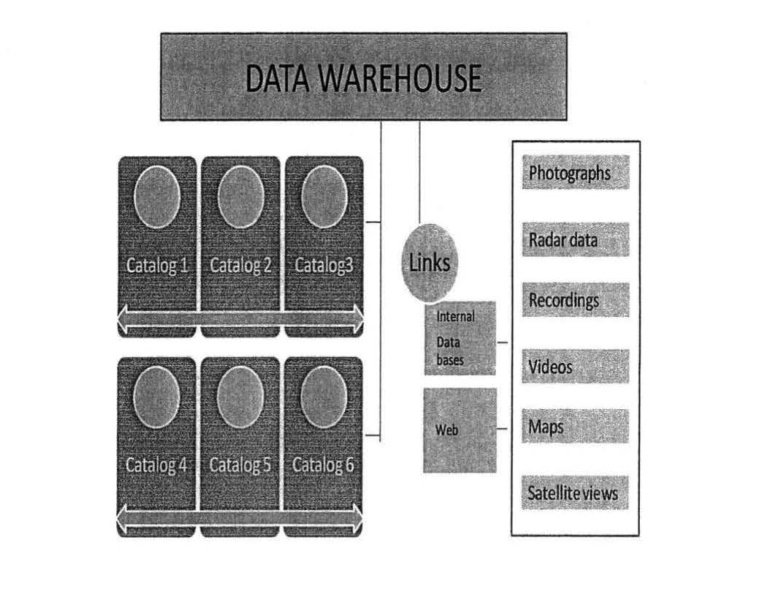
The background opens with the Battelle Memorial Institute study for Project Blue Book in 1953, whose punch cards were not kept, and moves through the catalogs the author says he compiled with his wife, UFOCAT, the 1968 Magonia catalog, the MUFON files and the French GEIPAN database, with more than 3.000 Gendarmerie reports. According to the report, there are at least 30 active catalogs, with no common standards, often with the bias of assuming that all cases are extraterrestrial craft. The proposal is a data warehouse that would sit on top of these catalogs, using ordinary Excel spreadsheets, with the worldwide total estimated at about 100 mil cases.
The text defines the system requirements: to catalog observations "whose nature or behavior suggests the presence of an unrecognized threat," to be operational quickly, to reach as many regions of the world as possible and to allow data mining. It suggests testing the format with the NIDS catalog, assembled in the 1990s in Las Vegas, and recording in the new standard every case that reached BAASS from January 1, 2009. It discusses whether the project should be public or internal, noting the risk of leaking witness names, and plans trips to France, Switzerland, Spain and Italy to contact catalog owners.
The team would have five roles: database administrator, an analyst who would interview witnesses by phone, an independent quality control coordinator, a statistician, and a second analyst dedicated to the literature and to files released by governments. The estimated budget, with a 30% margin, is US$ 610 mil in the first year and US$ 830 mil in the second. Appendix A describes the classification by the phenomenon's behavior (anomalies AN, close encounters CE, maneuvers MA and flybys FB, each with five grades) and the three-digit SVP reliability code, for the source, the site visit and the probability of a natural explanation.
Appendix B reproduces an article based on a 2003 lecture in Porto, Portugal. The authors criticize both skeptics and proponents of the extraterrestrial hypothesis and propose analyzing accounts in six layers: physical, "anti-physical", psychological, physiological, "psychic" and cultural. Their conclusion is a speculation attributed to them: everything would happen as if UAP were the product of a technology that integrates physical and psychic phenomena and acts on culture through the witnesses. Appendix C details the ten screens of the spreadsheet, from date and location to physiological and cultural effects, and ends with the NIDS catalog example.
The attachment (pp. 41-42) shows the first two pages of the NIDS catalog in the proposed format: 48 records from 1946 to 1967, from San Rafael to Myton, each with date, location, short description, classification, time and duration. The witness column is entirely redacted; the sources listed include radio programs, local newspapers, e-mails and surveys. Several of these records have their own dossiers on the portal. They are lines from a private catalog used as a format example, not BAASS investigations. The document is a methodology proposal; it does not say whether Capella was implemented.
More images from the document
DIRECT READING OF THE FILE
The document, in the original
Main report (pp. 1-11), Appendix A (pp. 12-19), Appendix C (pp. 36-40) and the attachment with the NIDS catalog (pp. 41-42) were translated in full, the latter line by line. Appendix B (pp. 20-35) reproduces a privately authored 2003 article and was translated as a complete summary of each page, with opinions attributed to the authors. Withheld passages appear as [withheld], and the redaction bar labels (AAP Person 5, 7, 8 and 58) were kept. The e-mail address that appears on p. 42 was omitted.
EXCERPT 1 · PHYSICAL PAGE 1
Physical page 1, full page
Project CapellaEditorial note: Cover sheet of the Project Capella file.
Check the original PDF
Project CapellaView the document record ↗ · Physical page 1, counting the cover.
EXCERPT 2 · PHYSICAL PAGE 10
Physical page 10, full page
systems expert or computer scientist. Experience in serving a diverse community
(such as a campus or multi-site company such as a bank) would be most useful.
(ii)
A data analyst who captures incoming data and reduces it intelligently to summary
text. This person will need to interview witnesses on the phone and to interface with
authors of external catalogues. He or she will need to be neat, very well organized,
able to maintain a paper-based filing system as a back-up. General knowledge of
standards for maps, weather reports and military and civilian aviation systems will be
useful. This person could come from the military or from a major company, possibly
as administrative assistant to an international manager.
Soon after the start ofimplementation we need to add:
(iii)
A quality control coordinator who can challenge the information in the file, verify
sources and codes, and check that all available information has been captured. This
person should be an independent thinker with a good eye for noticing mistakes and
inconsistencies. He or she could come from many backgrounds, such as copy-editing,
paralegal, or technical work where close inspection is mandatory. Most importantly,
this person must not report to others in the data warehouse team and must be
protected from criticism when challenging the integrity ofthe data in the files.
In the second year the project needs to be completed with the addition of
(iv)
A statistician in charge of pattern analysis, data extraction for specific studies and
reports, and advanced datamining. This person should have at least an M.S. degree in
statistics and practical experience with hard field data (as opposed to economics,
marketing or astronomy). Experience in geology, ecology, medicine (epidemiology)
or other field involving sparse data sets with high variability will be helpful.
(v)
A second data analyst specializ.ed in the large extant literature of aerial phenomena
This person would review the books and reports compiled over the last 50 years,
including files released by various governments (the U.K., Spain, France and others)
in order to improve the quality and consistency of the CAPELLA files. This person
must have knowledge offoreign languages such as French and Spanish in addition to
English. His or her background could be in library science, indexing or publishing,
with a keen interest in literature research and impeccable mastery of reference
systems and international library search techniques.
As a team the members ofthis group should be encouraged to review the cases on file and
critique them, looking for missing data elements or inconsistencies in the information. In this
author's experience, such mistakes are frequent and they naturally pollute any statistical
result or physical theory developed on the basis of the system Such collective review
sessions would be the best training process for the group and would enhance its contribution
to BAASS as a whole.
I .
Whether or not members ofthis group should be cleared is open to question. Most of the
information on file will be from open sources and only sensitive in terms of individual
CAPEI.LA Data WarehOU.Je
page 9Editorial note: Capella report: the five roles of the data warehouse team and the question of security clearances.
Check the original PDF
systems expert or computer scientist. Experience in serving a diverse community
(such as a campus or multi-site company such as a bank) would be most useful.
(ii)
A data analyst who captures incoming data and reduces it intelligently to summary
text. This person will need to interview witnesses on the phone and to interface with
authors of external catalogues. He or she will need to be neat, very well organized,
able to maintain a paper-based filing system as a back-up. General knowledge of
standards for maps, weather reports and military and civilian aviation systems will be
useful. This person could come from the military or from a major company, possibly
as administrative assistant to an international manager.
Soon after the start ofimplementation we need to add:
(iii)
A quality control coordinator who can challenge the information in the file, verify
sources and codes, and check that all available information has been captured. This
person should be an independent thinker with a good eye for noticing mistakes and
inconsistencies. He or she could come from many backgrounds, such as copy-editing,
paralegal, or technical work where close inspection is mandatory. Most importantly,
this person must not report to others in the data warehouse team and must be
protected from criticism when challenging the integrity ofthe data in the files.
In the second year the project needs to be completed with the addition of
(iv)
A statistician in charge of pattern analysis, data extraction for specific studies and
reports, and advanced datamining. This person should have at least an M.S. degree in
statistics and practical experience with hard field data (as opposed to economics,
marketing or astronomy). Experience in geology, ecology, medicine (epidemiology)
or other field involving sparse data sets with high variability will be helpful.
(v)
A second data analyst specializ.ed in the large extant literature of aerial phenomena
This person would review the books and reports compiled over the last 50 years,
including files released by various governments (the U.K., Spain, France and others)
in order to improve the quality and consistency of the CAPELLA files. This person
must have knowledge offoreign languages such as French and Spanish in addition to
English. His or her background could be in library science, indexing or publishing,
with a keen interest in literature research and impeccable mastery of reference
systems and international library search techniques.
As a team the members ofthis group should be encouraged to review the cases on file and
critique them, looking for missing data elements or inconsistencies in the information. In this
author's experience, such mistakes are frequent and they naturally pollute any statistical
result or physical theory developed on the basis of the system Such collective review
sessions would be the best training process for the group and would enhance its contribution
to BAASS as a whole.
I .
Whether or not members ofthis group should be cleared is open to question. Most of the
information on file will be from open sources and only sensitive in terms of individual
CAPEI.LA Data WarehOU.Je
page 9View the document record ↗ · Physical page 10, counting the cover.
EXCERPT 3 · PHYSICAL PAGE 11
Physical page 11, full page
privacy, unless BAASS has special access to recent military data It would also be useful to
setup a policy on foreign access. There are centers of excellence in this field outside the
United States, notably in France and Spain. Establishing a channel of collaboration with the
individuals there could be highly beneficial to BAASS, if it is consistent with the group's
security requirements.
6. Budget estimates
At this point we can only give a rough estimate ( + or - 30%) of the expense involved. The
following assumes that the team uses an already-established, secure system ofservers internal
to BAASS, professionally-maintained. It also assumes that offices and basic furniture are
already in place.
First Year
Three (3) persons at $120,000 fully-loaded average salary $360,000
Computer equipment: 5 desktop computers + 5 laptops . . . $ 40,000
Software packages ...... ................................. ........ $
5,000
Data acquisition (internal) . . . . . . . . . . . . . . . . . . . . . . . . . . . . . . . . . . . . . $ 20,000
Communications, local travel, meetings . . . . . . . . . . . . ............ $ 70,000
Filing systems, supplies, projection system, media . . . . . .
$ 15,000
External contracts for information gathering ............... $ 100,000
$610,000
Second Year
Five (5) persons at $120,000 fully-loaded average salary $ 600,000
Computer hardware/software updates .................. ... .. $ 10,000
Communications, travel, meetin~ . . . . . . . . . . . . . . . . . . . . . . . . . . . $ 80,000
Datamining and analysis software ............................. $ 20,000
Data acquisition (internal) . . . . . . . . . . . . . . . . . . . . . . . . . . . . . . . . . . . . . . $ 20,000
External contracts for information gathering ................ $100,000
$ 830,000
IAAP
CAPEILA Data Warehowe
page JO
Person 5Editorial note: Capella report: budget estimate of US$ 610 thousand in the first year and US$ 830 thousand in the second.
Check the original PDF
privacy, unless BAASS has special access to recent military data It would also be useful to
setup a policy on foreign access. There are centers of excellence in this field outside the
United States, notably in France and Spain. Establishing a channel of collaboration with the
individuals there could be highly beneficial to BAASS, if it is consistent with the group's
security requirements.
6. Budget estimates
At this point we can only give a rough estimate ( + or - 30%) of the expense involved. The
following assumes that the team uses an already-established, secure system ofservers internal
to BAASS, professionally-maintained. It also assumes that offices and basic furniture are
already in place.
First Year
Three (3) persons at $120,000 fully-loaded average salary $360,000
Computer equipment: 5 desktop computers + 5 laptops . . . $ 40,000
Software packages ...... ................................. ........ $
5,000
Data acquisition (internal) . . . . . . . . . . . . . . . . . . . . . . . . . . . . . . . . . . . . . $ 20,000
Communications, local travel, meetings . . . . . . . . . . . . ............ $ 70,000
Filing systems, supplies, projection system, media . . . . . .
$ 15,000
External contracts for information gathering ............... $ 100,000
$610,000
Second Year
Five (5) persons at $120,000 fully-loaded average salary $ 600,000
Computer hardware/software updates .................. ... .. $ 10,000
Communications, travel, meetin~ . . . . . . . . . . . . . . . . . . . . . . . . . . . $ 80,000
Datamining and analysis software ............................. $ 20,000
Data acquisition (internal) . . . . . . . . . . . . . . . . . . . . . . . . . . . . . . . . . . . . . . $ 20,000
External contracts for information gathering ................ $100,000
$ 830,000
IAAP
CAPEILA Data Warehowe
page JO
Person 5View the document record ↗ · Physical page 11, counting the cover.
EXCERPT 4 · PHYSICAL PAGE 12
Physical page 12, full page
Appendix A
A System of Classification and Reliability Indicators
for the Analysis of the Behavior
of Unidentified Aerial Phenomena
IAAP Person 5
When faced with hundreds or even thousands of reports of unusual aerial phenomena, no
serious research.er can undertake any study or hazard any hypothesis before analyzing the
patterns buried in th.e reports. These patterns only reveal themselves when the witnesses'
accounts arc classified into major categories whose prevalence and recurrence can then be
computed. This is a time-consuming task that demands a great deal of rigor, which explains
why so few research organizations have done it consistently. In our own work, we have used
such classification systems for many years, in the context of very different data sets. We
have learned from early mistakes, and this effort has led us to propose the current scheme
based on the reported behavior of the phenomenon under observation. The purpose of this
paper is to clarify the system and its practical use.
Background
Any classification system for anomalous reports needs to start from the observed behavior of the
phenomenon rather than any subjective feature special to the observer. At the same time, the
classification system must be able to support the testing of hypotheses by researchers coming
from "skeptical" as well as "proponent" positions with respect to popular interpretations of the
phenomena in question. And it must not presuppose any particular theory.
To my knowledge, the first classification system of this type that was applied to unidentified
aerial phenomena grew out of my work in 1961 and 1962 with!1 843(a)(2) l and l1843(a)(2)
1
~~)43(a) Iin Paris. I proposed to separate the massive collections of French sightings - notably
those from the 1954 wave - into four major categories. Briefly summarized, they encompassed
the following:
Appendix A
page 1Editorial note: Beginning of Appendix A of the Capella report: the system for classifying reports by the behavior of the phenomenon.
Check the original PDF
Appendix A
A System of Classification and Reliability Indicators
for the Analysis of the Behavior
of Unidentified Aerial Phenomena
IAAP Person 5
When faced with hundreds or even thousands of reports of unusual aerial phenomena, no
serious research.er can undertake any study or hazard any hypothesis before analyzing the
patterns buried in th.e reports. These patterns only reveal themselves when the witnesses'
accounts arc classified into major categories whose prevalence and recurrence can then be
computed. This is a time-consuming task that demands a great deal of rigor, which explains
why so few research organizations have done it consistently. In our own work, we have used
such classification systems for many years, in the context of very different data sets. We
have learned from early mistakes, and this effort has led us to propose the current scheme
based on the reported behavior of the phenomenon under observation. The purpose of this
paper is to clarify the system and its practical use.
Background
Any classification system for anomalous reports needs to start from the observed behavior of the
phenomenon rather than any subjective feature special to the observer. At the same time, the
classification system must be able to support the testing of hypotheses by researchers coming
from "skeptical" as well as "proponent" positions with respect to popular interpretations of the
phenomena in question. And it must not presuppose any particular theory.
To my knowledge, the first classification system of this type that was applied to unidentified
aerial phenomena grew out of my work in 1961 and 1962 with!1 843(a)(2) l and l1843(a)(2)
1
~~)43(a) Iin Paris. I proposed to separate the massive collections of French sightings - notably
those from the 1954 wave - into four major categories. Briefly summarized, they encompassed
the following:
Appendix A
page 1View the document record ↗ · Physical page 12, counting the cover.
EXCERPT 5 · PHYSICAL PAGE 13
Physical page 13, full page
.
••
/'
1843(a)(2)
Type I, which was further divided into three subgroups, gathered all the "landing" reports thaG
•
•••
l1843(a)(2)
Iwould later call "close encounters." It may be hard for the modem reader to
realize that until the late Sixties, American ufology did not admit that such re rts existed.
•
• ·1·
•
•
n1 APRO h ded
b □
·d 1843(a)(2)
1843(a)(2)
Among the maJor c1v1 1an orgaruzattons, o y
, ea
up y • an _____...•·········•··
...... .
recognized their significance. The Air Force's Project Blue Book automatically sent landing
reports into the psychological file.
Type II reports were observations of the "cloud cigars" so prevalent in Europe in 1954, and
whose apparent role in the development of major waves had been pointed out b~1843(a)(2) I
(+). Such reports became rare in the following years, and there is no longer a justification for this
category.
Type III reports involved objects that exhibited a discontinuity in their trajectory; either they
stopped and hovered, or they came towards the ground with a falling leaf motion before resuming
their flight, or they perfonned some other maneuver that identified a specific point in space and
time. This was important for us at the time because we were compiling a catalogue with
longitudes and latitudes, recorded with as much precision as possible.
Type IV, by contrast, gathered all cases of objects in uninterrupted flight. This classification
served its purpose for many years. It enabled us to uncover specific time and space patterns for
various types of behavior, notably the "law of the times" for landing reports.
1843(a)(2) classification
In 1972, on the basis of the work we had done together since the mid-si.x.tiesJ.___••...•Ibuilt upon •
my earlier classification when he proposed (*) to divide all reports into two groups: the short
range sightings which corresponded to my "Type r' and which be called Close Encounters
I'843(a)(2)
AAP Person
Appendix A
page 2
5Editorial note: Appendix A of the Capella report: the four types of the first classification, from 1961-1962, and the beginning of the 1972 classification.
Check the original PDF
.
••
/'
1843(a)(2)
Type I, which was further divided into three subgroups, gathered all the "landing" reports thaG
•
•••
l1843(a)(2)
Iwould later call "close encounters." It may be hard for the modem reader to
realize that until the late Sixties, American ufology did not admit that such re rts existed.
•
• ·1·
•
•
n1 APRO h ded
b □
·d 1843(a)(2)
1843(a)(2)
Among the maJor c1v1 1an orgaruzattons, o y
, ea
up y • an _____...•·········•··
...... .
recognized their significance. The Air Force's Project Blue Book automatically sent landing
reports into the psychological file.
Type II reports were observations of the "cloud cigars" so prevalent in Europe in 1954, and
whose apparent role in the development of major waves had been pointed out b~1843(a)(2) I
(+). Such reports became rare in the following years, and there is no longer a justification for this
category.
Type III reports involved objects that exhibited a discontinuity in their trajectory; either they
stopped and hovered, or they came towards the ground with a falling leaf motion before resuming
their flight, or they perfonned some other maneuver that identified a specific point in space and
time. This was important for us at the time because we were compiling a catalogue with
longitudes and latitudes, recorded with as much precision as possible.
Type IV, by contrast, gathered all cases of objects in uninterrupted flight. This classification
served its purpose for many years. It enabled us to uncover specific time and space patterns for
various types of behavior, notably the "law of the times" for landing reports.
1843(a)(2) classification
In 1972, on the basis of the work we had done together since the mid-si.x.tiesJ.___••...•Ibuilt upon •
my earlier classification when he proposed (*) to divide all reports into two groups: the short
range sightings which corresponded to my "Type r' and which be called Close Encounters
I'843(a)(2)
AAP Person
Appendix A
page 2
5View the document record ↗ · Physical page 13, counting the cover.
EXCERPT 6 · PHYSICAL PAGE 14
Physical page 14, full page
••
2
(a term later immortalized byl1843(a)( )
~; and the objects observed "at some distance,"
which he further divided into three categories:
NL for Nocturnal Lights
DD for Daylight Disks
RV for Radar-visual
l1843(a)(2) Iwas well aware that these divisions were arbitrary, and he remarked himself that the
categories "may not be mutually exclusive." The major contribution of~classification
~
was the clarity with which "landings" were now defined:
CEl was the class of objects seen on the ground or close to the ground
CE2 was the class of cases where physical effects or traces were reported
CE3 was the class of reports where "occupants" or "entities" were present, a
category from which he excluded claims of repeated contact.
These definitions bave stood the test of time. In recent years a new category has been invented.
Called CE4, it encompasses the abduction reports in which the witness claims not only to have
seen occupants but to have extensively interacted with them inside their vehicle or craft. Rather
than taking an abduction claim as our reference, we prefer to use the term "reality
transformation."
Serious complications arise, however, when one tries to use~ categories of nocturnal
lights, daylight disks and radar-visual cases, especially when the screening process works from a
computerized database, as it needs to do in any sophisticated effort to attack the problem. Not
only do these categories overlap (a "disk" may be seen in daylight and also tracked on radar, for
instance) but many reports cannot be placed into any of these classes: What happens if an object
is seen at night, but is not a light? Or when an object seen in daylight is not shaped like a disk?
What about reports of objects seen at dusk or dawn?
l~p Person
Appendix A
page 3Editorial note: Appendix A of the Capella report: the NL, DD and RV categories, the CE1 to CE3 definitions and the critique of the categories of distant sightings.
Check the original PDF
••
2
(a term later immortalized byl1843(a)( )
~; and the objects observed "at some distance,"
which he further divided into three categories:
NL for Nocturnal Lights
DD for Daylight Disks
RV for Radar-visual
l1843(a)(2) Iwas well aware that these divisions were arbitrary, and he remarked himself that the
categories "may not be mutually exclusive." The major contribution of~classification
~
was the clarity with which "landings" were now defined:
CEl was the class of objects seen on the ground or close to the ground
CE2 was the class of cases where physical effects or traces were reported
CE3 was the class of reports where "occupants" or "entities" were present, a
category from which he excluded claims of repeated contact.
These definitions bave stood the test of time. In recent years a new category has been invented.
Called CE4, it encompasses the abduction reports in which the witness claims not only to have
seen occupants but to have extensively interacted with them inside their vehicle or craft. Rather
than taking an abduction claim as our reference, we prefer to use the term "reality
transformation."
Serious complications arise, however, when one tries to use~ categories of nocturnal
lights, daylight disks and radar-visual cases, especially when the screening process works from a
computerized database, as it needs to do in any sophisticated effort to attack the problem. Not
only do these categories overlap (a "disk" may be seen in daylight and also tracked on radar, for
instance) but many reports cannot be placed into any of these classes: What happens if an object
is seen at night, but is not a light? Or when an object seen in daylight is not shaped like a disk?
What about reports of objects seen at dusk or dawn?
l~p Person
Appendix A
page 3View the document record ↗ · Physical page 14, counting the cover.
EXCERPT 7 · PHYSICAL PAGE 15
Physical page 15, full page
The work we have done in recent years with four parallel computer catalogues has led us to
suggest a practical solution to the problem.
A Classification System based on the Behavior of the Phenomenon
The major flaw in previous classification systems is that they take as their basis the position of
the observer, which is arbitrary and changing, rather than the reported behavior of the
phenomenon from which one could draw important conclusions in terms of patterns. In other
words, it may be interesting to know that a particular witness described a disk while another saw
a triangle or a square, but this is a purely subjective item that is a function of the percipient, not a
behavioral attribute of the phenomenon: one person's "disk" is another person's ''ball of light." It
is more relevant to know such stable facts as whether or not the object presented a discontinuity
in flight or came close to the ground, items for which there is more consistent agreement.
Another flaw in existing systems is that they are too complicated and require constant reference
to codebooks with overly-detailed definitions that are time consuming and error-prone. In order
to encompass the full range of phenomena one finds in the reports from witnesses, it is important
to acknowledge that what most people call ''UFOs" are related in significant ways to other
anomalies. It is the rule, rather than the exception, to find the observation of a flying object
preceded or followed by other unusual phenomena. For that reason, I find it useful to begin with a
classification of Anomalies that parallel~1843(a) lclose encounter designations:
1(2)
,
ANl events are anomalies like amorphous lights or unexplained explosions in the sky, that do
not have lasting physical effects.
AN2 reports involve lasting physical effects, such as poltergeist phenomena, anomalous
photographs, flattened grass or "apports."
AN3 cases are anomalies with associated entities. This could involve reports of ghosts and
instances of crytozoology, or even "spirits."
AN4 designates those anomalous reports in which witnesses describe personal interaction with
entities in the reality of the entities themselves. This includes near-d.eath experiences,
claims ofreligious visions and some cases of out-of-body experiences.
IAAP Person 5
Appendix A
page 4Editorial note: Appendix A of the Capella report: the proposal to classify by the behavior of the phenomenon and the anomaly categories AN1 to AN4.
Check the original PDF
The work we have done in recent years with four parallel computer catalogues has led us to
suggest a practical solution to the problem.
A Classification System based on the Behavior of the Phenomenon
The major flaw in previous classification systems is that they take as their basis the position of
the observer, which is arbitrary and changing, rather than the reported behavior of the
phenomenon from which one could draw important conclusions in terms of patterns. In other
words, it may be interesting to know that a particular witness described a disk while another saw
a triangle or a square, but this is a purely subjective item that is a function of the percipient, not a
behavioral attribute of the phenomenon: one person's "disk" is another person's ''ball of light." It
is more relevant to know such stable facts as whether or not the object presented a discontinuity
in flight or came close to the ground, items for which there is more consistent agreement.
Another flaw in existing systems is that they are too complicated and require constant reference
to codebooks with overly-detailed definitions that are time consuming and error-prone. In order
to encompass the full range of phenomena one finds in the reports from witnesses, it is important
to acknowledge that what most people call ''UFOs" are related in significant ways to other
anomalies. It is the rule, rather than the exception, to find the observation of a flying object
preceded or followed by other unusual phenomena. For that reason, I find it useful to begin with a
classification of Anomalies that parallel~1843(a) lclose encounter designations:
1(2)
,
ANl events are anomalies like amorphous lights or unexplained explosions in the sky, that do
not have lasting physical effects.
AN2 reports involve lasting physical effects, such as poltergeist phenomena, anomalous
photographs, flattened grass or "apports."
AN3 cases are anomalies with associated entities. This could involve reports of ghosts and
instances of crytozoology, or even "spirits."
AN4 designates those anomalous reports in which witnesses describe personal interaction with
entities in the reality of the entities themselves. This includes near-d.eath experiences,
claims ofreligious visions and some cases of out-of-body experiences.
IAAP Person 5
Appendix A
page 4View the document record ↗ · Physical page 15, counting the cover.
EXCERPT 8 · PHYSICAL PAGE 16
Physical page 16, full page
Finally, we place under ANS the cases in which anomalous injuries or deaths are reported, such
as unexplained wounds or spontaneous combustion. Claims ofpermanent healings would also fit
within this category.
We now come to the UFO reports themselves, which we will divide, followind1843(a)(2)
into close encounters and distant sightings.
We see no reason to change anything to the classification of close encounters that is in current
use, from CEl to CFA, althou~1843(a)(2) !was not responsible for creating the CFA category
and was not especially happy with this extension of his work. In recent years the need has arisen
for a new category, CE5, which encompasses cases of close encounters in which the witnesses
have suffered permanent injury or other physiological or pathological effects.
Naturally, in introducing these classes of items, we make no assumption regarding the reality of
the phenomenon as described by the witnesses, and we do not presuppose any physical
explanation.
The distant sightings will be classified according to the apparent behavior ofthe object under
two general categories, namely MA for "maneuver" and FB for "flyby." Within these categories,
the sub-definitions follow those of close encounters.
Maneuvers
MAl gathers those observations that involve an object with a discontinuous trajectory such as a
drop, a maneuver, a hovering stop, or a loop.
MA2 includes those cases that give rise to physical effects in addition to a discontinuity in
trajectory. For instance, an official French report described an object that hovered close to
a town's photocell, triggering an extinction ofthe street lighting system.
MA3 contains the cases of objects with discontinuous trajectories when beings are observed on
board.
Appendix A
page 5Editorial note: Appendix A of the Capella report: the AN5 category, the addition of the CE5 category and the maneuvers MA1 to MA3.
Check the original PDF
Finally, we place under ANS the cases in which anomalous injuries or deaths are reported, such
as unexplained wounds or spontaneous combustion. Claims ofpermanent healings would also fit
within this category.
We now come to the UFO reports themselves, which we will divide, followind1843(a)(2)
into close encounters and distant sightings.
We see no reason to change anything to the classification of close encounters that is in current
use, from CEl to CFA, althou~1843(a)(2) !was not responsible for creating the CFA category
and was not especially happy with this extension of his work. In recent years the need has arisen
for a new category, CE5, which encompasses cases of close encounters in which the witnesses
have suffered permanent injury or other physiological or pathological effects.
Naturally, in introducing these classes of items, we make no assumption regarding the reality of
the phenomenon as described by the witnesses, and we do not presuppose any physical
explanation.
The distant sightings will be classified according to the apparent behavior ofthe object under
two general categories, namely MA for "maneuver" and FB for "flyby." Within these categories,
the sub-definitions follow those of close encounters.
Maneuvers
MAl gathers those observations that involve an object with a discontinuous trajectory such as a
drop, a maneuver, a hovering stop, or a loop.
MA2 includes those cases that give rise to physical effects in addition to a discontinuity in
trajectory. For instance, an official French report described an object that hovered close to
a town's photocell, triggering an extinction ofthe street lighting system.
MA3 contains the cases of objects with discontinuous trajectories when beings are observed on
board.
Appendix A
page 5View the document record ↗ · Physical page 16, counting the cover.
EXCERPT 9 · PHYSICAL PAGE 17
Physical page 17, full page
MA4 covers instances of maneuvers accompanied by a sense of transformation of reality for the
percipient.
MAS involves reports of permanent injury or death related to a maneuvering object in the sky.
Flybys
The classification continues with the "Flyby" cases:
FB 1 is a simple sighting ofan unexplained object "flying by" in the sky without discontinuity. It
is the most-frequently reported category.
FB2 involves cases of flyby with physical evidence, such as a recorded sound or radar tracking.
FB3 gathers cases of flyby where report of an object is accompanied by the observation of beings
on board. Although rare, this type ofsighting is occasionally reported.
FB4 represents a flyby in connection with which the witness claims he or she has undergone a
transformation of reality.
FB5 has to do with cases where witnesses of a flyby suffer serious injuries, as in the well
documented "Cash-Landrum" medical incident near Houston, Texas, where two women and
a boy were hurt as an unexplained, very bright object flew above them without stopping.
These four major categories, with their five variants, define a very simple system of20 codes
that are easy to remember and to handle statistically since very little overlap can occur among the
categories. An additional benefit of a behavior-based classification system for the analyst is
found in the fact that certain hypotheses to explain the observations are specific to each category.
For instance, FB events should be examined for explanations involving meteors or airplanes,
which are unlikely to apply to CE cases.
The SVP Credibility Rating
No classification system is complete without a way of assigning credibility or "weight" to an
observation. While such a procedure is an integral part of any intelligence evaluation, UFO
l~P Person I
Appendix A
page 6Editorial note: Appendix A of the Capella report: the categories MA4, MA5 and FB1 to FB5, with mention of the Cash-Landrum incident, and the beginning of the SVP index.
Check the original PDF
MA4 covers instances of maneuvers accompanied by a sense of transformation of reality for the
percipient.
MAS involves reports of permanent injury or death related to a maneuvering object in the sky.
Flybys
The classification continues with the "Flyby" cases:
FB 1 is a simple sighting ofan unexplained object "flying by" in the sky without discontinuity. It
is the most-frequently reported category.
FB2 involves cases of flyby with physical evidence, such as a recorded sound or radar tracking.
FB3 gathers cases of flyby where report of an object is accompanied by the observation of beings
on board. Although rare, this type ofsighting is occasionally reported.
FB4 represents a flyby in connection with which the witness claims he or she has undergone a
transformation of reality.
FB5 has to do with cases where witnesses of a flyby suffer serious injuries, as in the well
documented "Cash-Landrum" medical incident near Houston, Texas, where two women and
a boy were hurt as an unexplained, very bright object flew above them without stopping.
These four major categories, with their five variants, define a very simple system of20 codes
that are easy to remember and to handle statistically since very little overlap can occur among the
categories. An additional benefit of a behavior-based classification system for the analyst is
found in the fact that certain hypotheses to explain the observations are specific to each category.
For instance, FB events should be examined for explanations involving meteors or airplanes,
which are unlikely to apply to CE cases.
The SVP Credibility Rating
No classification system is complete without a way of assigning credibility or "weight" to an
observation. While such a procedure is an integral part of any intelligence evaluation, UFO
l~P Person I
Appendix A
page 6View the document record ↗ · Physical page 17, counting the cover.
EXCERPT 10 · PHYSICAL PAGE 18
Physical page 18, full page
researchers have rarely applied it in support of their work. (A notable exception is the "quality
index" proposed by Spanish researchersl1843(a)(2)
!and 1843
but it may be too detailed
•
(a)(2)
for practical use on large databases.)
The system needs to be simple enough to be applied quickly, and with enough mnemonic value to
insure it does not require constant reference to a thick codebook.
In our own work we now use a simple, three-digit code to indicate the weight of a UFO report.
Each of the three digits has a value from zero to four, as follows:
The first digit, "S" indicates the reliability of the source:
0 is used for an unknown source, or an unreliable source
1 is for a report attributed to a source of unknown reliability
2 is from a credible source, second hand
3 is from a credible source, first hand
4 is a firsthand personal interview with the witness, by a source of proven reliability
The second digit, "V" indicates whether or not a site visit took place:
0 is used when there was no site visit, or the answer is unknown
1 indicates a visit by a casual person unfamiliar with such phenomena
2 flags a site visit by a personal familiar with the range of phenomena
3 is a site visit by a reliable investigator with some experience
4 indicates a site visit by a skilled analyst
The third digit, "P" indicates the probability of natural explanations:
0 is used when the data is consistent with one or more natural causes
1 means that a natural explanation onlly requires slight alteration of the data
2 means that a natural explanation would demand gross alteration of one parameter
3 means that a natural explanation demands gross alteration of several parameters
4 means that no natural explanation is possible, given the evidence
IAAP Person 5
Appendix A
page 7Editorial note: Appendix A of the Capella report: the three-digit SVP reliability code, covering source, site visit and probability of a natural explanation.
Check the original PDF
researchers have rarely applied it in support of their work. (A notable exception is the "quality
index" proposed by Spanish researchersl1843(a)(2)
!and 1843
but it may be too detailed
•
(a)(2)
for practical use on large databases.)
The system needs to be simple enough to be applied quickly, and with enough mnemonic value to
insure it does not require constant reference to a thick codebook.
In our own work we now use a simple, three-digit code to indicate the weight of a UFO report.
Each of the three digits has a value from zero to four, as follows:
The first digit, "S" indicates the reliability of the source:
0 is used for an unknown source, or an unreliable source
1 is for a report attributed to a source of unknown reliability
2 is from a credible source, second hand
3 is from a credible source, first hand
4 is a firsthand personal interview with the witness, by a source of proven reliability
The second digit, "V" indicates whether or not a site visit took place:
0 is used when there was no site visit, or the answer is unknown
1 indicates a visit by a casual person unfamiliar with such phenomena
2 flags a site visit by a personal familiar with the range of phenomena
3 is a site visit by a reliable investigator with some experience
4 indicates a site visit by a skilled analyst
The third digit, "P" indicates the probability of natural explanations:
0 is used when the data is consistent with one or more natural causes
1 means that a natural explanation onlly requires slight alteration of the data
2 means that a natural explanation would demand gross alteration of one parameter
3 means that a natural explanation demands gross alteration of several parameters
4 means that no natural explanation is possible, given the evidence
IAAP Person 5
Appendix A
page 7View the document record ↗ · Physical page 18, counting the cover.
EXCERPT 11 · PHYSICAL PAGE 19
Physical page 19, full page
Thus a rating of 222 or better (meaning that each of the three digits is 2 or higher) indicates
events reported through a reliable source, in which a site visit has been made, and where a
natural explanation would require the gross alteration ofat least one parameter.
Equipped with this reliability code and the classification described above, it is possible to start
making sense of the patterns extracted from the mass of unusual aerial phenomena reports.
This system has been used by several studies, notably by CUFOS in their UFOCA T catalogue,
by the National Institute for Discovery Science (NIDS) in its private database, and by the French
study of pilot sightings conducted byj1843(a)(2)
Iin connection with the GEIPAN
(Groupe d'Etudes et d'Information sur les Phenomenes Aeriens Non-identifies) and the CNES in
Paris.
Thus it is becoming possible to compare statistical data in cross-indexing among several
databases, a significant first step towards international cooperation in the study of this puzzling
phenomenon.
1843(a)(2)
AAP Person 5
Appendix A
page 8Editorial note: Last page of Appendix A of the Capella report: the meaning of the 222 classification and the catalogs that adopted the system.
Check the original PDF
Thus a rating of 222 or better (meaning that each of the three digits is 2 or higher) indicates
events reported through a reliable source, in which a site visit has been made, and where a
natural explanation would require the gross alteration ofat least one parameter.
Equipped with this reliability code and the classification described above, it is possible to start
making sense of the patterns extracted from the mass of unusual aerial phenomena reports.
This system has been used by several studies, notably by CUFOS in their UFOCA T catalogue,
by the National Institute for Discovery Science (NIDS) in its private database, and by the French
study of pilot sightings conducted byj1843(a)(2)
Iin connection with the GEIPAN
(Groupe d'Etudes et d'Information sur les Phenomenes Aeriens Non-identifies) and the CNES in
Paris.
Thus it is becoming possible to compare statistical data in cross-indexing among several
databases, a significant first step towards international cooperation in the study of this puzzling
phenomenon.
1843(a)(2)
AAP Person 5
Appendix A
page 8View the document record ↗ · Physical page 19, counting the cover.
EXCERPT 12 · PHYSICAL PAGE 2
Physical page 2, full page
. .___________
___ _ _
C_H_
__
oo_c_UMATICA RES_EAR_ , L_L_c
Report no.001
to Bigelow Aerospace Advanced Space Studies, LLC (BAASS)
Project CAPELLA:
Towards the development ofa data warehouse
in support of research on unusual aerial phenomena
and related anomalies
B AAP Person 5
San Francisco,
orma
December 10, 2008
CAPELLA Data Warehowe
page 1Editorial note: Cover of Documatica Research report no. 001 to BAASS, dated December 10, 2008, which proposes Project Capella.
Check the original PDF
. .___________
___ _ _
C_H_
__
oo_c_UMATICA RES_EAR_ , L_L_c
Report no.001
to Bigelow Aerospace Advanced Space Studies, LLC (BAASS)
Project CAPELLA:
Towards the development ofa data warehouse
in support of research on unusual aerial phenomena
and related anomalies
B AAP Person 5
San Francisco,
orma
December 10, 2008
CAPELLA Data Warehowe
page 1View the document record ↗ · Physical page 2, counting the cover.
EXCERPT 13 · PHYSICAL PAGE 20
Physical page 20, full page
I .
AppendixB
A six-layer model for Anomalous Phenomena:
Incommensurability, Orthodoxy and the Physics of Consciousness
I_
... P_P_er-so_n_s __.....lan~AAP Person 58
Abstract
The main argument presented in this paper is that the continuing study of unidentified
aerial phenomena ("UAP") may offer an existence theorem for new models of physical
reality. The current SETI paradigm and its "assumption of mediocrity" place restrictions
on forms of non-human inteUigence that may be researched. A similar bias exists in the
ufologists' often-stated hypothesis that UAP, if real, must represent space visitors.
Observing that both models are biased by anthropomorphism, the authors attempt to
clarify the issues surrounding "high strangeness" observations by distinguishing six layers
of information that can be derived from UAP events, namely (1) physical manifestations,
(2) anti-physical effects, (3) psychological factors, (4) physiological factors, (5) psychic
effects and (6) cultural effects. In a further step they propose a framework for scientific
analysis of unidentified aerial phenomena that takes into account the incommensurability
problem.
(*) Based on a presentation at the Forum on "Science, Religion and Consciousness" at the
University Fernando Pessoa. Porto (Portugal) 24 October 2003.
AAP Person
D
__58.--- ~
____..,.
AAP Person
r-.:::7
. -----
..
and~
Physics ofHigh Strangeness
page 1
5Editorial note: First page of Appendix B of the Capella report, a 2003 article reproduced in the report and presented here in summary.
Check the original PDF
I .
AppendixB
A six-layer model for Anomalous Phenomena:
Incommensurability, Orthodoxy and the Physics of Consciousness
I_
... P_P_er-so_n_s __.....lan~AAP Person 58
Abstract
The main argument presented in this paper is that the continuing study of unidentified
aerial phenomena ("UAP") may offer an existence theorem for new models of physical
reality. The current SETI paradigm and its "assumption of mediocrity" place restrictions
on forms of non-human inteUigence that may be researched. A similar bias exists in the
ufologists' often-stated hypothesis that UAP, if real, must represent space visitors.
Observing that both models are biased by anthropomorphism, the authors attempt to
clarify the issues surrounding "high strangeness" observations by distinguishing six layers
of information that can be derived from UAP events, namely (1) physical manifestations,
(2) anti-physical effects, (3) psychological factors, (4) physiological factors, (5) psychic
effects and (6) cultural effects. In a further step they propose a framework for scientific
analysis of unidentified aerial phenomena that takes into account the incommensurability
problem.
(*) Based on a presentation at the Forum on "Science, Religion and Consciousness" at the
University Fernando Pessoa. Porto (Portugal) 24 October 2003.
AAP Person
D
__58.--- ~
____..,.
AAP Person
r-.:::7
. -----
..
and~
Physics ofHigh Strangeness
page 1
5View the document record ↗ · Physical page 20, counting the cover.
EXCERPT 14 · PHYSICAL PAGE 21
Physical page 21, full page
The Challenge of High Strangeness
The rational study of reported cases of Unidentified Aerospace Phenomena (UAP) is currently at
an impasse. This situation has as much to do with the incomplete state of our models of physical
reality as it does with the complexity of the data. A primary objection to the reality of UAP
events among scientists is that witnesses consistently report objects whose seemingly absurd
behavior "cannot possibly" be related to actual phenomena, even under extreme conditions.
Skeptics insist that intelligent extraterrestrial (ETI) visitors simply would not perpetrate such
antics as are reported in the literature. This argument can be criticized as an anthropocentric,
self-selected observation resulting from our own limited viewpoint as 21st century Homo
Sapiens trying to draw conclusions about the nature of the universe. Nonetheless, the high
strangeness of many reports must be acknowledged.
Advocates of UAP reality, on the other hand, generally claim that the Extra-Terrestrial
Hypothesis (ETH) centered on interstellar travelers from extrasolar systems visiting the Earth is
the most likely explanation for the objects and the entities associated with them. This argument,
too, can be challenged on the basis of the witnesses' own testimony: Ufologists have consistently
ignored or minimized reports of seemingly absurd UAP behaviors that contradict the ETH, by
selectively extracting data that best fits their agenda or version of the ETH. Thus the ETH, just
like the skeptical argument, is based on anthropocentric self-selection IAAP Person 5 I Here we
are witnessing an interesting overlap between the SETI and UAP paradigms: each excludes
consideration of the other when laying claim to the legitimate search for and contact with
potential non-human intelligence.
In the view of the authors, current hypotheses are not strange enough to explain the facts of the
phenomenon, and the debate suffers from a lack of scientific information. Indeed, from the
viewpoint of modem physics, our Cosmic Neighborhood could encompass other (parallel)
universes, extra spatial dimensions and other time-like dimensions beyond the common 4
dimensional spacetime we recognize, and such aspects could lead to rational explanations for
apparently "incomprehensible" behaviors on the part of visitors to our perceived continuum. As
it attempts to reconcile theory with observed properties of elementary particles and with
discoveries at the frontiers of cosmology, modern physics suggests that mankind has not yet
discovered all of the universe's facets, and we must propose new theories and experiments in
Physics ofHigh Strangeness
page 2Editorial note: Appendix B of the Capella report, in summary: the authors' criticism of both the skeptics and the proponents of the extraterrestrial hypothesis.
Check the original PDF
The Challenge of High Strangeness
The rational study of reported cases of Unidentified Aerospace Phenomena (UAP) is currently at
an impasse. This situation has as much to do with the incomplete state of our models of physical
reality as it does with the complexity of the data. A primary objection to the reality of UAP
events among scientists is that witnesses consistently report objects whose seemingly absurd
behavior "cannot possibly" be related to actual phenomena, even under extreme conditions.
Skeptics insist that intelligent extraterrestrial (ETI) visitors simply would not perpetrate such
antics as are reported in the literature. This argument can be criticized as an anthropocentric,
self-selected observation resulting from our own limited viewpoint as 21st century Homo
Sapiens trying to draw conclusions about the nature of the universe. Nonetheless, the high
strangeness of many reports must be acknowledged.
Advocates of UAP reality, on the other hand, generally claim that the Extra-Terrestrial
Hypothesis (ETH) centered on interstellar travelers from extrasolar systems visiting the Earth is
the most likely explanation for the objects and the entities associated with them. This argument,
too, can be challenged on the basis of the witnesses' own testimony: Ufologists have consistently
ignored or minimized reports of seemingly absurd UAP behaviors that contradict the ETH, by
selectively extracting data that best fits their agenda or version of the ETH. Thus the ETH, just
like the skeptical argument, is based on anthropocentric self-selection IAAP Person 5 I Here we
are witnessing an interesting overlap between the SETI and UAP paradigms: each excludes
consideration of the other when laying claim to the legitimate search for and contact with
potential non-human intelligence.
In the view of the authors, current hypotheses are not strange enough to explain the facts of the
phenomenon, and the debate suffers from a lack of scientific information. Indeed, from the
viewpoint of modem physics, our Cosmic Neighborhood could encompass other (parallel)
universes, extra spatial dimensions and other time-like dimensions beyond the common 4
dimensional spacetime we recognize, and such aspects could lead to rational explanations for
apparently "incomprehensible" behaviors on the part of visitors to our perceived continuum. As
it attempts to reconcile theory with observed properties of elementary particles and with
discoveries at the frontiers of cosmology, modern physics suggests that mankind has not yet
discovered all of the universe's facets, and we must propose new theories and experiments in
Physics ofHigh Strangeness
page 2View the document record ↗ · Physical page 21, counting the cover.
EXCERPT 15 · PHYSICAL PAGE 22
Physical page 22, full page
order to explore these undiscovered facets. This is why continuing study of reported UAP
events is important: It may provide us with an existence theorem f or new models ofphysical
reality.
Much of the recent progress in cosmological concepts is directly applicable to the UAP
problem: Traversable wormholes (3-dimensional hypersurface tunnels) have now been derived
1343
2
from Einstein's General Theory of Relativity 1
(a)( )
I In
particular, it has been shown that Einstein's GeneraJ Theory of Relativity does not in any way
constrain spacetime topology, which allows for wormholes to provide traversable connections
between regions within two separate universes or between remote regions and/or times within
the same universe. Mathematically it can also be shown that higher-dimensional wormholes can
1843
2
provide hypersurface connections between multidimensional spaces l...__ _(a_)_( _)________.
Recent quantum gravity programs have explored this property in superstring theory, along with
proposals to theoretically and experimentally examine macroscopic-scale extra-•dimensionaJ
spaces l1843(a)(2)
I Thus it is now widely acknowledged that the nature of our
universe is far more complex than observations based on anthropocentric self-selection portend.
In this respect, ufologists and SETI researchers appear to be fighting a rear-guard battle. Both
suffer from identical limitations in the worldview they bring to their own domains, and to their
antagonism.
Anthropocentric Bias in the SETI and UAP Paradigms
The anthropocentric biases in the SETI program are evident in the present search paradigm.
Historically the founders of SETI defined the search paradigm from a series of complex
arguments and assumptions that led to the creation of a "SETI orthodox view" of interstellar
communication while applying the "assumption of mediocrity" to our known present
843
2
technological capabilities ...
11__ _(a-)(_ _) _____,
This approach was predicated on the notion that it was economically cheaper and
technologically easier to generate and receive radio-wave photons for interstellar signaling rather
than engage manned interstellar travel or robotic probes. Indeed the latter was considered
economically and technologically improbable within the "SETI orthodox view". This has led to
~p Person
EJandl~p Person
Physics ofHigh Strangeness
page3Editorial note: Appendix B of the Capella report, in summary: wormholes, extra dimensions and the anthropocentric bias of the SETI program.
Check the original PDF
order to explore these undiscovered facets. This is why continuing study of reported UAP
events is important: It may provide us with an existence theorem f or new models ofphysical
reality.
Much of the recent progress in cosmological concepts is directly applicable to the UAP
problem: Traversable wormholes (3-dimensional hypersurface tunnels) have now been derived
1343
2
from Einstein's General Theory of Relativity 1
(a)( )
I In
particular, it has been shown that Einstein's GeneraJ Theory of Relativity does not in any way
constrain spacetime topology, which allows for wormholes to provide traversable connections
between regions within two separate universes or between remote regions and/or times within
the same universe. Mathematically it can also be shown that higher-dimensional wormholes can
1843
2
provide hypersurface connections between multidimensional spaces l...__ _(a_)_( _)________.
Recent quantum gravity programs have explored this property in superstring theory, along with
proposals to theoretically and experimentally examine macroscopic-scale extra-•dimensionaJ
spaces l1843(a)(2)
I Thus it is now widely acknowledged that the nature of our
universe is far more complex than observations based on anthropocentric self-selection portend.
In this respect, ufologists and SETI researchers appear to be fighting a rear-guard battle. Both
suffer from identical limitations in the worldview they bring to their own domains, and to their
antagonism.
Anthropocentric Bias in the SETI and UAP Paradigms
The anthropocentric biases in the SETI program are evident in the present search paradigm.
Historically the founders of SETI defined the search paradigm from a series of complex
arguments and assumptions that led to the creation of a "SETI orthodox view" of interstellar
communication while applying the "assumption of mediocrity" to our known present
843
2
technological capabilities ...
11__ _(a-)(_ _) _____,
This approach was predicated on the notion that it was economically cheaper and
technologically easier to generate and receive radio-wave photons for interstellar signaling rather
than engage manned interstellar travel or robotic probes. Indeed the latter was considered
economically and technologically improbable within the "SETI orthodox view". This has led to
~p Person
EJandl~p Person
Physics ofHigh Strangeness
page3View the document record ↗ · Physical page 22, counting the cover.
EXCERPT 16 · PHYSICAL PAGE 23
Physical page 23, full page
four decades of the SETI program following a dominantly radio/microwave (RMW) oriented
search scheme.
Given the failure of this initial approach, in the last two decades alternative SETI programs
have been proposed. They exploit coherent laser optical/IR (COSETI), holographic signals and
worldwide web detection schemes, as well as ideas to search for ETI artifacts (SETA, or
astroarchaeology) and visiting probes (SETV, V=visitation) in the solar system or on Earth
1843(a)(2)
1
1
There are new proposed search schemes based on the application of high-energy (particle)
physics detection, such as modulated neutrino beams, X-rays, gamma rays, and cosmic rays, etc.
Other search schemes propose looking for artificially generated excess radiation emissions from
astronomical bodies in space or for high-energy radiation starship exhaust trailsl1843(a)(2)
ps43(a)(2)
I
These new programs have been at odds with members of the dominant RMW-SETI program,
possibly because of concern over having to share scarce resources or compete with other non
RMW programs for the very limited private funding available for overall SETI research.
The community of UAP researchers is also driven by its own orthodoxy, which is only violated
at great personal risk to the critic who proposes a deviant view, and by its own "principle of
mediocrity" when attempting to categorize and hypothesize explanations for the phenomenon.
For this reason we prefer to use the term "UAP" rather than the more common "UFO", which is
immediately associated with the idea of space visitors in the mind of the public and media. Yet a
bridge could be formed between the disparate SETI and UFOiogy communities if both would
only recognize a simple fact: No experiment can distinguish between phenomena manifested
by visiting interstellar (arbitrarily advanced) ETI and intelligent entities tltat may exist near
Earth within a parallel universe or in different dimensions, or who are (te"estrial) time
travelers.
Each of these interesting possibilities can be manifested via the application of the physical
principle of traversable wormholes since they theoretically connect between two different
• -1.iriiverses-;-fwo -remote- spacelocahons; -dJ.fferent times and dimensions l1843(a)(2)
Traversable wormholes are but one example of new physical tools that are available or on the
horizon for consideration of interuniversal, interstellar, interdimensional or chronological travel.
AAP
AAP Person
Physics ofHigh Strangeness
page4
..EJand Person 58
5Editorial note: Appendix B of the Capella report, in summary: the alternatives to radio SETI and the thesis that no experiment distinguishes among the possible origins of UAP.
Check the original PDF
four decades of the SETI program following a dominantly radio/microwave (RMW) oriented
search scheme.
Given the failure of this initial approach, in the last two decades alternative SETI programs
have been proposed. They exploit coherent laser optical/IR (COSETI), holographic signals and
worldwide web detection schemes, as well as ideas to search for ETI artifacts (SETA, or
astroarchaeology) and visiting probes (SETV, V=visitation) in the solar system or on Earth
1843(a)(2)
1
1
There are new proposed search schemes based on the application of high-energy (particle)
physics detection, such as modulated neutrino beams, X-rays, gamma rays, and cosmic rays, etc.
Other search schemes propose looking for artificially generated excess radiation emissions from
astronomical bodies in space or for high-energy radiation starship exhaust trailsl1843(a)(2)
ps43(a)(2)
I
These new programs have been at odds with members of the dominant RMW-SETI program,
possibly because of concern over having to share scarce resources or compete with other non
RMW programs for the very limited private funding available for overall SETI research.
The community of UAP researchers is also driven by its own orthodoxy, which is only violated
at great personal risk to the critic who proposes a deviant view, and by its own "principle of
mediocrity" when attempting to categorize and hypothesize explanations for the phenomenon.
For this reason we prefer to use the term "UAP" rather than the more common "UFO", which is
immediately associated with the idea of space visitors in the mind of the public and media. Yet a
bridge could be formed between the disparate SETI and UFOiogy communities if both would
only recognize a simple fact: No experiment can distinguish between phenomena manifested
by visiting interstellar (arbitrarily advanced) ETI and intelligent entities tltat may exist near
Earth within a parallel universe or in different dimensions, or who are (te"estrial) time
travelers.
Each of these interesting possibilities can be manifested via the application of the physical
principle of traversable wormholes since they theoretically connect between two different
• -1.iriiverses-;-fwo -remote- spacelocahons; -dJ.fferent times and dimensions l1843(a)(2)
Traversable wormholes are but one example of new physical tools that are available or on the
horizon for consideration of interuniversal, interstellar, interdimensional or chronological travel.
AAP
AAP Person
Physics ofHigh Strangeness
page4
..EJand Person 58
5View the document record ↗ · Physical page 23, counting the cover.
EXCERPT 17 · PHYSICAL PAGE 24
Physical page 24, full page
This leads the present authors to speculate that a new synthesis can be found by examining the
full context of the UAP phenomenon -- including its apparently "absurd" characteristics -- in
terms of a six-layer model. The model uses the framework of the incommensurability problem
and concepts borrowed from semiotics.
UAP - The Need for a Unified Approach
What we present here is a new framework for UAP analysis that takes into account the lessons
from SETI.
In any scientific question it must be possible to ascertain to what extent a
hypothesis, when tested and proven to be true, actually "explains" the observed facts. In the case
of UAP, however, as in physics generally, a hypothesis may well be "proven true" while an
apparently contradictory hypothesis is also proven true.
Thus the hypothesis that the
phenomenon of light is caused by particles is true, but so is the opposite hypothesis that it is
caused by waves. We must be prepared for the time when we will be in a position to formulate
scientific hypotheses for UAP, and then we may face a similar situation.
The framework we present here is based on such an apparent contradiction, because we will
argue that UAP can be thought of both as physical and as "psychic". We hope that it will prove
stimulating as a unified approach to a puzzling phenomenon that presents both undeniable
physical effects suggesting a technological device or craft and psychic effects reminiscent of the
literature on poltergeists and psychokinetic phenomena. Here we use the word "psychic" in the
sense of an interaction between physical reality and human consciousness.
The feeling of absurdity and contradiction in these two aspects is not worse than scientific
puzzlement during the particle/wave or, more recently, quantum entanglement and multi
dimensional transport controversies. The contradiction has to do with the inadequacy of our
language to grasp a phenomenon that defies our attempts at classification.
The Six Layers of UAP Analysis
Let us consider the characteristics of the sightings that are not explained by trivial natural
causes; we can recognize six major "layers" in terms of our perceptions of these characteristics,
~p Person
--EJan~~p Person
Physics ofHigh Strangeness
page5Editorial note: Appendix B of the Capella report, in summary: the proposal to treat UAP as a phenomenon that is at once physical and psychic.
Check the original PDF
This leads the present authors to speculate that a new synthesis can be found by examining the
full context of the UAP phenomenon -- including its apparently "absurd" characteristics -- in
terms of a six-layer model. The model uses the framework of the incommensurability problem
and concepts borrowed from semiotics.
UAP - The Need for a Unified Approach
What we present here is a new framework for UAP analysis that takes into account the lessons
from SETI.
In any scientific question it must be possible to ascertain to what extent a
hypothesis, when tested and proven to be true, actually "explains" the observed facts. In the case
of UAP, however, as in physics generally, a hypothesis may well be "proven true" while an
apparently contradictory hypothesis is also proven true.
Thus the hypothesis that the
phenomenon of light is caused by particles is true, but so is the opposite hypothesis that it is
caused by waves. We must be prepared for the time when we will be in a position to formulate
scientific hypotheses for UAP, and then we may face a similar situation.
The framework we present here is based on such an apparent contradiction, because we will
argue that UAP can be thought of both as physical and as "psychic". We hope that it will prove
stimulating as a unified approach to a puzzling phenomenon that presents both undeniable
physical effects suggesting a technological device or craft and psychic effects reminiscent of the
literature on poltergeists and psychokinetic phenomena. Here we use the word "psychic" in the
sense of an interaction between physical reality and human consciousness.
The feeling of absurdity and contradiction in these two aspects is not worse than scientific
puzzlement during the particle/wave or, more recently, quantum entanglement and multi
dimensional transport controversies. The contradiction has to do with the inadequacy of our
language to grasp a phenomenon that defies our attempts at classification.
The Six Layers of UAP Analysis
Let us consider the characteristics of the sightings that are not explained by trivial natural
causes; we can recognize six major "layers" in terms of our perceptions of these characteristics,
~p Person
--EJan~~p Person
Physics ofHigh Strangeness
page5View the document record ↗ · Physical page 24, counting the cover.
EXCERPT 18 · PHYSICAL PAGE 25
Physical page 25, full page
843
2
as they can be extracted from earlier works about UAP phenomenologyl... 1_ _ _(a_)_( _)______,
or from the current NIDS database.
Layer I: First of all is the physical layer, evident in most accounts describing an object that:
► occupies a position in space, consistent with geometry
► moves as time passes
► interacts with the environment through thennal effects
► exhibits light absorption and emission from which power output estimates can be derived
► produces turbulence
► when landed, leaves indentations and bums from which mass and energy figures can be
derived
► gives rise to photographic images
► leaves material residue consistent with Earth chemistry
► gives rise to electric, magnetic and gravitational disturbances
Thus UAP, in a basic physical sense, are consistent with a technology centered on a craft that
appears to be using a revolutionary propulsion system.
Layer II: For lack of an adequate term we will call the second layer anti-physical. The
variables are the same as those in the previous category but they form patterns that conflict with
those predicted by modem physics: Objects are described as physical and material but they are
also described as:
► sinking into the ground
► shrinking in size, growing larger, or changing shape on the spot
► becoming fuzzy and transparent on the spot
► dividing into two or more craft, several of them merging into one object at slow speed
► disappearing at one point and appearing elsewhere instantaneously
► remaining observable visually while not detected by radar
► producing missing time or time dilatation
► producing topological inversion or space dilatation ( object was estimated to be of small
exterior size/volume, but witness(s) saw a huge interior many times the exterior size)
► appearing as balls of colored, intensely bright light under intelligent control
AAP
AAP Person
Physics ofHigh Strangeness
page 6
E]an ...P_e_rs_on_ sa__,
5Editorial note: Appendix B of the Capella report, in summary: the physical and "antiphysical" layers of the model.
Check the original PDF
843
2
as they can be extracted from earlier works about UAP phenomenologyl... 1_ _ _(a_)_( _)______,
or from the current NIDS database.
Layer I: First of all is the physical layer, evident in most accounts describing an object that:
► occupies a position in space, consistent with geometry
► moves as time passes
► interacts with the environment through thennal effects
► exhibits light absorption and emission from which power output estimates can be derived
► produces turbulence
► when landed, leaves indentations and bums from which mass and energy figures can be
derived
► gives rise to photographic images
► leaves material residue consistent with Earth chemistry
► gives rise to electric, magnetic and gravitational disturbances
Thus UAP, in a basic physical sense, are consistent with a technology centered on a craft that
appears to be using a revolutionary propulsion system.
Layer II: For lack of an adequate term we will call the second layer anti-physical. The
variables are the same as those in the previous category but they form patterns that conflict with
those predicted by modem physics: Objects are described as physical and material but they are
also described as:
► sinking into the ground
► shrinking in size, growing larger, or changing shape on the spot
► becoming fuzzy and transparent on the spot
► dividing into two or more craft, several of them merging into one object at slow speed
► disappearing at one point and appearing elsewhere instantaneously
► remaining observable visually while not detected by radar
► producing missing time or time dilatation
► producing topological inversion or space dilatation ( object was estimated to be of small
exterior size/volume, but witness(s) saw a huge interior many times the exterior size)
► appearing as balls of colored, intensely bright light under intelligent control
AAP
AAP Person
Physics ofHigh Strangeness
page 6
E]an ...P_e_rs_on_ sa__,
5View the document record ↗ · Physical page 25, counting the cover.
EXCERPT 19 · PHYSICAL PAGE 26
Physical page 26, full page
Layer III: The third layer has to do with the psychology of the witnesses and the social
conditions that surround them. Human observers tend to see UAP while in their normal
environment and in normal social groupings. They perceive the objects as non-conventional but
they try to explain them away as common occurrences, until faced with the inescapable
conclusion that the object is truly unknown.
Layer IV: Physiological reactions are another significant layer of information.
The
phenomenon is reported to cause
► sounds (beeping, buzzing, humming, sharp/piercing whistling, swooshing/air rushing,
loud/deafening roaring, sound of a storm, etc.)
► vibrations
► burns
► partial paralysis
► extreme heat or cold sensation
► odors (powerful, sweet or strange fragrance, rotten eggs, sulphurous, pungent, musky,
etc.)
► metallic taste
► pricklings
► temporary blindness when exposed to the objects' light
► nausea
► bloody nose and/or ears; severe headache
► difficulty in breathing
► loss of volition
► drowsiness in the days following a close encounter
Layer V: The fifth category of effects can only be labeled psychic because it involves a class
of phenomena commonly found in the literature of parapsychology, such as
► impressions of communication without a direct sensory channel
► poltergeist phenomena: motions and sounds without a specific cause, outside the
observed presence of a UAP
► levitation of the witness or ofobjects and animals in the vicinity
► maneuvers of a UAP appearing to anticipate the witness' thoughts
► premonitory dreams or visions
► personality changes promoting unusual abilities in the witness
► healing
MP Person
Physics ofHigh Strangeness
page 7
5Editorial note: Appendix B of the Capella report, in summary: the psychological, physiological and "psychic" layers, with the list of effects reported by witnesses.
Check the original PDF
Layer III: The third layer has to do with the psychology of the witnesses and the social
conditions that surround them. Human observers tend to see UAP while in their normal
environment and in normal social groupings. They perceive the objects as non-conventional but
they try to explain them away as common occurrences, until faced with the inescapable
conclusion that the object is truly unknown.
Layer IV: Physiological reactions are another significant layer of information.
The
phenomenon is reported to cause
► sounds (beeping, buzzing, humming, sharp/piercing whistling, swooshing/air rushing,
loud/deafening roaring, sound of a storm, etc.)
► vibrations
► burns
► partial paralysis
► extreme heat or cold sensation
► odors (powerful, sweet or strange fragrance, rotten eggs, sulphurous, pungent, musky,
etc.)
► metallic taste
► pricklings
► temporary blindness when exposed to the objects' light
► nausea
► bloody nose and/or ears; severe headache
► difficulty in breathing
► loss of volition
► drowsiness in the days following a close encounter
Layer V: The fifth category of effects can only be labeled psychic because it involves a class
of phenomena commonly found in the literature of parapsychology, such as
► impressions of communication without a direct sensory channel
► poltergeist phenomena: motions and sounds without a specific cause, outside the
observed presence of a UAP
► levitation of the witness or ofobjects and animals in the vicinity
► maneuvers of a UAP appearing to anticipate the witness' thoughts
► premonitory dreams or visions
► personality changes promoting unusual abilities in the witness
► healing
MP Person
Physics ofHigh Strangeness
page 7
5View the document record ↗ · Physical page 26, counting the cover.
EXCERPT 20 · PHYSICAL PAGE 27
Physical page 27, full page
Layer VI: The sixth category could be called cultural. It is concerned with society's reactions
to the reports, the way in which secondary effects (hoaxes, fiction and science-fiction imagery,
scientific theories, cover-up or exposure, media censorship or publicity, sensationalism, etc.)
become generated, and the attitude of members of a given culture towards the concepts that UAP
observations appear to challenge. The greatest impact of the phenomenon has been on general
acceptance of the idea of life in space and a more limited, but potentially very significant, change
in the popular concept of non-human intelligence.
Possible Nature of UAP Technology
A framework for scientific hypothesis on the UAP observations can be built on the identification
(admittedly very coarse) of the six major layers of UAP effects. If we must formulate a view of
the problem in a single statement at this point, that statement will be:
Everything works as if UAPs were the product of a technology that integrates
physical and psychic phenomena and primarily affects cultural variables in our
society through manipulation ofphysiological and psychological parameters in
the witnesses.
This single statement can be developed as follows:
a) The phenomenon is the product of a technology. During the observation, the UAP is a
real, physical, material object. However, it appears to use either very clever deception or
very advanced physical principles, resulting in the effects we have called "anti-physical",
which must eventually be reconciled with the laws of physics.
b) The technology triggers psychic effects either purposely or as a side effect of its
manifestations. These consciousness phenomena are now too common to be ignored or
AAP Person
.EJami
5
..
AAP
Person 58
Physics ofHigh Strangeness
page8Editorial note: Appendix B of the Capella report, in summary: the cultural layer and the sentence in which the authors sum up the nature they attribute to UAP technology.
Check the original PDF
Layer VI: The sixth category could be called cultural. It is concerned with society's reactions
to the reports, the way in which secondary effects (hoaxes, fiction and science-fiction imagery,
scientific theories, cover-up or exposure, media censorship or publicity, sensationalism, etc.)
become generated, and the attitude of members of a given culture towards the concepts that UAP
observations appear to challenge. The greatest impact of the phenomenon has been on general
acceptance of the idea of life in space and a more limited, but potentially very significant, change
in the popular concept of non-human intelligence.
Possible Nature of UAP Technology
A framework for scientific hypothesis on the UAP observations can be built on the identification
(admittedly very coarse) of the six major layers of UAP effects. If we must formulate a view of
the problem in a single statement at this point, that statement will be:
Everything works as if UAPs were the product of a technology that integrates
physical and psychic phenomena and primarily affects cultural variables in our
society through manipulation ofphysiological and psychological parameters in
the witnesses.
This single statement can be developed as follows:
a) The phenomenon is the product of a technology. During the observation, the UAP is a
real, physical, material object. However, it appears to use either very clever deception or
very advanced physical principles, resulting in the effects we have called "anti-physical",
which must eventually be reconciled with the laws of physics.
b) The technology triggers psychic effects either purposely or as a side effect of its
manifestations. These consciousness phenomena are now too common to be ignored or
AAP Person
.EJami
5
..
AAP
Person 58
Physics ofHigh Strangeness
page8View the document record ↗ · Physical page 27, counting the cover.
EXCERPT 21 · PHYSICAL PAGE 28
Physical page 28, full page
relegated to the category of exaggerated or ill-observed facts. All of us who have
investigated close-range sightings have become familiar with these effects.
c) The purpose of the technology may be cultural manipulation - possibly but not
necessarily under control of a form of non-human intelligence - in which case the
physiological and psychological effects are a means to that end. But the parapsychologist
with a Jungian framework may argue that the human collective unconscious is also a
potential source ofsuch effects - without the need to invoke alien intervention.
The Incommensurability Problem
The above considerations bring us back to a discussion of the SETI paradigm. Many SETI
workers now realize that we cannot be so presumptuous as to assume that ET cultures,
possessing a cognitive mismatch with us, will behave as humans do in the 2 I
st century.
Specifically, there is no reason to restrict them to radio-based communications technology and to
exclude travel through interstellar space or the sending of automated probes.
Thus the
SETV/SETA program overlaps ETH-based UFOiogy. Both are dedicated to detecting non
human intelligence on or near the Earth, demonstrating a paradigm shift away from the "SETI
orthodox view" and principle ofmediocrity.
The view that ETs and humans may have such divergent ways of conceptualizing the world
that there can be no mutual understanding is referred to as the ''Incommensurability Problem" in
the SETI literatur~1843(a)(2)
I- The cognitive
mismatch or Incommensurability Problem between human and ET cultures will guarantee that
the latter will develop communication techniques other than radio. ET cultures may be sending
radio and optical signals to Earth now but they may also be sending signals in a variety of other
forms such as holographic images, psychic or other consciousness-related signals, modulated
neutrinos, gamma ray bursters, wonnhole-modulated starlight caustics, signals generated by
gravitational lensing techniques, modulated X-rays, quantum teleported signals, or some
quantum field theoretic effect, etc.
The lncommensurability Problem even applies to the
problem of understanding UAP manifestations within the framework of the ETH.
At the core of the Incommensurability Problem is the view that no intelligent species can
understand reality without making certain methodological choices, and that these choices may
AAP
AAP Person
EJand Person 58
Physics ofHigh Strangeness
page9
5Editorial note: Appendix B of the Capella report, in summary: the purpose the authors speculate for the phenomenon and the problem of incommensurability.
Check the original PDF
relegated to the category of exaggerated or ill-observed facts. All of us who have
investigated close-range sightings have become familiar with these effects.
c) The purpose of the technology may be cultural manipulation - possibly but not
necessarily under control of a form of non-human intelligence - in which case the
physiological and psychological effects are a means to that end. But the parapsychologist
with a Jungian framework may argue that the human collective unconscious is also a
potential source ofsuch effects - without the need to invoke alien intervention.
The Incommensurability Problem
The above considerations bring us back to a discussion of the SETI paradigm. Many SETI
workers now realize that we cannot be so presumptuous as to assume that ET cultures,
possessing a cognitive mismatch with us, will behave as humans do in the 2 I
st century.
Specifically, there is no reason to restrict them to radio-based communications technology and to
exclude travel through interstellar space or the sending of automated probes.
Thus the
SETV/SETA program overlaps ETH-based UFOiogy. Both are dedicated to detecting non
human intelligence on or near the Earth, demonstrating a paradigm shift away from the "SETI
orthodox view" and principle ofmediocrity.
The view that ETs and humans may have such divergent ways of conceptualizing the world
that there can be no mutual understanding is referred to as the ''Incommensurability Problem" in
the SETI literatur~1843(a)(2)
I- The cognitive
mismatch or Incommensurability Problem between human and ET cultures will guarantee that
the latter will develop communication techniques other than radio. ET cultures may be sending
radio and optical signals to Earth now but they may also be sending signals in a variety of other
forms such as holographic images, psychic or other consciousness-related signals, modulated
neutrinos, gamma ray bursters, wonnhole-modulated starlight caustics, signals generated by
gravitational lensing techniques, modulated X-rays, quantum teleported signals, or some
quantum field theoretic effect, etc.
The lncommensurability Problem even applies to the
problem of understanding UAP manifestations within the framework of the ETH.
At the core of the Incommensurability Problem is the view that no intelligent species can
understand reality without making certain methodological choices, and that these choices may
AAP
AAP Person
EJand Person 58
Physics ofHigh Strangeness
page9
5View the document record ↗ · Physical page 28, counting the cover.
EXCERPT 22 · PHYSICAL PAGE 29
Physical page 29, full page
1843
2
vary from civilization to civilization 1..___(_a_>(_>___. If ETs and UAP entities have different
biologies and live in considerably different environments from humans, they may well have
different goals for their science, and radically different criteria for evaluating the success of their
science. Their explanatory mechanisms, their predictive concerns, their modes of control over
nature might all be very different, and their means of formulating models of reality should be
expected to differ drastically from ours 11843(a)(2)
In this regard, there is one additional feature that needs to be mentioned in support of
alternative SETI paradigms. The SETI program's encryption/decryption emphasis on pictorial
images or messages is predicated on the assumption that ETs have sight like humans vis-a-vis
the "SETI orthodox view" l1843(a)(2)
IWe observe that this emphasis is not so much a
reflection of the primacy of vision in humans, but rather a reflection of the philosophical
assumptions about the proper means of gaining knowledge.
Hence, anthropocentric self
selection becomes manifest within the SETI and UFOlogy "orthodox view".
l1843(a)(2)
Iasserts that human reliance on science is based on studying visible
characteristics of objectsl1843(a)(2)
IThe belief that true knowledge must be acquired
from sight originated in the 17th century. This emphasis on sight led to eliminating the other
senses as potentially valuable sources of scientific information.
Without even raising the question of whether ETs or UAP entities can "see", we may be wise
not to overestimate the importance of pictorial representations for them. The same applies for
ET/UAP transmissions to us. We can see and gain knowledge by sight, but ET/UAP signals
potentially bombarding the Earth could be misunderstood, unrecognized or undetected because
we are not employing paradigms involving our other modalities, such as psychic functioning.
Many examples of this are found in interactions between humans from different cultures
I1843(a)(2)
Because we cannot be certain of the nature of ET/UAP recipients of our deliberate messages
and they cannot be certain of our nature when sending us their messages a priori, it is difficult to
construct pictures that will be unambiguous.
To some extent, ET/UAP viewers of our
pictograms may project characteristics from their own species-specific experiences onto our
messages, and we certainly project our own species-specific experiences onto their messages.
The former may be the cause for the lack of detected ET signals (save for those 100+ radio and
AAP Person
Physics ofHigh Strangeness
page 10
EJan ..~_e_~_o_n_s_a....
5Editorial note: Appendix B of the Capella report, in summary: the cognitive differences the authors suppose exist between humans and non-human intelligences.
Check the original PDF
1843
2
vary from civilization to civilization 1..___(_a_>(_>___. If ETs and UAP entities have different
biologies and live in considerably different environments from humans, they may well have
different goals for their science, and radically different criteria for evaluating the success of their
science. Their explanatory mechanisms, their predictive concerns, their modes of control over
nature might all be very different, and their means of formulating models of reality should be
expected to differ drastically from ours 11843(a)(2)
In this regard, there is one additional feature that needs to be mentioned in support of
alternative SETI paradigms. The SETI program's encryption/decryption emphasis on pictorial
images or messages is predicated on the assumption that ETs have sight like humans vis-a-vis
the "SETI orthodox view" l1843(a)(2)
IWe observe that this emphasis is not so much a
reflection of the primacy of vision in humans, but rather a reflection of the philosophical
assumptions about the proper means of gaining knowledge.
Hence, anthropocentric self
selection becomes manifest within the SETI and UFOlogy "orthodox view".
l1843(a)(2)
Iasserts that human reliance on science is based on studying visible
characteristics of objectsl1843(a)(2)
IThe belief that true knowledge must be acquired
from sight originated in the 17th century. This emphasis on sight led to eliminating the other
senses as potentially valuable sources of scientific information.
Without even raising the question of whether ETs or UAP entities can "see", we may be wise
not to overestimate the importance of pictorial representations for them. The same applies for
ET/UAP transmissions to us. We can see and gain knowledge by sight, but ET/UAP signals
potentially bombarding the Earth could be misunderstood, unrecognized or undetected because
we are not employing paradigms involving our other modalities, such as psychic functioning.
Many examples of this are found in interactions between humans from different cultures
I1843(a)(2)
Because we cannot be certain of the nature of ET/UAP recipients of our deliberate messages
and they cannot be certain of our nature when sending us their messages a priori, it is difficult to
construct pictures that will be unambiguous.
To some extent, ET/UAP viewers of our
pictograms may project characteristics from their own species-specific experiences onto our
messages, and we certainly project our own species-specific experiences onto their messages.
The former may be the cause for the lack of detected ET signals (save for those 100+ radio and
AAP Person
Physics ofHigh Strangeness
page 10
EJan ..~_e_~_o_n_s_a....
5View the document record ↗ · Physical page 29, counting the cover.
EXCERPT 23 · PHYSICAL PAGE 3
Physical page 3, full page
O·
Project CAPELLA:
Towards the development ofa data warehouse
in support of research on .unusual aerial phenomena and related anomalies
IAAP Person 5
Documatica Research, LLC
How this report is organized
This report consists of the present overview proposal and three appendices (two of which
summarize previously-published work). Together, these four documents describe a consistent
methodology for the capture, processing and retrieval of parameters characterizing unusual
aerial phenomena and related anomalies. The appendices address three specific
implementation areas, describing the technical choices we have made in each area and the
reasons for these choices:
-
A Classification methodology and reliability measures for reported sightings
-
B. Modeling ofinfonnation categories, including high-strangeness data elements
-
C. Data Structures and Software Platforms in support ofAerial Phenomena Research
Given the tools described hereafter, some of which have already been implemented and tested
in prototype form in the course ofprior research, we examine several scenarios for the long
term acquisition, exploitation and maintenance of a comprehensive data warehousing system
that could serve the needs ofa geographically diverse research community with a wide variety
ofinformation needs.
Historical Background
As we undertake this work we are building on a series ofprojects developed by many groups
around the world, whose experiences contain important lessons. Over the last half century
many researchers, both professional and amateurs, have undertaken to build catalogues (either
on paper or in computer readable form) or data bases about the range of phenomena that
interest us.
• As early as 1953, the U. S. Air Force entrusted the Battelle Memorial Institute with the
task of analyzing the reports that Project "Blue Book" had accumulated. Battelle used
punched cards for this work, developed a coding system, and produced extensive
statistics presented in Blue Book "Report 14." Unfortunately this work was not
pursued and the cards were not kept.
• Following the Battelle study the Air Force never built a computer catalogue ofProject
Blue Book files, but the author and his wife compiled their own version of it using
IAAP Person 5
CAPEUA Data WarehOU.fe
page 2Editorial note: Opening page of the Capella report: organization of the document and beginning of the history of sighting catalogs.
Check the original PDF
O·
Project CAPELLA:
Towards the development ofa data warehouse
in support of research on .unusual aerial phenomena and related anomalies
IAAP Person 5
Documatica Research, LLC
How this report is organized
This report consists of the present overview proposal and three appendices (two of which
summarize previously-published work). Together, these four documents describe a consistent
methodology for the capture, processing and retrieval of parameters characterizing unusual
aerial phenomena and related anomalies. The appendices address three specific
implementation areas, describing the technical choices we have made in each area and the
reasons for these choices:
-
A Classification methodology and reliability measures for reported sightings
-
B. Modeling ofinfonnation categories, including high-strangeness data elements
-
C. Data Structures and Software Platforms in support ofAerial Phenomena Research
Given the tools described hereafter, some of which have already been implemented and tested
in prototype form in the course ofprior research, we examine several scenarios for the long
term acquisition, exploitation and maintenance of a comprehensive data warehousing system
that could serve the needs ofa geographically diverse research community with a wide variety
ofinformation needs.
Historical Background
As we undertake this work we are building on a series ofprojects developed by many groups
around the world, whose experiences contain important lessons. Over the last half century
many researchers, both professional and amateurs, have undertaken to build catalogues (either
on paper or in computer readable form) or data bases about the range of phenomena that
interest us.
• As early as 1953, the U. S. Air Force entrusted the Battelle Memorial Institute with the
task of analyzing the reports that Project "Blue Book" had accumulated. Battelle used
punched cards for this work, developed a coding system, and produced extensive
statistics presented in Blue Book "Report 14." Unfortunately this work was not
pursued and the cards were not kept.
• Following the Battelle study the Air Force never built a computer catalogue ofProject
Blue Book files, but the author and his wife compiled their own version of it using
IAAP Person 5
CAPEUA Data WarehOU.fe
page 2View the document record ↗ · Physical page 3, counting the cover.
EXCERPT 24 · PHYSICAL PAGE 30
Physical page 30, full page
optical signals which were not false positives but also not repeated by their source) while the
latter can be the cause of the current impasse in the study of UAP phenomena.
Semiotics
ln his analysis of the communication problem SETI Institute psychologistl1843(a)(2) Ihas
advocated the application of semiotics, the general theory of signsl1843(a)(2)
I
!1843(a)(2)
!where a sign is something that represents something else, the signified.
For example the words "the coin" might represent the object you hold in your hand.
ln interstellar messages, in terms of classical infonnation theory, there is no innate relationship
between the form of the message and the content borne by the message. Once the infonnation of
the message is decided upon, an efficient means of encoding it is sought. ln this approach, there
is a purely arbitrary connection between content and form of the message. Semiotic-based
messages have a wider range of possibilities for relating form and content.
Semioticians categorize signs according to the ways that the sign and signified are related to
one another.
ln the association between the sign "the coin" and its signified object, this
relationship is purely arbitrary. The sign for this object could have well been ''the pootboffer".
This is a purely conventional association. In semiotics, when the association between sign and
signified is arbitrary, the sign is referred to as a symbol. With symbols, there is no intrinsic
connection between the form of expression (the sign) and the content that is expressed (the
signified).
There are alternatives to the arbitrary connection between sign and signified that are seen in
symbols. One alternative is the icon, a sign that bears a physical resemblance to the signified.
With icons, the form of the message reflects its contents. For example, the profile of the man on
a modem American quarter is an icon for a specific man who was the first President of the
United States. We can also represent the same man with the symbol "George Washington". In
the former case, the image of Washington is an icon because it physically resembles the
~ignified. Icons can also be used when the signified is less concrete. For example, the scales of
justice icon represents the concept of justice because there is similarity between the sign (scales
that balance two weights) and the signified (concept ofjustice, which involves a balance between
transgression and punishment).
AAP
~p Person
,,_,.EJanG ~rson
Physics ofHigh Strangeness
page 11Editorial note: Appendix B of the Capella report, in summary: the application of semiotics to the communication problem, with the distinction between symbol and icon.
Check the original PDF
optical signals which were not false positives but also not repeated by their source) while the
latter can be the cause of the current impasse in the study of UAP phenomena.
Semiotics
ln his analysis of the communication problem SETI Institute psychologistl1843(a)(2) Ihas
advocated the application of semiotics, the general theory of signsl1843(a)(2)
I
!1843(a)(2)
!where a sign is something that represents something else, the signified.
For example the words "the coin" might represent the object you hold in your hand.
ln interstellar messages, in terms of classical infonnation theory, there is no innate relationship
between the form of the message and the content borne by the message. Once the infonnation of
the message is decided upon, an efficient means of encoding it is sought. ln this approach, there
is a purely arbitrary connection between content and form of the message. Semiotic-based
messages have a wider range of possibilities for relating form and content.
Semioticians categorize signs according to the ways that the sign and signified are related to
one another.
ln the association between the sign "the coin" and its signified object, this
relationship is purely arbitrary. The sign for this object could have well been ''the pootboffer".
This is a purely conventional association. In semiotics, when the association between sign and
signified is arbitrary, the sign is referred to as a symbol. With symbols, there is no intrinsic
connection between the form of expression (the sign) and the content that is expressed (the
signified).
There are alternatives to the arbitrary connection between sign and signified that are seen in
symbols. One alternative is the icon, a sign that bears a physical resemblance to the signified.
With icons, the form of the message reflects its contents. For example, the profile of the man on
a modem American quarter is an icon for a specific man who was the first President of the
United States. We can also represent the same man with the symbol "George Washington". In
the former case, the image of Washington is an icon because it physically resembles the
~ignified. Icons can also be used when the signified is less concrete. For example, the scales of
justice icon represents the concept of justice because there is similarity between the sign (scales
that balance two weights) and the signified (concept ofjustice, which involves a balance between
transgression and punishment).
AAP
~p Person
,,_,.EJanG ~rson
Physics ofHigh Strangeness
page 11View the document record ↗ · Physical page 30, counting the cover.
EXCERPT 25 · PHYSICAL PAGE 31
Physical page 31, full page
.
It is also helpful to realize that icons are not specific to the visual sensory modality. It is
possible to have a sign that physically resembles the signified in a nonvisual way. For example,
the fly Spilomyia hamifera beats its wings at a frequency very close to,the wing-beat frequency
of the dangerous wasp Dolichovespula arenaria. As a result, when one of these flies is in the
vicinity of a group of these wasps, the fly gains some immunity from attack by insect-eating
birds. The fly's mimicry of the wasps occurs within the auditory modality. It is not attacked by
would-be predators because it sounds like the wasps. In short, the fly' s defense strategy is based
on producing an auditory icon, in which the fly's wing-beating (the sign) physically resembles
the wing-beat of the wasps (the signified)l1843(a)(2)
~.
Icons could function in any sensory modality. Given that we are not sure which sensory
modality will be primary for ETs/UAP, a sign for communication that is not reliant on any
particular sensory modality would be preferable. In SETI/CETI, electromagnetic radiation is
used as an iconic representation, allowing a direct communication of concepts (Earth chemistry,
solar system organization, human DNA, math, geometry, etc.) without encoding the message
into a format specific to a particular sensory modality. In using icons, the message's recipients
are pointed directly toward the phenomena of interest, and not toward our models of these
phenomena.
From a more complete perspective, the sign and the signified are in a triadic with the
interpreter of the relationship. Thus, the similarity that exists between an icon and its referent
does not exist independently of the intelligence perceiving this similarity. Although in iconicity
there is a natural connection between the sign and the signified, this connection cannot exist
without intelligence to observe the connection.
Ultimately, the problem of iconicity is that similarity is in the eye of the beholder. And
because we do not know what ETs/UAP are really like, we cannot be sure that what to us seems
an obvious similarity will be seen as such by an intelligence with a different biology, culture, and
history, possibly originating in a different universe. Thus, judgment of similarity is not purely
objective, but is influenced by a variety of factors that impact conventions of interpretation.
~p Person
. •.EJand ~~on 58
Physics ofHigh Strangeness
page 12Editorial note: Appendix B of the Capella report, in summary: non-visual icons and the limits of resemblance as a basis for communication.
Check the original PDF
.
It is also helpful to realize that icons are not specific to the visual sensory modality. It is
possible to have a sign that physically resembles the signified in a nonvisual way. For example,
the fly Spilomyia hamifera beats its wings at a frequency very close to,the wing-beat frequency
of the dangerous wasp Dolichovespula arenaria. As a result, when one of these flies is in the
vicinity of a group of these wasps, the fly gains some immunity from attack by insect-eating
birds. The fly's mimicry of the wasps occurs within the auditory modality. It is not attacked by
would-be predators because it sounds like the wasps. In short, the fly' s defense strategy is based
on producing an auditory icon, in which the fly's wing-beating (the sign) physically resembles
the wing-beat of the wasps (the signified)l1843(a)(2)
~.
Icons could function in any sensory modality. Given that we are not sure which sensory
modality will be primary for ETs/UAP, a sign for communication that is not reliant on any
particular sensory modality would be preferable. In SETI/CETI, electromagnetic radiation is
used as an iconic representation, allowing a direct communication of concepts (Earth chemistry,
solar system organization, human DNA, math, geometry, etc.) without encoding the message
into a format specific to a particular sensory modality. In using icons, the message's recipients
are pointed directly toward the phenomena of interest, and not toward our models of these
phenomena.
From a more complete perspective, the sign and the signified are in a triadic with the
interpreter of the relationship. Thus, the similarity that exists between an icon and its referent
does not exist independently of the intelligence perceiving this similarity. Although in iconicity
there is a natural connection between the sign and the signified, this connection cannot exist
without intelligence to observe the connection.
Ultimately, the problem of iconicity is that similarity is in the eye of the beholder. And
because we do not know what ETs/UAP are really like, we cannot be sure that what to us seems
an obvious similarity will be seen as such by an intelligence with a different biology, culture, and
history, possibly originating in a different universe. Thus, judgment of similarity is not purely
objective, but is influenced by a variety of factors that impact conventions of interpretation.
~p Person
. •.EJand ~~on 58
Physics ofHigh Strangeness
page 12View the document record ↗ · Physical page 31, counting the cover.
EXCERPT 26 · PHYSICAL PAGE 32
Physical page 32, full page
The UAP and Abduction Problem
The aforementioned behavior of UAP is not fundamentally absurd. This apparent absurdity is
merely a reflection of the cognitive mismatch or the Incommensurability Problem that exists
between humans and the phenomenon.
In this particular case, UAP are sending the message and we are the recipients. The message(s)
they are sending to us are icons, icons fashioned by the phenomenon and sent to us via various
sensory modalities.
The difference between our respective cultures, biologies, sensory
modalities, histories, dimensional existence, physical evolution, models of nature and science,
etc. is directly responsible for our lack of understanding of the phenomenon and its message. We
cannot see what UAP believe to be (iconical) similarities in the message that is intended for us.
These stated differences directly impact our conventions of interpretation in such a way as to
impair our recognition of the "similarity" between the sign and the signified contained within the
icons of the UAP message, further impairing our ability to "see and understand" the potential
message.
The difference between the sensory modalities of UAP entities and humans is responsible for
our inability to properly detect the UAP message (icons) and correspond with them. This
difference may also prevent us from correctly interpreting what their icons are if we do in fact
recognize them. In this regard, recall that we will project our own species-specific experiences
onto their icons (messages) thus manifesting the appearance of "absurdity'' during the human
UAP interaction.
UFO abduction cases may exemplify this, .in the sense that the "absurd" activities (or scenes)
concurrent with abduction events could merely be the iconical defense mechanism deployed by
the UAP to protect itself from the victim/subject much like the way Spilomyia hamifera protects
itself from insect eating birds by mimicry.
2
I1843(a)(2) Iandl1843(a)( ) Isuggest that ETs/UAP visiting Earth would find it necessary
to hide themselves from our detection mechanisms until they have assessed our technological
layer or potential threat and hazards. They would employ an adaptive multi-layer risk program
to avoid danger. Low observable stealth such as simple camouflage through mimicry, which
works well in nature, may be the technique of choice for visiting UAP/ETI experienced in
2
surveillance l1843(a)( )
I Examples of mimicry techniques are UAP/ETI entering the
AAP Person
... EJan AAP Person 58
Physics ofHigh Strangeness
page 13
4
5Editorial note: Appendix B of the Capella report, in summary: the authors' interpretation of the "absurdity" of abduction accounts and the idea of mimicry.
Check the original PDF
The UAP and Abduction Problem
The aforementioned behavior of UAP is not fundamentally absurd. This apparent absurdity is
merely a reflection of the cognitive mismatch or the Incommensurability Problem that exists
between humans and the phenomenon.
In this particular case, UAP are sending the message and we are the recipients. The message(s)
they are sending to us are icons, icons fashioned by the phenomenon and sent to us via various
sensory modalities.
The difference between our respective cultures, biologies, sensory
modalities, histories, dimensional existence, physical evolution, models of nature and science,
etc. is directly responsible for our lack of understanding of the phenomenon and its message. We
cannot see what UAP believe to be (iconical) similarities in the message that is intended for us.
These stated differences directly impact our conventions of interpretation in such a way as to
impair our recognition of the "similarity" between the sign and the signified contained within the
icons of the UAP message, further impairing our ability to "see and understand" the potential
message.
The difference between the sensory modalities of UAP entities and humans is responsible for
our inability to properly detect the UAP message (icons) and correspond with them. This
difference may also prevent us from correctly interpreting what their icons are if we do in fact
recognize them. In this regard, recall that we will project our own species-specific experiences
onto their icons (messages) thus manifesting the appearance of "absurdity'' during the human
UAP interaction.
UFO abduction cases may exemplify this, .in the sense that the "absurd" activities (or scenes)
concurrent with abduction events could merely be the iconical defense mechanism deployed by
the UAP to protect itself from the victim/subject much like the way Spilomyia hamifera protects
itself from insect eating birds by mimicry.
2
I1843(a)(2) Iandl1843(a)( ) Isuggest that ETs/UAP visiting Earth would find it necessary
to hide themselves from our detection mechanisms until they have assessed our technological
layer or potential threat and hazards. They would employ an adaptive multi-layer risk program
to avoid danger. Low observable stealth such as simple camouflage through mimicry, which
works well in nature, may be the technique of choice for visiting UAP/ETI experienced in
2
surveillance l1843(a)( )
I Examples of mimicry techniques are UAP/ETI entering the
AAP Person
... EJan AAP Person 58
Physics ofHigh Strangeness
page 13
4
5View the document record ↗ · Physical page 32, counting the cover.
EXCERPT 27 · PHYSICAL PAGE 33
Physical page 33, full page
atmosphere with either the look or trajectory of a meteor or hidden within a meteor shower,
behaving like dark meteors without the associated optical signature, hiding within an artificial or
natural cloud or a satellite reentry, behaving as pseudo-stars sitting stationary over certain
regions, or mimicking man-made aircraft's aggregate featuresl1843(a)(2) IAnother possibility
is mimicry techniques employed for the manipulation of human consciousness to induce the
various manifestations of "absurd" interactions or scenery associated with the encounter.
Conclusion
Modern engineering has made us familiar with display technologies that produce three
dimensional images with color, motion and perspective through physical devices. We speculate
that UAP are analogous to these display technologies but utilize a wider range of variables to
operate on the percipients and, through them, on human culture. The long time scale and the
global nature of the effects make it difficult to test hypotheses involving such cultural effects.
Science fiction bas familiarized us with the concept of machines (or beings) projecting an
image of themselves that systematically confuses observers. One could imagine that UAP
represent physical craft equipped with the means to interact both with the surrounding
atmosphere and with the senses of observers in such a way as to convey a false image of their
real nature. One could argue that such an object could use microwave devices to create
perceptual hallucinations in the witnesses (including messages that are beard by a single
individual in a group).
Even such a complex scheme, however, fails to explain all the reported effects and the
subsequent behavior changes in close-range witnesses. We must assume something more, the
triggering of deep-seated processes within their personality. The question then becomes: to what
extent are these effects evidence of a purposeful action of the operators? To answer this
question, and to t,est more fully the hypothesis that UAP phenomena are both physical and
psychic in nature, we need much better investigations, a great upgrading of data quality, and a
more infonned analysis not only of the object being described, but of the impact of the
observation on the witnesses and their social environment.
~p Person
□a1 AAP Person 58
Physics ofHigh Strangeness
page 14Editorial note: Appendix B of the Capella report, in summary: examples of mimicry and the conclusion of the article.
Check the original PDF
atmosphere with either the look or trajectory of a meteor or hidden within a meteor shower,
behaving like dark meteors without the associated optical signature, hiding within an artificial or
natural cloud or a satellite reentry, behaving as pseudo-stars sitting stationary over certain
regions, or mimicking man-made aircraft's aggregate featuresl1843(a)(2) IAnother possibility
is mimicry techniques employed for the manipulation of human consciousness to induce the
various manifestations of "absurd" interactions or scenery associated with the encounter.
Conclusion
Modern engineering has made us familiar with display technologies that produce three
dimensional images with color, motion and perspective through physical devices. We speculate
that UAP are analogous to these display technologies but utilize a wider range of variables to
operate on the percipients and, through them, on human culture. The long time scale and the
global nature of the effects make it difficult to test hypotheses involving such cultural effects.
Science fiction bas familiarized us with the concept of machines (or beings) projecting an
image of themselves that systematically confuses observers. One could imagine that UAP
represent physical craft equipped with the means to interact both with the surrounding
atmosphere and with the senses of observers in such a way as to convey a false image of their
real nature. One could argue that such an object could use microwave devices to create
perceptual hallucinations in the witnesses (including messages that are beard by a single
individual in a group).
Even such a complex scheme, however, fails to explain all the reported effects and the
subsequent behavior changes in close-range witnesses. We must assume something more, the
triggering of deep-seated processes within their personality. The question then becomes: to what
extent are these effects evidence of a purposeful action of the operators? To answer this
question, and to t,est more fully the hypothesis that UAP phenomena are both physical and
psychic in nature, we need much better investigations, a great upgrading of data quality, and a
more infonned analysis not only of the object being described, but of the impact of the
observation on the witnesses and their social environment.
~p Person
□a1 AAP Person 58
Physics ofHigh Strangeness
page 14View the document record ↗ · Physical page 33, counting the cover.
EXCERPT 28 · PHYSICAL PAGE 34
Physical page 34, full page
References
IMP Person 58
1843(a)(2)
IMP Person 5
~p Person ··· -·•EJ and
AAP Person
58
Physics ofHigh Strangeness
page 15Editorial note: Reference list of Appendix B of the Capella report, withheld in the release.
Check the original PDF
References
IMP Person 58
1843(a)(2)
IMP Person 5
~p Person ··· -·•EJ and
AAP Person
58
Physics ofHigh Strangeness
page 15View the document record ↗ · Physical page 34, counting the cover.
EXCERPT 29 · PHYSICAL PAGE 35
Physical page 35, full page
AAP Person
5
AAP Person 5
IAAP Person
and 5g
Physics of High Strangeness
page 16Editorial note: Last page of Appendix B of the Capella report, with only a redaction bar and the footer.
Check the original PDF
AAP Person
5
AAP Person 5
IAAP Person
and 5g
Physics of High Strangeness
page 16View the document record ↗ · Physical page 35, counting the cover.
EXCERPT 30 · PHYSICAL PAGE 36
Physical page 36, full page
Appendix C
Data Structures and Software Platforms
in support ofAerial Phenomena Research:
Proposed Organization, with examples
IMP Person 5
I
Documatica Research, LLC
The implementation ofdata bases for the purpose ofresearch poses unusual challenges for the
software analyst. While an industrial database might consist of milJions of items in a rapidly
changing transaction environment, the data elements are well-defined and their characteristics
are fixed. For example, a database of parts for a car company will consist of elements where
composition, size, weight, price and availability are known at any given time. Furthermore, a
team of specialists is in charge of maintaining the database and optimizing it for specific
corporate departments whose requirements have been taken into account at the time ofdesign.
The situation is very different in research: Not all the questions to be posed can be defined at
the beginning ofdesign; new elements, or novel ways of characterizing them, may appear in
the course of the project; there may be different user communities to be served; and even the ,
nature of the phenomenon under study may be in question. The problem of unexplained aerial
phenomena is of particular complexity, because the database must accommodate not only
initial hypotheses or mind frames of the designers, but those of future groups of users with
unpredictable requirements. Some of the users may be strong believers in a particular
interpretation of the data, or they may look for certain patterns, while researchers with
opposing views (,or skeptics) will need to access the same data to creatively challenge their
colleagues' conclusions. The design mu~ serve all these needs.
In prior work the author and his colleagues have defined a general classification system for
reports ba.5ed on the observed behavior of the phenomenon. This three-digit system wa.5
adopted years ago by several catalogues, notably by NIDS in the 1990s, by UFOCAT (a
catalogue of the CUFOS organization) and by l1843(a)(2) Iin France in support of his
IMP
Appendix C
page 1
Person 5Editorial note: Beginning of Appendix C of the Capella report: why a research database on aerial phenomena is different from an industrial database.
Check the original PDF
Appendix C
Data Structures and Software Platforms
in support ofAerial Phenomena Research:
Proposed Organization, with examples
IMP Person 5
I
Documatica Research, LLC
The implementation ofdata bases for the purpose ofresearch poses unusual challenges for the
software analyst. While an industrial database might consist of milJions of items in a rapidly
changing transaction environment, the data elements are well-defined and their characteristics
are fixed. For example, a database of parts for a car company will consist of elements where
composition, size, weight, price and availability are known at any given time. Furthermore, a
team of specialists is in charge of maintaining the database and optimizing it for specific
corporate departments whose requirements have been taken into account at the time ofdesign.
The situation is very different in research: Not all the questions to be posed can be defined at
the beginning ofdesign; new elements, or novel ways of characterizing them, may appear in
the course of the project; there may be different user communities to be served; and even the ,
nature of the phenomenon under study may be in question. The problem of unexplained aerial
phenomena is of particular complexity, because the database must accommodate not only
initial hypotheses or mind frames of the designers, but those of future groups of users with
unpredictable requirements. Some of the users may be strong believers in a particular
interpretation of the data, or they may look for certain patterns, while researchers with
opposing views (,or skeptics) will need to access the same data to creatively challenge their
colleagues' conclusions. The design mu~ serve all these needs.
In prior work the author and his colleagues have defined a general classification system for
reports ba.5ed on the observed behavior of the phenomenon. This three-digit system wa.5
adopted years ago by several catalogues, notably by NIDS in the 1990s, by UFOCAT (a
catalogue of the CUFOS organization) and by l1843(a)(2) Iin France in support of his
IMP
Appendix C
page 1
Person 5View the document record ↗ · Physical page 36, counting the cover.
EXCERPT 31 · PHYSICAL PAGE 37
Physical page 37, full page
catalogue of pilot sightings. We propose to use it as one ofthe elements in the present work
(see definitions in Appendix A).
In the same work we also established an "SVP" code for reliability indicators, tracking (S)
the level of the source for the data, (V) the degree to which the site was visited or inspected
and (P) the probability for a conventional explanation of the reported facts. This system is
also described in detail in Appendix A.
The combination of the classification system and the reliability indicators enables a given
user to define his or her own "screen" to place over the data to select a particular sample or
subset of interest, or to split a catalogue into parts to be compared statistically against one
another - an operation that is usually impossible in most extant catalogues because behavior
and reliability are not clearly indicated.
More recently, f P Person 58 Iand the author have proposed a six-layer system for the
analysis of the phenomenon. This system (given in Appendix B) separates the various
elements of the witnesses' narrative into sections that are relevant to specific scientific
disciplines, from physics to medicine and psychology. Accordingly, the data structure we
have defined is implemented in Excel in the form of ten pages or screens, which can be
consulted and searched together, locally or globally. Each page is self-contained and designed
to be printed out separately ifneeded.
Screen 1: "When-where-what"
1.
Line number
2.
Catalog entry (case) number
3.
Day (1 to 31, blank if unknown)
4.
Month (I to 12, blank ifunknown)
5.
Year (such as 1845 if AD., or-56 ifB.C.)
6.
Location (usually town name and province or country)
7.
Narrative summary ofthe observation in plain English
8.
Classification (such as MAI or CE3)
9.
Time ofday (local time, such as 10:34 or 21 :45)
10.
Duration ofthe observation in minutes
rp Pe,son 5
AppendixC
page 2Editorial note: Appendix C of the Capella report: combined use of the classification and the SVP code, and the fields of Screen 1 of the spreadsheet.
Check the original PDF
catalogue of pilot sightings. We propose to use it as one ofthe elements in the present work
(see definitions in Appendix A).
In the same work we also established an "SVP" code for reliability indicators, tracking (S)
the level of the source for the data, (V) the degree to which the site was visited or inspected
and (P) the probability for a conventional explanation of the reported facts. This system is
also described in detail in Appendix A.
The combination of the classification system and the reliability indicators enables a given
user to define his or her own "screen" to place over the data to select a particular sample or
subset of interest, or to split a catalogue into parts to be compared statistically against one
another - an operation that is usually impossible in most extant catalogues because behavior
and reliability are not clearly indicated.
More recently, f P Person 58 Iand the author have proposed a six-layer system for the
analysis of the phenomenon. This system (given in Appendix B) separates the various
elements of the witnesses' narrative into sections that are relevant to specific scientific
disciplines, from physics to medicine and psychology. Accordingly, the data structure we
have defined is implemented in Excel in the form of ten pages or screens, which can be
consulted and searched together, locally or globally. Each page is self-contained and designed
to be printed out separately ifneeded.
Screen 1: "When-where-what"
1.
Line number
2.
Catalog entry (case) number
3.
Day (1 to 31, blank if unknown)
4.
Month (I to 12, blank ifunknown)
5.
Year (such as 1845 if AD., or-56 ifB.C.)
6.
Location (usually town name and province or country)
7.
Narrative summary ofthe observation in plain English
8.
Classification (such as MAI or CE3)
9.
Time ofday (local time, such as 10:34 or 21 :45)
10.
Duration ofthe observation in minutes
rp Pe,son 5
AppendixC
page 2View the document record ↗ · Physical page 37, counting the cover.
EXCERPT 32 · PHYSICAL PAGE 38
Physical page 38, full page
Screen 2: "Witnesses and references"
I.
Catalog entry (case) number
2.
Location (repeated from Screen I)
3.
Witness(es)
4.
Primary source
5.
Secondary reference
Screen 3: "Quality control"
1.
Catalog entry (case) number
2.
Location (repeated from Screen 1)
3.
Regional code (three letters, such as NAM for N.America, WEU for Western Europe)
4.
Country code (three letters, such as USA for the U.S., ITA for Italy)
5.
Julian date
6.
Time zone (-12 to +12, with Ofor Greenwich, positive towards the West)
7.
Local time in decimal hours (10.50 means lOh 30m)
8.
Universa! time in decimal hours
9.
Degrees oflongitude
10.
Minutes oflongitude
11 .
Longitude East or West (E or W)?
12.
Degrees oflatitude
13.
Minutes oflatitude
14.
Latitude North or South (Nor S)?
15.
Date-time accuracy: Y or N depending on the knowledge ofthe year,
month, date and hour
16.
Location accuracy (radius in kilometers)
17.
Reliability indicator (SVP) as defined in Appendix A
Screen 4: "Layer I: Physics"
1.
Catalog entry (case) number
2.
Location (repeated from Screen l)
3.
Weather (clear, cloudy, overcast, rain, fog, stonn, thunder)
4.
Terrain (country, urban, forest, mountain, ocean, desert etc.)
5.
Apparent nature ofthe object (metallic, light only, fuzzy, sharp etc)
6.
Shape
7.
Estimated size in meters
8.
Presence ofsound (whirring, buzzing, melodious, whistling etc)
IAAP Person 5
I
Appendix c
page 3Editorial note: Appendix C of the Capella report: fields of Screens 2 to 4 of the proposed spreadsheet.
Check the original PDF
Screen 2: "Witnesses and references"
I.
Catalog entry (case) number
2.
Location (repeated from Screen I)
3.
Witness(es)
4.
Primary source
5.
Secondary reference
Screen 3: "Quality control"
1.
Catalog entry (case) number
2.
Location (repeated from Screen 1)
3.
Regional code (three letters, such as NAM for N.America, WEU for Western Europe)
4.
Country code (three letters, such as USA for the U.S., ITA for Italy)
5.
Julian date
6.
Time zone (-12 to +12, with Ofor Greenwich, positive towards the West)
7.
Local time in decimal hours (10.50 means lOh 30m)
8.
Universa! time in decimal hours
9.
Degrees oflongitude
10.
Minutes oflongitude
11 .
Longitude East or West (E or W)?
12.
Degrees oflatitude
13.
Minutes oflatitude
14.
Latitude North or South (Nor S)?
15.
Date-time accuracy: Y or N depending on the knowledge ofthe year,
month, date and hour
16.
Location accuracy (radius in kilometers)
17.
Reliability indicator (SVP) as defined in Appendix A
Screen 4: "Layer I: Physics"
1.
Catalog entry (case) number
2.
Location (repeated from Screen l)
3.
Weather (clear, cloudy, overcast, rain, fog, stonn, thunder)
4.
Terrain (country, urban, forest, mountain, ocean, desert etc.)
5.
Apparent nature ofthe object (metallic, light only, fuzzy, sharp etc)
6.
Shape
7.
Estimated size in meters
8.
Presence ofsound (whirring, buzzing, melodious, whistling etc)
IAAP Person 5
I
Appendix c
page 3View the document record ↗ · Physical page 38, counting the cover.
EXCERPT 33 · PHYSICAL PAGE 39
Physical page 39, full page
Screen 5: "Layer I: Physics, continued"
1.
Catalog entry (case) number
2.
Location (repeated from Screen 1)
3.
Lights, beams or other projections
4.
Electromagnetic effects
5.
Ground traces (including vegetation effects)
6.
Material sample(s)
7.
Trajectory characteristics
8.
Radar return characteristics
9.
Photographs or video? (YIN)
Screen 6: "Layer II: anti-physics"
1.
Catalog entry (case) number
2.
Location (repeated from Screen 1)
3.
Reported patterns conflicting with conventional physics
Screen 7: "Layer ID: Psychological factors"
1.
Catalog entry (case) number
2.
Location (repeated from Screen 1)
3.
Witnesses reactions, including disorientation, fear or terror, bliss or ecstasy, etc.
4.
Social parameters
Screen 8: "Layer IV: physiological factors"
1.
Catalog entry (case) number
2.
Location (repeated from Screen I)
3.
Physiological effects
4.
Pathological effects
IAAP
AppendixC
page 4
Person 5Editorial note: Appendix C of the Capella report: fields of Screens 5 to 8 of the proposed spreadsheet.
Check the original PDF
Screen 5: "Layer I: Physics, continued"
1.
Catalog entry (case) number
2.
Location (repeated from Screen 1)
3.
Lights, beams or other projections
4.
Electromagnetic effects
5.
Ground traces (including vegetation effects)
6.
Material sample(s)
7.
Trajectory characteristics
8.
Radar return characteristics
9.
Photographs or video? (YIN)
Screen 6: "Layer II: anti-physics"
1.
Catalog entry (case) number
2.
Location (repeated from Screen 1)
3.
Reported patterns conflicting with conventional physics
Screen 7: "Layer ID: Psychological factors"
1.
Catalog entry (case) number
2.
Location (repeated from Screen 1)
3.
Witnesses reactions, including disorientation, fear or terror, bliss or ecstasy, etc.
4.
Social parameters
Screen 8: "Layer IV: physiological factors"
1.
Catalog entry (case) number
2.
Location (repeated from Screen I)
3.
Physiological effects
4.
Pathological effects
IAAP
AppendixC
page 4
Person 5View the document record ↗ · Physical page 39, counting the cover.
EXCERPT 34 · PHYSICAL PAGE 4
Physical page 4, full page
punched cards following a data scheme that had been first used in France in 1962 and
expanded at the University of Texas and at Northwestern University in the period
1963-1967. This catalogue served as the source of a series of statistical studies that
were published in several works.
• Our database, which included all unidentified cases from Project Blue Book, was
turned over to the Condon study at the University ofColorado in 1968 and eventuall
~e b~is for the catalogue (now known as UFOC~T) direct~ b~. 1843(a)(2)
1843(a)(2)
t:=__J This catalogue has been greatly expanded and 1s now mamtamed by the
CUFOS organization 1843(a)(2)
separately developed a catalogue ofvehicle
interference cases, an 1843(a)(2)
compiled all known cases ofphysical traces.
• In 1968 the author compiled and published the Magonia catalogue, a list of over 700
close encounter cases (landings) reported between 1868 and 1968.
• Other groups, such as MUFON, have started to compile their own computer files, and
IAAP Person 8
r5sembled a catalogue ofphysiological effects.
• In the 1980s an independent researcher 1843(a)(2)
developed a catalogue called
UNICAT in collaboration wi 1843( a )(2)
Several independent projects have been implemented around the world since that time.
• In the United State~1843(a)(2)
!a private researcher working alone, developed a
popular scheme to be run on PC platforms under DOS. His catalogue eventually
reached almost 20,000 entries.
• In France the GEPAN (now GEiPAN) group under the CNES, implemented an
ACCESS database available to a "College of Experts" under password access control
on the Internet. The system maintains the full text of over 3,000 official reports to the
French Gendarmerie, in the form of scanned images. It is embedded in an online
collaboration system that gives experts access to maps, Google Earth views,
photographs and videos. Note that both the GEiPAN database and UFOCAT treat
every report of a given case as a separate entry (iffive witnesses in separate locations
report sighting the same object, there are five entries in the file), while other
catalogues, like the Hatch catalogue, give a single entry per sighting.
• Also in France a database of pilot sightings has been built by l1843(a)(2)
!1843(a)(2) rrtie file uses EXCEL and a set ofspecial codes to facilitate retrieval. Every
case has been scrupulously re-analyzed and transcribed. A larger set of pilot data, as
CAPEUA Data Warehouse
page 3
IEditorial note: Capella report: history of sighting catalogs, from Blue Book to UFOCAT, Magonia and the GEIPAN database.
Check the original PDF
punched cards following a data scheme that had been first used in France in 1962 and
expanded at the University of Texas and at Northwestern University in the period
1963-1967. This catalogue served as the source of a series of statistical studies that
were published in several works.
• Our database, which included all unidentified cases from Project Blue Book, was
turned over to the Condon study at the University ofColorado in 1968 and eventuall
~e b~is for the catalogue (now known as UFOC~T) direct~ b~. 1843(a)(2)
1843(a)(2)
t:=__J This catalogue has been greatly expanded and 1s now mamtamed by the
CUFOS organization 1843(a)(2)
separately developed a catalogue ofvehicle
interference cases, an 1843(a)(2)
compiled all known cases ofphysical traces.
• In 1968 the author compiled and published the Magonia catalogue, a list of over 700
close encounter cases (landings) reported between 1868 and 1968.
• Other groups, such as MUFON, have started to compile their own computer files, and
IAAP Person 8
r5sembled a catalogue ofphysiological effects.
• In the 1980s an independent researcher 1843(a)(2)
developed a catalogue called
UNICAT in collaboration wi 1843( a )(2)
Several independent projects have been implemented around the world since that time.
• In the United State~1843(a)(2)
!a private researcher working alone, developed a
popular scheme to be run on PC platforms under DOS. His catalogue eventually
reached almost 20,000 entries.
• In France the GEPAN (now GEiPAN) group under the CNES, implemented an
ACCESS database available to a "College of Experts" under password access control
on the Internet. The system maintains the full text of over 3,000 official reports to the
French Gendarmerie, in the form of scanned images. It is embedded in an online
collaboration system that gives experts access to maps, Google Earth views,
photographs and videos. Note that both the GEiPAN database and UFOCAT treat
every report of a given case as a separate entry (iffive witnesses in separate locations
report sighting the same object, there are five entries in the file), while other
catalogues, like the Hatch catalogue, give a single entry per sighting.
• Also in France a database of pilot sightings has been built by l1843(a)(2)
!1843(a)(2) rrtie file uses EXCEL and a set ofspecial codes to facilitate retrieval. Every
case has been scrupulously re-analyzed and transcribed. A larger set of pilot data, as
CAPEUA Data Warehouse
page 3
IView the document record ↗ · Physical page 4, counting the cover.
EXCERPT 35 · PHYSICAL PAGE 40
Physical page 40, full page
•
Screen 9: "Layer V: Psychic effects" and "Layer VI: Cultural effects"
I.
Catalog entry (case) number
2.
Location (repeated from Screen 1)
3.
Psychic effects: reports ofout-of-body experiences, associated
poltergeist orother phenomena before or after the sighting
4.
Cultural effects, including religious, social or media reactions
Screen 10: Hyperlinks
1.
Catalog entry (case) number
2.
Location (repeated from Screen l}
3.
Web links to specific catalogues, documents, experts or special databases about the
case such as photographs, videos or special websites
4.
Final comments on documentation
An example ofthe proposed format is given in the Exhibit below, with the first two pages
from the NIDS catalogue.
Conclusion
The requirements of a searchable, portable, easily-accessible series ofdatabases capturing all
six layers of information about unexplained aerial phenomena can be satisfied with a
comprehensive data structure using nothing more complex than Microsoft Excel. The
proposed 10-page structure, which can be started with a single page and expanded later as
information is reviewed or becomes available, has already been tested on several catalogues
in prototype form It will support data sorting and the production ofgraphs, mathematical or
statistical functions, and export to more special.iz,ed studies without requiring either new
training ofoperators or new programming.
The resulting files, in most cases, will be small enough to be transferred via e-mail
attachments. They will fit on most electronic media and even on portable devices.
IAAP Person 5 1
AppendixC
page 5Editorial note: Last page of Appendix C of the Capella report: Screens 9 and 10 and the conclusion that the spreadsheet is sufficient for the data warehouse.
Check the original PDF
•
Screen 9: "Layer V: Psychic effects" and "Layer VI: Cultural effects"
I.
Catalog entry (case) number
2.
Location (repeated from Screen 1)
3.
Psychic effects: reports ofout-of-body experiences, associated
poltergeist orother phenomena before or after the sighting
4.
Cultural effects, including religious, social or media reactions
Screen 10: Hyperlinks
1.
Catalog entry (case) number
2.
Location (repeated from Screen l}
3.
Web links to specific catalogues, documents, experts or special databases about the
case such as photographs, videos or special websites
4.
Final comments on documentation
An example ofthe proposed format is given in the Exhibit below, with the first two pages
from the NIDS catalogue.
Conclusion
The requirements of a searchable, portable, easily-accessible series ofdatabases capturing all
six layers of information about unexplained aerial phenomena can be satisfied with a
comprehensive data structure using nothing more complex than Microsoft Excel. The
proposed 10-page structure, which can be started with a single page and expanded later as
information is reviewed or becomes available, has already been tested on several catalogues
in prototype form It will support data sorting and the production ofgraphs, mathematical or
statistical functions, and export to more special.iz,ed studies without requiring either new
training ofoperators or new programming.
The resulting files, in most cases, will be small enough to be transferred via e-mail
attachments. They will fit on most electronic media and even on portable devices.
IAAP Person 5 1
AppendixC
page 5View the document record ↗ · Physical page 40, counting the cover.
EXCERPT 36 · PHYSICAL PAGE 41
Physical page 41, full page
I
Catalog
WHEN?
WHERE?
WH..\T?
tim~
Jur.
2
Entrv
Dav Monti, Year
Location
Oe<criPliou
Cl_a,,.--.if. hh:mm min.
J
N-301
7
I
l!M6 San Rmel (Outside Movie~)
Siu:IOX plane disk with hwm,. Weatbcr.OEAR.sun scttin• Cokr.limt brown OD Im, silent
FBI
19:00
I
4
N-223
7
I
1943 Orville (While Wall<ino In'The Woods)
Shaoe:disk. Weather.bot. CLEAR. beautiful Color:brimt white, almost translucent
CE2
3
5
N-163
I
I
1l>50 Ri~ide (Over The atv\
Siu2 linJe bi•...,. than I ieL Cokr.silv•~t silent
MAI
18:00
6
N-389
JS
6
1l>50 San Diem
Size:- 50+ feet '-'"-:sauca. Weather.a.EAR and sunnv Co...,.,.,ue ~" metallic
CEI
22:00
2
7
N-260
I
3
1951 Dulce (Slinlcin,: Lau. S OfDulce)
Siu:737 ie!Siu Sbaoerinr. Wealher:a.EAR. sunny Colcr.silverfalwninum/ silent
CEI
16:00
8
N-412
7
I
1!152 Siem Nllicoal 1uest(Sinw Peale)
Size:600 ft X 200 ft Shl"":i'U4 pie). Wcatber.5unny, a.EAR Cok:r.shiny mctlllic. like mim:n
MAI
14:00
20
'I
N-490
I
3
1952 Salton Sea (UsafBambino Ran..,\
Size:30 ft ID 50 ft diam. Sb.toe::aucer (similar ID Arnold's?). Watber:O.EAR Colar.dull aluminum
MAI
12:00
7
lO
N-731
I
7
1952 Demint: CIO Miles S\
Size:40 fee.I Shl•"""-n-sha.,..,, . Weather:O<ar Cokr.Silwr/silent
MAI
16:00
10
I I
N-859
7
I
1952 Mountain Home Afb
Reddis!Hranoe "star" nmv-d at incredJ'ble ........,,, Weather.Clear Dusk
MAI
19:00
90
12
N-866
I
I
1952 Salt Laite nrv
Siu:Seemed tofill 2' windows. Shloe:Round Color:Glowine silver
FBI
01:00
1-2
13
N-016
I
JO
1953 Hanford
Shlne:blmccirculuOD radar sc:ra:n f silent
MAI
30
14
N-608
I
I
1953 Ducbeme
Siu:dime Shandfuk-shaotd . Weatbcr.O:ar blueskvCokrMulti<olaredf silent
MAI
1-2
15
N-775
7
I
1953 Cottonwood (Shuta .:tJUnfVI
Sm,'.1.in,er than I fist Slretched 0UL Weather.Clear Color.Varied! silent
MAl
18:00
0
16
N-4S8
I
I
1954 St>Dbn,, (Near)
Shano,:litrh,. in triantrnm fannllioo. Weatber:O.EAR niPht Cokr.bluc-.....,,,n/ silent
MAI
01:00
30
17
N-010
I
I
1955 Asun. Jan,m
, • ....,. lim• ;"""' movemenl3 seen Sminutes. Watber.OEAR f silent
MAI
4
18
N-336
8
2
1955 Navme ( JO Mi Sw OfCanton. Ohl
Sm::Jooked ,....,. Sbaoe:ci-. Weather.a.EAR nim• starsCokr.oranw silent
MAI
21:00
120
19
N-379
I
s
1955 Riverside IFrom 2Nd Floor Bedroom Wu><lo. Sm::27'X30' in diamc.ru. Wea
_,... ~ n full moonColor:eoldenf silent
CEJ
21:00
8
~ N-653
1
I
1956 ~Beach
Size:100 ftx40 ft Shlpc:Dw:-domes. WeaJber.Vuy clear Color:black-bluc,mecallic:/HUM
FBI
3
21
N-434
I
9
1957 Fuito <Main Sa.et)
size:1-lf2X moon Shant,:classie saucer. Weatber:O.EAR. winter ruPhr Color.white or silver/ silent
FBI
15
22
N-809
7
l
1957 Oiimavo (Countv Rd. 1941
Sitt:l/2 football field 050 van!• in diametr:r) Sb.toe:Disk . Weather.Clear Coler.Black/....,.v/
FBI
OS:00 s
23
N-055
1
I
1958 Sbreveoort IWestO!RedRiverl
Sbaoe:raund like a ball . Weathr:r:Cll,AR nieht Colcr.210WCO '"""n, silent
MAI
21:00
I
24
N-216
I
l
1958 Cancu
Size:like Venus Sba-:tm""t star . Wealbe:r:CI.EAR skies. Cokr:whitefsilent
MAI
21 :00
IS
!S
N-326
l
9
1951 Can'bbeanSea CAboiird Uss Fdrl
Size:75-100' loni -..,.:x:;.., . Wealhet:Cl£AR &wtrmColanedltlnnte ;,Im,,,/ silent
CE3
20:00
5
26
N-168
I
s
195!1 Ashford
Shl- ~late "'•""'d . Weather.Clear Coler.white! silen1
CEI
30
27
N-190
7
I
1960 RafKim>ewton 6952 Rsm u..r
Size:like a Bocin, 747. Wealh:r.Clear Coler.darlt/ sileru
CEI
10
28
N-28S
I
I
1960 Alamosa (I Mi N)
Size:beadliebts &raway Sb.tpc:round . Wcalh:r.Clear Color.red & white/ silent
AN I
09:00
5
29
N-749
I
I
1960 San Francuco
Sm::100-150 feet Slante:Dw: . Weather.Clear, calm Cokr.Silvcr/ silent
CEI
13:00
0
JO
N-217
I
7
1961 ~= Somewhere Soulh, Hieb Desert
Size:IS meters diam. Sbaoe:Jem (saucer). Weather.bluesn. Color:silver/mercurvf silent
CEI
12:00
II
31
N-460
7
I
1962 Be Border
size:8 ftdilm Sba""'"•t11rn. Weather:Cl.EAR r
)e(dy silver metallic/ silent
CE!
12:00
0
32
N-416
19
8
1!163 Pitman rnn.n 0,urcb Field. Houses Around) size:eacb 25-30 ft in diameter ,.,._,circular tiehl3 . Weatber:Clear Coler.solid red!silent
CEI
02:00
10
:;3
N.U2
I
9
1!163 Kincheloe Afl>.B52 Alert Pad (Sault Ste.ManSiu:Gn,,..tn,;t at arm's len2tb """"":Discs . Weather.Clear Colar.Si,_,.,, wlute/ silent
MAI
01:00
0
34
N-68S
1
I
1!163 Kamas (20 Miles E. In Uinllb Mountains!
Sitt:2n~m trucksesch Shan,•,.••·sba""-". Weather.Clear calm Coler.Silver/ silent
FBI
16:00
4
JS
N-764
I
I
1!163 GulfOfTonkin (Al. 20,000 R, 200 Mi Fm Ca Siz<::20-30 feet in diameter '-"-:Saucer. Weather:Oear cloud declr. above 20,000 ft.Color.Dan:
CEI
21:00
2
36
N--062
I
I
15165 M,,.,......., Peninsula
Siu:foolball field Colcr.mellllic/ silent
MAI
17:00
I
37
N-263
l
I
1965 Dulce
Shlne:domed disc / silent
CE2
01:00
0
38
N-413
1
I
15165 Show I.Dw (On77N Showlow-Holbroolcl
size:20 ft diameter Shlpc:ball oflimt . W
.
Clear Cokr.brieht wbite/EMEIHUM
CE2
23:00
65
39
N-S63
I
8
1965 Cbe....,,,.. ll"OXtnlt Ar=- Al. F.E. Warren Afb size:V=bi2 Sha
. Wealh:r.Clear, beautiful Coler.Dark/EMEi silent
FBI
08:00
18
40
N-698
I
8
1965 Yori< (Seen From Women-S Peniten,;.,.,,,
Size:50-cent oie<:e Shane:Dw: . W
ClearColer.Ma""" silver (Jilhoucw:l/silent
MAI
2
4 1
N-780
I
7
1965 Klamath Falls CJ<in......, Fieldl
Si:zie:n.u....,.1111'11'.l's len""' Circular liehts. Weather.Clear fniehll Color:like aircn:fi landio2 liehtsf silent
ANI
02:00
20
42
N-807
I
8
1965 Whittier
Siz<::LikeI vw Sh~:rll'Cball . Weather.Clear Color:Greenf
ANl
03:00
0
43
N--067
16
8
1966 Prcobeutown
Siu:112 Sat arms lenom Weatbe:r:Cl.EAR Color:bri2ht onn,:et sileoc
FBI
21:00
1
44
N-ln
7
I
1966 Eulem
Siu:ar Shloe:lon1t. cinr-sha,,.,, Color:couldn\ see a coJac/ silent
CEJ
18:00
90
45
N-316
I
JO
1!166 Pboenix <44K-47K R Altl
Pilot USAFT-38 saw white liebt offnebt win~. off when IDDl'Oached. Weatber.C.EAR nieht
MAJ
1-2
46
N-327
l
7
1966 Nashville (Back Yard O!Resideoce)
Weat!H:r.ClilAR /HUM/DRONE
AN2
20:00
47
N-337
I
s
1966 Canton rn,,,. Home)
Sm:·b.--.-than runmoon SMnt-:round . w
.rt ~.1.n surrv ni
oranoef silent
CEJ
02:00
IS
48
N-444
I
s
1!166 M""'O
Shi
ball. Weather.moon out Color.silver 'nnlisbed stainless) red tinl/EMEfsilent
49
N-640
9
5
1966 Deerfield Beach CFrom r.
'Y•"'
siz:e:Oollar at um•, ~".th
Frisbee. Weatber:Clear, noclouds Coler.Blue-"""'"' silent
MAI
22:00
2
50
N-23S
I
I
1!167 MvtonArea
Sitt:50'diameter Shlpc:round . Weatb<r.Cl<2r Color.red. dark to lieblf silenl
MAJ
21:00
30 IEditorial note: First page of the Capella report attachment: 48 records from the NIDS catalog, from 1946 to 1967, used as an example of the proposed format.
Check the original PDF
I
Catalog
WHEN?
WHERE?
WH..\T?
tim~
Jur.
2
Entrv
Dav Monti, Year
Location
Oe<criPliou
Cl_a,,.--.if. hh:mm min.
J
N-301
7
I
l!M6 San Rmel (Outside Movie~)
Siu:IOX plane disk with hwm,. Weatbcr.OEAR.sun scttin• Cokr.limt brown OD Im, silent
FBI
19:00
I
4
N-223
7
I
1943 Orville (While Wall<ino In'The Woods)
Shaoe:disk. Weather.bot. CLEAR. beautiful Color:brimt white, almost translucent
CE2
3
5
N-163
I
I
1l>50 Ri~ide (Over The atv\
Siu2 linJe bi•...,. than I ieL Cokr.silv•~t silent
MAI
18:00
6
N-389
JS
6
1l>50 San Diem
Size:- 50+ feet '-'"-:sauca. Weather.a.EAR and sunnv Co...,.,.,ue ~" metallic
CEI
22:00
2
7
N-260
I
3
1951 Dulce (Slinlcin,: Lau. S OfDulce)
Siu:737 ie!Siu Sbaoerinr. Wealher:a.EAR. sunny Colcr.silverfalwninum/ silent
CEI
16:00
8
N-412
7
I
1!152 Siem Nllicoal 1uest(Sinw Peale)
Size:600 ft X 200 ft Shl"":i'U4 pie). Wcatber.5unny, a.EAR Cok:r.shiny mctlllic. like mim:n
MAI
14:00
20
'I
N-490
I
3
1952 Salton Sea (UsafBambino Ran..,\
Size:30 ft ID 50 ft diam. Sb.toe::aucer (similar ID Arnold's?). Watber:O.EAR Colar.dull aluminum
MAI
12:00
7
lO
N-731
I
7
1952 Demint: CIO Miles S\
Size:40 fee.I Shl•"""-n-sha.,..,, . Weather:O<ar Cokr.Silwr/silent
MAI
16:00
10
I I
N-859
7
I
1952 Mountain Home Afb
Reddis!Hranoe "star" nmv-d at incredJ'ble ........,,, Weather.Clear Dusk
MAI
19:00
90
12
N-866
I
I
1952 Salt Laite nrv
Siu:Seemed tofill 2' windows. Shloe:Round Color:Glowine silver
FBI
01:00
1-2
13
N-016
I
JO
1953 Hanford
Shlne:blmccirculuOD radar sc:ra:n f silent
MAI
30
14
N-608
I
I
1953 Ducbeme
Siu:dime Shandfuk-shaotd . Weatbcr.O:ar blueskvCokrMulti<olaredf silent
MAI
1-2
15
N-775
7
I
1953 Cottonwood (Shuta .:tJUnfVI
Sm,'.1.in,er than I fist Slretched 0UL Weather.Clear Color.Varied! silent
MAl
18:00
0
16
N-4S8
I
I
1954 St>Dbn,, (Near)
Shano,:litrh,. in triantrnm fannllioo. Weatber:O.EAR niPht Cokr.bluc-.....,,,n/ silent
MAI
01:00
30
17
N-010
I
I
1955 Asun. Jan,m
, • ....,. lim• ;"""' movemenl3 seen Sminutes. Watber.OEAR f silent
MAI
4
18
N-336
8
2
1955 Navme ( JO Mi Sw OfCanton. Ohl
Sm::Jooked ,....,. Sbaoe:ci-. Weather.a.EAR nim• starsCokr.oranw silent
MAI
21:00
120
19
N-379
I
s
1955 Riverside IFrom 2Nd Floor Bedroom Wu><lo. Sm::27'X30' in diamc.ru. Wea
_,... ~ n full moonColor:eoldenf silent
CEJ
21:00
8
~ N-653
1
I
1956 ~Beach
Size:100 ftx40 ft Shlpc:Dw:-domes. WeaJber.Vuy clear Color:black-bluc,mecallic: /HUM
FBI
3
21
N-434
I
9
1957 Fuito <Main Sa.et)
size:1-lf2X moon Shant,:classie saucer. Weatber:O.EAR. winter ruPhr Color.white or silver/ silent
FBI
15
22
N-809
7
l
1957 Oiimavo (Countv Rd. 1941
Sitt:l/2 football field 050 van!• in diametr:r) Sb.toe:Disk . Weather.Clear Coler.Black/....,.v/
FBI
OS:00 s
23
N-055
1
I
1958 Sbreveoort IWestO!RedRiverl
Sbaoe:raund like a ball . Weathr:r:Cll,AR nieht Colcr.210WCO '"""n, silent
MAI
21:00
I
24
N-216
I
l
1958 Cancu
Size:like Venus Sba-:tm""t star . Wealbe:r:CI.EAR skies. Cokr:whitefsilent
MAI
21 :00
IS
!S
N-326
l
9
1951 Can'bbeanSea CAboiird Uss Fdrl
Size:75-100' loni -..,.:x:;.., . Wealhet:Cl£AR &wtrmColanedltlnnte ;,Im,,,/ silent
CE3
20:00
5
26
N-168
I
s
195!1 Ashford
Shl- ~late "'•""'d . Weather.Clear Coler.white! silen1
CEI
30
27
N-190
7
I
1960 RafKim>ewton 6952 Rsm u..r
Size:like a Bocin, 747. Wealh:r.Clear Coler.darlt/ sileru
CEI
10
28
N-28S
I
I
1960 Alamosa (I Mi N)
Size:beadliebts &raway Sb.tpc:round . Wcalh:r.Clear Color.red & white/ silent
AN I
09:00
5
29
N-749
I
I
1960 San Francuco
Sm::100-150 feet Slante:Dw: . Weather.Clear, calm Cokr.Silvcr/ silent
CEI
13:00
0
JO
N-217
I
7
1961 ~= Somewhere Soulh, Hieb Desert
Size:IS meters diam. Sbaoe:Jem (saucer). Weather.bluesn. Color:silver/mercurvf silent
CEI
12:00
II
31
N-460
7
I
1962 Be Border
size:8 ftdilm Sba""'"•t11rn. Weather:Cl.EAR r
)e(dy silver metallic/ silent
CE!
12:00
0
32
N-416
19
8
1!163 Pitman rnn.n 0,urcb Field. Houses Around) size:eacb 25-30 ft in diameter ,.,._,circular tiehl3 . Weatber:Clear Coler.solid red!silent
CEI
02:00
10
:;3
N.U2
I
9
1!163 Kincheloe Afl>.B52 Alert Pad (Sault Ste.ManSiu:Gn,,..tn,;t at arm's len2tb """"":Discs . Weather.Clear Colar.Si,_,.,, wlute/ silent
MAI
01:00
0
34
N-68S
1
I
1!163 Kamas (20 Miles E. In Uinllb Mountains!
Sitt:2n~m trucksesch Shan,•,.••·sba""-". Weather.Clear calm Coler.Silver/ silent
FBI
16:00
4
JS
N-764
I
I
1!163 GulfOfTonkin (Al. 20,000 R, 200 Mi Fm Ca Siz<::20-30 feet in diameter '-"-:Saucer. Weather:Oear cloud declr. above 20,000 ft.Color.Dan:
CEI
21:00
2
36
N--062
I
I
15165 M,,.,......., Peninsula
Siu:foolball field Colcr.mellllic/ silent
MAI
17:00
I
37
N-263
l
I
1965 Dulce
Shlne:domed disc / silent
CE2
01:00
0
38
N-413
1
I
15165 Show I.Dw (On77N Showlow-Holbroolcl
size:20 ft diameter Shlpc:ball oflimt . W
.
Clear Cokr.brieht wbite/EMEIHUM
CE2
23:00
65
39
N-S63
I
8
1965 Cbe....,,,.. ll"OXtnlt Ar=- Al. F.E. Warren Afb size:V=bi2 Sha
. Wealh:r.Clear, beautiful Coler.Dark/EMEi silent
FBI
08:00
18
40
N-698
I
8
1965 Yori< (Seen From Women-S Peniten,;.,.,,,
Size:50-cent oie<:e Shane:Dw: . W
ClearColer.Ma""" silver (Jilhoucw:l/silent
MAI
2
4 1
N-780
I
7
1965 Klamath Falls CJ<in......, Fieldl
Si:zie:n.u....,.1111'11'.l's len""' Circular liehts. Weather.Clear fniehll Color:like aircn:fi landio2 liehtsf silent
ANI
02:00
20
42
N-807
I
8
1965 Whittier
Siz<::LikeI vw Sh~:rll'Cball . Weather.Clear Color:Greenf
ANl
03:00
0
43
N--067
16
8
1966 Prcobeutown
Siu:112 Sat arms lenom Weatbe:r:Cl.EAR Color:bri2ht onn,:et sileoc
FBI
21:00
1
44
N-ln
7
I
1966 Eulem
Siu:ar Shloe:lon1t. cinr-sha,,.,, Color:couldn\ see a coJac/ silent
CEJ
18:00
90
45
N-316
I
JO
1!166 Pboenix <44K-47K R Altl
Pilot USAFT-38 saw white liebt offnebt win~. off when IDDl'Oached. Weatber.C.EAR nieht
MAJ
1-2
46
N-327
l
7
1966 Nashville (Back Yard O!Resideoce)
Weat!H:r.ClilAR /HUM/DRONE
AN2
20:00
47
N-337
I
s
1966 Canton rn,,,. Home)
Sm:·b.--.-than runmoon SMnt-:round . w
.rt ~.1.n surrv ni
oranoef silent
CEJ
02:00
IS
48
N-444
I
s
1!166 M""'O
Shi
ball. Weather.moon out Color.silver 'nnlisbed stainless) red tinl/EMEfsilent
49
N-640
9
5
1966 Deerfield Beach CFrom r.
'Y•"'
siz:e:Oollar at um•, ~".th
Frisbee. Weatber:Clear, noclouds Coler.Blue-"""'"' silent
MAI
22:00
2
50
N-23S
I
I
1!167 MvtonArea
Sitt:50'diameter Shlpc:round . Weatb<r.Cl<2r Color.red. dark to lieblf silenl
MAJ
21:00
30 IView the document record ↗ · Physical page 41, counting the cover.
EXCERPT 37 · PHYSICAL PAGE 42
Physical page 42, full page
•
1843(a)(i2)
AAP Person 7
Cnratog
WH£R£?
WHO SAW IT?
Eu-
Locatlou
Witnt5SOS
N-301
San Rafael IOulSide Movie lbeaccr)
1843(a)(2)
N-223
Orville /While Wa""•• InThe Woodt\
N-163
Rlvuaide /OverThe CiM
N-389
San Die•o
N-260 Dulce ISdnkln• Lake S OfDulce\
N-412 Siem National Fcrest /SI-•• Peak)
N-490
SallOCISea /Usaf Bomb••• 11•"-'
N-731
Demln• 110 Miles S\
N-859 Mountain HOIM Afb
N-866 Salt Lake Cirv
N-016
Hanford
N-608
Dudrdne
N-ns Cottonwood (Shula Counrvl
N-458
S"""•nclNearl
N-010
AJu•i J1n1n
N-336
NaVUTC II0 Ml Sw OfCanr- Oh\
N-379
Rlvcraldc /from 2Nd Floor Bedroom Window)
N-653
Lon• Beach
N-434 Far... /Main Satttl
N-809 Chima- tCounrv Rd. #941
N.OSS s1u-e- rwui 0tRed iu-1
N-216
Caracu
N-326
Caribbean Sea I Aboard Uu Fdtl
N-168
Aahford
N-190
Raf Klr1cnew1on 6952 Ram Usaf
N-285
Alam0&1 t I Ml N)
N-749
San fnnclJco
N-217
Peru: Somewhere Soulh Hl•h DClen
N-460
Be Border
N-416
Pitman 1n....n Oiurch Reid. HOUICI Around)
N-662
Kincheloe Alb-BS2 Alert Pad /Sault Sre.Marlel
N-685
Kamu 120 Mllea B.. In Ulnlah Mountalnal
N-764 Oul!OfTonkln IA120 000 PL 200 Ml Fm Carri
N-062
/Y(Oftlerev Peninsula
N-263 Dulce
N-413 Show Low /On 77N Sbowlow-Holbrool<I
N-563 Oie-•..., IFoxlroc Arena At F.B. WIUTCn Albl
N-698
York /Seen From Women'S ~Dentlarvl
N-780
Klamath Falb ,,.,..,_le• Aeldl
N-807 Whittier
N-067 .,__bctatown
N-ln
Eutr:m
N-3 16
Phoenix f44K-47K. R Alll
N-327 Nubville iBaclc Yard OfRcaldmce l
N-337
CantonrH.. Home1
N-444 Mvtnn
N-640
Deerfield Beach CFrnm '
rs'Yard)
N-235 M-AR&
WHO SA \'S SO?/
Sourcn
·on me radio.
C2C radio prooam
Radio inccrvlew bi
I
An:lkllradlo -
11843(a) lofLwnbcnOA NM
SP Survey
Fox ll New•1•"'•0 anv.ncr
Radin QA '1. t lie-mail
C2C
11841(a l
I I radio _.--,..
I
I radio MMftffl.le-mall
lnttmel
Penional ccn11e1
hlt1orical
Ron.cvclt CU11 Slandarcl nc-•-
C2C
Local IICWfflll)U
SP Sunev
KUTV-TV ncwa/e,.mail
Md
IMUR:>N~um
AFSPAanev
I
-1
I
It-mail
tnccrncc/~-m.11
FBl,c-lMI
l w■s n - ..~
.... 1843(a)(2)
....
....
\
OTltER REFERENCES?
1843(a)(2)
-
1---
AAP Person 7
1--
/1. /1. D r->orc,nn '-..,
I
1843(a)(2)
t==
-xKD~,
I
1843(a)(2)
AAP Person 58
I
1843(a)(2)
,___
...___
,___
,___
l'l l'lD r->orc,nn l;Q
I
HM" J
AAP Person 7
I
I
1843(a)(2)
.___
-
..___
1--
.___ ----
.___
.___
AAP Person 58
_:1_a.43f~X2)
164.~iaj ( 2)
\
AAP Person 7
1843(a)(2)Editorial note: Second page of the Capella report attachment: sources for each record in the NIDS example, with the witnesses withheld in the release.
Check the original PDF
•
1843(a)(i2)
AAP Person 7
Cnratog
WH£R£?
WHO SAW IT?
Eu-
Locatlou
Witnt5SOS
N-301
San Rafael IOulSide Movie lbeaccr)
1843(a)(2)
N-223
Orville /While Wa""•• InThe Woodt\
N-163
Rlvuaide /OverThe CiM
N-389
San Die•o
N-260 Dulce ISdnkln• Lake S OfDulce\
N-412 Siem National Fcrest /SI-•• Peak)
N-490
SallOCISea /Usaf Bomb••• 11•"-'
N-731
Demln• 110 Miles S\
N-859 Mountain HOIM Afb
N-866 Salt Lake Cirv
N-016
Hanford
N-608
Dudrdne
N-ns Cottonwood (Shula Counrvl
N-458
S"""•nclNearl
N-010
AJu•i J1n1n
N-336
NaVUTC II0 Ml Sw OfCanr- Oh\
N-379
Rlvcraldc /from 2Nd Floor Bedroom Window)
N-653
Lon• Beach
N-434 Far... /Main Satttl
N-809 Chima- tCounrv Rd. #941
N.OSS s1u-e- rwui 0tRed iu-1
N-216
Caracu
N-326
Caribbean Sea I Aboard Uu Fdtl
N-168
Aahford
N-190
Raf Klr1cnew1on 6952 Ram Usaf
N-285
Alam0&1 t I Ml N)
N-749
San fnnclJco
N-217
Peru: Somewhere Soulh Hl•h DClen
N-460
Be Border
N-416
Pitman 1n....n Oiurch Reid. HOUICI Around)
N-662
Kincheloe Alb-BS2 Alert Pad /Sault Sre.Marlel
N-685
Kamu 120 Mllea B.. In Ulnlah Mountalnal
N-764 Oul!OfTonkln IA120 000 PL 200 Ml Fm Carri
N-062
/Y(Oftlerev Peninsula
N-263 Dulce
N-413 Show Low /On 77N Sbowlow-Holbrool<I
N-563 Oie-•..., IFoxlroc Arena At F.B. WIUTCn Albl
N-698
York /Seen From Women'S ~Dentlarvl
N-780
Klamath Falb ,,.,..,_le• Aeldl
N-807 Whittier
N-067 .,__bctatown
N-ln
Eutr:m
N-3 16
Phoenix f44K-47K. R Alll
N-327 Nubville iBaclc Yard OfRcaldmce l
N-337
CantonrH.. Home1
N-444 Mvtnn
N-640
Deerfield Beach CFrnm '
rs'Yard)
N-235 M-AR&
WHO SA \'S SO?/
Sourcn
·on me radio.
C2C radio prooam
Radio inccrvlew bi
I
An:lkllradlo -
11843(a) lofLwnbcnOA NM
SP Survey
Fox ll New•1•"'•0 anv.ncr
Radin QA '1. t lie-mail
C2C
11841(a l
I I radio _.--,..
I
I radio MMftffl.le-mall
lnttmel
Penional ccn11e1
hlt1orical
Ron.cvclt CU11 Slandarcl nc-•-
C2C
Local IICWfflll)U
SP Sunev
KUTV-TV ncwa/e,.mail
Md
IMUR:>N~um
AFSPAanev
I
-1
I
It-mail
tnccrncc/~-m.11
FBl,c-lMI
l w■s n - ..~
.... 1843(a)(2)
....
....
\
OTltER REFERENCES?
1843(a)(2)
-
1---
AAP Person 7
1--
/1. /1. D r->orc,nn '-..,
I
1843(a)(2)
t==
-xKD~,
I
1843(a)(2)
AAP Person 58
I
1843(a)(2)
,___
...___
,___
,___
l'l l'lD r->orc,nn l;Q
I
HM" J
AAP Person 7
I
I
1843(a)(2)
.___
-
..___
1--
.___ ----
.___
.___
AAP Person 58
_:1_a.43f~X2)
164.~iaj ( 2)
\
AAP Person 7
1843(a)(2)View the document record ↗ · Physical page 42, counting the cover.
EXCERPT 38 · PHYSICAL PAGE 5
Physical page 5, full page
w II
ecific investigation files, are maintained by the NARCAP group under D
J?43(a)(2)
1843(a)(2)
In recent years, easy access to personal computers and the Internet has made it much easier
for interested groups to start their own files. There are at least 30 active catalogues at various
points of development, with obvious overlap and widely-varying standards. Special
catalogues exist for material trace analysis, abduction claims, ancient sightings, and also for
particular countries or regions. Several groups are active through closed Internet conferences
and have begun to develop and exchange information through wikis in various languages.
Furthermore, the range of available data sources has been expanded as countries like the U.K
and Spain followed the example of the U.S. Project Blue Book in releasing their declassified
files, although not in an organized, structured computer-readable format.
Lack of data validation and lack of standards has impeded progress among the researchers
responsible for these databases. It is natural for people who have recently become aware of
the field to launch into their own implementation of a file of selected cases in the hope of
rapidly "solving" some of the problems raised by this pu1..zling phenomenon. Unfortunately,
they rarely have the financial wherewithal or professional staff necessary to conduct field
investigations or even elementary checks on the validity ofthe information they collect.
As time goes on, unfortunately, this reinventing of the wheel fails to generate new results.
Every group has implemented its own way of indexing, ":'hich makes it impractical, if not
impossible, to exchange data Furthennore, these groups have often used software techniques
that were overly complex and hindered research and ease of access instead of promoting it:
These catalogues rely on ambitious coding systems that demand large editing and updating
efforts. As the implementers get older and are constrained by family or professional
requirements they tend to move on and lose interest, and the files get abandoned for lack of
trained staff to maintain the overaJI structure.
1. Implementation requirements
The new system to be developed needs (I) to support a family·ofcatalogues of observations
of unusual aerial phenomena whose nature or behavior suggest the presence of an
unrecognized threat, (2) to be up and running within a short time, (3) to extend the search for
such data to as many relevant regions ofthe world as possible to find out what knowledgeable
researchers or authorities in those regions possess about such phenomena and (4) to allow
sophisticated analyses and datamining to improve our own understanding of the extent,
structure, and frequency of such events, as well as their potential correlation to known
physical, environmental, biological or socio-political factors.
The project should avoid the major pitfalls identified above. It should not require any special
hardware or network scheme. It has to serve a closed community of physicists and analysts
CAPEI.LA Data Warehowe
page 4Editorial note: Capella report: problems with private catalogs and the requirements of the new system, which mentions phenomena that may suggest an unrecognized threat.
Check the original PDF
w II
ecific investigation files, are maintained by the NARCAP group under D
J?43(a)(2)
1843(a)(2)
In recent years, easy access to personal computers and the Internet has made it much easier
for interested groups to start their own files. There are at least 30 active catalogues at various
points of development, with obvious overlap and widely-varying standards. Special
catalogues exist for material trace analysis, abduction claims, ancient sightings, and also for
particular countries or regions. Several groups are active through closed Internet conferences
and have begun to develop and exchange information through wikis in various languages.
Furthermore, the range of available data sources has been expanded as countries like the U.K
and Spain followed the example of the U.S. Project Blue Book in releasing their declassified
files, although not in an organized, structured computer-readable format.
Lack of data validation and lack of standards has impeded progress among the researchers
responsible for these databases. It is natural for people who have recently become aware of
the field to launch into their own implementation of a file of selected cases in the hope of
rapidly "solving" some of the problems raised by this pu1..zling phenomenon. Unfortunately,
they rarely have the financial wherewithal or professional staff necessary to conduct field
investigations or even elementary checks on the validity ofthe information they collect.
As time goes on, unfortunately, this reinventing of the wheel fails to generate new results.
Every group has implemented its own way of indexing, ":'hich makes it impractical, if not
impossible, to exchange data Furthennore, these groups have often used software techniques
that were overly complex and hindered research and ease of access instead of promoting it:
These catalogues rely on ambitious coding systems that demand large editing and updating
efforts. As the implementers get older and are constrained by family or professional
requirements they tend to move on and lose interest, and the files get abandoned for lack of
trained staff to maintain the overaJI structure.
1. Implementation requirements
The new system to be developed needs (I) to support a family·ofcatalogues of observations
of unusual aerial phenomena whose nature or behavior suggest the presence of an
unrecognized threat, (2) to be up and running within a short time, (3) to extend the search for
such data to as many relevant regions ofthe world as possible to find out what knowledgeable
researchers or authorities in those regions possess about such phenomena and (4) to allow
sophisticated analyses and datamining to improve our own understanding of the extent,
structure, and frequency of such events, as well as their potential correlation to known
physical, environmental, biological or socio-political factors.
The project should avoid the major pitfalls identified above. It should not require any special
hardware or network scheme. It has to serve a closed community of physicists and analysts
CAPEI.LA Data Warehowe
page 4View the document record ↗ · Physical page 5, counting the cover.
EXCERPT 39 · PHYSICAL PAGE 6
Physical page 6, full page
with the need to test certain theories (and counter-theories) about the nature ofthe phenomena
involved. Therefore the work cannot be limited to data acquisition, indexing and storage but
extends to the essential tasks ofdynamic data validation and ofproviding the ability for users
in the project environment to apply their own interactive screens against the data
The project should also be of service in contacting experts in other countries to validate
certain findings from our teams and "drill down" deeper into certain hypotheses, archives or
interesting sites around the world. Therefore it should be accessible anywhere through the
Internet (under password protection when applicable).
The software should make it easy to convert existing data into a single standard structure, to
search for specific natural language expressions or keywords, to sort according to specific
criteria and to support statistical tables and graphs.
The system also must empower a community of researchers to propose and test their own
hypotheses. Such testing is not possible today: Although many interesting theories have been
advanced, they are limited by the poor selection of physical and social data available to us.
The phenomenon is so diverse that any theory of it can be proven, provided one is free to
select the "right'' observations - and ignore the rest! This is not good science, but in the
absence of reliable data bases this selection bias is unavoidable. The large, scientifically
based effort that is contemplated here cannot afford to repeat the mistakes that, unfortunately,
characterize the field.
In summary, in order to accomplish all this, the system bas to be portable, frugal, easily
implemented on various computer platforms, without the need for a dedicated system team for
maintenance or special programming.
2. Recommended platform(s) and structure
Given the variety ofdata sources we do not believe it is practical to design a single, massive
chronological catalogue for sightings of unidentified phenomena Nor is it practical to merge
existing databases together since every one of them has its own social, demographic and
cultural bias, and serves its own community and type ofresearch (e.g., on pilot cases, on trace
analysis, on vehicle interference, etc.) Instead we propose a data warehousing system that
supersedes the individual databases, using a standard structure and coding system over the set
offiles.
In contrast to the patchwork ofdatabases mentioned above, we propose to assemble a small
specializ.ed team and to train its members in data acquisition, data validation and quality
control, using only standard, commercially-available software for storage and analysis as first
step to reach rapid implementation
We believe that this can be accomplished using a standard Microsoft package such as
EXCEL, which is widely available (even on Apple computers) and benefits from a large
AAP
CAPELLA Data Warehouse
Person 5
page 5Editorial note: Capella report: system requirements and the proposal for a data warehouse in standardized spreadsheets.
Check the original PDF
with the need to test certain theories (and counter-theories) about the nature ofthe phenomena
involved. Therefore the work cannot be limited to data acquisition, indexing and storage but
extends to the essential tasks ofdynamic data validation and ofproviding the ability for users
in the project environment to apply their own interactive screens against the data
The project should also be of service in contacting experts in other countries to validate
certain findings from our teams and "drill down" deeper into certain hypotheses, archives or
interesting sites around the world. Therefore it should be accessible anywhere through the
Internet (under password protection when applicable).
The software should make it easy to convert existing data into a single standard structure, to
search for specific natural language expressions or keywords, to sort according to specific
criteria and to support statistical tables and graphs.
The system also must empower a community of researchers to propose and test their own
hypotheses. Such testing is not possible today: Although many interesting theories have been
advanced, they are limited by the poor selection of physical and social data available to us.
The phenomenon is so diverse that any theory of it can be proven, provided one is free to
select the "right'' observations - and ignore the rest! This is not good science, but in the
absence of reliable data bases this selection bias is unavoidable. The large, scientifically
based effort that is contemplated here cannot afford to repeat the mistakes that, unfortunately,
characterize the field.
In summary, in order to accomplish all this, the system bas to be portable, frugal, easily
implemented on various computer platforms, without the need for a dedicated system team for
maintenance or special programming.
2. Recommended platform(s) and structure
Given the variety ofdata sources we do not believe it is practical to design a single, massive
chronological catalogue for sightings of unidentified phenomena Nor is it practical to merge
existing databases together since every one of them has its own social, demographic and
cultural bias, and serves its own community and type ofresearch (e.g., on pilot cases, on trace
analysis, on vehicle interference, etc.) Instead we propose a data warehousing system that
supersedes the individual databases, using a standard structure and coding system over the set
offiles.
In contrast to the patchwork ofdatabases mentioned above, we propose to assemble a small
specializ.ed team and to train its members in data acquisition, data validation and quality
control, using only standard, commercially-available software for storage and analysis as first
step to reach rapid implementation
We believe that this can be accomplished using a standard Microsoft package such as
EXCEL, which is widely available (even on Apple computers) and benefits from a large
AAP
CAPELLA Data Warehouse
Person 5
page 5View the document record ↗ · Physical page 6, counting the cover.
EXCERPT 40 · PHYSICAL PAGE 7
Physical page 7, full page
population already trained in its use. Although EXCEL is not a database system, it has some
advantages over ACCESS or other software in our case because it makes it very easy to find,
sort, replace and tabulate significant amounts ofdata among a set offlat files.
We have mentioned above that many private efforts in this field have suffered from over
ambitious schemes and coding systems that were too complex. They also contain an
Figure 1: Data Warehouse concept
embedded bias as a consequence ofthe beliefs ofthose compiling the data, usually under the
(unstated) assumption that all cases involve spacecraft from extraterrestrial origin, to the
exclusion of any other hypothesis. In the three appendices below we propose a series of
simple conventions that minimize such bias and can be applied widely across the various
datasets.
It should be noted that the total number of available cases that have given rise to sighting
reports is estimated to number only about 100,000. Even if we double or triple this number,
AAP
CAPELLA Data WarehOU3e
page 6
Person 5Editorial note: Capella report: the diagram of the data warehouse concept, which brings together catalogs, photographs, radar, recordings, videos and maps.
Check the original PDF
population already trained in its use. Although EXCEL is not a database system, it has some
advantages over ACCESS or other software in our case because it makes it very easy to find,
sort, replace and tabulate significant amounts ofdata among a set offlat files.
We have mentioned above that many private efforts in this field have suffered from over
ambitious schemes and coding systems that were too complex. They also contain an
Figure 1: Data Warehouse concept
embedded bias as a consequence ofthe beliefs ofthose compiling the data, usually under the
(unstated) assumption that all cases involve spacecraft from extraterrestrial origin, to the
exclusion of any other hypothesis. In the three appendices below we propose a series of
simple conventions that minimize such bias and can be applied widely across the various
datasets.
It should be noted that the total number of available cases that have given rise to sighting
reports is estimated to number only about 100,000. Even if we double or triple this number,
AAP
CAPELLA Data WarehOU3e
page 6
Person 5View the document record ↗ · Physical page 7, counting the cover.
EXCERPT 41 · PHYSICAL PAGE 8
Physical page 8, full page
the resulting file is a small one by the standards ofmodem databases, and it does not require a
sophisticated software system for editing and searching.
This framework, in our estimation, will be useful in supporting the various projects
contemplated by BAASS over the first two years. When the size and quality of the available
files reaches maturity, the project may wish to revisit the implementation scheme and extend
it through a more sophisticated collaboration system that would integrate instant messaging
and electronic mail as part of its structure. Another useful extension of CAPELLA would be
the implementation of an artificial intelligence screening program (using a rules-based engine)
that would simplify the work of the analysts and prioritize assignments to field investigation
teams. However, such undertakings are not needed at the beginning and would only distract
the staff from the immediate practical objectives ofthe project. It would require the addition
ofcomputer resources and personnel that are not needed in the initial stages.
3. Priorities in data capture
The most direct way to test the proposed system is to implement it using already-available
AAP Person
data such as the NIDS catalogue, developed in the 1990s bf,AP Person 7
I
!
58
AAP Person
EJ and their colleagues in Las Vegas. Appendix C contains an example of such
58
implementation. Since the original data is still available, converting it into the proposed
format could be a straightforward way to train the new staffand test the system. •
Another effort that could be started immediately involves the capture ofnew information in
raw form. For instance the project could decide that, starting on January lat, 2009, all cases
coming to the knowledge ofBAASS would be recorded in the new fonnat by a staff person
dedicated to this task. This person (a data analyst) would continue to maintain paper files and
folders (to keep newspaper articles, photographs etc.) but would also enter the highlights of
the case into a CAPELLA file.
These two efforts assume that a basic computer facility will be in place at BAASS. It is
expected that it will use the same secure servers already installed for other user groups, and
would take advantage of network-attached storage for back-up, etc. thus minimizing initial
expense. The data project itself does not require an elevated system of security as long as
access can be controlled by the database administrator.
In connection with the building of the full data warehouse, a separate effort needs to be
initiated towards an extensive literature review, with books and reports available in the major
languages. Internet links to selected remote experts need to be in place to facilitate quality
assurance, consistency ofdata and access to photographs, videos and other items ofinterest.
AAP
CAPEi.LA Data Warehouse
page 7
Person 5Editorial note: Capella report: collection priorities, with the NIDS catalog as a test and the recording of new BAASS cases starting January 1, 2009.
Check the original PDF
the resulting file is a small one by the standards ofmodem databases, and it does not require a
sophisticated software system for editing and searching.
This framework, in our estimation, will be useful in supporting the various projects
contemplated by BAASS over the first two years. When the size and quality of the available
files reaches maturity, the project may wish to revisit the implementation scheme and extend
it through a more sophisticated collaboration system that would integrate instant messaging
and electronic mail as part of its structure. Another useful extension of CAPELLA would be
the implementation of an artificial intelligence screening program (using a rules-based engine)
that would simplify the work of the analysts and prioritize assignments to field investigation
teams. However, such undertakings are not needed at the beginning and would only distract
the staff from the immediate practical objectives ofthe project. It would require the addition
ofcomputer resources and personnel that are not needed in the initial stages.
3. Priorities in data capture
The most direct way to test the proposed system is to implement it using already-available
AAP Person
data such as the NIDS catalogue, developed in the 1990s bf,AP Person 7
I
!
58
AAP Person
EJ and their colleagues in Las Vegas. Appendix C contains an example of such
58
implementation. Since the original data is still available, converting it into the proposed
format could be a straightforward way to train the new staffand test the system. •
Another effort that could be started immediately involves the capture ofnew information in
raw form. For instance the project could decide that, starting on January lat, 2009, all cases
coming to the knowledge ofBAASS would be recorded in the new fonnat by a staff person
dedicated to this task. This person (a data analyst) would continue to maintain paper files and
folders (to keep newspaper articles, photographs etc.) but would also enter the highlights of
the case into a CAPELLA file.
These two efforts assume that a basic computer facility will be in place at BAASS. It is
expected that it will use the same secure servers already installed for other user groups, and
would take advantage of network-attached storage for back-up, etc. thus minimizing initial
expense. The data project itself does not require an elevated system of security as long as
access can be controlled by the database administrator.
In connection with the building of the full data warehouse, a separate effort needs to be
initiated towards an extensive literature review, with books and reports available in the major
languages. Internet links to selected remote experts need to be in place to facilitate quality
assurance, consistency ofdata and access to photographs, videos and other items ofinterest.
AAP
CAPEi.LA Data Warehouse
page 7
Person 5View the document record ↗ · Physical page 8, counting the cover.
EXCERPT 42 · PHYSICAL PAGE 9
Physical page 9, full page
4. Access to Foreign and Private Catalogues
Apart from capturing new data and converting the existing NIOS files, there is a need for
integrating as many of the available catalogues as possible under the CAPELLA framework
Some of these files are publicly available, or are likely to be made available by authors
interested in collaborating with BAASS, but other catalogues are jealously guarded or covered
by intellectual property agreements restricting their use. In such cases it will be necessary to
review the legal rules governing access and data conversion. These catalogues usually contain
information obtained from published sources and cannot claim ownership of each case, only
its representation in a computer fonnat. To the extent that the same information can be
converted by BAASS into a new format, and is not used in any commercial operation, any
claims restricting the use of such data is debatable. This question should be examined on a
case-by-case basis with the owners ofthe catalogues.
A major decision to be made by BAASS concerns the external visibility ofthe CAPELLA
effort. While it is entirely conceivable to keep it as an in-house effort, ifonly to prevent leaks
of private information such as the names of witnesses or the conclusions reached by BAASS
AAP Person
about certain cases, one can also argue for releasing the data structure used by CAPELLA and
5
inviting other groups to use it in their own work. (Similarly our system of codification and /
reliability indicators was published in several languages years ago, and thel
-- I ···· f:. ~~Person
model in six layers bas also been widely reviewed and translated). It woul!d be a service to the
field in general to, publish our standards and to stimulate others to bring data to the surface in
a fonnat that was easily usable by everyone.
In connection with this phase ofthe work we would undertake two trips to present the project
and its methods to knowledgeable researchers with their own databases in Western Europe,
with initial emphasis on France, Switzerland, Spain and Italy where such catalogues are
known to exist. This could later be extended to Scandinavia, Germany, Russia and the U.K
and (in a later stage) to other continents. We would expect the CAPELLA project to facilitate
access to and serious discussion with responsible managers at the level ofindustry and foreign
governments.
5. Personnel
In the above presentation we have identified three important roles, namely:
(i)
A database administrator whose job is to decide which catalogues need to be
integrated into the data warehousing structure, to maintain the consistency of the
information, to insure the security and integrity of the files, to verify that regular
backups are properly executed and kept, and to make the information easily
accessible by the user community, including over the Internet. This person also needs
to be in charge of access priorities, permissions and passwords. He or she will be
expected to have a sound background in data processing with knowledge of
networking standards and notions ofprogramming, but he or she does not need to be a
CAPELLA Data Warehowe
page 8Editorial note: Capella report: access to foreign and private catalogs, confidentiality of witness names and the first function of the team.
Check the original PDF
4. Access to Foreign and Private Catalogues
Apart from capturing new data and converting the existing NIOS files, there is a need for
integrating as many of the available catalogues as possible under the CAPELLA framework
Some of these files are publicly available, or are likely to be made available by authors
interested in collaborating with BAASS, but other catalogues are jealously guarded or covered
by intellectual property agreements restricting their use. In such cases it will be necessary to
review the legal rules governing access and data conversion. These catalogues usually contain
information obtained from published sources and cannot claim ownership of each case, only
its representation in a computer fonnat. To the extent that the same information can be
converted by BAASS into a new format, and is not used in any commercial operation, any
claims restricting the use of such data is debatable. This question should be examined on a
case-by-case basis with the owners ofthe catalogues.
A major decision to be made by BAASS concerns the external visibility ofthe CAPELLA
effort. While it is entirely conceivable to keep it as an in-house effort, ifonly to prevent leaks
of private information such as the names of witnesses or the conclusions reached by BAASS
AAP Person
about certain cases, one can also argue for releasing the data structure used by CAPELLA and
5
inviting other groups to use it in their own work. (Similarly our system of codification and /
reliability indicators was published in several languages years ago, and thel
-- I ···· f:. ~~Person
model in six layers bas also been widely reviewed and translated). It woul!d be a service to the
field in general to, publish our standards and to stimulate others to bring data to the surface in
a fonnat that was easily usable by everyone.
In connection with this phase ofthe work we would undertake two trips to present the project
and its methods to knowledgeable researchers with their own databases in Western Europe,
with initial emphasis on France, Switzerland, Spain and Italy where such catalogues are
known to exist. This could later be extended to Scandinavia, Germany, Russia and the U.K
and (in a later stage) to other continents. We would expect the CAPELLA project to facilitate
access to and serious discussion with responsible managers at the level ofindustry and foreign
governments.
5. Personnel
In the above presentation we have identified three important roles, namely:
(i)
A database administrator whose job is to decide which catalogues need to be
integrated into the data warehousing structure, to maintain the consistency of the
information, to insure the security and integrity of the files, to verify that regular
backups are properly executed and kept, and to make the information easily
accessible by the user community, including over the Internet. This person also needs
to be in charge of access priorities, permissions and passwords. He or she will be
expected to have a sound background in data processing with knowledge of
networking standards and notions ofprogramming, but he or she does not need to be a
CAPELLA Data Warehowe
page 8View the document record ↗ · Physical page 9, counting the cover.
Dates and documentary context
- Event
- 10/12/2008 — Date on the cover of report no. 001.
- Document
- 10/12/2008 — December 10, 2008.
- Publication
- Not established — Released by the Department of War in batch 07 of UAP documents; exact release date does not appear in the pages.
Origin and release
Documatica Research, LLC (San Francisco), for Bigelow Aerospace Advanced Space Studies (BAASS), DIA contractor in the AAWSAP program; author's name withheld (AAP Person 5) · DOW-UAP-D167-Project_Capella-December-2008.pdf
Physical pages 1 to 42.
Related accounts and their differences
Questions to continue the investigation
- Was Project Capella ever implemented by BAASS, and was the NIDS catalog actually converted to the new format?
- What sources lie behind the attachment entries whose source column is empty or withheld?
GEOGRAPHY OF THE CASE
San Francisco, California, USA
Approximate reference to the city indicated on the report's cover, placed by the editorial team. It does not indicate the company's address.
DOCUMENTARY TRAIL
Go back to the sources
References use physical pages of the PDF, counting the cover. Summaries are presented in English; the documents keep their original language.
- DOW-UAP-D167-Project_Capella-December-2008.pdf
Physical pages 1 to 42: Documatica Research report no. 001 to BAASS, dated 10/12/2008, with appendices A, B and C and the attachment with the NIDS catalog (pp. 41-42)
DOW · 42 pages
Editorial summary based on the collection's research notes. How we read the documents.


