Date: 30/03/2010Location: Report prepared for the DIA Acquisition Support Division (DWO-3), Washington, D.C., USA
DIA, 2010: AAWSAP study compares independent and corporate inventors to say where the next innovations in energy and propulsion will arise
The DIRD of March 30, 2010 classifies five types of inventor, from the self-taught inventor without resources to the small commercial group, and compares them with the inventor in large organizations. It concludes that trained independents (Types 3 and 4) are the best bet for innovations in energy and propulsion and that Types 1 and 2 should merely be observed.
- Event date
- 30/03/2010
- Location
- Report prepared for the DIA Acquisition Support Division (DWO-3), Washington, D.C., USA
- Topic
- AAWSAP and advanced technologies
- Source agencies
- DOW
- Documents
- 1 document · 19 pages
- Reading time
- 47 min
 Official report tablePhysical page 16
DOCUMENTARY SOURCES · DOW
What the records tell
This is a study of how innovation arises, not a sighting report. The DIRD “Maverick Inventor Versus Corporate Inventor: Where Will the Next Major Innovations Arise?”, dated March 30, 2010 (DIA-08-1003-017), was prepared by the Acquisition Support Division (DWO-3) of the DIA's Defense Warning Office, in a series of advanced technology reports produced in fiscal year 2009 under the AAWSA program. The author, “AAP Person 75,” has the same code as in the study on superconductors and gravity. The text does not mention UAPs, UFOs, or reverse engineering.
The starting point is historical. In the early twentieth century, the author says, the independent (maverick) inventor created the foundation of much of industry. Later, companies began maintaining their own laboratories, universities gained weight, and governments created research centers because of wars and social needs. The study focuses on two areas in which solutions are difficult: energy, and aerospace and space propulsion. In the author's view, new and expensive materials and the capital required shifted research from the lone inventor to the corporate inventor, tied to a large organization.
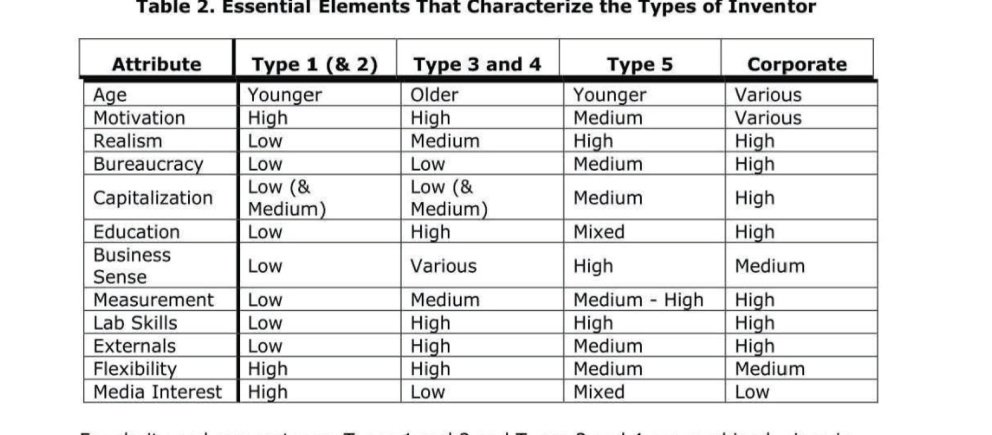
The core of the document is a typology of five inventors. Type 1 has neither training nor money, uses cheap instruments, measures poorly, avoids independent verification, publicizes through videos, and lives off small investors. Type 2 has more resources but the same lack of training. Type 3 has training, starts from a hypothesis and incremental experiments, and publishes, but may make measurement errors. Type 4 has training and its own money but avoids fundamental questions such as gravity. Type 5 is a group of five to six inventors, focused on short-term commercial products. Table 2 summarizes age, motivation, realism, bureaucracy, capitalization, measurement, and other attributes.
The conclusions are the author's and include no calculations. Types 1 and 2 are motivated and flexible but weak in training, measurement, and laboratory facilities, and dependent on the media. Types 3 and 4 outperform the first two in almost everything, and the author sees them as the best choice among independents, to be selected by criteria such as publications and credibility, monitored, and encouraged with financial resources. The corporate inventor, especially the university-based one, would be an excellent candidate if he had motivation and flexibility. Types 1 and 2 should only be observed casually. The text cites Dean Kamen, Ovshinsky, Tesla, Goddard, Tsiolkovsky, and Marc Millis as examples and references.
The technological horizon is long-term and diffuse: new primary energy, such as zero-point and fusion, and propulsion by modification of the gravitational field, in addition to antimatter, which the author cites as a proposal that is too expensive. The document is critical of the free-energy and antigravity claims circulating on the internet: it says many rely on permanent magnets and uncontrolled measurements and ignore conservation of energy. As for why the study was commissioned, it says only that it seeks to indicate where to expect the needed innovations in energy and propulsion; beyond the AAWSA series front matter, the text does not explain why the program requested it.
It is worth separating the layers. The typology and the comparisons in Table 2 are the author's qualitative classification, with no stated sample or measurement. The references are largely internet pages, accessed in January 2009, and name companies and inventors as examples of claims. The fraud and free-energy cases cited are not evaluated one by one, and the text itself says that the exploits of con artists will not be analyzed. The document also does not claim that any exotic technology exists or has been built.
DIRECT READING OF THE FILE
The document, in the original
All 19 pages of the document were translated in full: cover, front matter, table of contents, introduction, the text of the study (pages 4 to 18), tables 1 and 2 (in list form), and the reference lists (pages 18 and 19). In the references, only the descriptive elements were translated; the titles of works in English were marked as “bibliographic references in the original,” and the internet addresses were kept.
EXCERPT 1 · PHYSICAL PAGE 1
full page
30 Marc'h 2010
ICOD: 1 December 2009
DIA-08- 1003-017
UNCLASSIFIED/ I FOR 8FFIEiIAl W&& &Nia¥
Defense
Intelligence
Reference
Document
Acquisition Threat Support
Maverick Inventor Versus
Corporate Inventor: Where
Will the Next Major
Innovations Arise?
UNCLASSIFIED/ /5i0A OFFIEil.t.l WS& OHL¥Editorial note: Cover of the DIA reference document, dated March 30, 2010, number DIA-08-1003-017, with the title of the study; the ICOD date printed on the cover is December 1.º, 2009.
Check the original PDF
30 Marc'h 2010
ICOD: 1 December 2009
DIA-08- 1003-017
UNCLASSIFIED/ I FOR 8FFIEiIAl W&& &Nia¥
Defense
Intelligence
Reference
Document
Acquisition Threat Support
Maverick Inventor Versus
Corporate Inventor: Where
Will the Next Major
Innovations Arise?
UNCLASSIFIED/ /5i0A OFFIEil.t.l WS& OHL¥View the document record ↗ · Physical page 1, counting the cover.
EXCERPT 2 · PHYSICAL PAGE 10
full page
UNCLASSIFIED// POR OPPICIJltt tt9! or•t I
The inventors highlighted in this study investigate technologies encompassing the
production or conversion of energy from novel sources, sometimes referred to as "new
primary energy sources," including permanent magnets, cold and warm fusion, "zero
point fluctuations," and novel uses of batteries and rotating systems, as well as
theoretical and experimental approaches to modulating the local gravity field. Some of
these inventors and inventions are described in recent books (see Reference 5, 6).
Historically, what has been the relative contribution to the major innovations in these
areas? Taking the specific area of electrical energy production as an example, it was the
contributions, inspiration, and determination of maverick inventors such as Tesla that
resulted in the design of many of the current power-generating technologies in use
today. As far as radically new recent designs of alternators and motors is concerned,
there have been very few innovations from maverick inventors, Flynn's dual-path
magnetic circuit being a notab le exception (Reference 7). Most of the innovations in this
area come from corporate inventors in the electric power industry, as the only path left
toward increasing efficiency is through novel materials such as high-temperature
superconductors. Such research is generally out of reach of the maverick inventor.
There has been no lack of attempts by maverick inventors to produce electrical "free
energy" and related machines.
In the area of space propulsion and earth-to-orbit methods in particular, again it was
the contributions of mavericks such as Tsiolkovsky and Goddard that laid the
foundations for modern rocketry. Both inventors took a practical approach to rocketry,
as the field was in its embryonic state. Initially denigrated as being "on ly" a high school
math teacher with no formal scientific training, Tsiolkovsky developed the fundamental
equation for rocket propullsion. Although Goddard was university trained, like
Tsiolkovsky, his fundamental work on rocket dynamics was largely ignored until later in
his life. During their early, creative years, neither man worked for large organizations.
As far as radically new propulsive means are concerned, there have been innovat ions
only in the efficiency and overall design, and the fundamental mass expulsion model
has remained unchanged. The efficiency innovations have sprung from corporate
inventors who have the resources to plan and test their increasingly costly designs only
in the context of large organizations.
The current innovations in these two fields come from larger organizations such as
those highlighted in the previous section. However it should be noted that these
innovations, largely increased in efficiency, have been economically as well as
technically viable. There are plenty of novel thruster designs that would be excellent
candidates for inclusion in the breakthrough category if only they were not so
expensive. Antimatter propulsion using positrons and antiprotons is a good example
(Reference 8, 9). In the early development of electr ical machines, many parts of the
system were very expensive-electrical steel laminations, for example - but mass
production brought prices down. Fortunately inventions are not completely discarded
simply because they are too costly at the time of their conception. Increasingly today,
materials costs rather than manufacturing costs drive economic decisions about the
development and commercialization of inventions in this category. This is due in part to
the replacement of human manpower with its robotic equivalent and the scarcity of
certain strategic technologically important raw materials, such as rare earths.
UNCLASSIFIED/ ,'FOR QfifilCIAk Wli& 8PtLY
5Editorial note: Cites historical contributions by independents to electric power generation and to rockets and notes that modern, expensive improvements generally depend on organizations; antimatter propulsion appears as an expensive proposal.
Check the original PDF
UNCLASSIFIED// POR OPPICIJltt tt9! or•t I
The inventors highlighted in this study investigate technologies encompassing the
production or conversion of energy from novel sources, sometimes referred to as "new
primary energy sources," including permanent magnets, cold and warm fusion, "zero
point fluctuations," and novel uses of batteries and rotating systems, as well as
theoretical and experimental approaches to modulating the local gravity field. Some of
these inventors and inventions are described in recent books (see Reference 5, 6).
Historically, what has been the relative contribution to the major innovations in these
areas? Taking the specific area of electrical energy production as an example, it was the
contributions, inspiration, and determination of maverick inventors such as Tesla that
resulted in the design of many of the current power-generating technologies in use
today. As far as radically new recent designs of alternators and motors is concerned,
there have been very few innovations from maverick inventors, Flynn's dual-path
magnetic circuit being a notab le exception (Reference 7). Most of the innovations in this
area come from corporate inventors in the electric power industry, as the only path left
toward increasing efficiency is through novel materials such as high-temperature
superconductors. Such research is generally out of reach of the maverick inventor.
There has been no lack of attempts by maverick inventors to produce electrical "free
energy" and related machines.
In the area of space propulsion and earth-to-orbit methods in particular, again it was
the contributions of mavericks such as Tsiolkovsky and Goddard that laid the
foundations for modern rocketry. Both inventors took a practical approach to rocketry,
as the field was in its embryonic state. Initially denigrated as being "on ly" a high school
math teacher with no formal scientific training, Tsiolkovsky developed the fundamental
equation for rocket propullsion. Although Goddard was university trained, like
Tsiolkovsky, his fundamental work on rocket dynamics was largely ignored until later in
his life. During their early, creative years, neither man worked for large organizations.
As far as radically new propulsive means are concerned, there have been innovat ions
only in the efficiency and overall design, and the fundamental mass expulsion model
has remained unchanged. The efficiency innovations have sprung from corporate
inventors who have the resources to plan and test their increasingly costly designs only
in the context of large organizations.
The current innovations in these two fields come from larger organizations such as
those highlighted in the previous section. However it should be noted that these
innovations, largely increased in efficiency, have been economically as well as
technically viable. There are plenty of novel thruster designs that would be excellent
candidates for inclusion in the breakthrough category if only they were not so
expensive. Antimatter propulsion using positrons and antiprotons is a good example
(Reference 8, 9). In the early development of electr ical machines, many parts of the
system were very expensive-electrical steel laminations, for example - but mass
production brought prices down. Fortunately inventions are not completely discarded
simply because they are too costly at the time of their conception. Increasingly today,
materials costs rather than manufacturing costs drive economic decisions about the
development and commercialization of inventions in this category. This is due in part to
the replacement of human manpower with its robotic equivalent and the scarcity of
certain strategic technologically important raw materials, such as rare earths.
UNCLASSIFIED/ ,'FOR QfifilCIAk Wli& 8PtLY
5View the document record ↗ · Physical page 10, counting the cover.
EXCERPT 3 · PHYSICAL PAGE 11
full page
UNCLASSIFIED/) FOR CFFIEIAL ~SE 8PU1¥
The Type 1 Inventor
One should examine the area of novel energy generation inventions from the
standpoint of the maverick inventor who has no formal training. Because the approach
and timel ine of the typica l energy inventor mimic those of the propuls ion (read
"antigravity") inventor ,2 we will concentrate on the energy inventor. Often the invention
involves a device that is p•urported to produce more energy than it consumes. In some
cases the inventor naively thinks his invention is simply creat ing the ext ra energy from
nothing. More often the invento r believes his device is tapping a new energy source,
such as "zero-point energy" or "magnet ic energy ." He typically begins his quest by
literally playing with storage batteries or pulse-driv en, simple, permanent-magnet
based motors. Since the typical maverick inventor has negligible funds for research and
development, cheap measuring instruments are the norm. A very cursory
understand ing of electr ical wiring and possibly a rudimentary capability in designing
solid-state circuitry seem all that are necessary from an educational standpoint. Delving
into thermodynamics, proper experiment design, error analysis, or even power factor is
usually seen as taking valuable time away from construction of an invention prototype.
Alas, it is most often in the area of measurement that the maverick inventor solidifies
his belief that he has discovered the answer to the world's energy problems. His fear of
ridicule and belief that the local university or testing agency would (a) steal the
invent ion, (b) not do a proper test because they do not believe in the underly ing
concept (for example, zero-point energy), or (c) are in league with big oil and will
suppress the invention ensure that proper measurements are rarely performed at the
important early stages of the invention's developme nt. Fear of suppression also
contributes to the typical inventor's lack of proper note taking. The test instruments
used usually are not suitable for use in measuring the various electrical parameters in,
for example, pulsed-motor designs. Even if more expensive oscilloscopes are
purchased, their internal math functions are overrelied upon without giving a second
thought to applicability, calibrat ion, or use of proper probes within specification, among
a host of bothersome deta ils. The measurement problem is generally compounded
when attempting to measure the true power or energy output of a device, especially
where the output is a rotating shaft or source of heat.
The modern Type 1 inventor shuns publishing in the peer-reviewed literature for
obvious reasons and instead makes a YouTube video or appears on a TV "weird science"
program or news clip to further promote this incredible invention .
Up to th is point, the invention has been developed using personal or immediate family
funds. Once the maverick inventor is convinced he has the ultimate solution, the next
step is to raise the necessary funds to produce a larger, higher power prototype . Note
the key step of independently verifying the technical validity of the device at low power
is to be avoided . "Only a big power output will convince the skeptics" is the slogan at
this stage. And a high-power prototype will take much longer to build, thus buying
more time for the inventor to invent excuses for why the whole idea was unworkable in
the first place. Usually the original prototype is either scrapped or robbed of
components to make a new high-power device.
2 For t ypical examples of Inventors concentrating on gravity and propul sion means, see Reference 10, 11, 12.
UNCLASSIFIED//EAR 0551Cl.t.L Wi& 8PtLY
6Editorial note: Describes Type 1, the untrained inventor who claims to obtain excess energy through inadequate measurements, avoids independent verification and seeks to scale up the prototype.
Check the original PDF
UNCLASSIFIED/) FOR CFFIEIAL ~SE 8PU1¥
The Type 1 Inventor
One should examine the area of novel energy generation inventions from the
standpoint of the maverick inventor who has no formal training. Because the approach
and timel ine of the typica l energy inventor mimic those of the propuls ion (read
"antigravity") inventor ,2 we will concentrate on the energy inventor. Often the invention
involves a device that is p•urported to produce more energy than it consumes. In some
cases the inventor naively thinks his invention is simply creat ing the ext ra energy from
nothing. More often the invento r believes his device is tapping a new energy source,
such as "zero-point energy" or "magnet ic energy ." He typically begins his quest by
literally playing with storage batteries or pulse-driv en, simple, permanent-magnet
based motors. Since the typical maverick inventor has negligible funds for research and
development, cheap measuring instruments are the norm. A very cursory
understand ing of electr ical wiring and possibly a rudimentary capability in designing
solid-state circuitry seem all that are necessary from an educational standpoint. Delving
into thermodynamics, proper experiment design, error analysis, or even power factor is
usually seen as taking valuable time away from construction of an invention prototype.
Alas, it is most often in the area of measurement that the maverick inventor solidifies
his belief that he has discovered the answer to the world's energy problems. His fear of
ridicule and belief that the local university or testing agency would (a) steal the
invent ion, (b) not do a proper test because they do not believe in the underly ing
concept (for example, zero-point energy), or (c) are in league with big oil and will
suppress the invention ensure that proper measurements are rarely performed at the
important early stages of the invention's developme nt. Fear of suppression also
contributes to the typical inventor's lack of proper note taking. The test instruments
used usually are not suitable for use in measuring the various electrical parameters in,
for example, pulsed-motor designs. Even if more expensive oscilloscopes are
purchased, their internal math functions are overrelied upon without giving a second
thought to applicability, calibrat ion, or use of proper probes within specification, among
a host of bothersome deta ils. The measurement problem is generally compounded
when attempting to measure the true power or energy output of a device, especially
where the output is a rotating shaft or source of heat.
The modern Type 1 inventor shuns publishing in the peer-reviewed literature for
obvious reasons and instead makes a YouTube video or appears on a TV "weird science"
program or news clip to further promote this incredible invention .
Up to th is point, the invention has been developed using personal or immediate family
funds. Once the maverick inventor is convinced he has the ultimate solution, the next
step is to raise the necessary funds to produce a larger, higher power prototype . Note
the key step of independently verifying the technical validity of the device at low power
is to be avoided . "Only a big power output will convince the skeptics" is the slogan at
this stage. And a high-power prototype will take much longer to build, thus buying
more time for the inventor to invent excuses for why the whole idea was unworkable in
the first place. Usually the original prototype is either scrapped or robbed of
components to make a new high-power device.
2 For t ypical examples of Inventors concentrating on gravity and propul sion means, see Reference 10, 11, 12.
UNCLASSIFIED//EAR 0551Cl.t.L Wi& 8PtLY
6View the document record ↗ · Physical page 11, counting the cover.
EXCERPT 4 · PHYSICAL PAGE 12
full page
UNCLASSIFIED/ }FOR 8FFI@IAL ~91! 8HLY
Where does the inventor find funding for such a development? The typical inventor
(Reference 13) will canvas a wider network of friends, his church, a local venture
capitalist or private investor who is not very savvy, or a fund specifically establlished to
invest in exotic energy startups (Reference 14, 15). After convincing them of the
incredible return on their investment in the technology by "demonstrating" it (without
proper protocols, test equipment, and so forth), manpower, space, and new equipment
are purchased. Usually the last thing on the inventor's mind at this stage is wasting
investors' money on an independent laboratory test such as might be found at a local
university's engineering or physics department or certified testing laboratory to
determine whether there is any validity to the technology.
Around this time, the major investors start to sense there might be something amiss in
their original assessment of the validity of the technology. This might arise from any
number of factors, including continual requests for more funding, continual delays in
demonstrating the new high-power unit, more-informed friends asking probing
technical questions, and so forth. Investors start to withdraw, accepting the fact of their
bad investment, and the inventor eventually recedes into oblivion or skips town to start
up again under a different guise somewhere else. This is typical behavior for the con
artist (Reference 16, 17, 18), whose exploits will not be further analyzed herein.
However, some enterprising individuals parlay their experience into related
conventional businesses (Reference 19), and some investors hang on long past the time
a reasonable person would quit (Reference 20).
Patent protection generally is not sought by the Type 1 inventor. And if a patent is
sought, either it is rejected outright by the patent office or a watered-down version is
obtained that is usually worthless from either the physics or technical point of view or
as part of the intellectual property to eventually be sold to an investor interested in
commercializing the device.
What can be learned from the Type 1 inventor? Given their lack of formal education in
the relevant disciplines, there is a negligible chance that Type 1 inventors will
contribute anything of significance to major innovations in the energy and propulsion
areas. Their undisciplined approach, coupled with th,eir lack of funds and interest in
science by media, virtually guarantees failure.
The Type 2 Inventor
The major-and sometimes only-difference between Type 2 and Type 1 inventors is
that Type 2 inventors tend to be even more confident in their inventions because they
have been able to purchase fancy and costly measuring equipment and have high
quality machining done. However, because of their general lack of education in the
relevant areas of instrumentation, they can misuse the instruments or misinterpret the
resulting data just as badly as Type 1 inventors (Reference 21). However, Type 2
inventors have the advantage of being able to purchase external expertise in these
areas (Reference 22). The degree to which they rely on and believe the external
expertise-for example, a university laboratory-is dependent on several factors, most
notably the personality of the inventor himself. The more self-assured personality relies
less on outside expertise.
Type 2 inventors generally have more to lose in terms of money, as they typically start
out big and want to go bigger faster. They tend to investigate less speculative areas of
UNCLASSIFIED/ ,'FOR OFFI&ilAL Wili QNL¥
7Editorial note: Continues the trajectory of funding and failure attributed to Type 1 and begins describing Type 2, which has more resources but may misinterpret the instruments.
Check the original PDF
UNCLASSIFIED/ }FOR 8FFI@IAL ~91! 8HLY
Where does the inventor find funding for such a development? The typical inventor
(Reference 13) will canvas a wider network of friends, his church, a local venture
capitalist or private investor who is not very savvy, or a fund specifically establlished to
invest in exotic energy startups (Reference 14, 15). After convincing them of the
incredible return on their investment in the technology by "demonstrating" it (without
proper protocols, test equipment, and so forth), manpower, space, and new equipment
are purchased. Usually the last thing on the inventor's mind at this stage is wasting
investors' money on an independent laboratory test such as might be found at a local
university's engineering or physics department or certified testing laboratory to
determine whether there is any validity to the technology.
Around this time, the major investors start to sense there might be something amiss in
their original assessment of the validity of the technology. This might arise from any
number of factors, including continual requests for more funding, continual delays in
demonstrating the new high-power unit, more-informed friends asking probing
technical questions, and so forth. Investors start to withdraw, accepting the fact of their
bad investment, and the inventor eventually recedes into oblivion or skips town to start
up again under a different guise somewhere else. This is typical behavior for the con
artist (Reference 16, 17, 18), whose exploits will not be further analyzed herein.
However, some enterprising individuals parlay their experience into related
conventional businesses (Reference 19), and some investors hang on long past the time
a reasonable person would quit (Reference 20).
Patent protection generally is not sought by the Type 1 inventor. And if a patent is
sought, either it is rejected outright by the patent office or a watered-down version is
obtained that is usually worthless from either the physics or technical point of view or
as part of the intellectual property to eventually be sold to an investor interested in
commercializing the device.
What can be learned from the Type 1 inventor? Given their lack of formal education in
the relevant disciplines, there is a negligible chance that Type 1 inventors will
contribute anything of significance to major innovations in the energy and propulsion
areas. Their undisciplined approach, coupled with th,eir lack of funds and interest in
science by media, virtually guarantees failure.
The Type 2 Inventor
The major-and sometimes only-difference between Type 2 and Type 1 inventors is
that Type 2 inventors tend to be even more confident in their inventions because they
have been able to purchase fancy and costly measuring equipment and have high
quality machining done. However, because of their general lack of education in the
relevant areas of instrumentation, they can misuse the instruments or misinterpret the
resulting data just as badly as Type 1 inventors (Reference 21). However, Type 2
inventors have the advantage of being able to purchase external expertise in these
areas (Reference 22). The degree to which they rely on and believe the external
expertise-for example, a university laboratory-is dependent on several factors, most
notably the personality of the inventor himself. The more self-assured personality relies
less on outside expertise.
Type 2 inventors generally have more to lose in terms of money, as they typically start
out big and want to go bigger faster. They tend to investigate less speculative areas of
UNCLASSIFIED/ ,'FOR OFFI&ilAL Wili QNL¥
7View the document record ↗ · Physical page 12, counting the cover.
EXCERPT 5 · PHYSICAL PAGE 13
full page
UNCLASSIFIED! /FOR OfifilQlalik wse 8HL'I
a technology. Also, they are not generally plagued by the insecurities of the Type 1
inventor about subject ing their invent ions to outside scrutiny, and some will be bold
enough to publish in respected scientific journals (Reference 23). This means they keep
better lab notes than Type 1 inventors. It does not mean they are intrinsically better
scientists or inventors.
Type 2 inventors generally have a bit more training in physics and sometimes start with
a theory of which they request analysis from a local university professor, for example.
Usually the theory is either partially formed or is not directly relevant to the proposed
invention. The professor dutifully examines the theory presented while not being
informed of the overall us,e to which his work is to be put and makes a pronouncement
that the inventor can usually twist one way or another to suit his future fundraising
efforts (Reference 24). Often the inventor has access to various theories about energy
or gravity that are posted in non-peer-reviewed media and uses these to initia te or
justify the proposed invention.
Type 2 inventors have a generally greater success at securing a patent, as they have a
better basis on which to make a claim and can afford better patent lawyers. Some of
the more advanced Type 2 inventors realize they need to start with a more pure
physics experimental approach rather than going straight for the applied invention,
although these are rare (Reference 23).
Once the initial concept has proved infeasible on the bench, these inventors can burn
through a large amount of additional money in a scatter -shot approach, trying to save
face and what little money is left . Some will continually scan the Internet or
underground press for other likely energy candidates to switch allegiance to (Reference
14, 15), or will simply convince other gullible investors to continue to prop up the
technology with ever-more contorted descriptions of what is needed to succeed.
Eventually the house of cards collapses, and all the players go home, licking their
financial and psychological wounds. This occurs when an investor finally starts asking
the tough technical and measurement questions that should have been addressed at
the outset.
What can be learned from the Type 2 inventor? On the one hand, these inventors can
be much more dangerous than Type 1 inventors, as they can use their enhanced
financial clout to make it appear as if they have something of value and thereby attract
capital that might otherwise be used in more fruitful pursuits. On the other hand, Type
2 inventors can serve a useful purpose in showing others where not to tread. Their
ability to instantiate some degree of professional sophistication - for example, university
professor-marginally increases the likelihood of a true innovation. However, the
personality of the Type 2 inventor will dictate their receptiveness to external advice.
The Type 3 Inventor
As the inventor gains more formal training, the foundation for the innovations tends to
be a hypothesis or mathematical model leading to basic experiments, as opposed to
starting with a full -blown embodiment of the hoped-for invention . In the best case, this
is a staged approach in which the inventor already has sufficient knowledge about the
area to know how to design a succession of experiments and interpret the results
properly to make increasingly accurate assessments of the likely validity of the
invention. Optimally, the hypothesis is based on an extension of known physical laws
UNCLASSIFIED/ ffiOR OFifilCIOL 11ili ONI X
8Editorial note: Says that Type 2 may obtain patents and expert opinions, but warns against theories poorly connected to the device and the lack of measurement questions, and introduces Type 3.
Check the original PDF
UNCLASSIFIED! /FOR OfifilQlalik wse 8HL'I
a technology. Also, they are not generally plagued by the insecurities of the Type 1
inventor about subject ing their invent ions to outside scrutiny, and some will be bold
enough to publish in respected scientific journals (Reference 23). This means they keep
better lab notes than Type 1 inventors. It does not mean they are intrinsically better
scientists or inventors.
Type 2 inventors generally have a bit more training in physics and sometimes start with
a theory of which they request analysis from a local university professor, for example.
Usually the theory is either partially formed or is not directly relevant to the proposed
invention. The professor dutifully examines the theory presented while not being
informed of the overall us,e to which his work is to be put and makes a pronouncement
that the inventor can usually twist one way or another to suit his future fundraising
efforts (Reference 24). Often the inventor has access to various theories about energy
or gravity that are posted in non-peer-reviewed media and uses these to initia te or
justify the proposed invention.
Type 2 inventors have a generally greater success at securing a patent, as they have a
better basis on which to make a claim and can afford better patent lawyers. Some of
the more advanced Type 2 inventors realize they need to start with a more pure
physics experimental approach rather than going straight for the applied invention,
although these are rare (Reference 23).
Once the initial concept has proved infeasible on the bench, these inventors can burn
through a large amount of additional money in a scatter -shot approach, trying to save
face and what little money is left . Some will continually scan the Internet or
underground press for other likely energy candidates to switch allegiance to (Reference
14, 15), or will simply convince other gullible investors to continue to prop up the
technology with ever-more contorted descriptions of what is needed to succeed.
Eventually the house of cards collapses, and all the players go home, licking their
financial and psychological wounds. This occurs when an investor finally starts asking
the tough technical and measurement questions that should have been addressed at
the outset.
What can be learned from the Type 2 inventor? On the one hand, these inventors can
be much more dangerous than Type 1 inventors, as they can use their enhanced
financial clout to make it appear as if they have something of value and thereby attract
capital that might otherwise be used in more fruitful pursuits. On the other hand, Type
2 inventors can serve a useful purpose in showing others where not to tread. Their
ability to instantiate some degree of professional sophistication - for example, university
professor-marginally increases the likelihood of a true innovation. However, the
personality of the Type 2 inventor will dictate their receptiveness to external advice.
The Type 3 Inventor
As the inventor gains more formal training, the foundation for the innovations tends to
be a hypothesis or mathematical model leading to basic experiments, as opposed to
starting with a full -blown embodiment of the hoped-for invention . In the best case, this
is a staged approach in which the inventor already has sufficient knowledge about the
area to know how to design a succession of experiments and interpret the results
properly to make increasingly accurate assessments of the likely validity of the
invention. Optimally, the hypothesis is based on an extension of known physical laws
UNCLASSIFIED/ ffiOR OFifilCIOL 11ili ONI X
8View the document record ↗ · Physical page 13, counting the cover.
EXCERPT 6 · PHYSICAL PAGE 14
full page
UNCLASSIFIED/} FOR OfPle!AL HSE 8PtLlf
and calls on known or reasonably postulated primary energy sources. In contrast to
Type 1 and 2 inventors, who seem never to realize that a permanent magnet cannot be
an energy source in and of itself, for instance, the Type 3 inventor relies on the known
conservation laws. Type 3 ( and 4) inventors generally realize the enormity of the
problems they face, whereas Types 1 and 2 have insulated themselves from this
realization.
As a result of his education, the Type 3 (and 4) inventor should know where to access
specific technical and scientific literature to aid in the process of researching their ideas.
The inventor may be associated with a local university or an emeritus professor and use
this expertise on an informal basis to compensate for a lack of funds. Primary funding
comes from personal or family finances or from small groups of like-minded aficionados
(Reference 25). Generally the Type 3 (and 4) inventors are older than Types 1 and 2.
They are also much better at explaining the scientific basis for their proposed invention
and thus can attract additional funding from venture capitalists, foundations, or
government granting agencies. This is a much more palatable approach in the eyes of
prospective investors, as there is the feeling that their investment is based on science
rather than on pure speculation and thus has a better chance of a positive return. In
some cases, the individua I or venture investors' funds can be matched by government
grants if the idea is passed by a scientific review board. Most investors in Type 3 and 4
invent ions are more sophisticated than those who invest in Types 1 and 2.
Type 3 inventors generally have a record of publications in peer-reviewed literature.
However, even with a greater degree of education, it is ohen the case that the inventor
makes mistakes in measurement or interpretations of data (Reference 26, 27),
especially when the init ial results apparently confirm the inventor's hypothesis or
physical model (Reference 28). This is most often what leads to the demise of the
innovation. However, in these cases, the investors are not as angry or embarrassed as
Type 1 and 2 inventors, and so may continue to support the inventor for some time as
he tries to work out the problems in understanding the innovation more fully.
The very fact of their higher education makes the Type 3 inventor more easily able to
denigrate competing theories and experiments. This facet can be derived from or
evolve into a rather dogmatic belief that the Type 3 inventor's theory is the only correct
interpretation and the only one likely to succeed. This aspect must be taken into
account when assessing tile inventor's potential to accept other explanations or
assistance when he eventually encounters difficulty with his theory or experiment.
Typically the scope of the claims is more modest compared with Types 1 and 2. Instead
of trumpeting that the invention will literally save the world, these inventors are more
realistic, suggesting how the invention might be one part of an overall solution.
What can be learned from the Type 3 inventor? Type 3 inventors' education and
familiarity with the scientific method puts them in an entirely different league from
Types 1 and 2. Access to their publications provides good insight into their capabilities.
They are more realistic in their goals and expectations. It is easier for investors and
other scientists to deal with Type 3 inventors, but Type 3 inventors are hungrier for
funding than Type 4 inventors, so caution is still required in interpreting their spiel. A
Type 3 inventor displaying a rigid and dogmatic approach should be avoided.
UNCLASSIFIED/ /POI\ OfPlelAL t,91! or~tY
9Editorial note: Type 3 starts from a hypothesis and incremental tests, respects conservation of energy and publishes, but can still err in measuring and in interpreting favorable data.
Check the original PDF
UNCLASSIFIED/} FOR OfPle!AL HSE 8PtLlf
and calls on known or reasonably postulated primary energy sources. In contrast to
Type 1 and 2 inventors, who seem never to realize that a permanent magnet cannot be
an energy source in and of itself, for instance, the Type 3 inventor relies on the known
conservation laws. Type 3 ( and 4) inventors generally realize the enormity of the
problems they face, whereas Types 1 and 2 have insulated themselves from this
realization.
As a result of his education, the Type 3 (and 4) inventor should know where to access
specific technical and scientific literature to aid in the process of researching their ideas.
The inventor may be associated with a local university or an emeritus professor and use
this expertise on an informal basis to compensate for a lack of funds. Primary funding
comes from personal or family finances or from small groups of like-minded aficionados
(Reference 25). Generally the Type 3 (and 4) inventors are older than Types 1 and 2.
They are also much better at explaining the scientific basis for their proposed invention
and thus can attract additional funding from venture capitalists, foundations, or
government granting agencies. This is a much more palatable approach in the eyes of
prospective investors, as there is the feeling that their investment is based on science
rather than on pure speculation and thus has a better chance of a positive return. In
some cases, the individua I or venture investors' funds can be matched by government
grants if the idea is passed by a scientific review board. Most investors in Type 3 and 4
invent ions are more sophisticated than those who invest in Types 1 and 2.
Type 3 inventors generally have a record of publications in peer-reviewed literature.
However, even with a greater degree of education, it is ohen the case that the inventor
makes mistakes in measurement or interpretations of data (Reference 26, 27),
especially when the init ial results apparently confirm the inventor's hypothesis or
physical model (Reference 28). This is most often what leads to the demise of the
innovation. However, in these cases, the investors are not as angry or embarrassed as
Type 1 and 2 inventors, and so may continue to support the inventor for some time as
he tries to work out the problems in understanding the innovation more fully.
The very fact of their higher education makes the Type 3 inventor more easily able to
denigrate competing theories and experiments. This facet can be derived from or
evolve into a rather dogmatic belief that the Type 3 inventor's theory is the only correct
interpretation and the only one likely to succeed. This aspect must be taken into
account when assessing tile inventor's potential to accept other explanations or
assistance when he eventually encounters difficulty with his theory or experiment.
Typically the scope of the claims is more modest compared with Types 1 and 2. Instead
of trumpeting that the invention will literally save the world, these inventors are more
realistic, suggesting how the invention might be one part of an overall solution.
What can be learned from the Type 3 inventor? Type 3 inventors' education and
familiarity with the scientific method puts them in an entirely different league from
Types 1 and 2. Access to their publications provides good insight into their capabilities.
They are more realistic in their goals and expectations. It is easier for investors and
other scientists to deal with Type 3 inventors, but Type 3 inventors are hungrier for
funding than Type 4 inventors, so caution is still required in interpreting their spiel. A
Type 3 inventor displaying a rigid and dogmatic approach should be avoided.
UNCLASSIFIED/ /POI\ OfPlelAL t,91! or~tY
9View the document record ↗ · Physical page 14, counting the cover.
EXCERPT 7 · PHYSICAL PAGE 15
full page
UNCLASSIFIED/fFOA OFFI&IAb WSE ONbV
The Type 4 Inventor
If a maverick inventor educated in science or engineering already has personal funding,
many of the attributes ascribed to the Type 3 inventor also apply. However, the Type 4
inventor is freer to pursue his innovation without as much concern for outside opinion.
It is often the case that such inventors have made their money from previous
inventions, so they already know the process. They have a much easier time attracting
capital, as evidenced by their track records. However, not all have money from previous
inventions. Some have family wealth, and some may have made money developing
technology in areas somewhat removed from their current interest.
Type 4 inventors generally are less inclined to pursue inventions in the areas of energy
generation and propulsion as defined above. In fact, the likelihood of such inventors
even being interested in novel primary energy generation or gravity modification is
greatly diminished. They still tackle difficult technical challenges, but not generally
fundamental issues like gravity and primary energy. It is by avoiding these supremely
difficult areas that they have been able to invent in other areas and are thus already
better funded!
Type 4 inventors realize the necessity of a step-by-step approach and the pitfalls of
developing ideas from scratch. They tend to apply their genius to improvements to
status quo in these areas rather than providing complete breakthroughs. For instance,
Kamen's Segway (Reference 29) contains no fundamentally new technology. Although
Ovshinsky (Reference 30) did manage to develop new materials for solar electricity
generation, the general idea of harnessing the Sun's energy to produce electricity was
not new. Incidentally, Ovshinsky is included in this category even though he had no
formal university education but is a self-taught genius. Notwithstanding their aversion
to the fundamental issues relevant to this study, Type 4 inventors are capable of
determining at an early stage whether an idea has merit and how it might properly be
developed, assuming the basic concept is sound.
It should be noted that Type 1 and 2 inventors usually are true loners, whereas Types 3
and 4 may be part of a small group of up to 3-4 people dedicated to a single objective.
What can be learned from the Type 4 inventor is quite similar to that of the Type 3
inventor. The major differ ,ence is the track record of invention and the likely increased
business sense of the Type 4 inventor compared with those of the Type 3 inventor.
The Type 5 Inventor
Here one starts to see an overlap in form and function with the corporate inventor . The
primary distinction is the number of active inventors constituting the group: in this
study, we assume that 5-6 inventors is a typical group size. The small group setting
allows the individuals to bounce seemingly crazy ideas back and forth with little concern
about ridicule. Depending on the nature of the organization, no topic is taboo. However,
the inventor in this situation is usually required to contribute to near-term commercial
products rather than exotic innovations. This is because most small groups of inventors
are primarily interested in keeping their enterprise afloat. They realize that the effort
required to tackle topics such as gravity and primary energy would be enormous, and
although the payoff would be exceedingly large, the probability of success is small
given that their competitors are in well-funded academic and government laboratories.
UNCLASSIFIED/ /FOA QFFI&IAL l:t.!I! 6NLI
10Editorial note: Type 4 has training or experience and its own resources; Type 5 is a small commercial group that tends to make short-term improvements rather than exotic propulsion.
Check the original PDF
UNCLASSIFIED/fFOA OFFI&IAb WSE ONbV
The Type 4 Inventor
If a maverick inventor educated in science or engineering already has personal funding,
many of the attributes ascribed to the Type 3 inventor also apply. However, the Type 4
inventor is freer to pursue his innovation without as much concern for outside opinion.
It is often the case that such inventors have made their money from previous
inventions, so they already know the process. They have a much easier time attracting
capital, as evidenced by their track records. However, not all have money from previous
inventions. Some have family wealth, and some may have made money developing
technology in areas somewhat removed from their current interest.
Type 4 inventors generally are less inclined to pursue inventions in the areas of energy
generation and propulsion as defined above. In fact, the likelihood of such inventors
even being interested in novel primary energy generation or gravity modification is
greatly diminished. They still tackle difficult technical challenges, but not generally
fundamental issues like gravity and primary energy. It is by avoiding these supremely
difficult areas that they have been able to invent in other areas and are thus already
better funded!
Type 4 inventors realize the necessity of a step-by-step approach and the pitfalls of
developing ideas from scratch. They tend to apply their genius to improvements to
status quo in these areas rather than providing complete breakthroughs. For instance,
Kamen's Segway (Reference 29) contains no fundamentally new technology. Although
Ovshinsky (Reference 30) did manage to develop new materials for solar electricity
generation, the general idea of harnessing the Sun's energy to produce electricity was
not new. Incidentally, Ovshinsky is included in this category even though he had no
formal university education but is a self-taught genius. Notwithstanding their aversion
to the fundamental issues relevant to this study, Type 4 inventors are capable of
determining at an early stage whether an idea has merit and how it might properly be
developed, assuming the basic concept is sound.
It should be noted that Type 1 and 2 inventors usually are true loners, whereas Types 3
and 4 may be part of a small group of up to 3-4 people dedicated to a single objective.
What can be learned from the Type 4 inventor is quite similar to that of the Type 3
inventor. The major differ ,ence is the track record of invention and the likely increased
business sense of the Type 4 inventor compared with those of the Type 3 inventor.
The Type 5 Inventor
Here one starts to see an overlap in form and function with the corporate inventor . The
primary distinction is the number of active inventors constituting the group: in this
study, we assume that 5-6 inventors is a typical group size. The small group setting
allows the individuals to bounce seemingly crazy ideas back and forth with little concern
about ridicule. Depending on the nature of the organization, no topic is taboo. However,
the inventor in this situation is usually required to contribute to near-term commercial
products rather than exotic innovations. This is because most small groups of inventors
are primarily interested in keeping their enterprise afloat. They realize that the effort
required to tackle topics such as gravity and primary energy would be enormous, and
although the payoff would be exceedingly large, the probability of success is small
given that their competitors are in well-funded academic and government laboratories.
UNCLASSIFIED/ /FOA QFFI&IAL l:t.!I! 6NLI
10View the document record ↗ · Physical page 15, counting the cover.
EXCERPT 8 · PHYSICAL PAGE 16
full page
UNCLASSIFIED/ I FOR 8FFI@IAL ~SE er•t'i'
These innovators have a high degree of motivation for near-term commercial projects
but less motivation for exotic long-term projects and typically have specific educational
qualifications in the relevant fields. They generally work on improvements to the
technological status quo (Reference 31). These improvements are expected to be
commercial products in the near-to-medium term, compared with the energy and
propulsion technology discussed here, which have a long time horizon.
What can be learned from the Type 5 inventor? He is significantly less interested than
the lone maverick inventor in pursuing exotic inventions . As part of a commercial
enterprise, a Type 5 inventor's motivation to investigate long-term possibilities with a
low likelihood of success is small. This is not to say that the individual inventor within
the group might not be the most suitable candidate for considering exotic inventions if
he can operate with considerable freedom and enjoy the support and intellectual milieu
of the small group.
Comparisons
Table 2 below compares the essential elements that characterize the types of inventors
discussed in the previous sections. The various attributes shown can be used as criteria
for dete rmi ning the inventor type most likely to produce the necessary innovations in
the areas of advanced primary energy and exotic propulsion.
Table 2. Essential Elements That Characterize the Types of Inventor
I Attribute I Type 1 (& 2) Type 3 and 4 Type 5 Corporate
Aqe Younqer Older Younqer Various
Motivation Hiqh Hiqh Medium Various
Rea lism Low Medium High High
Bureaucracy Low Low Medium Hiqh
Capitalization Low (&
Medium)
Low (&
Medium) Medium High
Education Low Hiqh Mixed Hiqh
Business
Sense Low Various High Medium
Measurement Low Medium Medium - High Hiqh
Lab Skills Low High High High
Externals Low Hiqh Medium Hiqh
Flexibility Hiqh Hiqh Medium Medium
Media Interest Hioh Low Mixed Low
For clarity and compactness, Types 1 and 2 and Types 3 and 4 are combined, since in
general the only meaning f ul difference is the capitalization. As discussed above,
unfortunately, merely having more funding does not lead to substantially greater
capabilities in other areas.
Motivation: degree of commitment to initiating and completing the task and belief that
it is possible a priori.
Realism: degree of realization of the difficulties to be faced.
UNCLASSIFIED/ /EAR OFFICI0L Wi& 9,.LY
11Editorial note: Table classifying the types of inventor according to the author, with attributes such as age, motivation, training, measurement and laboratory skills, and the beginning of the definition of the criteria.
Check the original PDF
UNCLASSIFIED/ I FOR 8FFI@IAL ~SE er•t'i'
These innovators have a high degree of motivation for near-term commercial projects
but less motivation for exotic long-term projects and typically have specific educational
qualifications in the relevant fields. They generally work on improvements to the
technological status quo (Reference 31). These improvements are expected to be
commercial products in the near-to-medium term, compared with the energy and
propulsion technology discussed here, which have a long time horizon.
What can be learned from the Type 5 inventor? He is significantly less interested than
the lone maverick inventor in pursuing exotic inventions . As part of a commercial
enterprise, a Type 5 inventor's motivation to investigate long-term possibilities with a
low likelihood of success is small. This is not to say that the individual inventor within
the group might not be the most suitable candidate for considering exotic inventions if
he can operate with considerable freedom and enjoy the support and intellectual milieu
of the small group.
Comparisons
Table 2 below compares the essential elements that characterize the types of inventors
discussed in the previous sections. The various attributes shown can be used as criteria
for dete rmi ning the inventor type most likely to produce the necessary innovations in
the areas of advanced primary energy and exotic propulsion.
Table 2. Essential Elements That Characterize the Types of Inventor
I Attribute I Type 1 (& 2) Type 3 and 4 Type 5 Corporate
Aqe Younqer Older Younqer Various
Motivation Hiqh Hiqh Medium Various
Rea lism Low Medium High High
Bureaucracy Low Low Medium Hiqh
Capitalization Low (&
Medium)
Low (&
Medium) Medium High
Education Low Hiqh Mixed Hiqh
Business
Sense Low Various High Medium
Measurement Low Medium Medium - High Hiqh
Lab Skills Low High High High
Externals Low Hiqh Medium Hiqh
Flexibility Hiqh Hiqh Medium Medium
Media Interest Hioh Low Mixed Low
For clarity and compactness, Types 1 and 2 and Types 3 and 4 are combined, since in
general the only meaning f ul difference is the capitalization. As discussed above,
unfortunately, merely having more funding does not lead to substantially greater
capabilities in other areas.
Motivation: degree of commitment to initiating and completing the task and belief that
it is possible a priori.
Realism: degree of realization of the difficulties to be faced.
UNCLASSIFIED/ /EAR OFFICI0L Wi& 9,.LY
11View the document record ↗ · Physical page 16, counting the cover.
EXCERPT 9 · PHYSICAL PAGE 17
full page
UNCLASSIFIED/; FOR eFFlelAL WS& Ql'U,¥
Bureaucracy: amount of general and administrative overhead to be put up with by the
inventor.
Capitalization: relative amount of funding available to the inventor for the specific
invention.
Education: level of education achieved by the inventor in the relevant fields of science
or engineering.
Business Sense: degree of business acumen associated with inventor.
Measurement: capability of the inventor to understand and properly use measuring
instruments.
Lab Skills: ability to show orderly development from original concept, keep proper lab
notes and communicate ideas to others.
Externals: inventor's interest in and capability of using external assistance-for
example, a university, including publishing.
Flexibility: ability to work on different sorts of projects, even when highly exotic.
Media Interest: interest in self-promotion and reliance on various popular (nonscientific)
media for guidance; this is more an indicator of the psychology of the inventor than of
his technical skills.
In a 2003 NASA tutorial on breakthrough propulsion (Reference 32), Millis describes the
division between "masters" and "pioneers" in the context of determining where the next
space propulsion breakthrough might arise. At the extreme end of the masters are the
"pedantic prudes" who cornsider that the process is already at the end-point of
advancements in the field. This classification is similar to the least motivated corporate
inventor. At the opposite end of the pioneers, he places the "pathological pundits" who
characterize themselves using phrases such as "My theory is great...! can't be wrong ...If
you don't agree, you are part of the suppression conspiracy," and can thereby be
classified as Type 1 or 2 inventors. Millis also characterizes Type 1 and 2 inventors and
"nonrigorous enthusiasts" (Reference 33).
Conclusions
We can draw several conclusions from the comparisons in Table 2.
Maverick inventors of Types 1 and 2 score high in motivation and flexibility with little
bureaucracy, but in all other areas, they are lacking. Especially troubling for the present
scenario is the lack of education leading to substandard to nonexistent measurement
capabilities and laboratory skills, together with overreliance on media.
Types 3 and 4 also exhibit beneficial attributes relat ing to motivation, flexibility, and
bureaucracy, as well as their treatment of media. As far as the present scenario is
concerned, in all other attributes, Types 3 and 4 rank higher than their Type 1 and 2
counterparts. Their measurement skills could be improved, particularly in view of the
requirements of these new areas of energy and propulsion.
UNCLASSIFIED//FOR OFFICI0L Wi& 9,.LY
12Editorial note: Defines the comparative criteria of the table and concludes, according to the author, that Types 3 and 4 bring together a better combination of attributes for difficult research than Types 1 and 2.
Check the original PDF
UNCLASSIFIED/; FOR eFFlelAL WS& Ql'U,¥
Bureaucracy: amount of general and administrative overhead to be put up with by the
inventor.
Capitalization: relative amount of funding available to the inventor for the specific
invention.
Education: level of education achieved by the inventor in the relevant fields of science
or engineering.
Business Sense: degree of business acumen associated with inventor.
Measurement: capability of the inventor to understand and properly use measuring
instruments.
Lab Skills: ability to show orderly development from original concept, keep proper lab
notes and communicate ideas to others.
Externals: inventor's interest in and capability of using external assistance-for
example, a university, including publishing.
Flexibility: ability to work on different sorts of projects, even when highly exotic.
Media Interest: interest in self-promotion and reliance on various popular (nonscientific)
media for guidance; this is more an indicator of the psychology of the inventor than of
his technical skills.
In a 2003 NASA tutorial on breakthrough propulsion (Reference 32), Millis describes the
division between "masters" and "pioneers" in the context of determining where the next
space propulsion breakthrough might arise. At the extreme end of the masters are the
"pedantic prudes" who cornsider that the process is already at the end-point of
advancements in the field. This classification is similar to the least motivated corporate
inventor. At the opposite end of the pioneers, he places the "pathological pundits" who
characterize themselves using phrases such as "My theory is great...! can't be wrong ...If
you don't agree, you are part of the suppression conspiracy," and can thereby be
classified as Type 1 or 2 inventors. Millis also characterizes Type 1 and 2 inventors and
"nonrigorous enthusiasts" (Reference 33).
Conclusions
We can draw several conclusions from the comparisons in Table 2.
Maverick inventors of Types 1 and 2 score high in motivation and flexibility with little
bureaucracy, but in all other areas, they are lacking. Especially troubling for the present
scenario is the lack of education leading to substandard to nonexistent measurement
capabilities and laboratory skills, together with overreliance on media.
Types 3 and 4 also exhibit beneficial attributes relat ing to motivation, flexibility, and
bureaucracy, as well as their treatment of media. As far as the present scenario is
concerned, in all other attributes, Types 3 and 4 rank higher than their Type 1 and 2
counterparts. Their measurement skills could be improved, particularly in view of the
requirements of these new areas of energy and propulsion.
UNCLASSIFIED//FOR OFFICI0L Wi& 9,.LY
12View the document record ↗ · Physical page 17, counting the cover.
EXCERPT 10 · PHYSICAL PAGE 18
full page
UNCLASSIFIED/} POR OPPlelAL l:t9! 8HLY
Type 5 inventors are not as motivated as their Type 1 to 4 counterparts in these areas
of innovation, possibly owing to their increased sensitivity to the difficulty of the task.
Business sense is higher than Types 1 to 4, but the extent to which this impacts their
ability to innovate is not clear. They are more constrained insofar as bureaucracy is
concerned, which tends to hamper carrying out "blue-sky" innovations.
Finally, the corporate inventor scores high in all areas except motivation, business
acumen, and flexibility. As noted previously, the corporate inventor suffers from being
employed in an agency that, except for the unive rsity, does not generally promote the
types of innovations addressed in this paper. In many cases, university innovators are
hidebound by dogma that prevents them from even entertaining the possibility.
Therefore, as far as maverick inventors are concerned, Types 3 and 4 appear to be the
best choice regarding where to expect the next innovations to arise and should be
carefully selected based on criteria similar perhaps to those used above. Millis considers
the same scenario (Reference 32) when he states that the innovators he seeks are
published, credible risk-takers with vision. They should be monitored and encouraged
by means of financial and other incentives to pursue these difficult areas of innovation.
If the corporate inventor, and especially the university-based inventor, could be
motivated and granted sufficient flexibility, he would be an excellent candidate to carry
out the required innovations in energy and propulsion and rival Types 3 and 4 for
innovation capacity.
Type 5 inventors are the next best possibility, with Types 1 and 2 merely being watched
casually, as no substantial innovation is expected to arise from these quarters.
1 http ://peswiki.com/index.php/Main _Page, accessed Jan 12, 2009
2 http ://www .americanantigravlty .com/, accessed Jan 13, 2009
3 http://www.cnn.com/2009/LIVING/worklife/Ol/12/entrepreneur.psychology/index.html, accessed Jan 12, 2009
4 http://www.ilsb.tuwien .ac.at/~tajmar/, accessed Jan 14, 2009
5 Cook, N., The Hunt for Zero Point, Century/Random House, London, 2001
6 Tutt, K., The Search for Free Energy, Simon and Schuster, London, 2001
7 http ://www.flynnresearch.net/, accessed Jan 12, 2009
6 Chiang, P.R., Smith, G.A., et al "An Antiproton Driver for Internal Confinement Fusion Propulsion," Kammash, T.
(ed), Fusion Energy in Space Propulsion, Progress in Astronautics and Aeronautics, Vol. 167, AIAA, Washington,
DC, 1995
9 Smith, G.A., "Positron Propelled and Powered Space Transport Vehicle for Planetary Missions," NIAC Phase I Final
Report, Research Subaward # 07605 -003-048, presented at NIAC Phase I Fellows Meeting, Atlanta GA, Mar 7-8,
2006
10 Zinsser, R., "Mechanical Energy from Anisotropic Gravitational Fields," Hathaway (ed.) The First International
Symposium on Non-Conventional Energy Technology, University of Toronto, Oct 23 - 24, 1981 (privately
published)
11 Interav ia, Vol. XI, No. 12, pp. 992, (Switzerland), 1956
12 "Anti -Gravity not so Crazy After All," New Scientist, Feb 14, 1980
13 Ball, P. " Burning water and other myths," Nature News, Sept. 14, 2007
14 http://www .magneticpow erinc.com/, accessed Jan 15, 2009
15 http:/ /www .theor ionproject .org/en/ index.htm l, accessed Jan 15, 2009
16 http ://www.greaterthlngs .com/News/Tilley/fraud/index .html, accessed Jan 11, 2009
17 http://www.phact .org/e/z/perendev .htm, accessed Jan 11, 2009
16 Krieg, E. "Examining the Amazing Free-Energy Claims of Dennis Lee," Skeptical Inquirer Magazine, Vol. 21, No.
4, pp 34 - 36, July/Aug 1997
19 http ://www.r-charge.com/about.html, accessed Jan 13, 2009
13
UNCLASSIFIED/ (FOR OFFICI0L Mi& &PtLYEditorial note: Recommends following experienced independent inventors and giving flexibility to institutional researchers; the list of references begins here.
Check the original PDF
UNCLASSIFIED/} POR OPPlelAL l:t9! 8HLY
Type 5 inventors are not as motivated as their Type 1 to 4 counterparts in these areas
of innovation, possibly owing to their increased sensitivity to the difficulty of the task.
Business sense is higher than Types 1 to 4, but the extent to which this impacts their
ability to innovate is not clear. They are more constrained insofar as bureaucracy is
concerned, which tends to hamper carrying out "blue-sky" innovations.
Finally, the corporate inventor scores high in all areas except motivation, business
acumen, and flexibility. As noted previously, the corporate inventor suffers from being
employed in an agency that, except for the unive rsity, does not generally promote the
types of innovations addressed in this paper. In many cases, university innovators are
hidebound by dogma that prevents them from even entertaining the possibility.
Therefore, as far as maverick inventors are concerned, Types 3 and 4 appear to be the
best choice regarding where to expect the next innovations to arise and should be
carefully selected based on criteria similar perhaps to those used above. Millis considers
the same scenario (Reference 32) when he states that the innovators he seeks are
published, credible risk-takers with vision. They should be monitored and encouraged
by means of financial and other incentives to pursue these difficult areas of innovation.
If the corporate inventor, and especially the university-based inventor, could be
motivated and granted sufficient flexibility, he would be an excellent candidate to carry
out the required innovations in energy and propulsion and rival Types 3 and 4 for
innovation capacity.
Type 5 inventors are the next best possibility, with Types 1 and 2 merely being watched
casually, as no substantial innovation is expected to arise from these quarters.
1 http ://peswiki.com/index.php/Main _Page, accessed Jan 12, 2009
2 http ://www .americanantigravlty .com/, accessed Jan 13, 2009
3 http://www.cnn.com/2009/LIVING/worklife/Ol/12/entrepreneur.psychology/index.html, accessed Jan 12, 2009
4 http://www.ilsb.tuwien .ac.at/~tajmar/, accessed Jan 14, 2009
5 Cook, N., The Hunt for Zero Point, Century/Random House, London, 2001
6 Tutt, K., The Search for Free Energy, Simon and Schuster, London, 2001
7 http ://www.flynnresearch.net/, accessed Jan 12, 2009
6 Chiang, P.R., Smith, G.A., et al "An Antiproton Driver for Internal Confinement Fusion Propulsion," Kammash, T.
(ed), Fusion Energy in Space Propulsion, Progress in Astronautics and Aeronautics, Vol. 167, AIAA, Washington,
DC, 1995
9 Smith, G.A., "Positron Propelled and Powered Space Transport Vehicle for Planetary Missions," NIAC Phase I Final
Report, Research Subaward # 07605 -003-048, presented at NIAC Phase I Fellows Meeting, Atlanta GA, Mar 7-8,
2006
10 Zinsser, R., "Mechanical Energy from Anisotropic Gravitational Fields," Hathaway (ed.) The First International
Symposium on Non-Conventional Energy Technology, University of Toronto, Oct 23 - 24, 1981 (privately
published)
11 Interav ia, Vol. XI, No. 12, pp. 992, (Switzerland), 1956
12 "Anti -Gravity not so Crazy After All," New Scientist, Feb 14, 1980
13 Ball, P. " Burning water and other myths," Nature News, Sept. 14, 2007
14 http://www .magneticpow erinc.com/, accessed Jan 15, 2009
15 http:/ /www .theor ionproject .org/en/ index.htm l, accessed Jan 15, 2009
16 http ://www.greaterthlngs .com/News/Tilley/fraud/index .html, accessed Jan 11, 2009
17 http://www.phact .org/e/z/perendev .htm, accessed Jan 11, 2009
16 Krieg, E. "Examining the Amazing Free-Energy Claims of Dennis Lee," Skeptical Inquirer Magazine, Vol. 21, No.
4, pp 34 - 36, July/Aug 1997
19 http ://www.r-charge.com/about.html, accessed Jan 13, 2009
13
UNCLASSIFIED/ (FOR OFFICI0L Mi& &PtLYView the document record ↗ · Physical page 18, counting the cover.
EXCERPT 11 · PHYSICAL PAGE 19
full page
UNCLASSIFIED/ /FOR OFFICIAL tt!iE 81'1L:¥
20 http ://www.searleffect.com/free/jt _biodetail.html, accessed Jan 12, 2009
21 http://www.steorn.com/, accessed Jan 12, 2009
22 Cambier, J-L., Micheletti, D.A., "Theoretical Analysis of the Electron Spiral Toroid Concept," NASA Report
NASA/CR-2000-210654, Langley Research Center, Hampton, VA, Dec. 2000
23 http://www.law rencevilleplasmap hysics.com/, accessed Jan 12, 2009
24 http://gammamanager.blogspot .com/, accessed Jan 14, 2009
25 Woodward, J., "Flux Capacitors and the Origin of Inertia" Foundations of Physics, Vol. 34, pg 1475, 2004.
26 Little, S.R., "Null Tests of "Free-Energy" Claims," Frontiers of Propulsion Science, (in print), MIiiis, M.G., Davis,
E.W. (eds), Progress in Astronauti cs and Aeronautics Series, 227, AIAA, 2009
27 Hathaway, G.D., "Nightmares of the Art of Measuring," Space Technologies and Applications Internationa l Forum
2006, El Genk, M.S. (ed.) American Institute of Physics Conference Proceedings, Melville, NY, 2006
28 Graneau, P., Graneau, N., et al "Arc-Liberated Chemical Energy Exceeds Electrical Input Energy" J. Plasma
Physics Vol. 63, part 2, pg 115, 2000
29 http://www.dekaresearch.com/aboutDean.html, accessed Jan 13, 2009
30 http://ovshinskyinnovation.com/, (under construction) accessed Jan 2009
31 http://clever -fellows-innovation -consortium .sbcontract .com/profile .htm, accessed Jan 15, 2009
32 Millis, M.G., "The NASA Breakthrough Propulsion Project: Methods of Advanced Research," AIAA Professional
Short Course, NASA Glenn Research Center, 2003
33 Millis, M.G., "Prioritizing Pioneering Research," Frontiers of Propulsion Science, (in print), Millis, M.G., Davis, E.W.
(eds), Progress in Astronautics and Aeronautics Series, 227, AIAA, 2009
UNCLASSIFIED/ (FOR OFFICI0L: Mi& 8Ptl\f
14Editorial note: End of the bibliography: works and internet addresses cited on measurement, independent innovation and advanced propulsion.
Check the original PDF
UNCLASSIFIED/ /FOR OFFICIAL tt!iE 81'1L:¥
20 http ://www.searleffect.com/free/jt _biodetail.html, accessed Jan 12, 2009
21 http://www.steorn.com/, accessed Jan 12, 2009
22 Cambier, J-L., Micheletti, D.A., "Theoretical Analysis of the Electron Spiral Toroid Concept," NASA Report
NASA/CR-2000-210654, Langley Research Center, Hampton, VA, Dec. 2000
23 http://www.law rencevilleplasmap hysics.com/, accessed Jan 12, 2009
24 http://gammamanager.blogspot .com/, accessed Jan 14, 2009
25 Woodward, J., "Flux Capacitors and the Origin of Inertia" Foundations of Physics, Vol. 34, pg 1475, 2004.
26 Little, S.R., "Null Tests of "Free-Energy" Claims," Frontiers of Propulsion Science, (in print), MIiiis, M.G., Davis,
E.W. (eds), Progress in Astronauti cs and Aeronautics Series, 227, AIAA, 2009
27 Hathaway, G.D., "Nightmares of the Art of Measuring," Space Technologies and Applications Internationa l Forum
2006, El Genk, M.S. (ed.) American Institute of Physics Conference Proceedings, Melville, NY, 2006
28 Graneau, P., Graneau, N., et al "Arc-Liberated Chemical Energy Exceeds Electrical Input Energy" J. Plasma
Physics Vol. 63, part 2, pg 115, 2000
29 http://www.dekaresearch.com/aboutDean.html, accessed Jan 13, 2009
30 http://ovshinskyinnovation.com/, (under construction) accessed Jan 2009
31 http://clever -fellows-innovation -consortium .sbcontract .com/profile .htm, accessed Jan 15, 2009
32 Millis, M.G., "The NASA Breakthrough Propulsion Project: Methods of Advanced Research," AIAA Professional
Short Course, NASA Glenn Research Center, 2003
33 Millis, M.G., "Prioritizing Pioneering Research," Frontiers of Propulsion Science, (in print), Millis, M.G., Davis, E.W.
(eds), Progress in Astronautics and Aeronautics Series, 227, AIAA, 2009
UNCLASSIFIED/ (FOR OFFICI0L: Mi& 8Ptl\f
14View the document record ↗ · Physical page 19, counting the cover.
EXCERPT 12 · PHYSICAL PAGE 2
full page
UNCLASSIFIED/ /f8R 8FFIOIAL Y&E 8ttL¥
Maverick Inventor Versus Corporate Inventor: Where Will
the Next Major Innovations Arise?
Prepa red by:
Acquisition Support Division ( DW0 -3)
Defense Warning Office
Directorate for Analvsis
Defense Intelligence Agency
Author:
AAP Person 75
Administrative Note
COPYRIGHT WARNING: Furth er disseminati on o f the photographs in this publ icatio n is not authori zed.
This product is one in a series of advanced technology reports produced in FY 2009
under the Defense I ntelligence Agency, Defense Warning Office's Advanced Aerospace
Weapon System Applications (AAWSA) Program. Comments or questions pertai ning to
this document should be addressed to !AAP Person 1 lAAWSA Program
Manager, Defense Intelligence Agency, ATTN: CLAR/DWO-3, Bldg 6000, Washington,
DC 20340-5100.
UNCLASSIFIED/ /liQA QFfilGlillk W&& BHLY
iiEditorial note: Masthead page: indicates the DIA division that prepared the study, the author with name substituted, and the link to the AAWSA program's report series.
Check the original PDF
UNCLASSIFIED/ /f8R 8FFIOIAL Y&E 8ttL¥
Maverick Inventor Versus Corporate Inventor: Where Will
the Next Major Innovations Arise?
Prepa red by:
Acquisition Support Division ( DW0 -3)
Defense Warning Office
Directorate for Analvsis
Defense Intelligence Agency
Author:
AAP Person 75
Administrative Note
COPYRIGHT WARNING: Furth er disseminati on o f the photographs in this publ icatio n is not authori zed.
This product is one in a series of advanced technology reports produced in FY 2009
under the Defense I ntelligence Agency, Defense Warning Office's Advanced Aerospace
Weapon System Applications (AAWSA) Program. Comments or questions pertai ning to
this document should be addressed to !AAP Person 1 lAAWSA Program
Manager, Defense Intelligence Agency, ATTN: CLAR/DWO-3, Bldg 6000, Washington,
DC 20340-5100.
UNCLASSIFIED/ /liQA QFfilGlillk W&& BHLY
iiView the document record ↗ · Physical page 2, counting the cover.
EXCERPT 13 · PHYSICAL PAGE 3
full page
UNCLASSIFIEDt {FOR OSFIQIAl ~91!! e ..c,
Contents
Introduction ............................................................................................... ............ iv
Maverick Inventor ...................................................................................... ............ 1
Corporate Inventor .................................................................................... ............ 2
Technologies .......................................................................................................... 4
The Type 1 Inventor ............................................................................................... 6
The Type 2 Inventor ................................................................................... ............ 7
The Type 3 Inventor .................................................................................... .. ........... 8
The Type 4 Inventor ................................................................................... .......... 10
The Type 5 Inventor ................................................................................... .......... 10
Comparisons .............................................................................................. .......... 11
Conclusions ................................................................................................. .......... 12
Tables
Table 1. Types and Examples of Think Tanks .............................................. ............ 3
Table 2. Essential Elements That Characterize the Types of Inventor ........ .......... 11
UNCLASSIFIED/ I FOR 8FFl@IAL ~91! 8HLY
iiiEditorial note: Table of contents of the study, with the sections, the five types of inventor and the two tables, in the printed numbering.
Check the original PDF
UNCLASSIFIEDt {FOR OSFIQIAl ~91!! e ..c,
Contents
Introduction ............................................................................................... ............ iv
Maverick Inventor ...................................................................................... ............ 1
Corporate Inventor .................................................................................... ............ 2
Technologies .......................................................................................................... 4
The Type 1 Inventor ............................................................................................... 6
The Type 2 Inventor ................................................................................... ............ 7
The Type 3 Inventor .................................................................................... .. ........... 8
The Type 4 Inventor ................................................................................... .......... 10
The Type 5 Inventor ................................................................................... .......... 10
Comparisons .............................................................................................. .......... 11
Conclusions ................................................................................................. .......... 12
Tables
Table 1. Types and Examples of Think Tanks .............................................. ............ 3
Table 2. Essential Elements That Characterize the Types of Inventor ........ .......... 11
UNCLASSIFIED/ I FOR 8FFl@IAL ~91! 8HLY
iiiView the document record ↗ · Physical page 3, counting the cover.
EXCERPT 14 · PHYSICAL PAGE 4
full page
UNCLASSIFIED/ f FOR OFFI@IAL ~SI! 8HL'I
Maverick Inventor Versus Corporate Inventor: Where Will
the Next Major Innovations Arise?
Introduction
Technological innovation has been advanced by several sectors of human
society and via a diverse set of circumstances. In the early 20th century, the
solitary maverick inventor was responsible for the bedrock of most of today's
industrial and commercial enterprises. As these enterprises grew larger, they
could afford their own research and development departments, tasking them
with developing products and processes aimed at increasing the market share
of the parent company. Generally speaking, as time went on these types of
enterprises became less hotbeds of true innovation than places where
improvements to the current technologies were tightly managed. Such
management became stultifying for many inventors wishing to produce true
innovation, and these mavericks shunned the commercial research agencies
and went off to carry out their own brand of research.
Another institution where true innovation is fostered is the university.
University research as it exists today started in Europe only in the 18th
century. The bulk of the discoveries in science leading to technologica l
innovation came from university research laboratories in the 19th and early
20th centuries. Currently there is considerable controversy surrounding the
degree to which research at universities is free from external influences,
whether from within the university, from the greater scientific community, or
from public and/or private agencies that fund the research. As university
salaries and expenses go up, there is increasing reliance on external funding
sources, the majority of which wish to exert some influence over the type of
research they are underwriting.
Human aggression and human needs gave birth to two additional areas of
innovation. As governments became embroiled in conflicts, they found the
need to fund "think tanks" for the purposes of stimulating scientific
developments that could aid war efforts. As well, the needs of their
constituents for food, shelter, health care, energy, economic development,
space exploration, and so forth demanded the establishment of government
funded agencies to perform research and produce policy. To be effective,
military planners needed access to the most innovative technologies in all
areas of endeavor, not just armaments, and so established their own research
and development departments.
Circumstances determine the temporal requirement for innovation. Modern
versions of the Four Horsemen of the Apocalypse {wars, pestilence, lies,
famine/death: read conflict, environment, economy, health) pretty well sum
up the major stimulants that foster innovation. Fortunately, human society-at
least so far-has shown a remarkable propensity for inventing methods of
overcoming seemingly insurmountable obstacles.
This paper concentrates on two areas of technological innovation where
solutions have been particularly hard to come by-namely energy and
UNCLASSIFIED/ ,'P81t err1e1At ~SI! er~L'I
ivEditorial note: Introduction: the author contrasts the independent inventor, the company, the university and public research centers as environments for innovation, highlighting the influence of funding and management.
Check the original PDF
UNCLASSIFIED/ f FOR OFFI@IAL ~SI! 8HL'I
Maverick Inventor Versus Corporate Inventor: Where Will
the Next Major Innovations Arise?
Introduction
Technological innovation has been advanced by several sectors of human
society and via a diverse set of circumstances. In the early 20th century, the
solitary maverick inventor was responsible for the bedrock of most of today's
industrial and commercial enterprises. As these enterprises grew larger, they
could afford their own research and development departments, tasking them
with developing products and processes aimed at increasing the market share
of the parent company. Generally speaking, as time went on these types of
enterprises became less hotbeds of true innovation than places where
improvements to the current technologies were tightly managed. Such
management became stultifying for many inventors wishing to produce true
innovation, and these mavericks shunned the commercial research agencies
and went off to carry out their own brand of research.
Another institution where true innovation is fostered is the university.
University research as it exists today started in Europe only in the 18th
century. The bulk of the discoveries in science leading to technologica l
innovation came from university research laboratories in the 19th and early
20th centuries. Currently there is considerable controversy surrounding the
degree to which research at universities is free from external influences,
whether from within the university, from the greater scientific community, or
from public and/or private agencies that fund the research. As university
salaries and expenses go up, there is increasing reliance on external funding
sources, the majority of which wish to exert some influence over the type of
research they are underwriting.
Human aggression and human needs gave birth to two additional areas of
innovation. As governments became embroiled in conflicts, they found the
need to fund "think tanks" for the purposes of stimulating scientific
developments that could aid war efforts. As well, the needs of their
constituents for food, shelter, health care, energy, economic development,
space exploration, and so forth demanded the establishment of government
funded agencies to perform research and produce policy. To be effective,
military planners needed access to the most innovative technologies in all
areas of endeavor, not just armaments, and so established their own research
and development departments.
Circumstances determine the temporal requirement for innovation. Modern
versions of the Four Horsemen of the Apocalypse {wars, pestilence, lies,
famine/death: read conflict, environment, economy, health) pretty well sum
up the major stimulants that foster innovation. Fortunately, human society-at
least so far-has shown a remarkable propensity for inventing methods of
overcoming seemingly insurmountable obstacles.
This paper concentrates on two areas of technological innovation where
solutions have been particularly hard to come by-namely energy and
UNCLASSIFIED/ ,'P81t err1e1At ~SI! er~L'I
ivView the document record ↗ · Physical page 4, counting the cover.
EXCERPT 15 · PHYSICAL PAGE 5
full page
UNCLASSIFIED/ fFOA OFFI&IAl WSE 8HL'I
propulsion, in particular aerospace and space propulsion. It is now the case
that new and exotic materials and their dimensions are driving the quality and
quantity of energy and propulsion innovations and preventing the average
inventor from contributing new and useful forms and assemblies. The capital
outlay required to probe the limits of current high technology in search of a
new breakthrough is also beyond the means of the vast majority of lone
inventors. These are the major reasons for the shift in focus from the lone
maverick inventor to the "corporate inventor," the latter being a part of a
large organization.
This paper compares the roles of the maverick inventor who is less
constrained by the strictures of a large organization with those of the
corporate inventor and provides some insight into where to expect required
future innovations in the areas of energy and propulsion.
UNCLASSIFIED//EOR OFEICI CL lal&li 01'11.¥
VEditorial note: Delimits energy and propulsion as the examples of the study and argues that expensive materials and high investments shift research toward large organizations.
Check the original PDF
UNCLASSIFIED/ fFOA OFFI&IAl WSE 8HL'I
propulsion, in particular aerospace and space propulsion. It is now the case
that new and exotic materials and their dimensions are driving the quality and
quantity of energy and propulsion innovations and preventing the average
inventor from contributing new and useful forms and assemblies. The capital
outlay required to probe the limits of current high technology in search of a
new breakthrough is also beyond the means of the vast majority of lone
inventors. These are the major reasons for the shift in focus from the lone
maverick inventor to the "corporate inventor," the latter being a part of a
large organization.
This paper compares the roles of the maverick inventor who is less
constrained by the strictures of a large organization with those of the
corporate inventor and provides some insight into where to expect required
future innovations in the areas of energy and propulsion.
UNCLASSIFIED//EOR OFEICI CL lal&li 01'11.¥
VView the document record ↗ · Physical page 5, counting the cover.
EXCERPT 16 · PHYSICAL PAGE 6
full page
UNCLASSIFIED/ I FOR 8FFl@IAL ~8! er•t'i'
Maverick Inventor
Most of the easy combinations of components and materials have been invest igated
repeatedly since the time of Michael Faraday. However, it is still to this "low-hanging
fruit" that the average maverick inventor is drawn for inspiration. For example, in the
area of energy innovation, it is still attractive to many inventors to try various
combinations of permanent magnets and wire to try to improve the efficiency of
modern electrical machinery, or better yet, claim to extract possibly limitless energy
from these magnets. The average energy inventor is not bothered by pesky Laws of
Energy Conservation or that the devices he is spending endless time on have been
investigated hundreds of times before.
There is also the role of the media, most important the Internet, in continuing to
stimulate the creativity of the maverick inventor. Movies continue to depict the lone
genius saving the planet via some invention, be it a physical weapon or a piece of
computer code. This no doubt propels succeeding generations to believe that they may
one day single-handedly develop a new free-energy or antigravity device and save the
planet. Unfortunately, the Internet has fostered the belief that new inventions,
especially in the areas of energy generation and gravity control, are relatively
straightforward - one simply needs the correct comb,ination of macroscopic components.
One of the disadvantages of the access to apparent technological innovation that the
Internet provides is to foster and maintain intellectual and experimental laziness. This
manifests itself in many ways, principally in that the prospective inventor increasingly
believes that simply spending a few minutes on the Internet can give him all the
background information about who has done what in a particular field of invention.
Indeed, the would-be inventor does not even need to leave his chair and physically
investigate the situation himself. A corollary concern is the lack of information on prior
attempts that is available to maverick inventors. Whereas the corporate inventor has
immediate access to a broad range of technical resources, including patents and
scientific and technical publications, the cost of these resources and their publicly
accessible concentration in university libraries drive the average maverick inventor to
rely solely on the Internet. Fortunately there are now positive signs that at least as far
as "free energy" and antigravity are concerned, there are Internet sites trying to be
repositories for failed inventions in these areas (Reference 1, 2).
Another major problem is the decreasing reliance on a sound technical education, either
in the sciences or in engineering. Why bother enduri ng 4 years of an extremely difficult
undergraduate program when all the answers are right there on the computer screen. It
is the age of instant, albeit self-proclaimed, geniuses. No need to bother with correct
measurement procedures or proper control experiments when you can publish the
results of your studies on YouTube without bothersome peer review.
So how might one characterize the maverick inventor? Useful categories of maverick
inventors (assumed to be in the context of the late 20th and early 21st centur ies)
might include the following types:
• Individual with no formal training and little money.
• Individual with no formal training and some money.
UNCLASSIFIED/ IFOlil OFFIEiIAl WSE Ortllf
1Editorial note: Criticizes free-energy and antigravity claims based on simple components, on the internet and on measurements without adequate controls, and begins to classify independent inventors.
Check the original PDF
UNCLASSIFIED/ I FOR 8FFl@IAL ~8! er•t'i'
Maverick Inventor
Most of the easy combinations of components and materials have been invest igated
repeatedly since the time of Michael Faraday. However, it is still to this "low-hanging
fruit" that the average maverick inventor is drawn for inspiration. For example, in the
area of energy innovation, it is still attractive to many inventors to try various
combinations of permanent magnets and wire to try to improve the efficiency of
modern electrical machinery, or better yet, claim to extract possibly limitless energy
from these magnets. The average energy inventor is not bothered by pesky Laws of
Energy Conservation or that the devices he is spending endless time on have been
investigated hundreds of times before.
There is also the role of the media, most important the Internet, in continuing to
stimulate the creativity of the maverick inventor. Movies continue to depict the lone
genius saving the planet via some invention, be it a physical weapon or a piece of
computer code. This no doubt propels succeeding generations to believe that they may
one day single-handedly develop a new free-energy or antigravity device and save the
planet. Unfortunately, the Internet has fostered the belief that new inventions,
especially in the areas of energy generation and gravity control, are relatively
straightforward - one simply needs the correct comb,ination of macroscopic components.
One of the disadvantages of the access to apparent technological innovation that the
Internet provides is to foster and maintain intellectual and experimental laziness. This
manifests itself in many ways, principally in that the prospective inventor increasingly
believes that simply spending a few minutes on the Internet can give him all the
background information about who has done what in a particular field of invention.
Indeed, the would-be inventor does not even need to leave his chair and physically
investigate the situation himself. A corollary concern is the lack of information on prior
attempts that is available to maverick inventors. Whereas the corporate inventor has
immediate access to a broad range of technical resources, including patents and
scientific and technical publications, the cost of these resources and their publicly
accessible concentration in university libraries drive the average maverick inventor to
rely solely on the Internet. Fortunately there are now positive signs that at least as far
as "free energy" and antigravity are concerned, there are Internet sites trying to be
repositories for failed inventions in these areas (Reference 1, 2).
Another major problem is the decreasing reliance on a sound technical education, either
in the sciences or in engineering. Why bother enduri ng 4 years of an extremely difficult
undergraduate program when all the answers are right there on the computer screen. It
is the age of instant, albeit self-proclaimed, geniuses. No need to bother with correct
measurement procedures or proper control experiments when you can publish the
results of your studies on YouTube without bothersome peer review.
So how might one characterize the maverick inventor? Useful categories of maverick
inventors (assumed to be in the context of the late 20th and early 21st centur ies)
might include the following types:
• Individual with no formal training and little money.
• Individual with no formal training and some money.
UNCLASSIFIED/ IFOlil OFFIEiIAl WSE Ortllf
1View the document record ↗ · Physical page 6, counting the cover.
EXCERPT 17 · PHYSICAL PAGE 7
full page
UNCLASSIFIED/ }FOA OFFI€iIAb WSE ONblf
• Individual with formal training and little money.
• Individual with formal training and some money.
• Small group (usually two or three) of knowledgeable inventors with money.
"Formal training" is assumed to be in the specific scientific or engineering discipline in
which the invention would naturally be situated. Of course, in the last entry in the
above list, the maverick inventor begins to look more like the "corporate inventor," but
the idea should be clear.
Although this paper does not dwell on the personality of the maverick inventor, it is
useful to remind ourselves that the maverick inventor is by definition a loner both in
social and scientific/techn ical areas. In an online article (Reference 3), maverick
inventor Dean Kamen1 writes: "It's not that they're brilliant or well-educated ... They
work all the time. They don't let failure demoralize or destroy them. They pick
themselves up and keep going and eventually, every once in a while, one of your ideas
actually breaks through and works, and it makes all that stuff seem worthwhile."
Kamen's article goes on to state: "Stubborn, delusionally optimistic, creative, fearless,
flexible and focused are some of the ways psychologists and business people describe
the personality of the maverick ... 'You need to be in denial or in ignorance about the
huge challenges you face,' laughs Guy Kawasaki, a former Apple executive and
entrepreneur who's starting the self-described "magazine rack" alltop.com. 'You have to
believe that it wouldn't be hard for you to succeed."'
Corporate Inventor
The corporate inventor is a part of and relies on a large organization, conveniently
labeled a think tank, to both stimu late and sustain him. There is constant interaction
between like-minded innovators that serves both as a stimulus to explore new areas
and as a much-needed "dead-end detector." Usually, sufficient cash and equipment are
on hand, especially when the desired innovation is being funded externally. These think
tanks may be government, military, academic, corporate, or private. The closest model
to the freedom associated with the maverick inventor is usually found in a university
setting, although a number of privately sponsored institutions exist (for example,
Perimeter Institute in Waterloo, Canada). At least until recently, academic institutions
prided themselves in the freedom granted to their research scientists and engineers.
Table 1 provides examples of the various types of th ink tanks.
' Dean Kamen Is an experienced Inventor In the medical field, where his Invent ions Include the AutoSyrlnge . Among
his many other inventions are devices using the Stirling cycle for energy generation and water purification and the
Segway Personal Transporter .
UNCLASSIFIED//FOlt err1e1At t,91! eNtt
2Editorial note: Defines the profiles of independent inventors by training and resources and describes the corporate inventor within large organizations, with their resources, collaboration and limits.
Check the original PDF
UNCLASSIFIED/ }FOA OFFI€iIAb WSE ONblf
• Individual with formal training and little money.
• Individual with formal training and some money.
• Small group (usually two or three) of knowledgeable inventors with money.
"Formal training" is assumed to be in the specific scientific or engineering discipline in
which the invention would naturally be situated. Of course, in the last entry in the
above list, the maverick inventor begins to look more like the "corporate inventor," but
the idea should be clear.
Although this paper does not dwell on the personality of the maverick inventor, it is
useful to remind ourselves that the maverick inventor is by definition a loner both in
social and scientific/techn ical areas. In an online article (Reference 3), maverick
inventor Dean Kamen1 writes: "It's not that they're brilliant or well-educated ... They
work all the time. They don't let failure demoralize or destroy them. They pick
themselves up and keep going and eventually, every once in a while, one of your ideas
actually breaks through and works, and it makes all that stuff seem worthwhile."
Kamen's article goes on to state: "Stubborn, delusionally optimistic, creative, fearless,
flexible and focused are some of the ways psychologists and business people describe
the personality of the maverick ... 'You need to be in denial or in ignorance about the
huge challenges you face,' laughs Guy Kawasaki, a former Apple executive and
entrepreneur who's starting the self-described "magazine rack" alltop.com. 'You have to
believe that it wouldn't be hard for you to succeed."'
Corporate Inventor
The corporate inventor is a part of and relies on a large organization, conveniently
labeled a think tank, to both stimu late and sustain him. There is constant interaction
between like-minded innovators that serves both as a stimulus to explore new areas
and as a much-needed "dead-end detector." Usually, sufficient cash and equipment are
on hand, especially when the desired innovation is being funded externally. These think
tanks may be government, military, academic, corporate, or private. The closest model
to the freedom associated with the maverick inventor is usually found in a university
setting, although a number of privately sponsored institutions exist (for example,
Perimeter Institute in Waterloo, Canada). At least until recently, academic institutions
prided themselves in the freedom granted to their research scientists and engineers.
Table 1 provides examples of the various types of th ink tanks.
' Dean Kamen Is an experienced Inventor In the medical field, where his Invent ions Include the AutoSyrlnge . Among
his many other inventions are devices using the Stirling cycle for energy generation and water purification and the
Segway Personal Transporter .
UNCLASSIFIED//FOlt err1e1At t,91! eNtt
2View the document record ↗ · Physical page 7, counting the cover.
EXCERPT 18 · PHYSICAL PAGE 8
full page
UNCLASSIFIED/}FOA OFFI&IAb W&& 8PtbY
Table 1. Types and Examples of Think Tanks
Universit ies
Government
Type Examples
Radlab, MIT, Cambridge, MA
Sandia National Laboratories,
Albuquerque, NM
Lawrence Livermore National Laboratory,
Livermore, CA
Brookhaven National Laboratory, Upton,
NY
Quasi-Government/Military
Corporate
NASA (for example, Glenn Research
Center, Brook Park, OH)
DARPA, Arlinqton, VA
GM Research Laboratory, Warren, MI
Alcatel/Lucent - Bell Labs, Murray Hill, NJ
Privately Funded
Skunk Works, Palmdale, CA
Perimeter Institute for Theoretica I Physics,
Waterloo, Canada
Institute for Advanced Studies, Austin , TX
Independent, Nonprofit
SARA (Scient ific Applications & Research
Associates) Cypress, CA
Battelle, Columbus, OH
SRI International, Menlo Park, CA
EPRI (Electric Power Research Institute),
Palo Alto, CA
Austrian Research Centers, Sei bersdorf,
Austria
These entities typically arose in response to a particular need or crisis. Perhaps the
most famous and effect ive think tank was the vast agency known as the Manhattan
Distr ict. Less well known to the public was, for example, the RadLab at MIT.
Except in the case of privately funded organizat ions, they all support many hundreds to
thousands of researchers, of which a variable proportion could be termed "inventors."
Even the smaller entities support a dozen or so highly motivated scientists and
engineers easily classified as inventors.
A benefit of being an inventor in a large organ ization is access to information. The
corporate invento r can quick ly determine whether a certa in avenue of approach has
UNCLASSIFIED/ /EAR OFFICI0L !l&li Ql'lls¥
3Editorial note: Table with examples of universities, government laboratories, companies and private institutions, and text that associates large structures with resources and technical access.
Check the original PDF
UNCLASSIFIED/}FOA OFFI&IAb W&& 8PtbY
Table 1. Types and Examples of Think Tanks
Universit ies
Government
Type Examples
Radlab, MIT, Cambridge, MA
Sandia National Laboratories,
Albuquerque, NM
Lawrence Livermore National Laboratory,
Livermore, CA
Brookhaven National Laboratory, Upton,
NY
Quasi-Government/Military
Corporate
NASA (for example, Glenn Research
Center, Brook Park, OH)
DARPA, Arlinqton, VA
GM Research Laboratory, Warren, MI
Alcatel/Lucent - Bell Labs, Murray Hill, NJ
Privately Funded
Skunk Works, Palmdale, CA
Perimeter Institute for Theoretica I Physics,
Waterloo, Canada
Institute for Advanced Studies, Austin , TX
Independent, Nonprofit
SARA (Scient ific Applications & Research
Associates) Cypress, CA
Battelle, Columbus, OH
SRI International, Menlo Park, CA
EPRI (Electric Power Research Institute),
Palo Alto, CA
Austrian Research Centers, Sei bersdorf,
Austria
These entities typically arose in response to a particular need or crisis. Perhaps the
most famous and effect ive think tank was the vast agency known as the Manhattan
Distr ict. Less well known to the public was, for example, the RadLab at MIT.
Except in the case of privately funded organizat ions, they all support many hundreds to
thousands of researchers, of which a variable proportion could be termed "inventors."
Even the smaller entities support a dozen or so highly motivated scientists and
engineers easily classified as inventors.
A benefit of being an inventor in a large organ ization is access to information. The
corporate invento r can quick ly determine whether a certa in avenue of approach has
UNCLASSIFIED/ /EAR OFFICI0L !l&li Ql'lls¥
3View the document record ↗ · Physical page 8, counting the cover.
EXCERPT 19 · PHYSICAL PAGE 9
full page
UNCLASSIFIED/ /FOR 8FFl@IAL l:991! Oi ◄ Lf
already been tried, using resources not generally available to the maverick inventor,
such as patent searches, scientific and technical documents, or an in-house library.
Another benefit is access to the latest technical apparatus, prototyping, and machining
capabilities. In most cases, the inventor does not need to be an expert in the operation
of all types of analytical or experimental equipment or machine tools. There are
technicians at his disposal! able to convert his ideas i1nto reality.
A relatively recent development in the larger organizations is the establishment of a
"blue-sky" team of highly creative individuals, sometimes just two or three people,
whose job it is to think outside the corporate box and provide directions and policy,
usually for the long term. However, in general, their tasks still fall within the general
purview of the entity funding them. Sometimes government laboratories will allow such
teams to investigate unusual areas and possibly set up experiments leading to eventual
inventions assigned to the laboratory. A particular example is that of Tajmar (Reference
4). Other relevant models for this type of activity are found in research and university
hospitals, where continuous innovation is the norm.
Corporate inventors also benefit from belonging to an organization that includes people
with business acumen. An invention is worthless as a commercial innovation if it cannot
be produced or marketed at a competitive price. The business side of the corporation is
an essential component of successful innovation. The maverick inventor typically does
not have these skills close at hand, and often the enterprise fails not for techn ical
reasons, but because the inventor has not thought out an appropriate business plan.
However, there are drawbacks to the life of the corporate inventor. Fluctuations in the
overall economy can put projects on hold, cause them to be canceled, or force layoffs
that can stall or kill a project. The maverick inventor will strive to keep his project alive
regardless of the external economy, which unfortunately sometimes means loss of
savings, house, family, friends, and so forth. A Not Invented Here (NIH) syndrome
often can interfere with overall progress in areas where a corporate inventor approach
is the most suitable. If an idea did not originate with a particular organization, it may
not be pursued, even though it may represent the best approach. Maverick inventors
rarely suffer from NIH. Whereas the maverick inventor is generally accustomed to
putting 100 percent of his time into the invention, the corporate inventor may suffer
from burnout if he is not as personally motivated or has such a personal stock in the
invention. After a while, "group think" syndrome can infect large organizations,
including their innovators. This happens in organizations that do not recognize or
encourage radical thinking, resulting in mediocre innovation performance. This process
is exacerbated if the number of projects being attended to by corporate inventors starts
to overwhelm them. The maverick inventor is usually single minded in his attention.
Technologies
In order to gain a clearer understanding of the relatiive roles of the maverick and the
corporate invento r, it is instructive to observe how each addresses specific technological
areas. This paper concentrates on innovations in the areas of unconventional energy
and propulsion systems as examples of ideas pursued by the maverick inventor in
particular. The study does not focus on how the personality of the maverick inventor
determines his innovative capacity so much as it focuses on what tools and techniques
are available to him in addressing a particular potential innovation.
UNCLASSIFIED//FOA QFFI&IAL tt91! DNLf
4Editorial note: Contrasts institutional access to documentation, equipment and business knowledge with bureaucracy, canceled projects and groupthink, and introduces unconventional technologies as a case study.
Check the original PDF
UNCLASSIFIED/ /FOR 8FFl@IAL l:991! Oi ◄ Lf
already been tried, using resources not generally available to the maverick inventor,
such as patent searches, scientific and technical documents, or an in-house library.
Another benefit is access to the latest technical apparatus, prototyping, and machining
capabilities. In most cases, the inventor does not need to be an expert in the operation
of all types of analytical or experimental equipment or machine tools. There are
technicians at his disposal! able to convert his ideas i1nto reality.
A relatively recent development in the larger organizations is the establishment of a
"blue-sky" team of highly creative individuals, sometimes just two or three people,
whose job it is to think outside the corporate box and provide directions and policy,
usually for the long term. However, in general, their tasks still fall within the general
purview of the entity funding them. Sometimes government laboratories will allow such
teams to investigate unusual areas and possibly set up experiments leading to eventual
inventions assigned to the laboratory. A particular example is that of Tajmar (Reference
4). Other relevant models for this type of activity are found in research and university
hospitals, where continuous innovation is the norm.
Corporate inventors also benefit from belonging to an organization that includes people
with business acumen. An invention is worthless as a commercial innovation if it cannot
be produced or marketed at a competitive price. The business side of the corporation is
an essential component of successful innovation. The maverick inventor typically does
not have these skills close at hand, and often the enterprise fails not for techn ical
reasons, but because the inventor has not thought out an appropriate business plan.
However, there are drawbacks to the life of the corporate inventor. Fluctuations in the
overall economy can put projects on hold, cause them to be canceled, or force layoffs
that can stall or kill a project. The maverick inventor will strive to keep his project alive
regardless of the external economy, which unfortunately sometimes means loss of
savings, house, family, friends, and so forth. A Not Invented Here (NIH) syndrome
often can interfere with overall progress in areas where a corporate inventor approach
is the most suitable. If an idea did not originate with a particular organization, it may
not be pursued, even though it may represent the best approach. Maverick inventors
rarely suffer from NIH. Whereas the maverick inventor is generally accustomed to
putting 100 percent of his time into the invention, the corporate inventor may suffer
from burnout if he is not as personally motivated or has such a personal stock in the
invention. After a while, "group think" syndrome can infect large organizations,
including their innovators. This happens in organizations that do not recognize or
encourage radical thinking, resulting in mediocre innovation performance. This process
is exacerbated if the number of projects being attended to by corporate inventors starts
to overwhelm them. The maverick inventor is usually single minded in his attention.
Technologies
In order to gain a clearer understanding of the relatiive roles of the maverick and the
corporate invento r, it is instructive to observe how each addresses specific technological
areas. This paper concentrates on innovations in the areas of unconventional energy
and propulsion systems as examples of ideas pursued by the maverick inventor in
particular. The study does not focus on how the personality of the maverick inventor
determines his innovative capacity so much as it focuses on what tools and techniques
are available to him in addressing a particular potential innovation.
UNCLASSIFIED//FOA QFFI&IAL tt91! DNLf
4View the document record ↗ · Physical page 9, counting the cover.
Dates and documentary context
- Event
- 30/03/2010 — Cover date. ICOD printed on the cover: 1 December 2009. Document number: DIA-08-1003-017.
- Document
- 30/03/2010 — Cover, physical page 1.
- Publication
- Not established — Released in the DOW-UAP series on 18/09/2026.
Origin and release
Defense Intelligence Agency (DIA), Acquisition Support Division (DWO-3), AAWSAP program; author's name replaced with “AAP Person 75” · DOW-UAP-D134_AAWSAP-DIRD-Maverick-Inventor-Versus-Corporate-Inventor-Where-Will-the-Next-Major-Innovations-Arise-March-30-2010.pdf
Physical pages 1 to 19.
Related accounts and their differences
- AAWSAP contracting, 2008
- DIRDs on antigravity and negative mass
- DIRD on superconductors and gravity
- DIRDs on quantum vacuum energy
Questions to continue the investigation
- The ICOD on the cover (1 December 2009) is earlier than the document's date (30 March 2010); was the information cutoff date really earlier than the completion of the text, as the internet consultations of January 2009 indicate?
- Did the DIA use the typology to select or monitor specific inventors? The document names no one as a target for monitoring.
GEOGRAPHY OF THE CASE
Washington, D.C., USA (DIA headquarters)
Theoretical study with no location of occurrence; the report was prepared for the DIA in Washington.
DOCUMENTARY TRAIL
Go back to the sources
References use physical pages of the PDF, counting the cover. Summaries are presented in English; the documents keep their original language.
- DOW-UAP-D134_AAWSAP-DIRD-Maverick-Inventor-Versus-Corporate-Inventor-Where-Will-the-Next-Major-Innovations-Arise-March-30-2010.pdf
Physical pages 1 to 19: cover, front matter, table of contents, text of the study (printed pages iv to 12), tables 1 and 2 (pages 8 and 16), and references (13 and 14)
DOW · 19 pages
Editorial summary based on the collection's research notes. How we read the documents.